Wine is older than writing, older than the wheel, older than every civilization that ever claimed it as its own. When humans first pressed grapes and tasted what fermentation produced, they were still figuring out agriculture itself. Wine didn’t emerge from culture. Culture emerged alongside wine.
This is the compressed story of that relationship—eight thousand years of accidental discoveries, religious rituals, imperial ambitions, devastating plagues, stubborn winemakers, and the slow realization that a drink made from crushed fruit could express a place, a season, and a philosophy all at once.
The Accident That Started Everything (6000 BCE – 3000 BCE)
The Caucasus: Where Wine Began
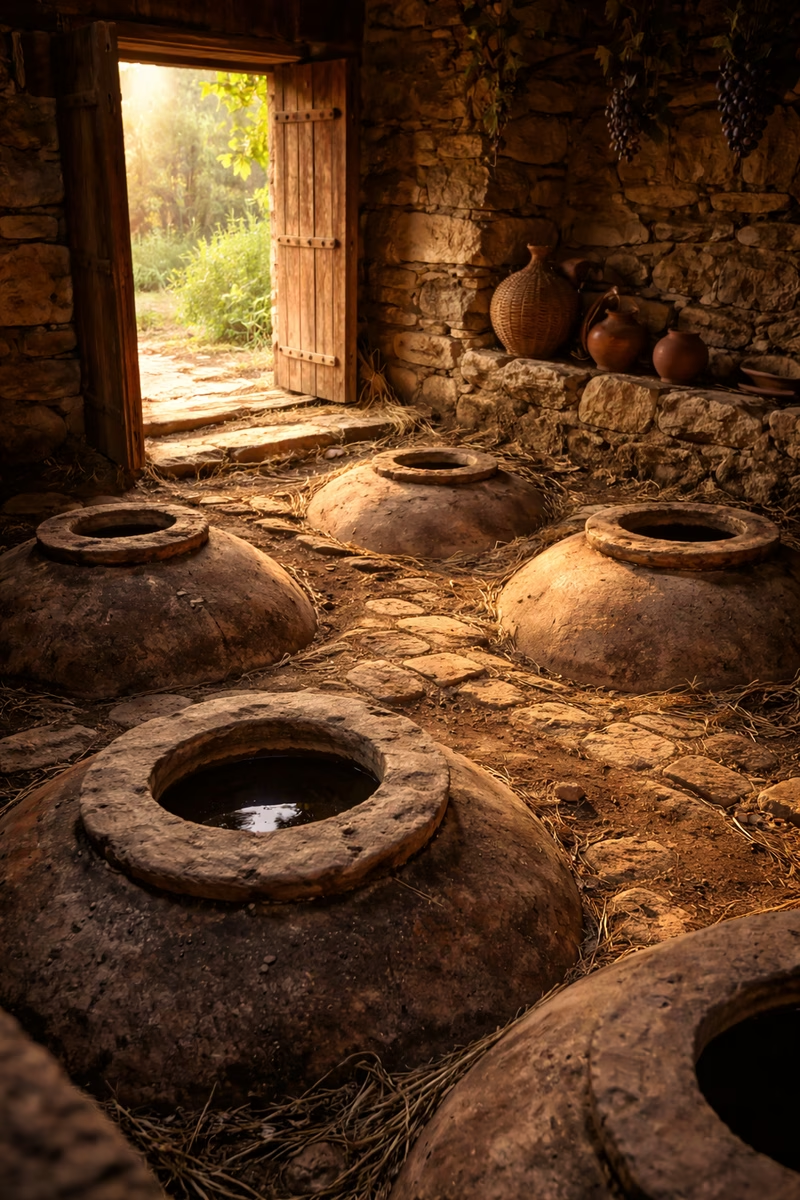
The earliest chemical evidence of winemaking comes from clay jars excavated in the Republic of Georgia, dating to approximately 6000 BCE. These jars—qvevri, large egg-shaped vessels buried in the ground—contained residues of tartaric acid, the chemical fingerprint of grapes.
Georgia’s claim is not just archaeological. Georgian winemakers still use qvevri today, fermenting and aging wine underground in vessels sealed with beeswax, exactly as their ancestors did eight millennia ago. It is the oldest continuous winemaking tradition on earth.
How did it start? Almost certainly by accident. Wild grapes (Vitis vinifera sylvestris) grew abundantly across the Caucasus. Somebody stored grapes in a container. Natural yeasts on the grape skins began fermenting the sugars into alcohol. Days later, the grape juice had become something different—something that altered perception, eased social tension, and tasted interesting enough to make deliberately.
That accidental transformation—sugar into alcohol via yeast—is the entire foundation of wine. Everything since has been refinement.
Mesopotamia and the Ancient Near East
By 3000 BCE, wine had spread across the Fertile Crescent. Mesopotamian clay tablets recorded wine transactions. Egyptian pharaohs were buried with labeled wine jars—vintage, vineyard, and winemaker inscribed on the vessels, making them the world’s first wine labels.
Wine was valuable precisely because it was difficult. Unlike beer (which could be brewed from grain almost anywhere), wine required specific grape varieties growing in specific climates, harvested at specific times, and fermented with care. This difficulty made wine prestigious—a drink of rulers, priests, and the wealthy.
The Greek and Roman Foundations (800 BCE – 500 CE)
Greece: Wine as Culture
The Greeks didn’t just drink wine. They built a civilization around it. The symposium—literally “drinking together”—was a structured social gathering where wine, diluted with water (drinking wine undiluted was considered barbaric), accompanied philosophical debate, poetry, and political discussion.
Dionysus, the god of wine, represented transformation itself: grape into wine, sobriety into ecstasy, order into creative chaos. Wine was sacred, social, and intellectual simultaneously.
Greek colonists planted vines across the Mediterranean—in southern Italy, Sicily, southern France, and Spain—establishing vineyards in regions that still produce wine today. They also developed early concepts of terroir, noting that the same grape variety produced different wines in different locations.
Rome: Wine as Empire
Rome industrialized Greek wine culture. Roman engineers built massive estates (latifundia) dedicated to viticulture. Roman agronomists—Cato, Varro, Columella, Pliny the Elder—wrote detailed manuals on grape growing, winemaking, and wine evaluation. Pliny’s Natural History describes over 80 grape varieties and includes tasting notes that would not be out of place in a modern review.
Roman wine culture established patterns that persist today:
- Aging wine was valued. Romans discovered that wine sealed in amphorae and stored for years developed complexity. Falernian wine, from Campania, was aged for decades.
- Vintage mattered. The vintage of 121 BCE (the Opimian vintage) was legendary—Romans stored it for over a century.
- Region mattered. Roman drinkers paid premiums for wine from specific origins: Falernian, Caecuban, Alban, Massic.
As the Roman Empire expanded, so did vineyards. Roman soldiers planted vines across Gaul (France), the Rhineland (Germany), the Iberian Peninsula (Spain and Portugal), and Britain. When the empire fell, the vineyards remained.
Monks, Trade, and the Medieval World (500 – 1500 CE)
The Church Saves the Vine
When the Western Roman Empire collapsed in the 5th century, the Christian Church became the institution that preserved viticulture. Wine was essential to the Eucharist—the liturgical heart of Christian worship—so monasteries maintained vineyards as a religious obligation.
Benedictine and Cistercian monks became Europe’s most dedicated viticulturists. They documented which plots produced the best grapes. They experimented with pruning, soil management, and fermentation. They created the concept of the clos—a walled vineyard whose boundaries defined a specific terroir.
The monks of Burgundy mapped their vineyards with a precision that modern appellations still follow. When you buy a bottle of Clos de Vougeot or Romanée-Conti, you’re drinking wine from a plot first defined by Cistercian monks nearly a thousand years ago.
Trade and Prestige
Medieval wine trade created economic corridors that shaped European commerce. Bordeaux’s wine trade with England began in 1152 when Eleanor of Aquitaine married Henry Plantagenet (later Henry II of England), bringing Bordeaux’s vineyards into the English crown’s holdings. English demand for claret (light red Bordeaux) created an export industry that still defines the region.
Port wine emerged because English merchants, shipping wine from the Douro Valley in Portugal, added brandy to stabilize it during the sea voyage. The fortification preserved the wine—and created an entirely new style.
Champagne was not yet sparkling. The wines of Champagne were still, pale reds that competed (poorly) with Burgundy. The bubbles would come later.
The Modern Wine World Takes Shape (1600s – 1850s)
The Bottle and the Cork
Two seemingly minor innovations in the 1600s–1700s transformed wine: the glass bottle and the cork stopper. Before bottles, wine was stored in barrels and consumed within months. Bottles allowed individual servings to be sealed and aged for years. Corks provided airtight (mostly) closures that let wine develop in the bottle.
These technologies made vintage wine possible as a consumer product. You could buy a bottle, store it, and open it years later. Wine became something with a past and a future—not just a present.
Classification and Science
The 1855 Classification of Bordeaux—ranking the region’s top estates by price and reputation—formalized a hierarchy that endures (controversially) to this day. The classification was created for the Paris Universal Exhibition and was meant to be temporary. It wasn’t.
Meanwhile, Louis Pasteur’s research in the 1860s finally explained fermentation scientifically. Wine wasn’t transformed by divine intervention or mysterious forces. Yeast converted sugar to alcohol through a biological process that could be studied, understood, and controlled.
Pasteur’s work gave winemakers scientific tools: understanding of bacteria, temperature control, hygiene protocols. Wine production became more consistent, safer, and more deliberate. The tension between science and tradition in winemaking—how much to control, how much to allow—began here and continues today.
The Great Catastrophe: Phylloxera (1860s – 1900s)
The Bug That Nearly Ended Wine
In the 1860s, a microscopic aphid called phylloxera arrived in Europe from North America, hidden in imported vine cuttings. Phylloxera feeds on grapevine roots, killing the vine within a few years. European Vitis vinifera had no natural resistance.
The devastation was total. Within three decades, phylloxera destroyed approximately two-thirds of all European vineyards. Entire regions were wiped out. Centuries-old vineyards died. Winemaking families lost everything.
The solution, when it came, was counterintuitive: graft European grape varieties onto American rootstock, which had evolved resistance to phylloxera. Nearly every vineyard in Europe was replanted on American roots. Today, almost all Vitis vinifera vines worldwide grow on grafted American rootstock.
Phylloxera reshaped the wine map. Some regions never recovered. Others were replanted with different varieties. The pre-phylloxera wine world is gone—replaced by a reconstructed version built on American roots.
New World, New Rules (1800s – 1970s)
Wine Beyond Europe
European colonists carried vines to every continent they settled. Spanish missionaries planted the first vines in the Americas. Dutch settlers planted in South Africa. British settlers planted in Australia and New Zealand. In each case, European varieties adapted to new climates and soils, producing wines that were similar to—but distinct from—their European parents.
For centuries, New World wines were considered inferior to European originals. That changed dramatically on May 24, 1976.
The Judgment of Paris
British wine merchant Steven Spurrier organized a blind tasting in Paris, pitting top California wines against top French wines. The judges were French. The expectation was that France would dominate.
California won. A Napa Valley Chardonnay (Chateau Montelena 1973) beat the white Burgundies. A Napa Valley Cabernet Sauvignon (Stag’s Leap Wine Cellars 1973) beat the red Bordeaux.
The result shocked the wine world and permanently ended the assumption that great wine could only come from France. It opened the door for wine from everywhere—Australia, Argentina, Chile, South Africa, New Zealand, Oregon, Washington—to compete on quality rather than pedigree.
Modern Wine: Globalization and Reaction (1980s – Present)
The Parker Effect
In the 1980s, American critic Robert Parker introduced the 100-point wine scoring system. Parker’s palate favored ripe, concentrated, oaky wines—and his influence was so great that winemakers worldwide adjusted their styles to earn higher scores.
The Parker effect was a double-edged homogenization. Wines from different regions began tasting more similar as producers chased the same flavor profile. Scores made wine accessible to newcomers (a number is easier to understand than a French label), but critics argued that scores reduced wine to a competition, flattening the diversity that made wine interesting.
The Natural Wine Movement
Starting in the 2000s, a growing movement of winemakers—first in France, then globally—pushed back against industrialized winemaking. “Natural wine” emphasized minimal intervention: native yeasts, no added sulfites (or very little), organic or biodynamic farming, and acceptance of the funky, unpredictable flavors that result.
Natural wine is polarizing. Supporters see it as authentic expression of place and tradition. Critics see it as sometimes flawed and inconsistent. The truth, as usual, is that the best natural wines are extraordinary and the worst are undrinkable—just like conventional wines.
For a deeper look, see the Natural Wine guide.
Climate Change
The most significant force shaping wine’s future is climate change. Warmer temperatures are shifting growing regions northward. England is producing credible sparkling wine. Scandinavia is planting vineyards. Traditional regions like Bordeaux and Burgundy are experiencing earlier harvests, higher alcohol levels, and unprecedented weather events.
Wine has survived phylloxera, world wars, and economic crises. Whether it can adapt to rapid climate change—and what it will taste like when it does—is the open question of this century.
What History Tells the Modern Wine Drinker
Tradition is shorter than you think. Many “ancient” wine traditions are a few centuries old at most. The Bordeaux classification is from 1855. The DOC system is from the 1960s. Natural wine is from the 2000s. Wine tradition is constantly being invented.
Place matters more than anything. From Georgian qvevri to Burgundian clos, the thread connecting 8,000 years of wine is the relationship between grape and ground. Terroir isn’t marketing—it’s the oldest idea in wine.
Crisis drives change. Phylloxera, the quartz-crisis equivalent for wine, destroyed the old world and created the conditions for the new one. The Judgment of Paris didn’t change what French wine was—it changed what everyone else was allowed to be.
Every bottle you open is part of this story. Pour it, taste it, and consider what it took—across millennia—to put that particular wine in your glass.
Next Steps
- Read Wine Regions of the World for the geography that history created
- See Wine Tasting 101 for the vocabulary to describe what you taste
- Explore Natural Wine: What It Is and Why It Matters for the latest chapter in wine’s ongoing story
- Try How to Buy Wine for navigating the modern shelf with historical context
- Check Aging vs. Drinking Now for the practical side of wine’s relationship with time