The alarm went off at 5:30 a.m., and I was already awake.
Not from excitement—though there was that—but because the house we were staying in had stone walls two feet thick and no insulation, and the September nights in Burgundy were colder than anyone had warned us. I pulled on every layer I’d brought, stepped outside into a darkness that smelled like cold earth and wood smoke, and walked up the hill to the vineyard where we’d been told to meet at six.
Fourteen people were already there. Some were locals who did this every year—harvest regulars with their own secateurs and boots worn to the exact contour of their feet. Some were travelers like me, drawn by curiosity and a romantic idea of what grape-picking would be like.
The romantic idea lasted approximately forty-five minutes.
What Harvest Actually Looks Like
The briefing
The vineyard manager—a compact, weathered woman named Isabelle—gave us the briefing in rapid French with occasional gestures toward the vines. The translation, provided by a patient bilingual harvester next to me, compressed to:
“Cut the grape clusters cleanly. Leave anything rotten. Don’t cut your fingers. Fill the hottes (small bins). Don’t step on anything. We’ll stop for lunch. Don’t be late.”
She handed out secateurs—small, curved harvest scissors—and pointed us toward our rows. Two people per row, one on each side. Start at the bottom of the slope. Work up.
The work
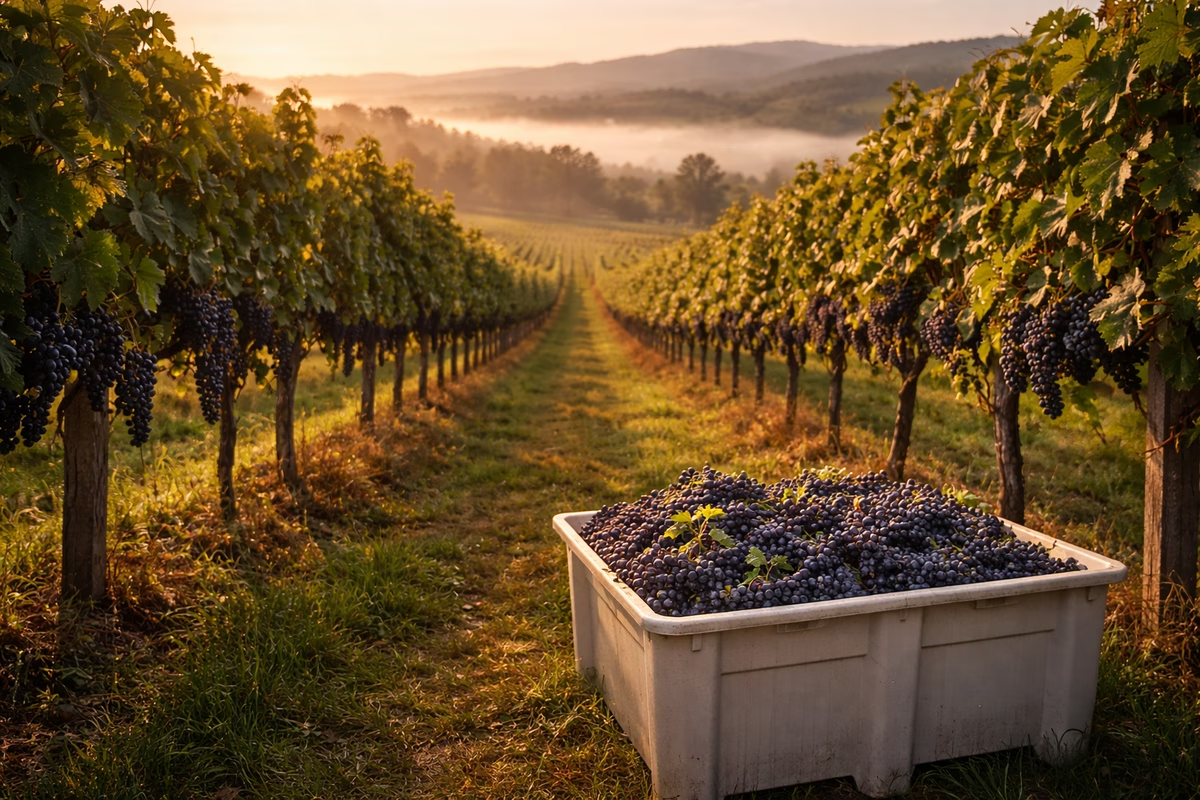
Grape-picking is repetitive, physical, and low to the ground. The vines are about chest-high, and the grapes hang at waist level or below. You lean, crouch, reach, snip, drop the cluster into your bucket, and move six inches down the row. Then you do it again. And again. For hours.
The first hour is pleasant. The air is cool. The light is soft. The clusters are beautiful—dark, dusted, heavy. You find a rhythm: reach, snip, drop. Reach, snip, drop.
The second hour is tiring. Your back protests the crouching. Your fingers, even through gloves, get sticky with juice and scratched by stems. The bucket gets heavy.
The third hour is when the romanticism fully evaporates and the work begins. This is farming. The grapes don’t care about your experience. They need to come off the vine quickly, cleanly, and before the weather changes. The winemaker’s entire year—everything she’s done since pruning in winter—converges on these few days. Every hour matters.
The Winemaker’s Week
What Isabelle watches
I spent the first lunch break talking to Isabelle about what she was actually doing while we were picking. The answer: worrying.
“The sugar is right,” she said, checking her refractometer—a small handheld device that measures grape sugar content by bending light through a drop of juice. “But the acid is dropping faster than I want. And there’s rain in the forecast for Thursday.”
Rain during harvest is a winemaker’s nightmare. Water dilutes the grapes. It promotes rot. It turns vineyard floors to mud. A week of perfect weather can produce a great vintage; three days of rain can ruin it. The decision of when to pick—not a day too early, not a day too late—is the single most consequential choice a winemaker makes all year.
Isabelle had been measuring sugar, acidity, and phenolic ripeness (the maturity of the tannins in the skins and seeds) for weeks, walking the vineyard every morning, tasting grapes from different rows, watching the weather forecast like someone monitoring an approaching storm.
“You want the grapes to be ripe,” she explained, “but not too ripe. Ripe gives you fruit and flavor. Too ripe gives you high alcohol and cooked character. The window is small. Some years, very small.”
The sorting table
After we picked, the grapes didn’t go straight to the press. They went to a sorting table—a slow-moving conveyor belt where workers picked through the clusters, removing leaves, stems, unripe berries, and any clusters with rot.
This was tedious, precise work. But standing at the sorting table, I understood something about wine quality that no tasting note ever communicated: quality starts with exclusion. A great wine is defined as much by what the winemaker removes as by what she keeps. Every rotten berry sorted out, every green stem discarded, every underripe cluster rejected—these are quality decisions made in real time, by hand, one cluster at a time.
The Cellar: Where Wine Is Born
Destemming and crushing
After sorting, the grapes moved to the destemmer—a machine that separates berries from their stems. For Burgundy Pinot Noir, Isabelle kept some whole clusters (stems and all) mixed in with the destemmed berries. “The stems add structure,” she said. “Tannin. A little green spice. But too much and the wine tastes vegetal.”
The proportion of whole clusters is a stylistic choice—some winemakers use 100%, some use none. Isabelle used about 30% this year. “It depends on how ripe the stems are,” she said. “Ripe stems add complexity. Green stems add harshness.”
Fermentation begins
The grapes—now a mix of destemmed berries and whole clusters—went into open-top concrete vats. No yeast was added. Isabelle relied on native yeasts: the wild yeasts present on the grape skins and in the cellar environment.
“They’re slower,” she said. “They’re less predictable. But they’re mine. They’re from this place. Cultured yeast will give you a reliable fermentation. Native yeast will give you a fermentation that belongs to this vineyard.”
Within 48 hours, the vats were bubbling. The cellar smelled like nothing I’d encountered—sweet, yeasty, fruity, alive. It was the smell of transformation: grape juice becoming wine.
Punch-downs
Twice a day during fermentation, someone had to “punch down” the cap—the thick layer of grape skins, seeds, and stems that floats to the top of the fermenting vat. Pushing the cap back into the juice extracts color, tannin, and flavor from the skins.
This was done by hand. Literally by hand. Isabelle’s assistant climbed into the vat in rubber waders and pushed the cap down with a paddle, waist-deep in fermenting grape must. The carbon dioxide released during fermentation made the cellar dangerous—CO₂ is heavier than air and pools in low spots—so ventilation was constant and the door stayed open.
I asked if I could try. Isabelle handed me the paddle and said, “Don’t fall in.”
The must was warm—fermentation generates heat—and thick, like porridge. Pushing the cap down took real force. Underneath, the liquid was dark, fizzy, and intensely flavored: part grape juice, part young wine, part something in between that doesn’t have a name. I tasted a small amount from the paddle. It was wild—raw, tannic, sweet, fizzy, nothing like wine yet but clearly on its way.
What Changes After You See the Harvest
You taste differently
After a week in the vineyard, every wine I drank tasted different. Not better or worse—more legible. When I tasted acidity, I thought of Isabelle watching her numbers drop. When I tasted tannin, I remembered the whole clusters and the punch-downs. When I tasted fruit, I saw the sorting table and the decision to include these grapes and not those.
Wine stopped being a finished product and started being a document—a record of decisions made by a person in a place, under specific conditions, during a specific week.
You understand vintage
“Vintage” used to mean “the year printed on the bottle.” After harvest, it meant something concrete: the weather that week, the sugar at harvest, the rain that did or didn’t come, the winemaker’s choice to pick Tuesday instead of Friday. Vintage variation is not a marketing concept. It’s the difference between “it rained during harvest” and “it didn’t.”
For more on how vintage affects what’s in your glass, see the Aging vs. Drinking Now guide.
You respect the price
Good wine is expensive because good wine is labor-intensive. Hand-harvesting. Sorting. Careful fermentation. Aging in barrels that cost over a thousand dollars each. Every step involves human attention, and human attention costs money.
This doesn’t mean expensive wine is always better. It means that when a wine is good and affordable, someone in the supply chain is accepting a thinner margin—and when wine is genuinely excellent, the price usually reflects the work.
The Last Evening
On my final night, Isabelle opened a bottle of the previous year’s wine—the 2024 vintage, made from grapes picked from the same rows I’d just worked. She poured it into simple glasses and we sat on the stone wall outside the cellar.
The wine was red Burgundy. Pinot Noir. Light-bodied by most standards but deeply flavored—cherry, earth, a hint of the spice she’d mentioned from the whole clusters. It tasted like the place smelled: soil, stone, fruit, and something green and alive underneath.
“You helped make the next one,” she said, gesturing toward the cellar where the 2025 vintage was fermenting.
I hadn’t made anything. I’d picked grapes and moved bins and stood at a sorting table. But I’d been present for the moment when the vineyard’s year converged into the cellar, and I’d seen the hundreds of small decisions that separate “grape juice” from “wine.”
I drank the glass slowly. It was, I thought, the best wine I’d ever tasted. Not because it was the most complex or prestigious, but because I understood—for the first time—everything it took to get it into the glass.
How to Experience a Harvest Yourself
If this story made you curious:
- Harvest volunteer programs exist in many wine regions. Burgundy, Bordeaux, the Rhône Valley, Tuscany, Napa, and New Zealand all have wineries that accept harvest volunteers (typically in exchange for room and board, not pay).
- Timing: Harvest season varies by hemisphere and region—typically September–October in the Northern Hemisphere, February–April in the Southern Hemisphere.
- Be realistic: This is physical work. Long days, crouching, lifting, and outdoor conditions. It’s also deeply rewarding if you enjoy physical work and want to understand wine from the inside.
- Language: In many European harvests, French, Italian, or Spanish proficiency helps enormously. In New World regions, English is usually sufficient.
Next Steps
- Read Wine Regions of the World for the geography behind every harvest
- See Wine History for the 8,000-year story behind what you just witnessed
- Explore Wine Tasting 101 for tasting with harvest context
- Try Your First Really Good Bottle for another wine discovery narrative
- Check Natural Wine for more on the winemaking philosophy Isabelle practices