The night everything changed, we opened the wrong bottle.
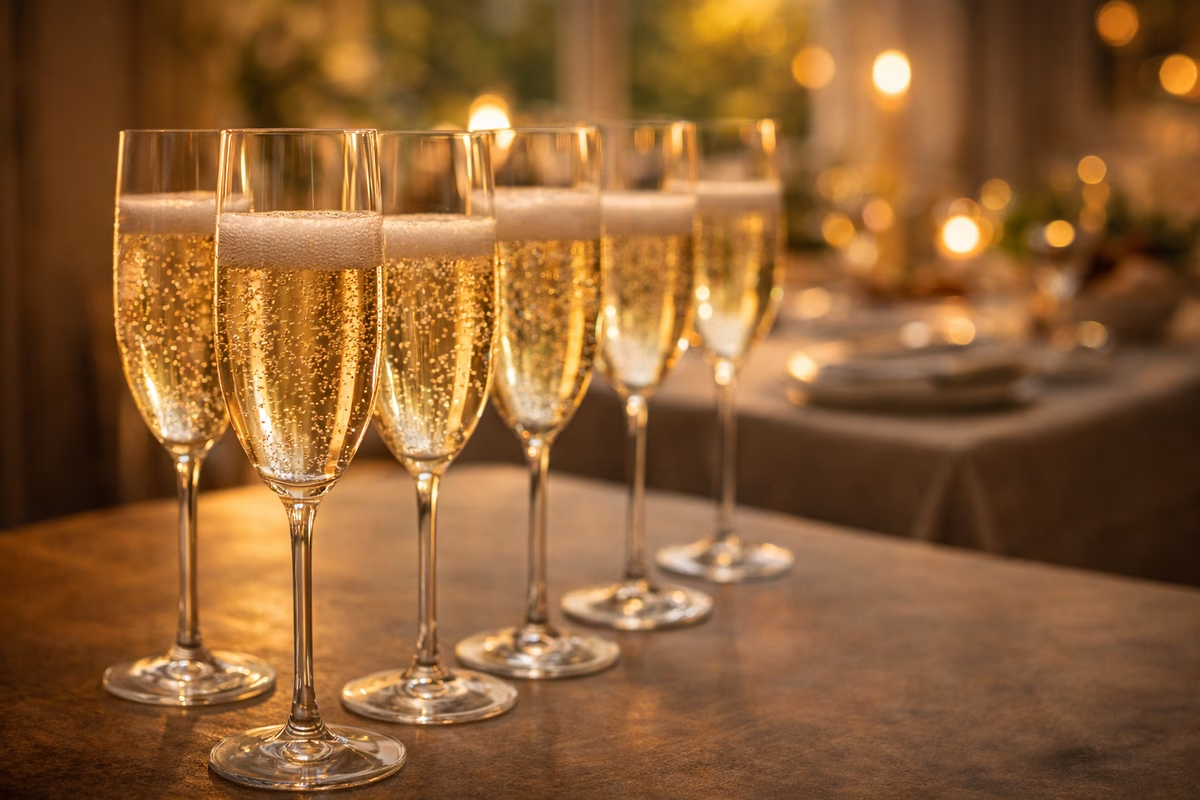
We had invited four friends to dinner. Nothing fancy—pasta, a green salad, good bread. I’d bought a bottle of Champagne for the occasion because it felt celebratory, like we were marking the fact that all six of us had survived the week.
But the Champagne stayed cold too long, and when I poured it, the first sip was all acid and no pleasure. Tight, sharp, almost angry. My friend Sophie, who knew more about wine than the rest of us combined, picked up the bottle, read the label, and said, “This is great wine. It just needs twenty minutes.”
We moved to the Prosecco I’d bought as backup—light, frothy, a little sweet, and immediately friendly. Everyone loved it.
Twenty minutes later, Sophie poured the Champagne again. It had warmed just enough. The mousse was finer, the acidity had turned from sharp to lively, and underneath it all was this gorgeous biscuity richness that made the Prosecco seem one-dimensional by comparison.
“They’re not competing,” she said. “They’re for different moments.”
That sentence reorganized how I think about sparkling wine. And this guide is the longer version of what Sophie taught me that night.
The first thing to understand: method makes the character
All sparkling wines have bubbles, but how those bubbles got there changes everything about the wine’s personality.
There are two main roads:
The traditional method (méthode traditionnelle)
The wine undergoes a second fermentation inside the bottle. This is slow, intimate, and labor-intensive. Yeast cells live with the wine for months or years, eventually giving up their flavor as they break down (a process called autolysis). The result: fine, persistent bubbles and complex flavors—toast, brioche, almonds, cream.
This is how Champagne, Crémant, Cava, and Franciacorta are made.
The tank method (Charmat method)
The second fermentation happens in a large pressurized tank, not in individual bottles. It’s faster, fresher, and designed to preserve the fruit rather than develop yeasty complexity. The bubbles are usually larger and more playful.
This is how Prosecco and most sparkling Moscato are made.
A map of the sparkling world
Here’s where things get quietly thrilling. Sparkling wine isn’t just Champagne. It’s a world tour.
Champagne (France)
The original, the benchmark, and—unfortunately—the reason many people think sparkling wine must be expensive. Champagne comes only from the Champagne region of northeastern France. It’s made exclusively by the traditional method, mostly from three grapes: Chardonnay, Pinot Noir, and Pinot Meunier.
Great Champagne has a tension to it: bright acidity pulling against biscuity depth, citrus against toast, freshness against age. It’s structured, often austere young, and rewards the kind of patience we didn’t have at our dinner party.
When to reach for it: Celebrations, yes—but also oysters, fried chicken, sushi, and aged cheese. Champagne’s acidity and complexity make it one of the most food-friendly wines on the planet.
What to try first: A non-vintage (NV) brut from a well-known house is the best starting point. It’s the house’s calling card—blended for consistency and designed to represent their style.
Crémant (France)
France’s beautiful secret. Crémants are made the same way as Champagne—traditional method, extended lees aging—but from other French regions. They’re often stunning and cost a fraction of Champagne.
- Crémant d’Alsace: Crisp, clean, often Pinot Blanc-based. The most popular Crémant.
- Crémant de Loire: Chenin Blanc-based, with apple and honey notes.
- Crémant de Bourgogne: Chardonnay-based, close to Champagne in style.
- Crémant de Limoux: From southern France, with a softer, warmer character.
When to reach for it: Whenever you’d drink Champagne but want to spend half as much without sacrificing quality.
Prosecco (Italy)
Made from the Glera grape in the Veneto region using the tank method. Prosecco is light, fruity, floral, and meant to be drunk young and fresh. It’s the world’s most popular sparkling wine by volume—and for good reason.
Good Prosecco has a gentle sweetness, notes of green apple and white flowers, and a frothy mousse that feels festive without being serious.
When to reach for it: Aperitivo hour, brunch, a warm afternoon, or any moment that calls for easy joy rather than contemplation.
Quality tip: Look for Prosecco Superiore DOCG (from Conegliano Valdobbiadene) for the best expression. Avoid the cheapest bottles—bad Prosecco tastes like sugary soda.
Cava (Spain)
Spain’s traditional-method sparkling wine, made primarily from Macabeo, Xarel·lo, and Parellada grapes. Cava offers remarkable value: complex, toasty sparkling wine at prices that would be impossible in Champagne.
When to reach for it: Tapas, paella, or anytime you want traditional-method quality without the price.
Franciacorta (Italy)
Italy’s answer to Champagne. Made in Lombardy by the traditional method, primarily from Chardonnay and Pinot Noir. Franciacorta is elegant, refined, and criminally underappreciated outside Italy.
When to reach for it: Fine dining, special occasions, or impressing someone who thinks they’ve tried everything.
The serving details that matter more than the label
Sophie’s lesson that night wasn’t really about wine knowledge. It was about temperature.
Temperature is everything
Sparkling wine is more temperature-sensitive than still wine. Here’s the practical guide:
| Style | Ideal Temperature | Why |
|---|---|---|
| Prosecco / Moscato | 38–42°F (3–6°C) | Very cold preserves freshness and fruitiness |
| Non-vintage Champagne / Cava | 43–47°F (6–8°C) | Cold enough to be refreshing, warm enough for complexity |
| Vintage / prestige Champagne | 47–50°F (8–10°C) | Warmer reveals depth, toast, and aged character |
| Crémant / Franciacorta | 43–47°F (6–8°C) | Same zone as NV Champagne |
The mistake most people make—the mistake I made—is serving good Champagne too cold. If you can’t taste anything except acid and bubbles, the wine needs ten minutes on the table.
The glass question
Flutes look beautiful. They also trap the wine in a narrow prison where you can’t smell much.
A tulip glass (wider bowl, slightly tapered rim) is the modern standard for serious sparkling wine. It lets you swirl gently, it concentrates aroma, and it still shows off the bubble stream.
For casual Prosecco? A flute is fine. For a vintage Champagne you paid real money for? Give it room.
Opening the bottle
Point the bottle away from people and breakable things. Hold the cork still and twist the bottle (not the cork). The goal is a gentle sigh, not a pop. A loud pop means you’ve lost pressure—and wine.
Understanding sweetness levels
Sparkling wine labels include a sweetness designation that confuses everyone. Here’s the decoder:
- Brut Nature / Zero Dosage: Bone dry, no added sugar
- Extra Brut: Very dry
- Brut: Dry (this is the most common and the safest bet)
- Extra Dry / Extra Sec: Slightly off-dry (confusingly, this is sweeter than Brut)
- Dry / Sec: Medium sweet
- Demi-Sec: Noticeably sweet
- Doux: Dessert-level sweet
Most people who say they like dry wine are happiest with Brut. If you think you don’t like Champagne, try an Extra Dry or Demi-Sec—the touch of sweetness might be exactly what you need.
Pairing sparkling wine with food
This is where sparkling wine quietly becomes the most versatile wine category.
The secret: Bubbles scrub your palate between bites. Combined with high acidity, this makes sparkling wine pair with almost everything.
Classic pairings that work
- Champagne + oysters — The mineral salinity of both creates a seamless bridge
- Prosecco + cured meats — Light bubbles cut through fat
- Cava + tapas — Regional harmony; olives, jamón, manchego
- Crémant + soft cheese — Brie and bubbles is a quiet miracle
- Vintage Champagne + fried chicken — This sounds wrong and tastes perfect; the acidity cuts through the oil
The one rule
Match the wine’s weight to the food’s weight. Light Prosecco with light appetizers. Rich vintage Champagne with richer dishes.
The ending: two bottles, two truths
By the end of that dinner, both bottles were empty.
The Prosecco was gone first—because it was easy, because it was friendly, because nobody had to think about it.
The Champagne lasted longer—because people were sipping it slowly, because it kept revealing new things, because it made conversation quieter and more attentive.
Neither was wrong. Neither was better. They were for different moments.
And that’s the whole secret of sparkling wine: know the moment, and the right bottle becomes obvious.
Next steps
- Read the Wine Tasting 101 guide to sharpen your palate for bubbles
- Explore Wine Regions for the geography behind these sparkling styles
- Check out Serving Temperature and Decanting for the science of why temperature transforms wine