My wine collection started by accident. I bought two bottles of the same Côtes du Rhône because it was on sale, drank one that week, and forgot about the other for eight months.
When I finally opened the second bottle, it was different. Not spoiled—transformed. The tannins that had been grippy and harsh in the first bottle had softened into something velvety. The fruit had deepened. A note of leather had appeared that I swore wasn’t there before.
Same wine. Same vintage. Same producer. Eight months of sitting in a cool closet had turned a pleasant $14 red into something I wanted to understand.
That was the evening I decided to start paying attention to what time does to wine—and the beginning of a collection that taught me more than any tasting class ever could.
Why collect wine?
Most wine in the world is meant to be consumed within a year or two of release. It’s fresh, fruit-forward, and ready to enjoy. There’s nothing wrong with this—it’s how most people drink wine, and how most wine is designed.
But a small percentage of wines are built to evolve. They have the structure—tannins, acidity, concentration—to change and improve over years or decades. Collecting these wines is an act of patience and optimism: you’re betting that a wine you enjoy today will become something you love in five, ten, or twenty years.
The other reason to collect is practical: if you like a particular wine, buying a case ensures you’ll have it when you want it. Wine production is finite. Popular vintages sell out. The bottle you loved at a restaurant may be gone by the time you look for it.
Starting with a single shelf
You don’t need a cellar to start collecting. You need a shelf that meets three conditions:
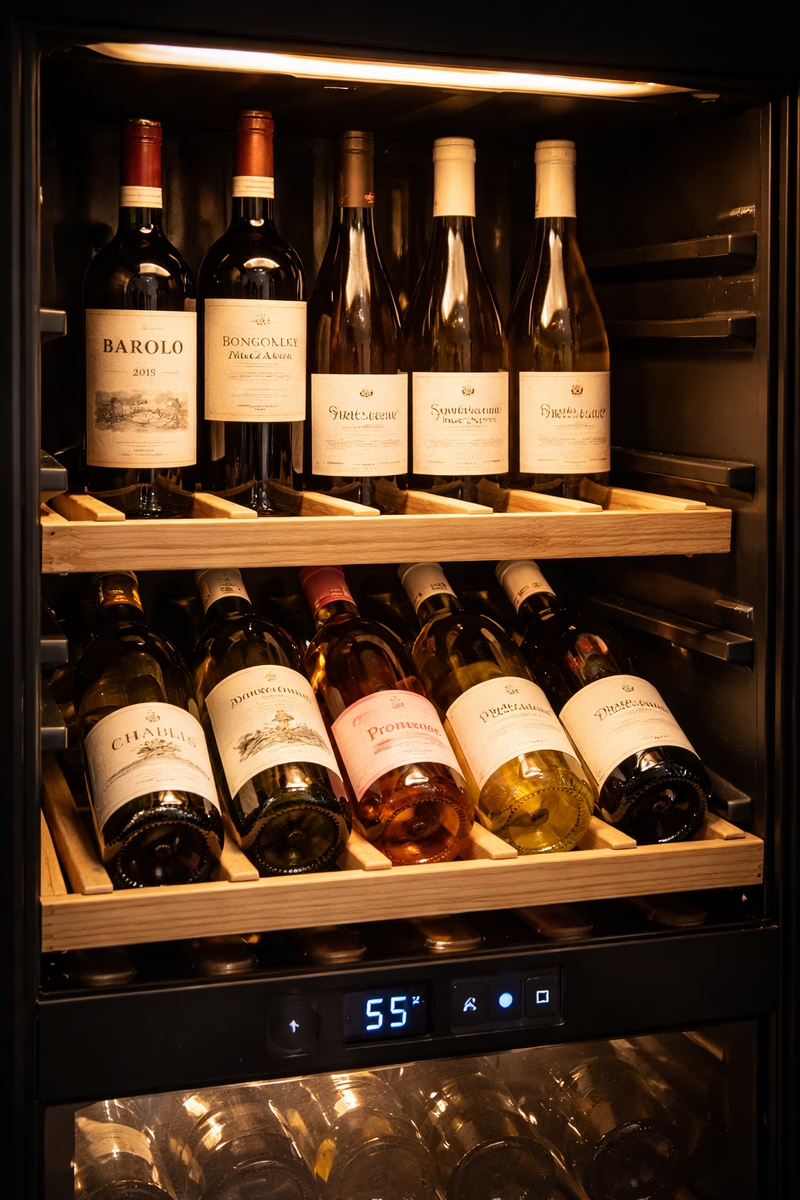
Temperature: 50-60°F (ideal: 55°F)
Wine ages best at a consistent, cool temperature. Too warm (above 70°F), and the wine ages prematurely—the fruit fades, the balance shifts, the flavors flatten. Too cold (below 40°F), and the aging process effectively stops.
A closet in a cool room, a basement corner, or even a spot under the stairs can work. What matters more than the exact temperature is consistency—fluctuations are more damaging than a temperature that’s slightly above or below ideal.
Humidity: 50-80%
Enough humidity to keep natural corks from drying out. A dried cork shrinks, lets air in, and the wine oxidizes. If your storage area is dry, a small tray of water nearby helps.
Darkness
Light, especially UV, degrades wine. This is why wine bottles are typically dark green or brown. Store bottles away from direct light—a closed closet is fine.
The orientation myth (and truth)
Conventional wisdom says to store bottles on their sides to keep the cork wet. This matters for wines you’ll store for years. For wines you’ll drink within a few months, orientation is less critical. But sideways storage is a good habit—and it’s more space-efficient.
My first twelve bottles: the learning case
After the Côtes du Rhône revelation, I bought twelve bottles with a plan: drink some now, drink some later, and learn from the difference.
Here’s what I chose and why:
Drink-now wines (opened within 3 months)
- A New Zealand Sauvignon Blanc — Bright, herbaceous, best young and fresh
- A Spanish Garnacha — Fruity and approachable, no need to wait
- An Italian Pinot Grigio — Crisp, clean, designed for immediate pleasure
Short-term aging (6-18 months)
- A Côtes du Rhône (red) — Grenache/Syrah blend, softens beautifully with a year of rest
- A Chilean Carménère — Plummy and spiced, gains complexity over a year
- A Portuguese Douro red — Structured and earthy, rewards patience
Medium-term aging (2-5 years)
- A Barolo Langhe — Baby Barolo; tannic when young, approachable at 3-4 years
- A Châteauneuf-du-Pape — Complex Rhône blend, peak at 4-6 years
- A Napa Cabernet Sauvignon — Concentrated and structured, needs time
Long-term aging (5-15 years)
- A classified Bordeaux — Tannic and austere young, revelatory at 10+ years
- A Barolo DOCG — One of Italy’s great agers; peak at 8-15 years
- A Vintage Port (vintage year) — The ultimate long game; can age for decades
The notebook: tracking what time does
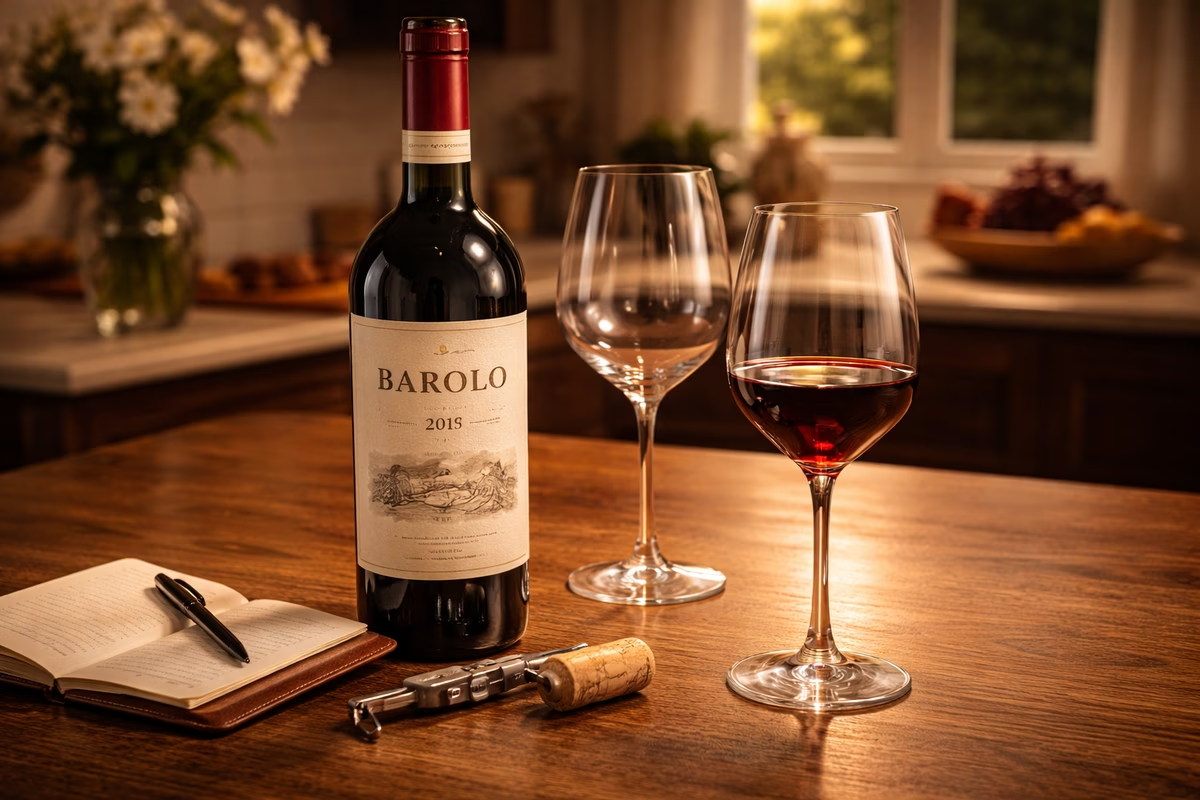
I bought a small leather-bound notebook and wrote an entry for every bottle I opened. The format was simple:
- Wine: Producer, region, vintage
- Purchased: Date and price
- Opened: Date (age of wine)
- Notes: What I tasted, how it compared to expectations
- Would I buy again? Yes/no
After a year, the notebook had taught me things no wine guide could:
Patience pays off with tannic reds. The Côtes du Rhône I’d opened at 6 months was good. The same wine at 18 months was considerably better. The tannins had softened, the fruit had deepened, and a spice complexity had emerged.
Not everything improves. The Sauvignon Blanc I’d accidentally kept for 8 months had lost its brightness. White wines, with rare exceptions, are at their best young. The herbaceous zing that makes NZ Sauv Blanc exciting fades into flatness after a year.
Vintage matters enormously. Two bottles of the same producer from different years tasted like different wines. A great vintage gives the wine more structure and concentration to age; a difficult vintage often means drink sooner.
Storage conditions matter more than the wine. A $15 red stored properly will always outperform a $50 red stored badly. Temperature consistency is the single most important factor.
Graduating from a shelf to a cooler
After two years and about sixty bottles, my closet shelf was full. I made the investment that many collectors eventually make: a wine cooler.
A basic 28-bottle dual-zone cooler costs $200-$400. Dual-zone means two temperature compartments: one for whites and lighter wines (~48°F) and one for reds and aging wines (~55°F).
What changed with proper storage
The difference was immediate—not in the wine I already had, but in my confidence about buying wines to age. With a closet, I was always slightly worried: was the temperature fluctuating when I wasn’t home? Was the humidity sufficient?
With a cooler, I had consistent temperature, built-in humidity from the cooling system, UV-protected glass, and vibration isolation. For the first time, I could buy a wine meant to age for ten years and feel confident it would arrive at that destination in good shape.
What to buy: the age-worthy wines
Not all wines benefit from aging. Here’s what I’ve learned about which wines to cellar and which to drink now:
Wines that generally age well
- Bordeaux (classified growths, especially left bank)
- Barolo and Barbaresco (Nebbiolo from Piedmont)
- Burgundy (Premier and Grand Cru Pinot Noir and Chardonnay)
- Northern Rhône Syrah (Hermitage, Côte-Rôtie)
- Napa Cabernet Sauvignon (from top producers)
- Vintage Port and Vintage Champagne
- Riesling (German Spätlese and Auslese; Alsatian Grand Cru)
- Sauternes and other noble rot dessert wines
Wines to drink young (within 1-3 years)
- Most Sauvignon Blanc, Pinot Grigio, and unoaked whites
- Beaujolais (especially Nouveau)
- Most rosé
- Basic Chianti and Valpolicella
- Entry-level wines from any region
The aging markers to look for
Tannin: Young wines with firm, mouth-drying tannins often need time. Tannins polymerize and soften over years. Acidity: High natural acidity preserves a wine’s freshness and structure during aging. Low-acid wines tend to fall apart. Concentration: Wines with intense, concentrated flavors have more raw material to evolve. Thin, light wines don’t gain complexity—they just fade. Balance: A wine that’s already balanced young will age gracefully. A wine that’s out of balance (too tannic, too acidic, too alcoholic) usually stays out of balance.
The opened-too-early lesson
Three years into collecting, I made the classic mistake: I opened my Barolo too early.
The wine was four years old. Barolo typically needs 8-15 years. I knew this intellectually. But it was a Friday night, I was curious, and the bottle was right there.
I poured a glass. The color was beautiful—garnet with orange edges. The nose was promising—roses, tar, dried cherry. But the palate was a wall of tannin. Harsh, astringent, gripping tannin that overwhelmed everything else. Underneath, I could taste the complexity trying to emerge—there were layers of flavor hiding behind the tannin curtain—but the wine wasn’t ready to reveal them.
I decanted the remaining wine for three hours. It improved—the tannins softened slightly, more fruit emerged—but it was still clearly a wine in progress, a sentence half-finished.
I wrote in my notebook: “Opened too early. Could taste the greatness it will become but can’t access it yet. This is why patience is a wine skill.”
I bought another bottle of the same wine and put it in the back of the cooler with a note: “Do not open before 2030.”
The surprise: a wine at its peak
The best moment in my collecting journey came when I opened a Châteauneuf-du-Pape that was five years old.
I’d bought it because a wine shop owner said, “This is going to be spectacular at five to seven years.” I trusted him, stored the bottle, and almost forgot about it.
When I opened it for a dinner party, the transformation was complete. The wine that had been tannic and closed at purchase was now silky, layered, and complex in a way that no young wine can be. I tasted dried herbs, leather, sweet plum, a hint of olive, and a long finish that went on for thirty seconds after I swallowed.
The table went quiet. Six people stopped talking and just looked at their glasses.
“Where did you get this?” someone asked.
“A shelf,” I said. “And five years.”
That’s the magic of collecting. You’re not just buying wine. You’re buying time—the time that transforms grape juice into something that can stop a conversation.
What my collection looks like now
Five years after that first accidental Côtes du Rhône experiment, my collection sits at about eighty bottles in a 50-bottle cooler and a 32-bottle cooler. It’s organized by drinking window:
- Drink now (0-2 years): ~25 bottles. Everyday wines, fresh whites, young reds
- Aging (2-5 years): ~30 bottles. Intermediate reds, reserve whites
- Long-term (5-15 years): ~20 bottles. Bordeaux, Barolo, vintage Port
- Special occasions: ~5 bottles. Wines I’m saving for specific milestones
Total investment: roughly $3,000 over five years—about $50 per month, which is less than I used to spend buying wine one bottle at a time at restaurants.
The collection isn’t expensive. It’s intentional. Every bottle has a reason and a timeline. And the notebook—now on its third volume—is a record of every lesson the wine has taught me.
Starting your own collection
You don’t need money. You don’t need a cellar. You don’t need expertise. You need:
- A cool, dark spot — A closet, a basement corner, or a $200 wine cooler
- A notebook — Track what you buy, when you buy it, when you open it, and what you taste
- A plan — Buy some wines to drink now and some to drink later
- Patience — The single most important ingredient in wine collecting
Start with twelve bottles. Drink six within three months. Age six for a year. Compare the experience. That comparison—between impatience and patience, between youth and evolution—is the beginning of a collection.
Next steps
- Read Wine Storage & Serving for the complete guide to proper conditions
- Explore Aging vs. Drinking Now for knowing when each wine is ready
- See Wine Collecting for the formal approach to building a cellar
- Try How to Buy Wine for navigating shops and evaluating quality
- Check The Bottle That Taught Me Patience for another story about wine and time