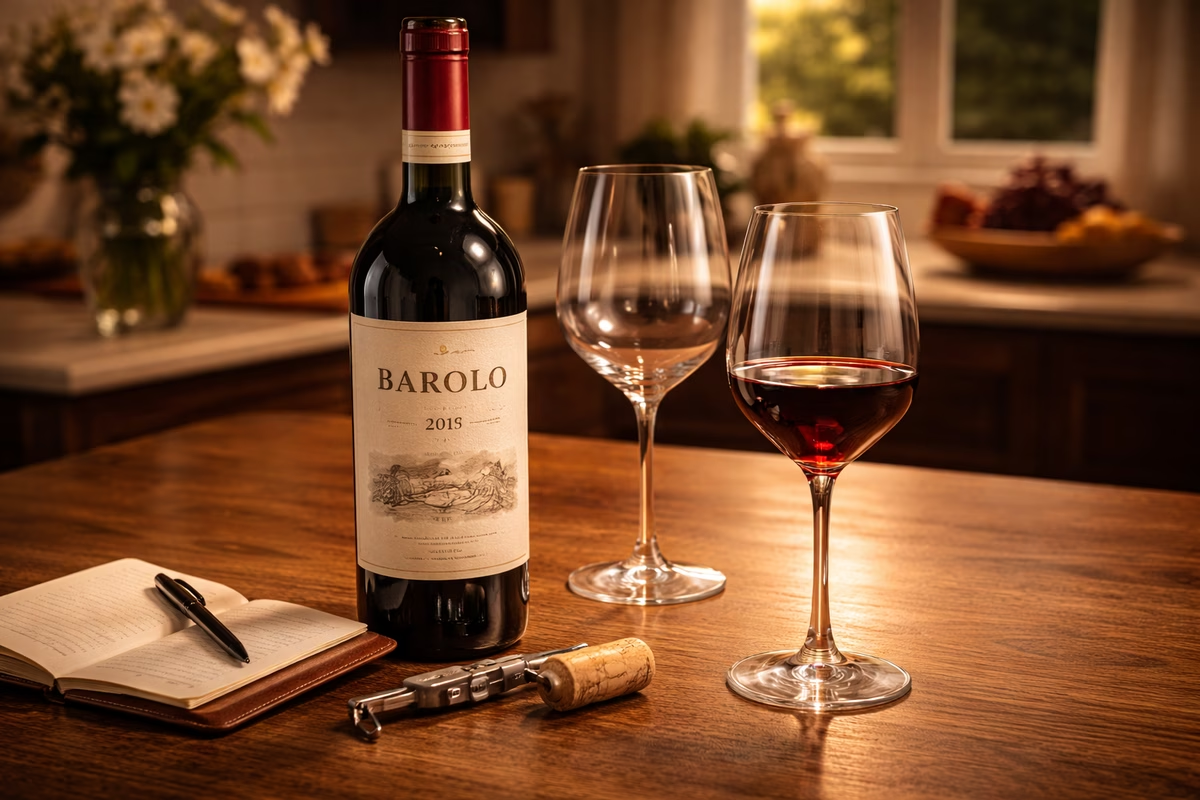
The Barolo had been in the closet for three years.
Not a proper wine cellar—a closet. The bottom shelf, behind the winter coats, in the coolest corner of the apartment. It was dark there, and relatively stable in temperature, and I’d read enough to know that these two conditions were the minimum for aging wine at home. The bottle was a 2016 Giacomo Conterno Cerretta, and I’d bought it on the advice of a shop owner who’d said, very clearly: “Don’t open this before 2028. Earlier if you must, but you’ll be meeting it before it’s ready.”
I’d written “2028” on a small piece of masking tape and stuck it on the bottle. For three years, every time I reached past it for a coat, I’d see the date and feel a small, responsible pride in my patience.
Then a friend came for dinner. The friend was a food writer. I wanted to impress her. The 2028 tape said wait. I peeled it off and opened the bottle anyway.
What happened next taught me more about wine than any tasting note or vintage chart ever had.
What “too young” actually means
I pulled the cork at 7:15 p.m. The wine was deep garnet—almost opaque, with a ruby rim. Beautiful in the glass.
I poured two glasses and handed one to Clara.
We both smelled it. The nose was… tight. Closed. There was fruit in there somewhere—dark cherry, maybe plum—but it was buried under a wall of tannin and what I can only describe as raw structure: the wine equivalent of walking into a house that’s still under construction. The framing is impressive, but the walls aren’t finished and there’s nowhere to sit.
We tasted it. Clara put down her glass after one sip and said, very diplomatically: “This is going to be wonderful.”
I noticed the verb tense.
The tannins were enormous—gripping, drying, astringent. They coated my mouth like strong over-brewed black tea. Behind them, I could sense depth: layers of fruit and earth and something floral. But sensing depth through tannin is like trying to appreciate architecture through scaffolding. The shape is there. The experience isn’t.
“How old is this?” Clara asked.
“2016.”
“What did the shop say?”
“2028.”
She nodded slowly. “So you’ve got about five years of potential in the glass that haven’t arrived yet.”
Why some wines need time (and most don’t)
Here’s what I didn’t fully understand before that evening: most wine is designed to be drunk young.
An estimated 90–95% of all wine produced globally is meant to be consumed within 1–3 years of release. It’s built for immediate pleasure—fruit-forward, soft tannins, approachable acidity, ready when you buy it.
The 5–10% of wine that improves with aging is a different kind of construction. These wines are built with:
- High tannin (which softens over time)
- Firm acidity (which preserves freshness as the wine evolves)
- Concentrated fruit (which gradually develops secondary and tertiary flavors)
- Structural complexity (enough components to interact and transform)
Barolo—made from the Nebbiolo grape in the hills of Piedmont, Italy—is one of the most age-worthy wines on Earth. A good Barolo can evolve for 20–40 years, during which time the aggressive tannins resolve, the dark fruit deepens into tar and roses and truffle, and the wine transforms from a young, muscular thing into something ethereal and profoundly complex.
My 2016 was seven years old when I opened it. It needed fifteen.
The dinner: watching a wine open up (slowly, reluctantly)
We didn’t pour the wine down the sink. We decanted it—poured it into a wide carafe to expose as much surface area to air as possible—and left it on the counter while we ate the first course.
Over the next two hours, the wine changed.
At 30 minutes: The tannins softened slightly. A hint of dried rose appeared on the nose. Still gripping on the palate.
At 60 minutes: More fruit emerged—sour cherry, dried cranberry. The mid-palate had more weight. The tannins were still dominant but less punishing.
At 90 minutes: A breakthrough. The wine started to integrate. The fruit, tannin, and acidity began to feel like components of a whole rather than separate forces fighting for attention. A whiff of tar and earth. The finish lengthened.
At 120 minutes: The best the wine would be that night. Still young, still firm, but now recognizably beautiful—complex, layered, with a length that kept going after each sip. The rose petal note was clear. The tannins had become texture rather than aggression.
Clara smiled. “Now imagine five more years of this, happening at molecular speed, inside a sealed bottle.”
That was the lesson. Decanting approximated in hours what aging would have done in years—but only approximately. Air exposure is a blunt instrument. Time in bottle is a scalpel.
How to know if a wine is worth aging
After the Barolo lesson, I started paying closer attention to which wines in my closet-cellar deserved patience and which ones I was hoarding for no reason.
Here’s the framework I built:
Wines that typically improve with 5–20 years of aging
- Barolo and Barbaresco (Nebbiolo): 10–30 years
- Classified Bordeaux (Cabernet Sauvignon blends): 10–25 years
- Burgundy Grand Cru (Pinot Noir): 10–20 years
- Northern Rhône Syrah (Hermitage, Côte-Rôtie): 10–20 years
- Vintage Port: 15–40+ years
- Riesling (dry or sweet, high acidity): 5–20 years
- Brunello di Montalcino (Sangiovese): 10–20 years
- Rioja Gran Reserva (Tempranillo): 10–20 years
Wines that are ready now (and won’t improve)
- Most Pinot Grigio, Sauvignon Blanc, and unoaked Chardonnay
- Most Beaujolais (except Cru wines from great vintages)
- Most rosé
- Most wines under $15 (these are engineered for immediate drinking)
- Any wine labeled “drink now” by the producer or critic
The gray zone
Some wines can age 3–7 years but don’t need to: quality Chianti, Argentine Malbec, California Cabernet in the $25–$50 range, Cru Beaujolais. These are enjoyable young and gain modest complexity with a few years. Whether to age them is a matter of preference, not necessity.
For the full framework, see Aging vs. Drinking Now.
Building patience: practical aging advice
Storage matters more than pedigree
A great wine stored badly will age worse than a good wine stored properly. The essentials:
- Temperature: 50–59°F (10–15°C), as stable as possible. Fluctuation is the enemy.
- Humidity: 60–70% to keep corks moist. Too dry and the cork shrinks; too humid and mold grows.
- Darkness: Light (especially UV) degrades wine. A closet is fine. A kitchen counter is not.
- Position: Bottles with cork should lie on their side to keep the cork wet. Screw-cap wines can stand.
My closet wasn’t ideal—it was probably 60–65°F in winter and 68–72°F in summer—but it was dark, stable-ish, and horizontal. For wines aging less than five years, it worked. For longer aging, a dedicated wine fridge or proper cellar is worth the investment.
For storage details, see Wine Storage.
Keep a notebook
For every bottle you’re aging, write down: the wine, the vintage, the date you bought it, the suggested drinking window, and (if you can find it) the critic’s notes on when it will peak. When you open the bottle, write down what you taste. Over time, you build a personal map of how your palate interacts with aged wine.
Buy multiples if you can
If you find a wine you think will age well and you can afford it, buy three or more bottles. Open one now to understand the baseline. Open the second in 3–5 years to track the evolution. Save the last for the peak. This is the only way to truly experience what aging does—by tasting the same wine at different points on its timeline.
What the Barolo taught me
Great wine has a schedule, and it’s not yours. Opening a wine before it’s ready doesn’t ruin it—but it reveals only a fraction of what it can offer. The wine I tasted at 7:15 p.m. and the wine I tasted at 9:15 p.m. were the same liquid, but the experience was fundamentally different. Five years in bottle would have made it different again, in ways that two hours of decanting couldn’t simulate.
Patience is a flavor. This sounds like a greeting card, but it’s literally true. The tertiary flavors that develop in aged wine—truffle, leather, dried flowers, forest floor, tobacco—don’t exist in young wine. They are created by time. You cannot rush them. You can only wait, and the waiting is part of what makes the eventual glass extraordinary.
Most wine doesn’t need patience. The Barolo lesson didn’t make me a snob about aging. It made me more precise. I learned to identify which wines were built for time and which ones were built for Tuesday night. Both have value. The mistake is treating one like the other.
The tape on the bottle was right. I should have listened to 2028. Not because the wine was undrinkable in 2023—it was beautiful, eventually—but because the best version of itself was still years away, and I would never get to taste it from that specific bottle. Every bottle you open early is a future experience you’ve traded for a present one. Sometimes that trade is worth it. Sometimes it isn’t.
The ending: the other bottle
I should mention: I’d bought two bottles of that Barolo. The second one is in the closet. It has a piece of masking tape on it that says “2030.”
I’ve been reaching past it for three years now, every time I get a coat. Some evenings I pick it up, feel its weight, and put it back.
Patience, it turns out, feels like holding something good and choosing not to open it yet.
When 2030 arrives, I’ll invite Clara back. We’ll open it properly—no decanting tricks, no apologies for tannin. Just a wine that has had fourteen years to become whatever it was always going to be.
I think it will be worth the wait.
I know it will be better than the last time.
Next steps
- Read Aging vs. Drinking Now for the full framework on when to wait and when to drink
- Explore Wine Storage for proper cellaring conditions
- See Wine Collecting for building a cellar with age-worthy bottles
- Check Serving Temperature and Decanting for making the most of whatever you open
- Try Wine Tasting 101 for the palate skills to detect what aging creates