The first scratch happened on day three.
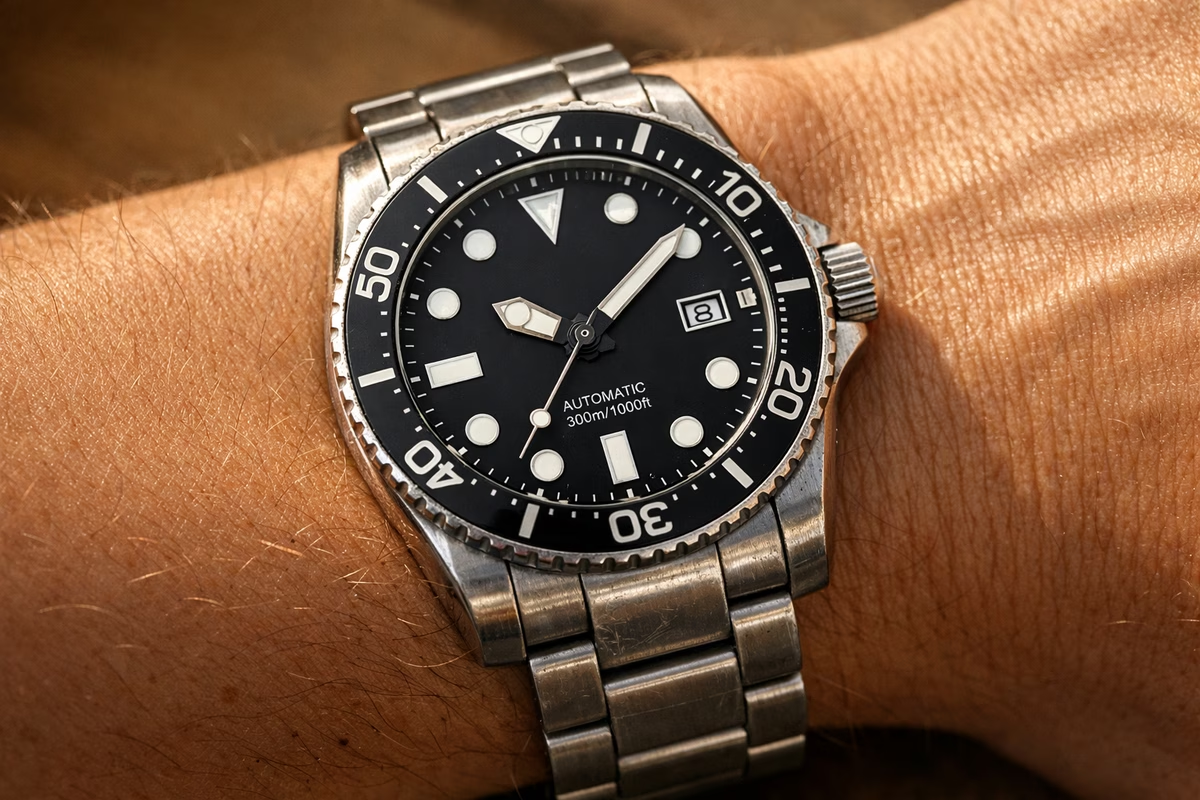
I’d bought the watch—a stainless steel dive watch with a black dial, luminous markers, and a unidirectional bezel I had no practical use for—on a Tuesday. By Friday, while reaching into a kitchen cabinet, my wrist grazed the granite countertop. A thin, bright line appeared on the polished side of the case, about eight millimeters long.
I stared at it the way you stare at the first scratch on a new car. The watch had been perfect for seventy-two hours, and now it wasn’t. Some part of me wanted to be upset. Another part—the better part—thought: Good. Now it’s mine.
Five years later, that watch has hundreds of scratches. The bracelet has the soft, satin-matte sheen that steel develops after years of daily contact with desks, door frames, and life. The crystal has three very fine hairlines visible only in direct light. The bezel insert has a nick at the forty-minute mark from an encounter with a metal fence.
It keeps time to within four seconds per day. It has been on my wrist through two job changes, a cross-country move, three camping trips, one ocean swim, and approximately 1,825 days of ordinary life.
It is, without question, the most personal object I own.
Why daily wear changes a watch (and a wearer)
A watch in a display case is a beautiful object. A watch on a wrist is a companion.
The difference is wear. Not damage—wear. The gradual accumulation of evidence that a watch has been used, carried, lived with. Scratches, patina, the way the bracelet conforms to your wrist over time, the desk-diving marks on the clasp—all of these are the watch’s autobiography, written one day at a time.
Some watch collectors avoid daily wear to preserve condition. They rotate through a collection, giving each piece limited wrist time. There’s nothing wrong with this—it’s a valid approach to a different relationship with watches.
But there’s something irreplaceable about choosing one watch and wearing it through everything. You stop seeing it as a possession and start experiencing it as an extension of your daily life. The watch becomes a constant in a world of variables—the same weight on your wrist every morning, the same glance for the time every afternoon, the same ritual of putting it on the nightstand every evening.
Year 1: Learning the watch
The first year with a daily-wear watch is a getting-to-know-you period. You learn:
How it wears. A 40mm case might feel different from a 42mm case in ways that spec sheets can’t convey. Weight distribution, lug-to-lug length, case thickness, crown position—all of these affect how the watch feels across a full day. My dive watch is 41mm, 13mm thick, and weighs 165 grams on the bracelet. For the first two weeks, I was aware of it constantly. By week three, it was invisible—just the right weight, just the right size, just enough presence without intrusion.
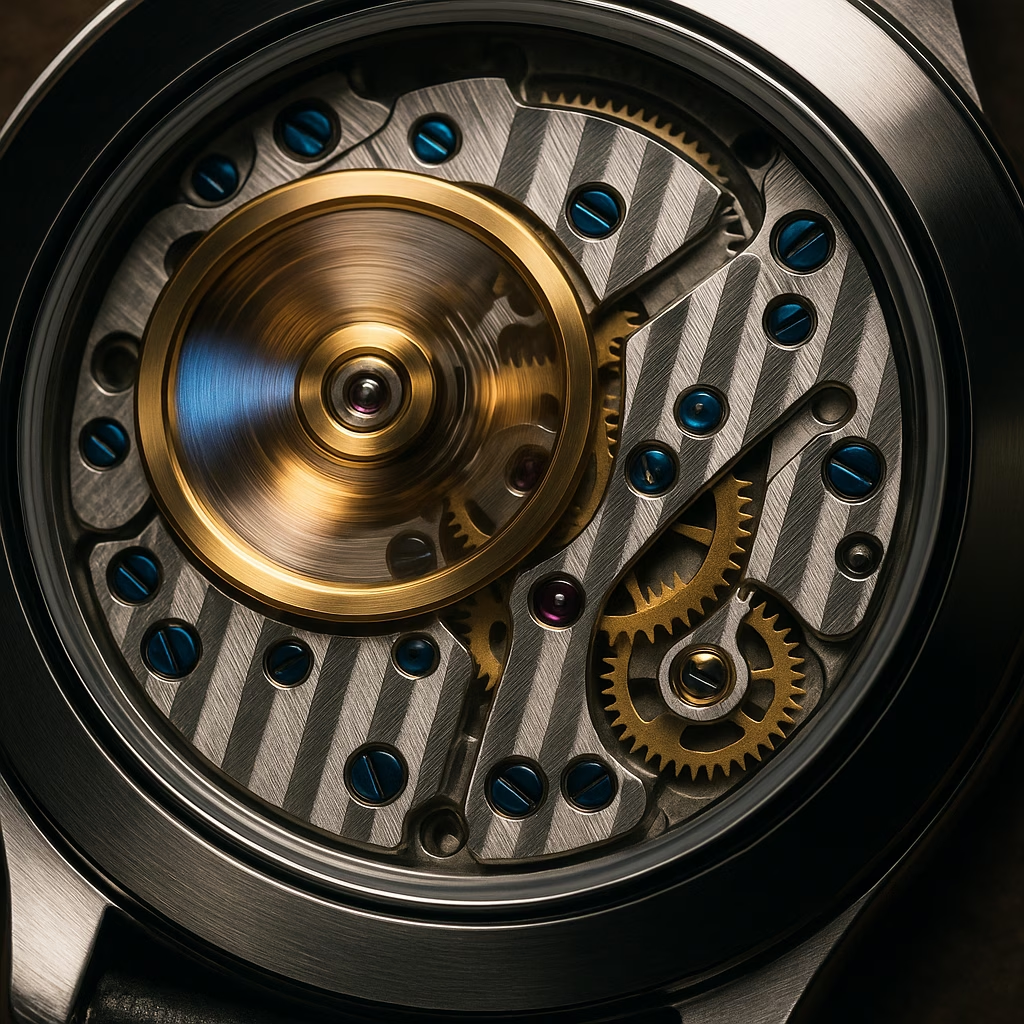
How it keeps time. Mechanical watches don’t keep quartz-perfect time. They gain or lose seconds per day, and the rate varies with position (dial up vs. crown up), temperature, and how wound the mainspring is. My watch runs about +4 seconds per day when fully wound, slowing to +2 when the power reserve drops. I set it every Sunday morning—a one-minute ritual that became a small weekly marker, like winding a clock.
How it reacts to your life. The first scratch from the countertop. The first time the crystal fogs slightly after a cold-to-warm transition (normal—moisture condenses briefly and clears). The first time you knock the crown while pulling on a jacket. These aren’t crises. They’re introductions. You’re learning what the watch can handle (almost everything) and what requires care (the crystal, the crown, the case back).
Year 2: The scratches become a map
By the second year, the case and bracelet had accumulated enough scratches to tell a story.
The left side of the case (which faces forward when your arm hangs naturally) was the most marked—desk edges, door frames, countertops. These are the desk-diving scratches, and they form a characteristic pattern that watch enthusiasts recognize and appreciate. They’re proof the watch was worn, not stored.
The bracelet clasp had deep, crossing scratches from thousands of contacts with desk surfaces. The original polished finish was gone, replaced by a soft, uniform matte that looked—to my eye—better than new. It had character.
The bezel had the nick at forty minutes. I remembered exactly when it happened: a hiking trip, a metal gate, a careless moment. The nick is small enough that most people wouldn’t notice. I notice every time I look at the watch.
Here’s the thing about scratches on a stainless steel tool watch: they don’t diminish the watch. They personalize it. No two daily-worn watches develop the same wear pattern, because no two people live the same life. My watch’s scratches are a map of my specific habits, movements, and accidents. They’re a patina—not in the traditional metallurgical sense, but in the broader sense of surfaces recording time.
Year 3: The service question
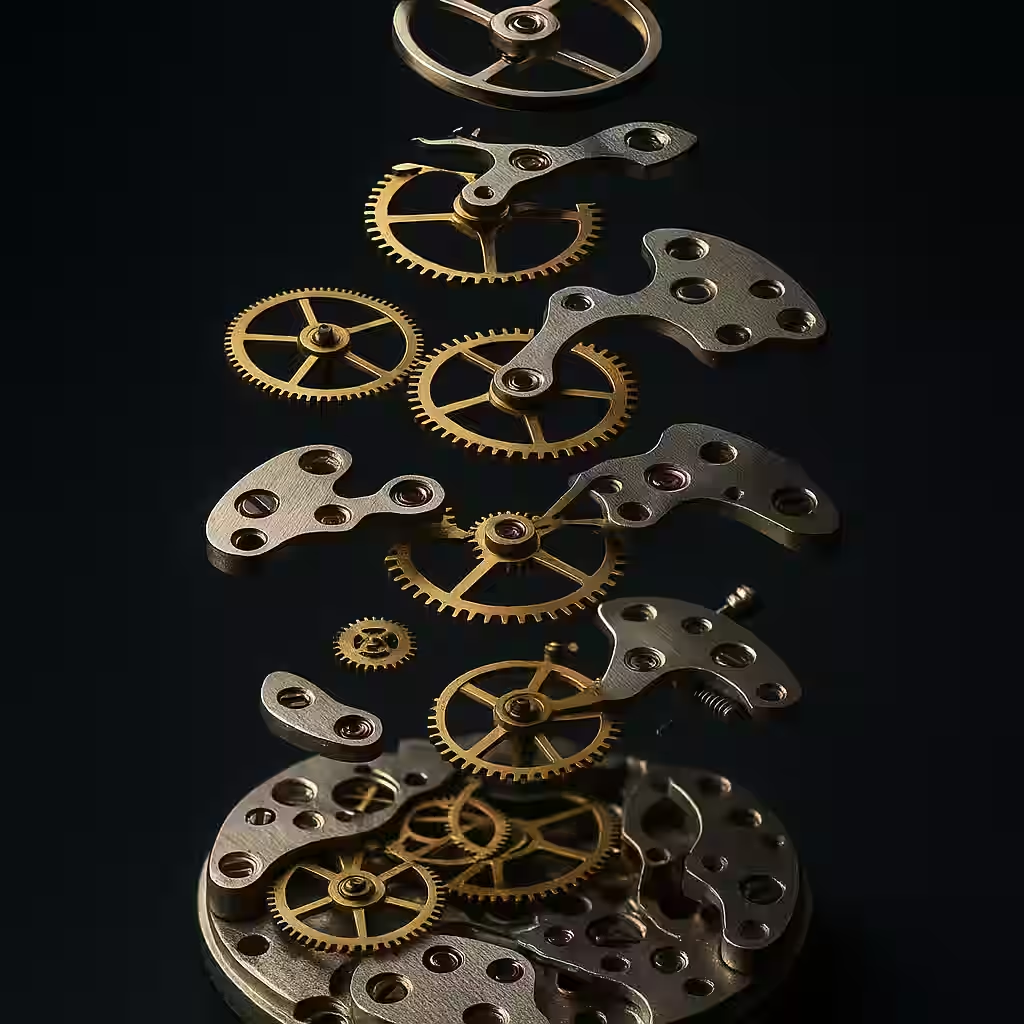
Most mechanical watches should be serviced every 5–7 years. A service involves disassembling the movement, cleaning every component in a series of chemical baths, replacing worn parts (gaskets, mainspring, and any compromised components), reassembling, lubricating, and regulating.
At year three, my watch was running fine—still +4 seconds per day, no issues with the crown or date change, no moisture intrusion. But I noticed two things:
The power reserve seemed shorter. A fully wound watch that used to run 48 hours now ran about 42 hours before stopping. This suggested the mainspring was losing some elasticity—normal wear for a three-year-old movement.
The winding felt slightly less smooth. The crown turned easily, but there was a faint grittiness that hadn’t been there before—likely degraded lubricant on the winding mechanism.
Neither was urgent. Both were signs that the movement, like any machine, was aging and would eventually need attention.
I decided to wait until year five for a full service, but I had the watch pressure-tested (water resistance check) at year three—a quick, inexpensive test that ensures the gaskets are still sealing properly. It passed at 200 meters, same as new.
For service details, see Watch Care and Maintenance.
Year 4: The ocean swim
The watch was rated to 200 meters water resistance. I’d never tested it beyond a rainstorm.
On a vacation in Maine, I went swimming in the ocean. Nothing dramatic—a calm bay, chest-deep water, twenty minutes of floating and looking at the sky.
Before going in, I screwed down the crown (a dive watch’s first line of defense against water—the crown threads into the case, creating a seal). In the water, I looked at the watch on my wrist. The dial was perfectly legible underwater—the luminous markers glowed faintly even in daylight, and the white text on the black dial was sharp through the water.
After the swim, I rinsed the watch in fresh water (salt water is corrosive to metal—always rinse) and dried it. No moisture under the crystal. No condensation. No issues.
The watch did exactly what it was designed to do: function in water, without drama, without failure. A tool used for its intended purpose, performing perfectly.
That evening, looking at the watch on my wrist—still wet from the rinse, salt residue drying on the bezel—I felt something I can only describe as trust. Not the way you trust a person, but the way you trust a well-made tool: it will do its job, it won’t let you down, and it doesn’t require your worry.
Year 5: The full service
At five years, I sent the watch for a full service. The watchmaker kept it for three weeks.
What was done:
- Complete movement disassembly and cleaning
- Mainspring replaced (the old one had lost ~10% of its torque, explaining the shorter power reserve)
- All gaskets replaced (crown, case back, crystal)
- Movement reassembled and lubricated with fresh oils
- Regulated to +3 seconds per day
- Case and bracelet ultrasonically cleaned (not polished—I asked them not to)
- Pressure-tested to 200 meters
Cost: $350 (for an ETA-based movement; a manufacture movement or Rolex-caliber service runs $500–$1,200+)
When the watch came back, it looked the same—same scratches, same patina, same wear pattern. But it felt different on the wrist. The winding was silk-smooth again. The power reserve was back to a full 48 hours. The date change snapped at midnight with a crispness I’d forgotten.
It was the same watch, refreshed. Like a car after a proper tune-up—you realize how much performance had gradually degraded only when it’s restored.
What five years of daily wear teaches you
A watch is a relationship, not a purchase. The transaction happens once. The relationship unfolds daily, over years. You learn the watch’s personality—its timekeeping rate, its quirks, the way it catches light at certain angles. The watch learns your life—recording your habits in its scratches, running at the rhythm of your activity level (the automatic winding responds to how much you move).
Durability isn’t about surviving extremes. My watch survived an ocean swim, but it also survived 1,800 days of ordinary life—the desk corners, the doorknobs, the daily wear that adds up to more total stress than any single dramatic event. True durability is boring. It’s showing up every day and working without complaint.
Fewer watches, worn more, is satisfying. I own one watch. Some collectors own fifty. Neither is wrong. But there’s a particular satisfaction in the deep familiarity that comes from wearing the same watch every day—a satisfaction that a rotating collection, no matter how impressive, can’t replicate. You trade variety for intimacy, and the trade is worth it.
The watch is a frame for memory. I look at the nick on the bezel and remember the hiking trip. I look at the hairlines on the crystal and remember the moves and the jobs and the years. The watch was present for all of it, and its physical record of those moments makes them more tangible than any photograph in my phone.
The ending: the weight on the wrist
This morning, I put the watch on. Same as every morning for five years. Left wrist, crown facing up, clasp clicked.
The weight settled. The watch was warm within seconds—body heat conducting through the steel. The dial was clean and sharp. The second hand swept smoothly around—five ticks per second, no stutter, no hesitation.
I looked at the scratches on the case. The map of five years. Every mark a moment, every moment ordinary, all of them mine.
A watch that survives everything isn’t a watch that endures extreme conditions. It’s a watch that endures time—the ordinary, accumulating kind that makes up a life.
This one has. And tomorrow morning, same as today, I’ll put it on again.
Next steps
- Read Watch Care and Maintenance for the full guide to cleaning, service, and preservation
- Explore Watch Styles to understand dive, field, dress, and pilot categories
- See Straps and Bracelets for changing the look without changing the watch
- Try Buying Guide for choosing your own daily-wear companion
- Check The Watch My Grandfather Left Behind for the emotional side of watch ownership