Every watch on your wrist starts with people trying to measure time better.
People noticed that a shadow moved with the sun. That led to the first clock, a stick in the ground and a way to divide the day.
From that stick to the watch on your wrist is a long chain of inventions, wars, fashion changes, and one crisis that nearly killed the mechanical watch before people chose it again.
Before the Watch: Making Time Portable (3500 BCE – 1400 CE)
Sundials and Water Clocks
The Egyptians formalized the sundial around 1500 BCE and divided daylight into twelve parts. Sundials do not work at night, indoors, or on cloudy days, so the Egyptians also built water clocks. These vessels dripped water at a steady rate and marked time by how much water had flowed.
Water clocks stayed standard for a thousand years. The Greeks refined them. The Romans used them. Chinese engineers built water-clock towers with bell-striking machines. But they were still furniture, not portable tools.
The Mechanical Clock Arrives
The first mechanical clocks appeared in European monasteries and cathedrals around 1270–1300 CE. They were weight-driven machines, with heavy stones on ropes turning gears through gravity. They sat in towers to regulate prayer schedules. They had no dials or hands. They rang bells. The word “clock” comes from the Celtic clocca and the German Glocke, both meaning “bell.”
By the 1300s, clock towers defined European city life. The clock told everyone the same time and helped standardize commerce, governance, and daily rhythm. But it was still attached to a building. Time was public, not personal.
The Spring-Driven Revolution (1400s – 1600s)
Clocks Get Small
The breakthrough that made timekeeping portable was the coiled mainspring, developed in the early 1400s. Instead of heavy weights, a spring stored energy in a small space. Wind it, and it slowly uncoils, driving the gear train.
Spring-driven clocks got smaller over time. First they sat on tables. Then they hung on walls. By the late 1400s, they were small enough to carry.
The First Portable Timepieces
Peter Henlein, a locksmith in Nuremberg, Germany, is traditionally credited with creating the first portable timekeeping devices around 1510. These were not wristwatches. They were small brass clocks that could be worn as pendants or carried in a pocket. Germans called them Taschenuhr or sometimes Nuremberg Eggs because of their shape.
They were bad timekeepers, losing hours a day, but they were portable. For the first time, time was something a person could carry.
The Balance Spring: Accuracy Arrives
In 1675, Dutch physicist Christiaan Huygens, with competing claims from Robert Hooke, introduced the balance spring. The tiny spiral spring regulated the balance wheel and improved portable timepiece accuracy from hours per day to minutes per day.
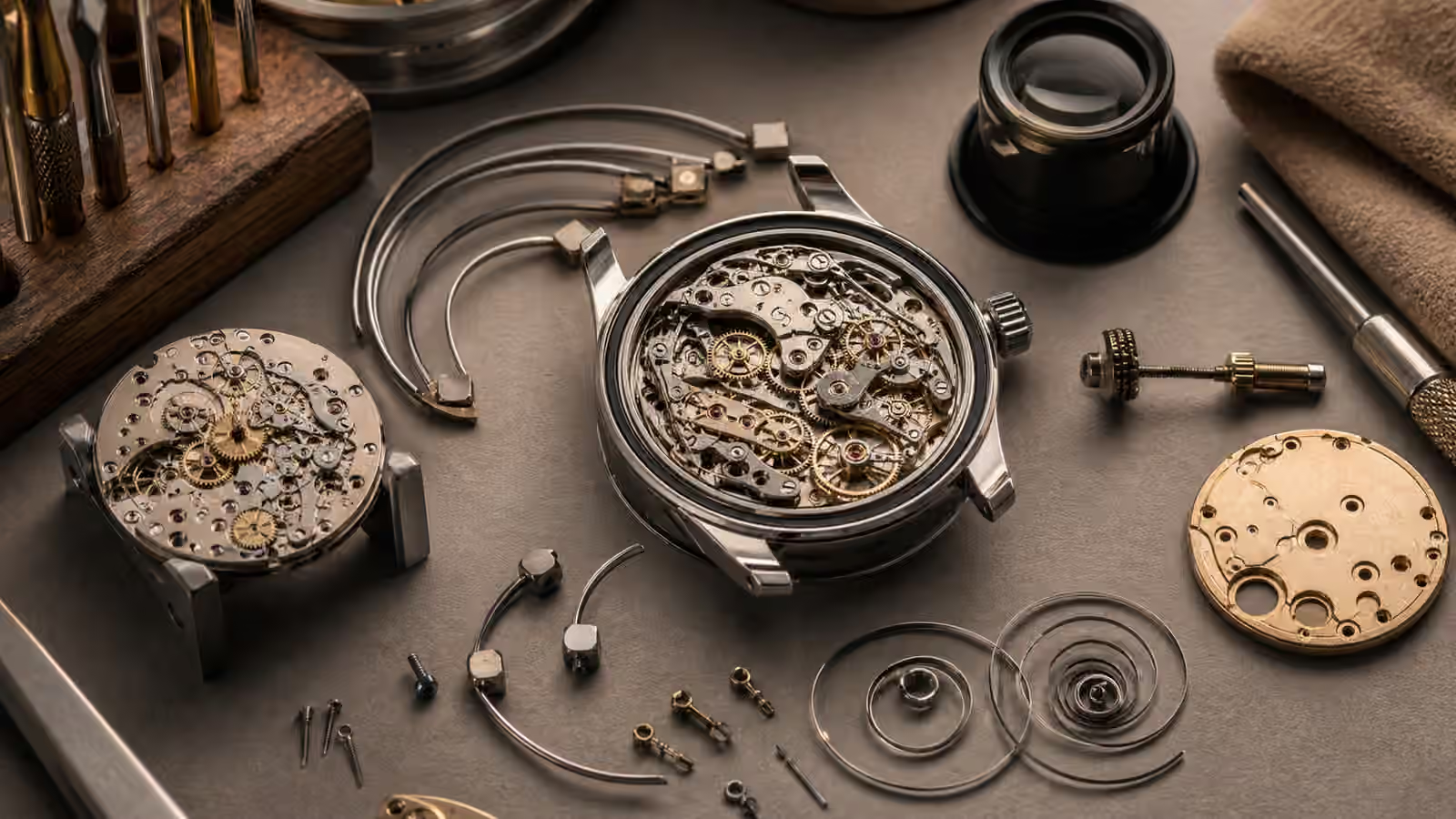
The balance spring is still the heart of every mechanical watch made today. The technology behind your modern automatic was invented 350 years ago.
The Pocket Watch Era (1600s – 1900s)
A Gentleman’s Essential
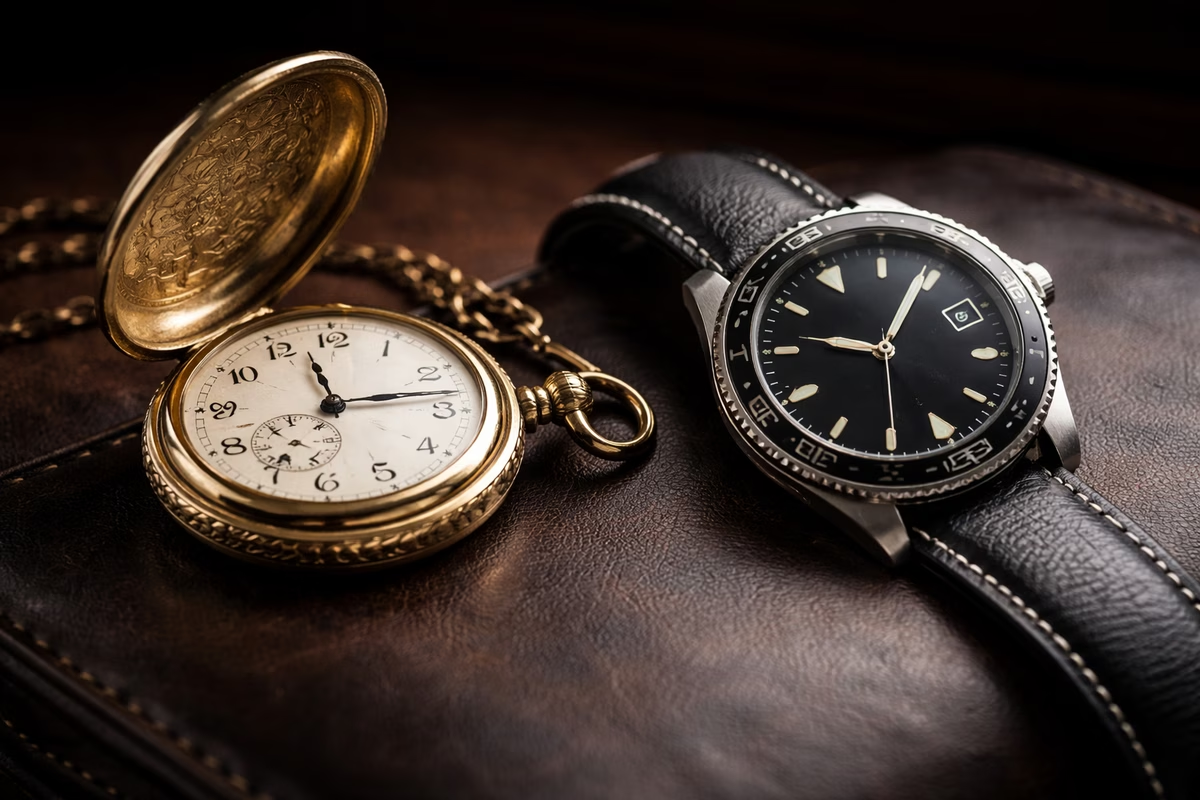
By the 1700s, the pocket watch had become a standard accessory for European gentlemen. Worn on a chain in a waistcoat pocket, it was both tool and status symbol. The quality of your watch said something about your position, your taste, and your relationship with punctuality.
Pocket watch innovation accelerated through the 1700s and 1800s:
- The lever escapement (1759, Thomas Mudge): Dramatically improved accuracy and shock resistance. Still used in most mechanical watches today.
- The tourbillon (1801, Abraham-Louis Breguet): A rotating cage that compensated for gravity’s effect on accuracy in different positions. An engineering marvel that remains the most prestigious complication.
- The keyless winding system (mid-1800s): Replaced the separate winding key with an integrated crown. The crown on the side of your watch is this invention.
The Marine Chronometer
The most consequential development in watchmaking wasn’t about fashion. It was about survival.
In the 18th century, determining longitude at sea was one of the most urgent technical problems in the world. Ships that could not calculate their east-west position ran aground, lost trade routes, and killed crews. The solution needed a clock that could keep time accurately at sea despite temperature changes, humidity, and constant motion.
John Harrison, a self-taught English carpenter, spent forty years building increasingly accurate marine chronometers. His H4, completed in 1761, was a large pocket watch that lost only 5 seconds over an 81-day sea voyage. It solved the longitude problem and saved lives. It also proved that a portable timepiece could be genuinely precise, not just convenient but reliable.
Harrison’s work elevated watchmaking from craft to science.
From Pocket to Wrist (1880s – 1945)
The Military Origin of the Wristwatch
Wristwatches existed before World War I, but men still favored pocket watches. War changed that. Soldiers needed both hands free, so they strapped watches to their wrists. Military use made the wristwatch normal, and after the war it replaced the pocket watch for most men.
The Interwar Golden Age
The 1920s and 1930s brought more shape variety. Rectangles, curves, and Art Deco designs all became common. Function also improved. Automatic movements meant less hand-winding. Water resistance became real. Chronographs became useful for sports and travel.
World War II: The Tool Watch Is Born
The Second World War turned the wristwatch into essential gear. Military watches had to be easy to read, shock resistant, water resistant, and useful for timing.
Those needs shaped the dive watch, pilot watch, and field watch. The Rolex Submariner, Omega Seamaster, and Breitling Navitimer all came out of that tool-watch mindset.
The Quartz Crisis (1969 – 1985)
The Revolution No One Saw Coming
In 1969, Seiko released the Astron, the first quartz wristwatch. It used a quartz crystal and a battery. It was more accurate and cheaper than mechanical watches, and it nearly wiped out Swiss watchmaking.
The Crisis
Through the 1970s, Japanese quartz watches flooded the market. Swiss mechanical production collapsed. Many brands closed.
Swiss brands answered in different ways. Some adopted quartz. Some leaned harder into mechanical prestige. Swatch, launched in 1983, helped the industry survive.
The Mechanical Renaissance (1990s – Present)
Why Mechanical Watches Came Back
By the late 1980s, it was clear that mechanical watches could never compete with quartz on accuracy or price. But something unexpected happened: people started wanting them anyway.
The mechanical watch survived because people started treating it as a craft object instead of a pure tool. A good movement has dozens or hundreds of small parts, all working without electricity. That is the appeal now.
The Luxury Boom
Through the 2000s and 2010s, mechanical watches became luxury goods. Brands like Patek Philippe, Audemars Piguet, and Rolex built long wait lists. Collecting turned into a real hobby, and vintage pieces became highly prized.
The Smartwatch Question
The Apple Watch and other smartwatches raised the same question again. They did not kill mechanical watches. They made the difference clearer. Smartwatches handle data. Mechanical watches handle craft, tradition, and physical beauty.
What History Means for Your Wrist
The watch you wear today sits at the end of a long line that runs from sundials to pocket watches to wristwatches to quartz. When you wind a mechanical watch, you are using a very old idea in a very small package. That is the point.
Next Steps
- Read Watch Movements Explained
- See Watch Styles Guide
- Explore Watch Brands
- Try The Inherited Watch
- Check Watch Complications Deep Dive