Calendar complications seem simple until you live with them. A date window is useful because it answers a question you ask all the time. A day-date display feels complete on a work watch. A pointer date adds charm. A moonphase turns the dial into something slower and more poetic. An annual or perpetual calendar can feel like a tiny mechanical memory of the year. Then the watch stops in a drawer, February ends, the crown has too many positions, and the owner has to remember what can be adjusted safely.
That tension is the real story of calendar watches. They add daily usefulness and mechanical character, but they also add responsibility. A clean three-hand watch can be set quickly after weeks unworn. A calendar watch may ask for patience, sequence, and respect for the mechanism. The more the watch knows about the calendar, the more carefully the owner needs to wake it up.
The date window is useful because it disappears
The ordinary date window is the most common calendar complication because it solves a real problem with little fuss. A disc under the dial advances once per day and shows the date through an aperture. On many watches the change happens around midnight, sometimes as a slow crawl and sometimes as a quick jump. The owner notices it only when the date is wrong.
That invisibility is its strength. A good date window supports the dial without dominating it. Placement matters. A date at three o’clock can balance a crown-side design but may interrupt markers. A date at six o’clock often feels symmetrical. A color-matched wheel can disappear into the dial, while a high-contrast wheel can improve readability or look like an afterthought. Watch Dial Legibility is useful here because calendar displays are still dial furniture. They change how quickly the watch reads.
The practical cost is correction. Months with fewer than thirty-one days require manual adjustment unless the watch has a more advanced calendar. Many owners do not mind. The small ritual becomes part of wearing the watch. Others find it annoying, especially if they rotate several watches. The same feature that feels helpful on a daily watch can become tedious on a watch worn twice a month.
Day-date watches belong to routine
A day-date display adds the day of the week to the date, usually through a second window or a longer aperture. It is a useful complication for people whose schedule has a weekly rhythm. The day display can make a watch feel practical, almost administrative, in a pleasing way. It also adds visual weight to the dial. On some watches that weight gives character. On others it crowds the design.
Language wheels add another layer. Some day-date watches can display the day in more than one language, depending on the wheel fitted to the movement. That can be charming, especially on vintage watches or watches tied to a region. It can also create confusion if the owner does not understand the setting sequence. A half-changed day at midnight is usually not a defect. It is the mechanism moving through its cycle.
The day-date is best on a watch that is worn often enough to stay current. If it stops for weeks, setting both day and date can feel like more work than the watch deserves. This is where Winding and Setting a Watch becomes practical. The right sequence matters, and the wrong force can damage parts that are small, specialized, and sometimes difficult to replace.
Pointer dates and big dates change the tone
A pointer date uses a hand, often with a crescent or arrow tip, to indicate the date around the edge of the dial. It gives the date a more traditional presence. Instead of hiding in a window, the calendar becomes part of the watch’s design language. Pointer dates can feel warm, vintage, and balanced, especially on watches with Arabic numerals or sector-style dials.
The trade-off is readability. A pointer date asks the eye to find a small hand among other hands and markers. On a quiet dial it can be lovely. On a busy dial it can be one more thing to decode. The owner should decide whether the charm is worth the extra glance.
Big date displays take the opposite approach. They use larger numerals, often with two discs, to make the date more legible and more architectural. A well-executed big date can give the dial a strong focal point. A poorly integrated one can make the watch look as if a calendar module was dropped into the dial after the fact. Big dates are about design confidence. They rarely feel neutral.
Moonphases are calendars of mood
The moonphase is technically a calendar complication, but it works on a different emotional scale. It tracks the lunar cycle rather than the work month. Most owners do not need it in a practical sense. They enjoy it because it gives the watch a slower rhythm. A small moon crossing an aperture can soften a formal dial, make a dress watch feel more romantic, or add a little astronomy to a daily glance.
Moonphases need occasional correction because the lunar cycle is not exactly the simplified mechanical cycle used by many movements. Some high-end moonphases remain accurate for very long periods if kept running, but the ownership point is simpler: if the watch stops, the moon may need to be reset. That process can be easy or fussy depending on the watch.
The moonphase also affects taste. It can make a watch feel decorative, and that is not a flaw. Not every complication has to justify itself by utility. Watch Complications Guide covers the broader hierarchy, but calendar complications remind us that usefulness and pleasure often share the same dial. A date helps you fill out a form. A moonphase changes how the watch feels after dinner.
Annual and perpetual calendars ask for continuity
An annual calendar recognizes the different lengths of most months and usually needs correction only once a year at the end of February. A perpetual calendar goes further by accounting for leap years according to its mechanical program. These watches are impressive because they turn the irregular calendar into arranged metal. They are also ownership commitments.
The first commitment is keeping the watch running or being willing to reset it carefully. If a perpetual calendar stops for months, returning it to the correct date can require advancing through days, months, moonphase, and leap-year indications in the correct order. Some watches make this surprisingly user-friendly. Others should be handled with instructions nearby. A watch with several recessed correctors is not asking for improvisation.
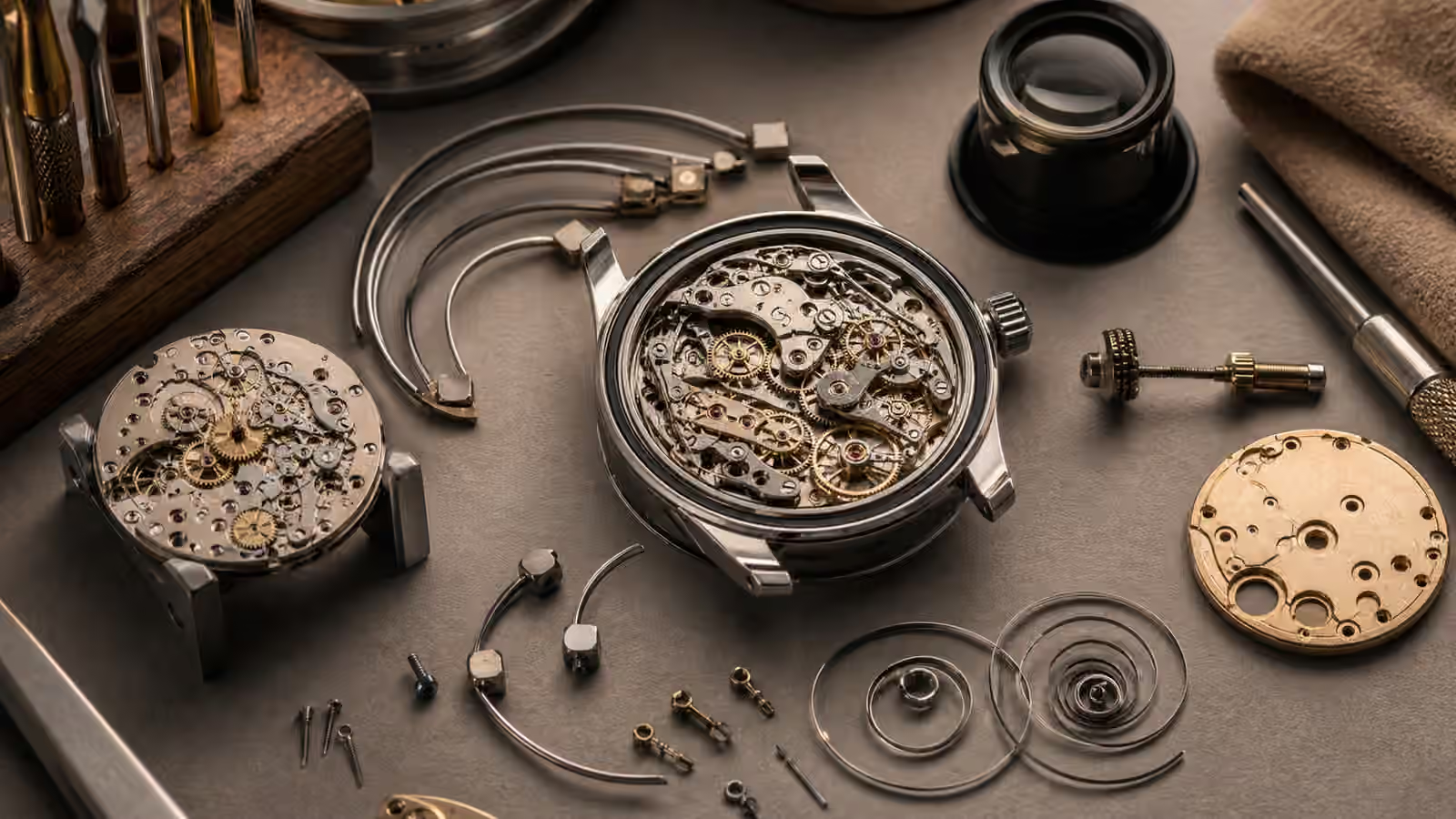
The second commitment is service quality. Calendar mechanisms include levers, jumper springs, wheels, cams, and correctors that must interact cleanly. A rough quick-set, a stuck pusher, or a calendar that fails to advance is not something to force. Your First Watch Service explains why service is a real craft rather than a vague tune-up. Complicated calendars make that point sharper.
The third commitment is emotional. An annual or perpetual calendar may be magnificent, but if you rotate watches casually and dislike setting them, the ownership may feel like homework. The same watch that delights one collector can frustrate another. Complexity should match temperament.
The danger zone is about engaged parts
Many calendar watches have a period around midnight when the calendar-change mechanism is engaged. During that window, forcing a quick-set date or related corrector can damage teeth, levers, or springs. The exact safe window varies by movement, so the owner’s manual matters. The conservative habit is to move the hands away from the midnight changeover before using quick-set calendar functions, then set the final time afterward.
This habit sounds fussy until it becomes automatic. If you pick up a stopped watch, first determine whether it is showing morning or evening. Move the hands to a safer time if needed. Set the calendar gently. Then set the correct time. Do not use recessed correctors with random sharp objects. A proper tool, a wooden peg, or the maker’s corrector is better than a steel pin that can scratch the case and slip into the wrong angle.
The crown feel should be light and clear. If the date does not change when it should, stop. If a corrector feels stuck, stop. If the day and date are misaligned after a fall or after someone forced the quick-set, stop. Calendar parts are small and often model-specific. The owner wins by not making the watchmaker’s job worse.
Calendar displays affect design more than owners expect
A calendar complication changes the dial even when it is small. It can break symmetry, shift visual weight, add color, interrupt numerals, or create a focal point. A no-date watch often feels calmer because the dial has fewer obligations. A date watch feels more useful. A day-date watch feels more organized. A moonphase feels more expressive. A perpetual calendar feels intentionally busy because the density is part of the appeal.
This is why calendar watches should be judged on the wrist, not only by specifications. A date window that looks awkward in a photo may make sense at wrist scale. A beautiful moonphase may become hard to read under a reflective crystal. A perpetual calendar may look balanced because every subdial has a reason, while a simpler watch may look cluttered because one date window is poorly placed. Dial design is not just the number of features. It is how convincingly those features belong.
Watch Dial Colors, Textures, and Finishes pairs well with this because surface and calendar layout affect each other. A glossy dial can make a tiny date harder to see. A textured dial can make an aperture edge more obvious. A sunburst finish may draw attention away from a pointer date. The calendar is never alone.
Choose the calendar you will actually maintain
The best calendar complication is the one that fits your rhythm. A simple date is excellent on a watch you wear every day. A no-date watch may be better for a rotation piece that stops often. A day-date suits routine. A pointer date suits charm. A moonphase suits someone who enjoys setting a watch with a little patience. An annual or perpetual calendar suits an owner who appreciates mechanical continuity and is willing to care for it.
There is no moral ranking here. More complicated is not automatically better. The simplest watch may give the most pleasure if it is always ready. The complicated watch may be worth every setting step if it makes the owner pause and admire the mechanism. The right choice depends on how often the watch is worn, how comfortable you are with setting procedures, and how much dial activity you enjoy.
Calendar watches are practical machines with a memory problem. They remember the date only while they keep running, and they ask for respect when they wake up. Learn the setting sequence, avoid forcing the mechanism, and let the design match your life. When that happens, a calendar complication becomes more than a window on the dial. It becomes part of the watch’s relationship with time.