
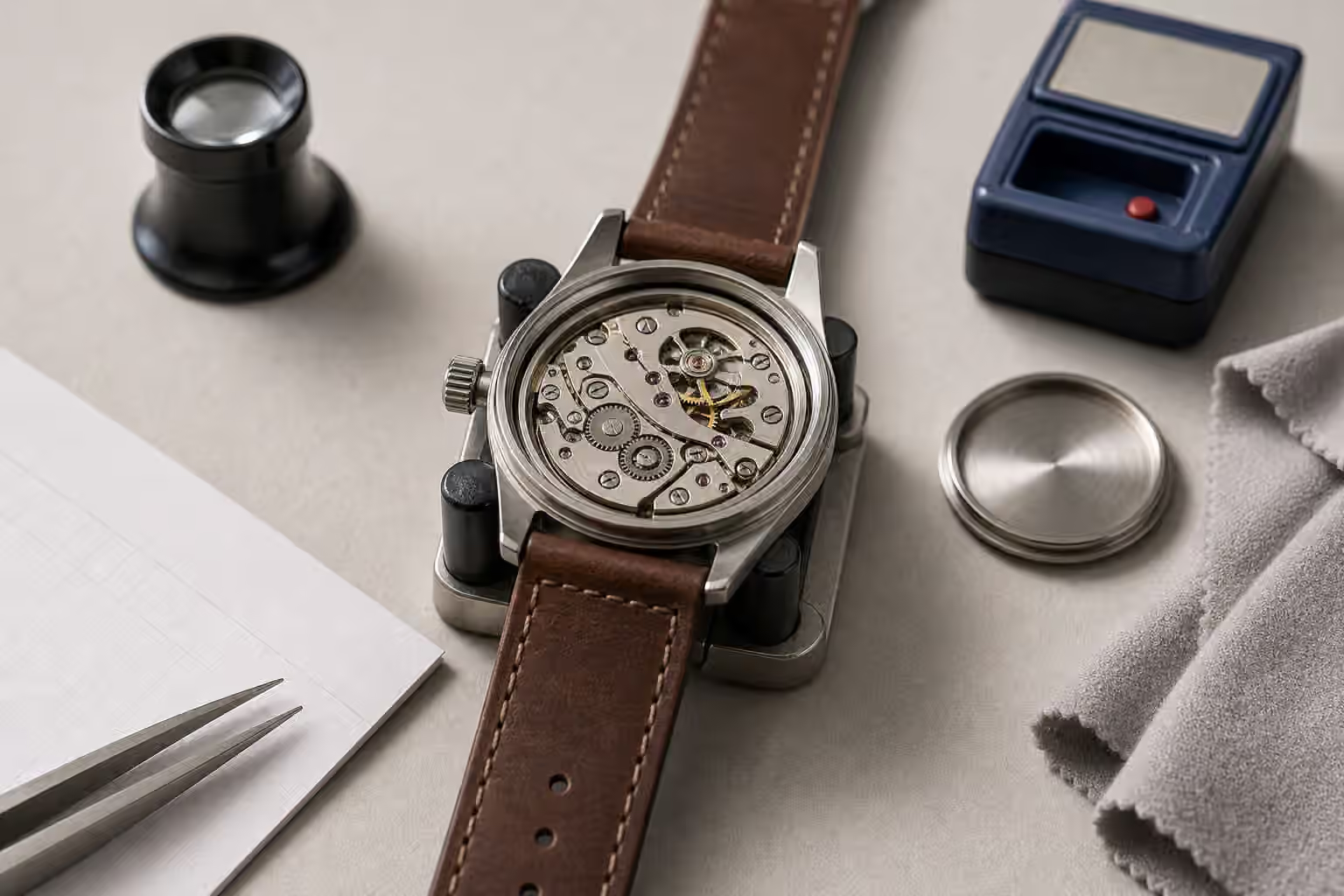
Accuracy is one of the first things watch owners measure, and one of the easiest things to misunderstand. A watch gains ten seconds one day, loses three the next, then seems perfectly steady for a week. That pattern can feel like a defect if you expect a mechanical watch to behave like a phone clock. It makes more sense when you remember that a mechanical watch is a tiny regulated machine living on a moving wrist. It reacts to position, temperature, wind, shock, magnetism, age, and the way you wear it.
The goal is not to turn every owner into a watchmaker. The goal is to know what the numbers mean before they start shaping your mood. Accuracy can tell you whether a watch is healthy, whether it needs a simple adjustment, or whether it is asking for service. It can also trick you into obsessing over a machine that is performing normally. A calm approach starts with the difference between a specification, a pattern, and a problem.
Accuracy is a pattern, not a single number
When a brand or seller says a watch runs within a certain number of seconds per day, that number is a simplified promise. It is useful, but it is not the whole ownership experience. A watch may be tested in several fixed positions, under controlled conditions, with a full wind and a stable temperature. Your wrist is not a laboratory. It swings, stops, warms, cools, rests dial-up on a nightstand, and sometimes spends a quiet day at a desk with barely enough motion to keep an automatic fully wound.
This is why one isolated timing result does not say much. A watch that gains fifteen seconds on Tuesday and loses two on Wednesday may not be broken. You need a pattern across several days, ideally with notes about how the watch was worn and how it rested overnight. Once you see the pattern, you can decide whether the behavior is normal, annoying, or genuinely worth attention.
If movement types are still new to you, start with Understanding Watch Movements . The basic technology matters. A quartz watch is expected to be far more precise than a mechanical one. A modern chronometer-grade mechanical watch should usually do better than an old unserviced hand-wound watch. A vintage watch may have earned patience by surviving decades, but it has not earned the right to be treated like a newly tested movement.
Position changes the rate
A mechanical watch does not run at exactly the same rate in every position. Dial up, dial down, crown up, crown down, crown left, and crown right each place the balance, pivots, and escapement under slightly different physical conditions. The differences are tiny, but timekeeping is made of tiny differences. Over a full day, those positions can add up.
This is why some owners learn how their watch behaves overnight. If it gains during the day but loses slightly when left crown-up, resting it that way may bring the daily average closer to zero. That is not magic and it is not repair. It is using positional variance as a gentle correction. Some watches respond dramatically; others barely move. A well-adjusted watch should behave reasonably across positions, but “reasonably” is still a range, not mathematical perfection.
Power reserve also matters. A mechanical watch often runs best when the mainspring is in a healthy part of its wind. As the spring winds down, the force delivered to the movement can change. Modern movement design reduces that effect, but it does not erase it. If an automatic watch is worn during a quiet day, especially by someone who types more than they walk, it may never reach a strong wind. Before blaming regulation, give the watch a full manual wind if the movement allows it, wear it normally, and watch the pattern for a few days.
Magnetism makes watches act strange
Magnetism deserves a special place because it can make a watch look much sicker than it is. A magnetized mechanical watch often runs fast, sometimes very fast, because magnetized parts in the balance spring can stick or behave irregularly. The watch may suddenly gain minutes per day after being near a magnetic clasp, speaker, tablet cover, phone mount, induction charger, or another everyday object with a strong magnet.
The good news is that demagnetizing is usually quick and inexpensive. Many watchmakers can check and fix it in minutes. Small consumer demagnetizers exist too, though they should be used carefully and only when you understand the process. If a watch suddenly changes behavior after a known exposure, magnetism is one of the first suspects, not the last.
This is also where Watch Care Guide becomes practical rather than fussy. Keeping a watch away from strong magnets is not superstition. It is the same kind of habit as closing the crown before water or wiping grit from a bracelet before it scratches everything it touches. Care is often just an owner making the easy failure less likely.
Quartz changes the benchmark
Quartz watches can distort expectations because they are so good at timekeeping. A simple quartz watch may drift only seconds per month, and higher-grade quartz can do far better. Solar quartz, thermocompensated quartz, and other advanced designs make mechanical accuracy look almost quaint by comparison. That does not mean mechanical watches are bad. It means they are doing a harder job in a more visible way.
If exact time matters for travel, work, medication schedules, or any situation where lateness has consequences, use a reliable reference device or a quartz watch. Let the mechanical watch be what it is: a durable, maintainable, expressive machine that tells time well enough for ordinary life when healthy. That distinction keeps the pleasure intact. A mechanical watch can be accurate and still not be the most accurate object you own.
This is useful when shopping, too. The Buying Guide talks about matching a watch to the way you live. Accuracy is part of that match. Someone who rotates five automatic watches and hates resetting them may be happier with quartz or a long power reserve than with a delicate mechanical piece that needs attention every time it leaves the box. Someone who enjoys the ritual may feel the opposite.
How to time a watch without becoming unreasonable
The healthiest timing method is boring. Set the watch against a reliable reference, wear it normally, check it at the same time each day, and write down the difference. Do that for a week. Include simple notes if something unusual happened, such as a full day off the wrist, a hard knock, a long drive, a magnet exposure, or the watch stopping overnight. The point is not to gather courtroom evidence. It is to learn whether the watch has a stable personality.
Avoid testing in a way that creates false problems. Do not judge an automatic watch after one lazy afternoon and one night in a drawer. Do not compare a vintage dress watch to a modern anti-magnetic chronometer. Do not panic over a few seconds if the watch is otherwise stable. The number that matters most is not the best single day or the worst single day, but the ordinary average you actually live with.
A timing machine can add useful information, but it is not the whole truth either. It listens to the movement and estimates rate, amplitude, and beat error in selected positions. That is extremely helpful for a watchmaker. It can also be misleading in the hands of an owner who sees one ugly reading and assumes disaster. The machine measures a moment. The wrist tells the longer story.
Regulation is not the same as service
Regulation is an adjustment to the rate of the movement. On many mechanical watches, a watchmaker can adjust the effective length of the balance spring or use a regulating system provided by the movement design. The purpose is to bring the watch closer to the desired rate. If the watch is clean, healthy, and merely running a little fast or slow in a stable way, regulation can be enough.
Service is different. A full mechanical service means opening the watch, disassembling the movement, cleaning parts, inspecting wear, replacing what needs replacement, lubricating, adjusting, and testing. It is more expensive because it is more work. If the oils are old, amplitude is poor, the crown feels gritty, the watch stops unpredictably, or water has entered the case, regulation is not the honest answer. Adjusting a dry or worn movement can make the timing number look better for a moment while leaving the real problem untouched.
Water resistance belongs in this conversation because service often disturbs seals, and seals age even when the movement is fine. If a watch is opened, and especially if you plan to swim with it, gaskets and pressure testing matter. Watch Water Resistance in Everyday Life explains why the printed rating on the caseback only means something when the sealed system is still healthy.
What good enough feels like
For most owners, good accuracy is the point where the watch supports daily life without demanding constant attention. That point varies. A daily mechanical watch that gains a few seconds per day may feel excellent. A casual vintage watch that gains half a minute may be charming if you set it once a week. A watch that gains several minutes per day, stops overnight despite a full wind, or changes behavior suddenly is telling you something more serious.
The emotional part is worth naming. Watches invite measurement, and measurement invites perfectionism. It is easy to turn a beautiful object into a small daily audit. That can be useful for a new purchase, a recent service, or a watch whose behavior has changed. It is not a great way to enjoy every watch forever. Once you know the pattern and the pattern is acceptable, let the watch return to being a watch.
Accuracy is not separate from ownership. It touches movement choice, service planning, daily habits, storage, and expectations. A watch that runs well is not only adjusted well; it is worn, rested, protected, and serviced in ways that respect what it is. Learn the pattern, fix the real problems, and leave a little room for the machine to be mechanical.


