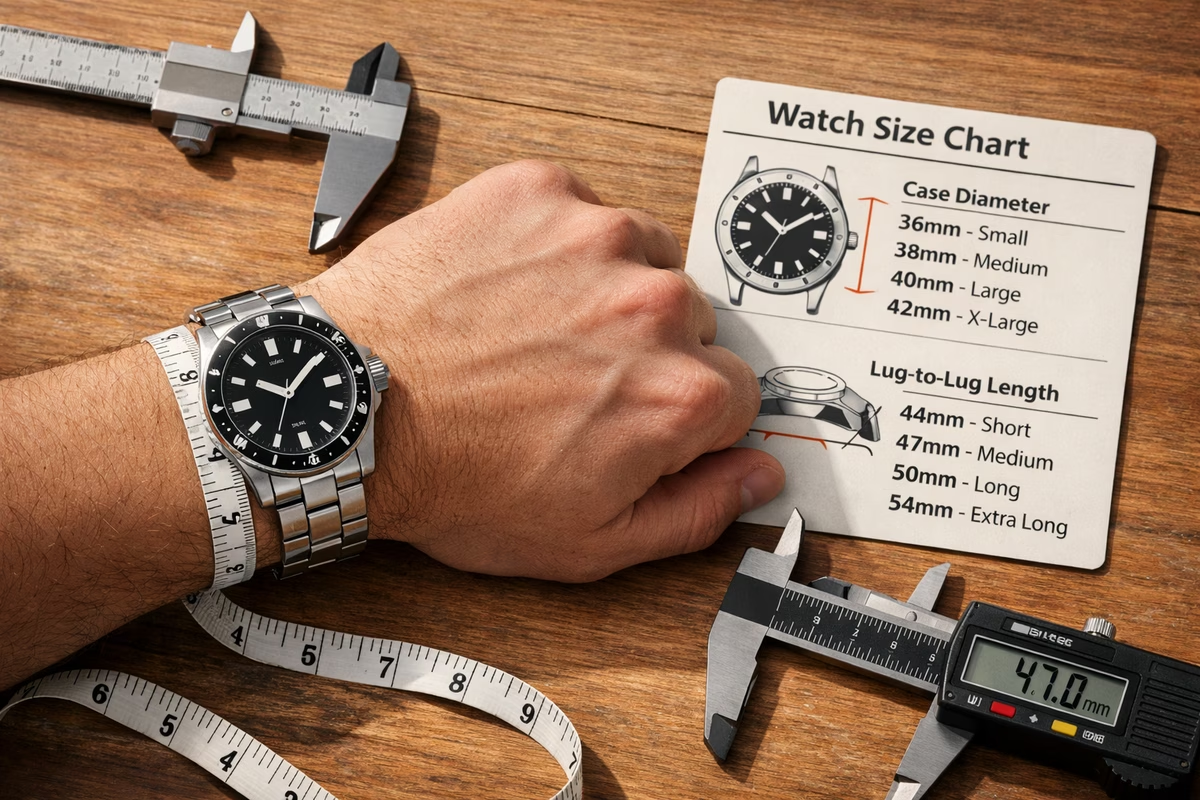
Watch Sizing Guide
Here’s a truth that nobody tells you when you’re starting out in the watch world: the single most common mistake in buying a watch isn’t overpaying, picking the wrong movement, or falling for hype. It’s choosing the wrong size. And it’s heartbreaking, because a great fit is one of those things that, when it’s right, feels almost invisible. The watch stays centered on your wrist, doesn’t pinch, doesn’t slide around like a bangle, and most importantly, doesn’t feel like it’s “announcing itself” from across the room. A bad fit, on the other hand, can turn even the most stunning timepiece into something awkward — a beautiful movement trapped in a case that just doesn’t belong on your wrist.
The good news? Nailing your ideal watch size isn’t rocket science. There’s a small set of measurements that actually predict fit, a quick way to measure your wrist, and a handful of practical checks that prevent the vast majority of sizing regrets. Consider this guide your cheat sheet for getting it right every time.
The Four Sizing Measurements That Matter
Before you get lost in spec sheets full of numbers, let’s zero in on the four measurements that actually determine how a watch looks and feels on your wrist. Everything else is noise.
1. Case Diameter
Case diameter is the one everybody knows — it’s the width of the watch measured across the case from roughly 9 o’clock to 3 o’clock. It’s the number that most listings lead with, the one you’ll see in big bold text on product pages, and it’s genuinely useful. But here’s the thing: it’s also the easiest number to misread, and leaning on it too heavily is how people end up disappointed.
As a rough mental frame, think of it this way. Mid-thirties — say 34 to 36mm — reads as vintage or “modern small,” and there’s a growing appreciation for watches in this range. The 38 to 40mm zone is what many collectors consider the sweet spot, versatile enough for dress and casual wear alike. Step up to 40 to 42mm and you’re in the popular modern sports range, where most dive watches and chronographs live. Push past 42mm and things start to feel large unless the rest of the watch’s proportions are very carefully restrained.
But here’s where it gets tricky: diameter can lie to you. A 42mm round watch often wears noticeably smaller than a 42mm square or cushion-shaped case, because of how those geometries fill visual space. And details like bezel thickness and dial opening can dramatically change the perceived size. A watch with a chunky bezel and a small dial window might feel bigger than one with a thin bezel and an expansive face — even at identical diameters. So yes, pay attention to case diameter, but don’t let it be the whole story.
2. Lug-to-Lug (Most Important!)
If you take only one thing away from this entire guide, let it be this: lug-to-lug distance is the single best predictor of whether a watch will actually fit your wrist. It measures from the tip of the top lug to the tip of the bottom lug — the 12 o’clock to 6 o’clock footprint of the watch head. While diameter tells you how wide the watch is, lug-to-lug tells you how long it is on your wrist, and that’s what truly determines whether you get that balanced, proportional look or the dreaded “dinner plate on a chopstick” effect.
The rule is wonderfully simple: if the lugs overhang your wrist — meaning they extend past the edges when you look from above — the watch is too big for you. Full stop. It doesn’t matter if the diameter sounds perfectly “normal” or if your favorite YouTuber wears the same reference. If those lugs are hanging off into space, it’s not your watch.
For a conservative guideline, smaller wrists (under about 16cm circumference) usually want to stay under the high forties in lug-to-lug. Mid-size wrists in the 16 to 18cm range often do beautifully in the 48 to 52mm zone. And larger wrists above 18cm can comfortably handle 52mm and beyond, depending on case shape and strap choice. But always, always check this number before you buy.
3. Case Thickness
Thickness is the measurement that doesn’t show up well in photos but absolutely shows up in daily life. It’s the height of the case from the caseback to the top of the crystal, and it’s fundamentally a comfort measurement more than a style one. Thickness is what catches on shirt cuffs, makes a watch feel top-heavy on your wrist, and transforms “this looks great on my wrist” into “why am I constantly aware of this thing?”
For dress watches, you’ll generally want to target under 10mm if you plan to slide it under a cuff with any grace. The 10 to 12mm range can still work depending on the case shape and whether your shirts have generous cuffs, but you’ll notice it more. Above that, most watches start to behave and look decidedly casual, no matter how elegant the dial. For sports and dive watches, 12 to 14mm is the common range, and that’s perfectly fine — these are meant to have presence. Push to 14 to 16mm and you’re getting into thick territory, though many wearers adapt just fine. Above 16mm, you should expect a very tall, very noticeable presence on the wrist. That’s not necessarily bad — some people love it — but go in with your eyes open.
4. Lug Width (Strap Size)
Lug width is one of those specs that seems boring until you realize it affects both your day-to-day comfort and your long-term flexibility. It’s simply the distance between the lugs where the strap attaches, and it determines what straps will fit your watch.
Most watches use 18mm, 20mm, or 22mm lug widths, and sticking with these common sizes opens up a massive world of aftermarket straps — leather, rubber, NATO, you name it. Odd sizes like 19mm or 21mm aren’t deal-breakers by any means, but they do limit your options and sometimes force you into brand-specific straps that cost more. A wider strap tends to read sportier; a narrower one feels dressier. It’s a small detail, but if you’re the kind of person who likes swapping straps to change up the vibe, pay attention to this number.
Measure Your Wrist
How to Measure
This part takes about thirty seconds and saves you from a world of regret. Grab a flexible tape measure — the kind you’d use for sewing — and wrap it around your wrist right where you’d actually wear a watch. That’s usually just above the wrist bone, where your wrist naturally narrows a bit. Pull it snug but not tight — you’re measuring, not making a tourniquet — and read the number. Round to the nearest half centimeter.
Don’t have a flexible tape measure? No problem. Use a piece of string or a strip of paper, mark where it overlaps, and measure the length against a ruler. It’s low-tech, it works, and now you have the one number you need to make every sizing decision from here on out.
Wrist Size Categories
Think of wrist size categories as a starting point — a way to narrow the field before you try anything on. They’re not gospel, but they’ll save you from wasting time on watches that are obviously wrong for your frame.
If you’re under about 15cm, you’ll generally find that smaller cases and shorter lug-to-lug lengths look the most proportionate and feel the most comfortable. In the 15 to 16.5cm range, 36 to 40mm case diameters tend to work beautifully, and lug-to-lug becomes the decisive measurement — this is where that number really earns its crown. From 16.5 to 18cm, you can wear a surprisingly wide range of sizes, and the “feel” of the watch — its thickness, the strap or bracelet, the overall weight — starts to matter more than raw dimensions. And above 18cm, many modern sports watches sit comfortably and you can handle larger lug-to-lug measurements without any overhang worries.
The Perfect Fit Checklist
Here’s a fit test you can do in under a minute, and it’ll tell you more than any spec sheet ever could.
Start by checking for lug overhang. Look at the watch from the side — if the lugs extend past the edges of your wrist, it’s too big, period. Next, wear the watch for at least ten minutes. Go about your business — type, reach for something, gesture while talking. If you’re constantly aware of it, if it keeps pulling your attention, something about the size, thickness, or balance is off. Then, if you plan to wear it with dress shirts, make sure it actually slides under a cuff without catching or creating an unsightly bump. Finally, check the strap or bracelet fit: it shouldn’t be tight enough to leave marks on your skin, but it also shouldn’t be loose enough to spin freely around your wrist.
And here’s one last thing that sounds obvious but people constantly ignore: trust your eyes. Stand in front of a mirror and really look at it. If something feels off to you — if the proportions just don’t seem right — that feeling isn’t going to magically go away. It will bug you every single time you wear it.
Common Sizing Mistakes
Mistake #1: Chasing Modern Size Trends
Somewhere in the 2000s and 2010s, the watch industry decided that 40 to 42mm was “standard,” and a whole generation of buyers internalized that as the baseline. But here’s the reality: vintage standards were 34 to 36mm, and those watches wore perfectly on the wrists of an era that cared deeply about elegance and proportion. The pendulum is swinging back, too — the modern trend is clearly moving toward 38 to 40mm again, and plenty of new releases are landing in the 36 to 38mm range. Case shape matters far more than raw diameter, and a well-designed 38mm watch can have more wrist presence than a bloated 42mm one.
The solution? Try on various sizes with an open mind. You might walk in assuming you need a 42mm and walk out in love with a 38mm. It happens all the time.
Mistake #2: Ignoring Lug-to-Lug
This one bites people constantly. Someone sees a watch listed at “only 42mm!” and figures it’ll be fine, not realizing that the case has 52mm of lug-to-lug distance that’s going to completely overhang their 16cm wrist. The case diameter seemed reasonable; the watch doesn’t look reasonable on their arm.
Always, always check the lug-to-lug spec. It’s available for almost every watch if you dig for it, and it is hands-down the most important measurement for predicting fit. This is the hill worth dying on.
Mistake #3: Buying Based on Photos
Instagram and YouTube have a complicated relationship with watch sizing. Camera angles, lens distortion, perspective tricks, and lighting can make a 40mm watch look massive on an 18cm wrist, or make a 44mm piece look perfectly proportioned when it absolutely isn’t. You simply cannot trust photos to tell you how a watch will look on your wrist.
The solution is straightforward: always try a watch in person if you can. If you’re buying online, make sure the retailer has a generous return policy. Treat that first delivery as a fitting, not a commitment.
Mistake #4: “Bigger is Better”
Oversized watch trends — fueled by brands like Invicta, Panerai, and Hublot — convinced a lot of people that 46mm is somehow normal. It isn’t, at least not for most wrists. The sweet spot for the vast majority of people falls somewhere between 38 and 42mm. Oversized watches tend to look awkward and wear uncomfortably once the novelty fades, and while trends come and go, classic proportions remain timeless.
If you’re not sure where to start, begin at 40mm and adjust up or down from there based on how it feels. That one reference point will save you a lot of trial and error.
Mistake #5: Ignoring Case Shape
A 42mm round case, a 42mm square case, and a 42mm cushion case are three very different animals on the wrist. Square and cushion cases fill more visual space than round ones, which means they wear larger than their stated diameter suggests. Integrated bracelets add visual width too, and bezel thickness can shift the perceived diameter significantly.
The takeaway is simple: try the actual watch, not just the spec sheet. Numbers tell part of the story, but your eyes and wrist tell the rest.
Case Shapes & How They Wear
Understanding case shapes is like learning a secret language of watch sizing — once you speak it, you’ll never be fooled by dimensions alone.
Round (Most Common)
Round cases are the default for a reason: they wear true to size, meaning a 40mm round watch feels like a 40mm watch. No surprises, no mental math. Think of icons like the Rolex Submariner or the Omega Speedmaster. If you’re just starting out, round cases are the safest bet because what you see on the spec sheet is essentially what you get on the wrist. Their universal appeal makes them a great canvas for every style from dressy to sporty.
Cushion (Rounded Square)
Cushion cases — that appealing rounded-square shape you see on watches like the Panerai Luminor and the Tudor Black Bay — tend to wear about 2mm larger than their stated diameter. So a 42mm cushion case is going to feel more like a 44mm round. They have a bold, statement-making presence that works beautifully on larger wrists, but can overwhelm smaller ones. Factor in that extra visual heft when you’re comparing specs.
Square
True square cases push this effect even further, typically wearing 3 to 4mm larger than stated. The Cartier Tank and the TAG Heuer Monaco are the poster children here. These designs are beloved by people who appreciate geometry and design-forward aesthetics, and they tend to shine in dressier contexts. Just be prepared for the size surprise — a 33mm Tank wears closer to a 36 or 37mm round.
Tonneau (Barrel)
Tonneau-shaped watches are the pleasant exception: their tapered, barrel-like curves actually cause them to wear smaller than their stated dimensions. Watches like the Cartier Tortue and various Franck Muller references have this flattering quality that makes them sit elegantly on the wrist. They’re perfect for people who love unique shapes but don’t want an oversized look. If you’re drawn to distinctive design but have a smaller wrist, the tonneau is your friend.
Bracelet vs. Strap: Sizing Differences
Bracelet Sizing
Getting a bracelet right is both an art and a science. The goal is snug but not tight — you want minimal rotation, with the watch staying more or less in position throughout the day without cutting off circulation.
A well-sized bracelet should slide about 1 to 2cm up and down your wrist, but it shouldn’t spin completely around. Keep in mind that your wrist swells and contracts throughout the day and with temperature changes — you might find the bracelet feels tighter in the heat and looser in cold air, which is perfectly normal.
To get the fit dialed in, you can take the watch to a watchmaker who’ll remove links for about $20 to $50, or you can do it yourself with a bracelet sizing tool that costs $15 to $30 and is genuinely easy to use. One important tip: when removing links, take them evenly from both sides of the clasp. This keeps the clasp centered on the underside of your wrist, which looks better and distributes wear more evenly.
Most modern bracelets also come with micro-adjustment holes at the clasp, giving you 5 to 8mm of on-the-fly fine-tuning. Use this feature throughout the day as your wrist naturally swells and shrinks — it’s one of the best quality-of-life features in modern bracelet design.
Leather/Rubber Strap Sizing
Straps are generally more forgiving than bracelets when it comes to sizing. Multiple punch holes allow for more precise adjustment, and swapping to a different hole takes about two seconds. It’s one reason many new collectors find strap watches less intimidating.
When it comes to strap length, you’ll typically see three categories. Short straps (under 110mm on the long side) are designed for smaller wrists and are sometimes marketed for women’s watches. Regular straps in the 115 to 125mm range fit the majority of wrists. And long straps at 125mm and above are intended for larger wrists or for wearing over clothing.
Comfort-wise, leather straps have the lovely quality of conforming to the shape of your wrist over time — a new leather strap might feel a bit stiff for the first week, but it’ll break in and eventually feel like it was molded just for you. Rubber straps, by contrast, offer more consistent sizing from day one — they don’t stretch or conform much, which some people actually prefer for the predictability.
Special Considerations
Wearing Watch Over Clothing (Pilot Style)
If you’ve ever seen old photos of pilots with their watches strapped over their flight suits, you know this is a real thing — and it requires a meaningfully longer strap, typically 20 to 30mm longer than standard. This often means custom ordering, since most watches don’t ship with straps long enough for over-clothing wear. The practice is most common with pilot watches worn over flight suits, dive watches worn over wetsuits, and field watches worn over jacket sleeves. If this is your intended use case, factor strap length into your planning from the start.
Women’s Watches on Men’s Wrists
Here’s something the watch industry doesn’t talk about enough: many watches marketed as “women’s” sizes — in the 32 to 36mm range — are genuinely perfect for men with smaller wrists. Gendered marketing in watches is largely a relic of convention, and some of the most iconic references in history straddle that arbitrary line. The Cartier Tank at 33mm? Unisex classic, worn by everyone from Jackie Kennedy to Andy Warhol. The Rolex Datejust at 36mm? Men wore that for decades before the trend toward bigger watches took hold. The Omega Aqua Terra at 38mm? Perfect proportions that flatter virtually any wrist.
The bottom line: ignore the labels and wear what fits. Your wrist doesn’t know — or care — what section of the store the watch came from.
Vintage Sizing
If you’re exploring the vintage market, you’ll quickly discover that the standard in the 1950s through the 1970s was 34 to 36mm. By today’s inflated standards, that might sound tiny, but do yourself a favor: try one on before you dismiss it. These sizes work beautifully in the modern era, often looking better-proportioned than their oversized contemporary counterparts. Dress watches in particular benefit from vintage dimensions — thin, elegant, and refined in a way that a 42mm dress watch simply can’t replicate. Some of the most sophisticated wrists in the world are wearing 34 to 36mm vintage pieces right now. Don’t dismiss them based on modern standards that are already shifting back in their favor.
How to Size When Buying Online
Before Buying
Buying online without trying a watch on first is a leap of faith, but you can make it a very calculated one. Start by measuring your wrist circumference if you haven’t already. Then check all the specs, not just diameter — you need case diameter, lug-to-lug (this is critical!), thickness, and lug width. Next, compare those numbers to a watch you already own and like the fit of. Measure your current watch with a ruler or calipers, think about how it fits, and figure out whether the new watch will be bigger or smaller in the dimensions that matter.
Finally, do your homework on photos. Watch forums are goldmines for “wrist shots” where collectors include their wrist measurements, so you can see how a specific reference looks on a wrist similar to yours. Instagram can help too — search for the watch model plus “wrist” and you’ll find real-world examples that are far more useful than staged product photography.
Red Flags (Might Be Too Big)
When you’re shopping online without the benefit of a try-on, there are a few combinations that should raise a yellow flag. If the lug-to-lug exceeds 50mm and your wrist is under 17cm, you’re likely heading into overhang territory. If the thickness exceeds 14mm and you plan to wear the watch with suits, expect cuff problems. And if the diameter pushes past 42mm while your wrist is under 17cm, the overall proportions are likely going to feel off. None of these are absolute deal-breakers — case shape and design can shift things — but they should make you pause and think twice, or at least ensure you’re buying from somewhere with easy returns.
Sizing by Watch Category
Dress Watches
Dress watches play by slightly different rules than the rest of the watch world. The ideal dress watch lands somewhere between 36 and 40mm in diameter with a thickness under 10mm, and a lug-to-lug under 48mm works for most wrists. The logic is simple: a dress watch needs to fit under a cuff with grace, and elegant proportions are the entire point. Think of the Jaeger-LeCoultre Master Ultra Thin at 39mm and a mere 7mm thick — that’s about as perfect as dress watch sizing gets. The Nomos Tangente in the 35 to 38mm range is another ideal example, as is the Cartier Tank, which spans 31 to 41mm depending on the model. Slim, refined, and never fighting for attention.
Dive Watches
Dive watches are meant to have presence — they’re robust, purposeful tools with a casual personality. The sweet spot for most wrists is 40 to 42mm in diameter, 12 to 14mm thick, with a lug-to-lug around 48 to 50mm. The Rolex Submariner at 41mm by 12.5mm is the textbook example. If you want something a touch smaller, the Tudor Black Bay 58 at 39mm is a fantastic alternative that wears like a dream on smaller wrists. And the Omega Seamaster at 42mm by 13.5mm sits right at the top of the comfortable range for most people.
Pilot Watches
Pilot watches have historically been on the larger side — legibility was paramount when you were reading instruments in a cockpit — but modern interpretations have reined things in. The ideal range is about 40 to 44mm in diameter, 11 to 14mm thick, with lug-to-lug in the 48 to 52mm zone. The IWC Pilot Mark XX at 40mm represents the refined end of the spectrum, while the Breitling Navitimer at 43mm goes bigger with its iconic slide rule bezel. The Hamilton Khaki line, spanning 38 to 42mm, offers terrific versatility across wrist sizes.
Chronographs
Chronographs are inherently a bit bulkier than their time-only counterparts — those pushers and sub-dials add physical and visual mass. Plan for 40 to 42mm in diameter, 13 to 15mm thick, and about 48 to 50mm lug-to-lug. The Omega Speedmaster at 42mm by 13.2mm is widely considered the gold standard of chronograph sizing — present but not overwhelming. The Rolex Daytona at 40mm by 12.5mm is even more restrained and disappears on the wrist beautifully. And the Zenith El Primero, available in 38 to 42mm, gives you the full range to find your sweet spot.
Try Before You Buy
Nothing replaces the experience of a watch on your actual wrist. Authorized dealers are the most obvious option — you can try on multiple sizes with no pressure to buy immediately, get expert fitting advice, and see an inventory of various references side by side. Don’t be shy about walking in, trying on six watches, and walking out empty-handed. Good ADs expect and welcome that.
Watch meetups and groups like RedBar are another fantastic resource. These community gatherings let you try watches from other collectors’ personal collections, see how different sizes wear in person, and network with people who’ve already made every sizing mistake in the book. They’re free, social, and genuinely educational.
And don’t underestimate the simplest option of all: ask your friends. If someone in your life wears watches, ask to try theirs on. Compare sizes side by side, get honest opinions about fit, and use their collection as a free sizing laboratory.
The “Too Big” Test
Let’s get honest. Your watch is too big if the lugs overhang the edges of your wrist when viewed from the side. It’s too big if you’re constantly noticing it — feeling its weight, catching it on things, adjusting it. It’s too big if it spins freely around your wrist like a loose bracelet. It’s too big if you find yourself making excuses like “I’ll get used to it” (you won’t). It’s too big if other people comment “wow, that’s huge!” — they’re not complimenting you. It’s too big if it won’t fit under a dress shirt cuff when that’s how you intend to wear it. And it’s too big if it looks disproportionate in photos, because the camera doesn’t lie even when the mirror is kind.
If three or more of those ring true, size down. Seriously. The right watch in the wrong size isn’t the right watch.
The “Too Small” Test
On the flip side, your watch might be too small if it looks lost on your wrist with no visual presence at all. It’s potentially too small if you feel self-conscious wearing it, or if the dial is so compact you struggle to read it at a glance. And it’s probably too small if you find yourself constantly wishing it were bigger — that nagging feeling isn’t going to fade.
If three or more of those resonate, consider sizing up. There’s a sweet spot between “too small” and “too big,” and finding it is what this whole guide is about.
Embrace Your Ideal Size
Here’s where we get philosophical for a moment, because this might be the most important section in the entire guide.
Your ideal watch size is deeply personal, and no forum consensus, influencer recommendation, or brand marketing campaign should override what your own eyes and wrist are telling you. If 38mm feels perfect to you even though every YouTube reviewer insists you need 42mm, buy the 38mm. Your wrist, your call.
Remember that lug-to-lug is king — prioritize it over diameter every single time. Remember that comfort beats specs — if 40mm feels right and 42mm doesn’t, the choice is obvious regardless of what the numbers say. Remember that proportions matter more than raw measurements — a well-proportioned 38mm watch will always look better than a poorly proportioned 42mm one. And don’t forget that vintage sizes absolutely work today. A 34 to 36mm dress watch looks elegant, refined, and confident in a way that no oversized modern piece can match. Don’t dismiss them based on standards that are already shifting.
Final Sizing Wisdom
The best-sized watch is the one you forget you’re wearing — until you glance down and smile. It looks proportional in photos without needing a strategic camera angle. It fits your lifestyle, sliding under cuffs when needed and standing up to your daily activities without complaint. And most of all, it makes you happy every single time you check the time.
When in doubt, size down. It’s almost always easier to appreciate a watch that’s slightly smaller than you expected than to adapt to one that’s too large. Try in person whenever possible, and when that’s not possible, buy from retailers with generous return policies. Trust your gut — if something feels off when you first put it on, that feeling has a nasty habit of never going away.
And here’s one last thought to carry with you: a $300 watch in the right size will bring you more joy than a $3,000 watch that doesn’t fit. Size is everything. Get it right, and the rest of the hobby falls into place.
Next Steps
- Watch Care - Proper bracelet fit prevents wear
- Watch Brands - Popular models and their sizes
- Collection Strategy - Diversify sizes in your collection