Quartz watches are often treated as the sensible side of watch ownership, which is true but incomplete. They are sensible because they keep excellent time, ask for little day-to-day attention, and can sit in a drawer for weeks without turning into a setting ritual. But they are not merely the budget alternative to mechanical watches. A good quartz watch has its own character: the quiet confidence of a watch that is ready when you are, the pleasure of accuracy that does not need apology, and a kind of design freedom that comes from a movement that can be thin, durable, and efficient.
That can be hard to appreciate if your first watch education came through mechanical romance. Mechanical watches have visible gears, service traditions, and a language of craft that is easy to admire. Quartz watches work differently. Their beauty is less theatrical. The movement is usually hidden behind a caseback, and the most impressive part of the experience is that nothing dramatic happens. The watch is simply right, or close enough to right that you stop thinking about it. For many owners, that is not a compromise. It is the whole point.
Quartz is a different ownership rhythm
A mechanical watch asks for a relationship built around energy. You wind it, wear it, set it, and eventually service the oils, pivots, seals, and regulation that keep the movement healthy. A quartz watch asks for a relationship built around readiness. The oscillator is a tiny quartz crystal that vibrates at a highly stable frequency when powered by electricity. A circuit counts those vibrations and tells the motor when to move the hands or refresh the display. The result is timekeeping that is usually far more accurate than an ordinary mechanical movement.
That difference changes daily use. If you own several watches, a mechanical piece may need to be wound and set when it comes out of the box. A quartz piece usually comes out running. If you travel, a quartz watch can be reset quickly without worrying about reserve. If you need one watch for mornings when you are late, tired, or distracted, quartz has a calm advantage. It removes friction from ownership.
This does not make quartz better in every emotional sense. It makes it better at a specific job. The broader Watch Movements guide explains the family tree of manual, automatic, quartz, and hybrid systems. The useful addition here is that movement choice is not only technical. It decides how the watch fits into your life. Quartz is the choice for people who value precision, low ritual, and a watch that can disappear into a routine.
The battery is maintenance, not a flaw
The most familiar quartz watch uses a small battery. When that battery is healthy, the watch runs quietly for years. When it weakens, some watches give a warning by making the seconds hand jump in larger intervals, while others simply stop. A dead battery is not usually a crisis, but it should not be ignored for a long time. Old batteries can sometimes leak and damage the movement, especially if the watch is left forgotten in a drawer for years.
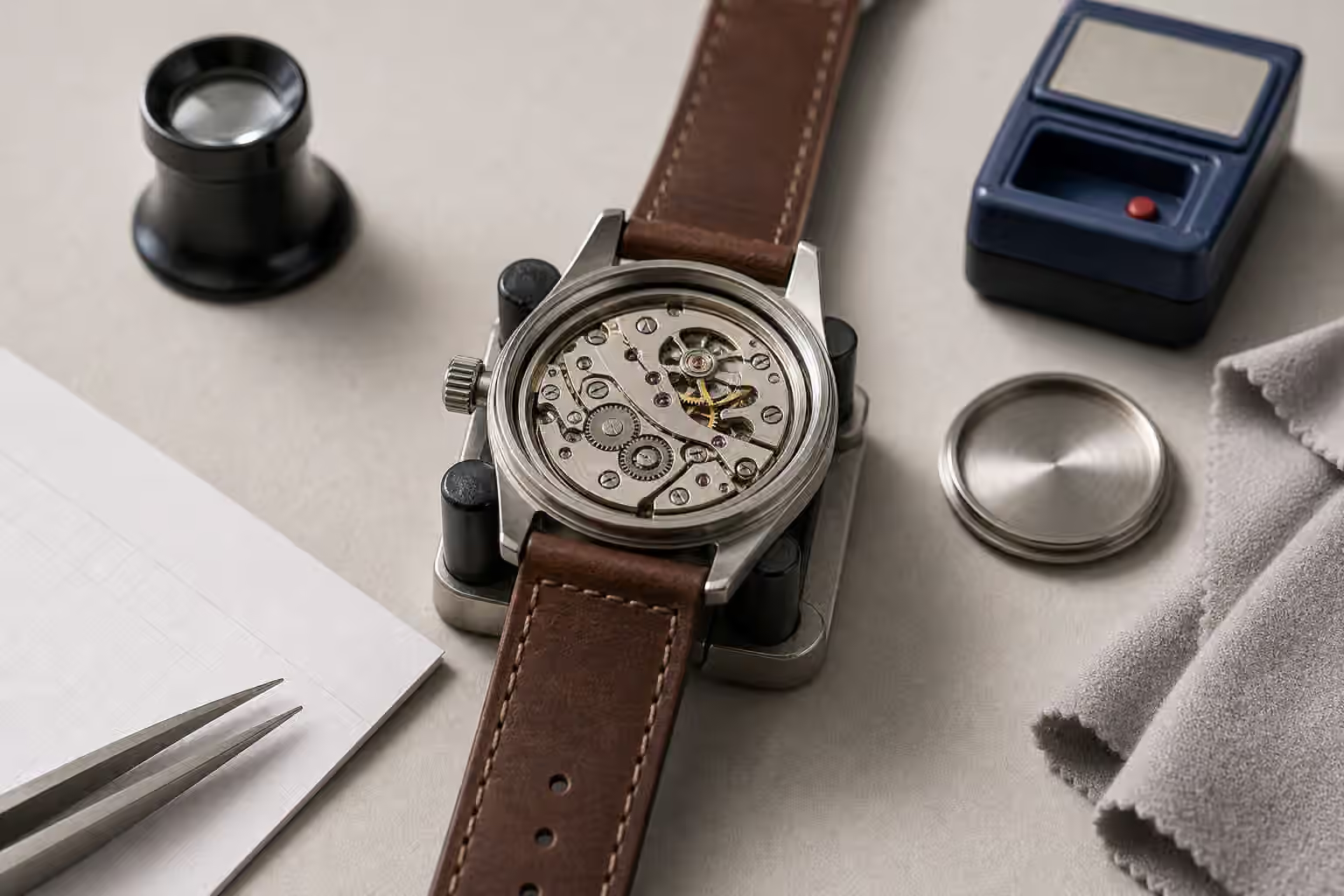
Battery changes are simple in concept and worth doing carefully in practice. The caseback has to be opened, the old cell removed, the new cell fitted correctly, and the case closed without pinching or damaging the gasket. On a cheap watch with no water ambitions, this may be a low-stress job. On a watch you care about, a watch with a screw-down crown, or anything you plan to wear around water, the battery change is also a sealing event. The gasket condition matters. The caseback fit matters. A pressure test may matter.
That is why battery service belongs beside Watch Care Guide rather than in a mental folder labeled “electronics.” A quartz watch has a case, crown, crystal, gasket, strap, and bracelet just like any other watch. The battery is only one consumable part. Treating the whole watch respectfully during a battery change protects the features that made you choose it in the first place.
There is also no shame in letting a professional handle it. Many casebacks are easy to mark with the wrong tool. Some snapbacks need controlled pressure. Some screwbacks require a proper opener. A battery replacement that scratches the case, bends a contact, or compromises a gasket is not a bargain. The job is small, but the watch is still a sealed object.
Solar quartz changes the calendar
Solar and light-powered quartz watches solve the battery habit in a different way. They still use quartz regulation, but the movement stores energy gathered from light. Instead of planning ordinary battery changes every few years, the owner keeps the watch exposed to enough light for the rechargeable cell to stay healthy. The appeal is obvious: the watch remains accurate and ready, while the maintenance cycle becomes less visible.
The word “solar” can make the system sound more delicate than it is. These watches do not need constant sunbathing. Ordinary daylight is often enough when the watch is worn regularly. The problem appears when a light-powered watch spends months in a dark drawer. It may run down, enter a power-save mode, or stop. Bringing it back usually means giving it sustained light, not a quick flash under a lamp. The owner habit is simple: do not hide a solar watch from the thing that powers it.
Solar watches are especially good for practical daily roles. They make sense for travel, field use, office wear, and any situation where you want the watch to be boring in the best way. If the design is analog, it can still feel like a traditional watch. If it has radio-controlled, satellite, or connected time-setting features, it may become even more independent. Those features vary by model and region, so the evergreen lesson is not to chase every function. Choose the level of automation that actually helps you.
The best solar quartz watches feel less like gadgets than like mature tools. They remind you that convenience can be a form of design quality. A watch that avoids dead batteries, avoids constant resetting, and keeps good time is not being lazy. It is doing its work with very little drama.
High-accuracy quartz is a serious watchmaking lane
Ordinary quartz is already accurate enough for most lives. High-accuracy quartz takes the idea further by managing temperature effects, improving regulation, and building the movement to tighter expectations. Quartz crystals are stable, but temperature can still influence timing. More sophisticated movements account for that instability through thermocompensation or other correction methods. The result can be accuracy measured across a year in terms that make ordinary mechanical tolerances look poetic rather than practical.
This is where quartz becomes interesting to collectors who normally prefer mechanical watches. A high-accuracy quartz movement is not impressive because it imitates a balance wheel. It is impressive because it commits to a different ideal. The goal is not visible motion or traditional service romance. The goal is precision, autonomy, and a movement built around the strengths of electricity rather than springs.
Accuracy also changes your relationship with other watches. If you keep one very accurate quartz piece in the collection, it can become the reference watch for setting the rest. It can be the travel watch, the work watch, or the watch you wear when punctuality matters more than ceremony. The Watch Accuracy and Regulation guide explains why mechanical timekeeping changes with position, magnetism, shock, and service condition. Quartz reduces many of those variables, which is why its owner experience feels so steady.
Still, accuracy should not become a purity contest. A watch can be accurate and unpleasant to wear. It can be precise and badly proportioned. It can have a strong movement and a weak clasp. The best quartz watch is not the one with the most impressive spec line. It is the one whose accuracy supports a watch you actually enjoy wearing.
The seconds hand tells a small story
The most visible symbol of quartz is the ticking seconds hand. Some owners dislike it because it lacks the smooth sweep associated with mechanical watches. Others find it honest. A one-second step is a visual statement of the movement’s logic: count, pulse, move. It is efficient and direct.
Not all quartz seconds hands feel the same. On a well-made analog quartz watch, the hand should land cleanly and consistently on its markers, or at least close enough that the eye is not constantly bothered. Misalignment can happen for many reasons, including hand placement, dial printing tolerances, viewing angle, and backlash in the gear train. Some designs hide the issue with smaller seconds subdials, darker minute tracks, or no seconds hand at all. Others make each tick part of the personality.
There are also quartz movements that sweep, glide, or move in smaller increments, along with hybrid systems that blur the visual boundary between quartz precision and mechanical feel. Those designs can be wonderful, but they are not required for quartz to be legitimate. A ticking hand is not a confession of cheapness. It is simply one way a watch expresses its engine.
Legibility matters here too. A quartz field watch with bold hands and clear markers may be more useful than a mechanical watch with a romantic but fussy dial. If you care about quick reading at a glance, the ideas in The Dial That Told a Story apply just as strongly to quartz as to any other movement. The power source does not read the time for you. The dial still has to do that work.
Water resistance still ages
Quartz convenience can create false confidence. Because the movement needs so little attention, owners sometimes forget that the case is aging. Gaskets dry, crowns wear, casebacks are opened for battery changes, and seals are disturbed. A quartz dive watch may be a capable water watch, but only if the sealed system is maintained. A quartz dress watch with modest resistance is still a dress watch.
This is especially important after battery service. If a watch was rated for swimming when new, then opened years later on a mall counter with no pressure test, the printed rating has not magically refreshed itself. The watch may still be fine for daily splashes, or it may not. The only honest answer comes from condition, gasket care, and appropriate testing. Watch Water Resistance in Everyday Life covers that logic in detail, and quartz owners should take it seriously because battery access is a common point where seals are handled.
The practical habit is to match the watch to the day. Wear the solar or battery-powered diver when water is part of the plan and the watch has been maintained for that role. Wear the slim quartz dress watch for dry, controlled settings. Rinse salt and grit from watches designed for water. Keep leather straps away from soaking. Quartz makes the movement easy, not the whole object invincible.
Vintage quartz deserves more respect than it gets
Early and older quartz watches can be fascinating because they come from an era when electronic timekeeping still felt new. Some have distinctive case shapes, thin profiles, unusual displays, or design choices that would be expensive to reproduce now. They can also be risky in ways that differ from vintage mechanical watches. Parts availability may be limited. Circuit boards can fail. Displays can fade. A watchmaker who can service a mechanical movement may not be able to source or repair a specific obsolete quartz module.
That does not mean vintage quartz should be avoided. It means the buying question changes. With a mechanical watch, you may ask about movement condition, parts availability, originality, and service history. With a quartz watch, you still ask those things, but you also care about battery leakage, module health, correct function of setting modes, display segments if digital, and whether replacement parts exist if something electronic fails.
The Buying Guide gives the broader seller and condition framework. For vintage quartz, apply that caution with extra attention to proof of function. A watch described only as “needs battery” may be a simple fix, or it may be a seller avoiding the phrase “does not run.” A working watch with a clean battery compartment is a very different proposition from a non-running one with unknown history.
Choose quartz for what it does well
Quartz is at its best when you stop asking it to justify itself in mechanical terms. It is not a lesser automatic. It is a different answer to the same old problem: how to carry reliable time on the wrist. It can be inexpensive or luxurious, disposable or repairable, plain or beautifully finished, battery-powered or solar, simple or technically ambitious. The movement type does not decide the whole watch. It decides the rhythm of ownership.
For a first watch, quartz can remove anxiety. You learn size, comfort, style, straps, and daily habits without also learning winding, positional variation, and service timing. For an experienced collector, quartz can bring balance to a box full of mechanical pieces. It can be the watch that is always ready, always close, and rarely needy. For someone who simply wants one dependable object, quartz may be the most honest answer.
The healthiest way to choose is practical. Look for a case that fits, a dial you can read, a strap or bracelet that works on your wrist, and a movement whose maintenance rhythm suits your patience. If battery changes annoy you, consider solar. If yearly precision delights you, explore high-accuracy quartz. If you love thin dress watches, quartz may give you proportions that are harder to achieve mechanically at the same cost. If you need a watch that can sit untouched and then work immediately, quartz belongs near the top of the list.
A quartz watch does not need to be defended with an essay every time someone mentions sweeping seconds hands. Wear it because it works, because it fits, because it keeps time cleanly, and because life sometimes rewards objects that ask very little while doing their job well.