The auction closed at 11:47 p.m. on a Tuesday.
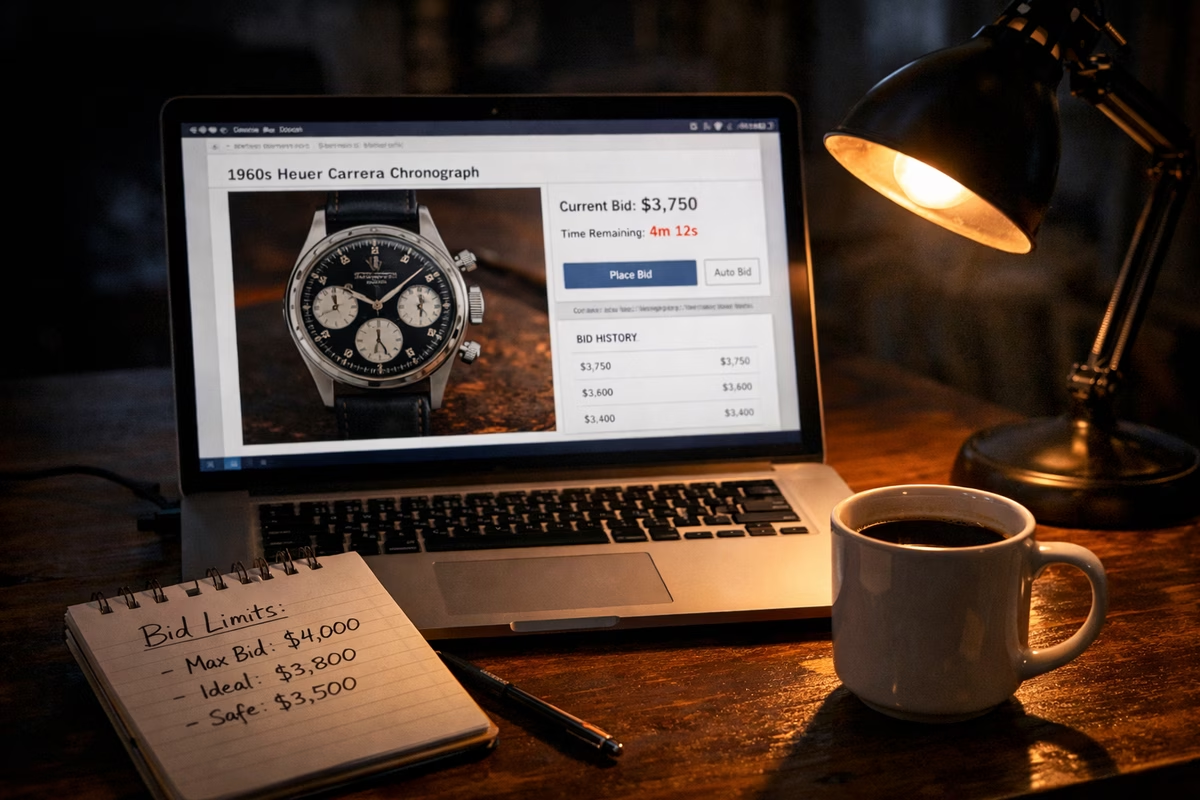
I was sitting at my desk with a cup of coffee that had gone cold an hour ago, a browser tab open to the lot page, and a number written on a sticky note: $2,800. That was my ceiling. My absolute, non-negotiable, do-not-exceed number—arrived at through a week of research, three days of deliberation, and one honest conversation with myself about how much a forty-year-old watch was worth to me.
The current bid was $2,100. There were three minutes left. Two other bidders were active.
At $2,300, one of them dropped out.
At $2,500, the remaining bidder paused. Fifteen seconds. Twenty. Thirty. I thought they were done.
At forty-five seconds, they bid $2,600.
I bid $2,700.
They bid $2,750.
Ninety seconds left. The sticky note said $2,800. I had exactly one bid left.
Why auctions exist in the watch world
Most watches are bought new from authorized dealers or secondhand from trusted resellers. Auctions occupy a different space—they’re where rare, discontinued, vintage, and unusual watches change hands, often with incomplete information and unpredictable pricing.
Auctions matter for several reasons:
They surface watches you can’t find elsewhere. Certain vintage models—specific reference numbers, specific dial configurations, specific years of production—appear at auction and nowhere else. If you’re looking for a 1970s Omega Speedmaster with a tropical brown dial, you won’t find it at your local watch dealer. You’ll find it at auction, mixed in among hundreds of other lots, listed with a two-paragraph description and four photos.
They establish market value. Auction results are public records. The price a watch achieves at auction becomes a data point that influences secondhand pricing across the market. Collectors, dealers, and insurers all reference auction results.
They carry risk. Auction watches are typically sold “as is.” Descriptions vary in accuracy. Condition assessments are subjective. Service history may be unknown. You’re bidding on a watch based on photos, a description, and your own ability to evaluate what you’re seeing.
That risk is part of what makes auctions exciting—and part of what makes preparation essential.
The watch: what caught my eye
Three weeks before the auction, I was browsing upcoming lots on an online auction platform—something I did most evenings with the same compulsive, low-stakes energy of scrolling social media.
Lot 247 was a 1982 Seiko 6138-0040 “Bullhead” chronograph.
The Bullhead is named for its unusual case design: the chronograph pushers are on top of the case (at 12 o’clock) rather than on the side, giving it a profile that looks like the horns of a bull. It’s a bold, idiosyncratic design from an era when Seiko was making some of the most interesting chronographs in the world—competing directly with Swiss brands at a fraction of the price.
This particular example had an original blue dial that had aged to a faded denim color—what collectors call a “tropical” dial, caused by UV exposure over decades. The aging was even and attractive. The hands were original. The case showed wear consistent with forty years of use but no serious damage.
The auction estimate was $1,500–$2,500.
I looked at the four photos for approximately ten minutes. Then I started researching.
The research: becoming an expert on one watch
The reference
Every vintage watch exists in a web of reference numbers, production years, dial variants, and known issues. For the 6138-0040, I learned:
- Produced from approximately 1970 to 1979 (my example from 1982 was late in the production run, possibly a regional variant)
- The 6138 movement was Seiko’s first automatic chronograph—a landmark in horological history
- Blue dials were less common than black dials
- The column wheel chronograph mechanism is regarded as the “proper” way to build a chronograph (most modern chronographs use a cheaper cam system)
For more on what makes movements special, see Watch Movements Explained.
The condition assessment
From the photos, I evaluated:
- Dial: Faded evenly. No water spots. Lume plots intact. Printing legible. This was aging, not damage.
- Hands: Original (matching style, correct lume color for the era). Not replacements.
- Case: Scratches consistent with regular wear. No deep gouges. The crown and pushers appeared original.
- Crystal: The original Hardlex mineral crystal, with light scratches (replaceable for $15).
- Movement: The listing said “running” but didn’t mention service history. This is a yellow flag—an un-serviced 40-year-old movement might need $200–$400 in work.
Establishing value
I looked at recent auction results and resale listings for comparable 6138-0040s:
- Average condition examples: $1,200–$1,800
- Good condition with original parts: $2,000–$2,800
- Exceptional condition or rare variants: $3,000+
My example fell in the “good condition, original” range. I set my ceiling at $2,800—the top of the comparable range, with room for the servicing cost.
The bid: psychology under pressure
I registered for the auction, verified my payment method, and waited.
The bidding opened at $800 and climbed steadily over the final day. By evening, it was at $1,600. I placed my first bid at $1,800—not to win, but to establish myself as a bidder and signal serious intent.
The next hour was a slow dance. Bids came in increments of $50–$100. The price passed $2,000. Then $2,200. Two other bidders were active; a third had dropped out at $1,900.
What happens to your brain during an auction
Auction psychology is well-studied, and the effects are real:
The endowment effect. Once you’ve bid on something, your brain begins treating it as something you already own. Losing feels like having something taken away, which is psychologically more painful than not getting something you never had. This is why people overbid—they’re paying to avoid loss, not to acquire value.
Competitive arousal. Bidding against another person triggers competitive instincts. The watch becomes secondary; winning becomes primary. You stop asking “Is this watch worth $2,800?” and start asking “Can I beat this person?”
The sunk cost fallacy. “I’ve already invested time researching this. I’ve been watching this auction for a week. I can’t walk away now.” Yes, you can. The time you’ve already spent is gone regardless of whether you win.
Anchoring. The auction estimate ($1,500–$2,500) frames your expectations. If the bidding passes the high estimate, it feels like “overpaying”—even if the actual market value is higher.
Knowing these effects doesn’t make you immune to them. But it helps you recognize when your bidding decisions are being driven by emotion rather than valuation.
The final minutes
At 11:44 p.m., the bid stood at $2,600. Three minutes to go.
I bid $2,700. The other bidder responded immediately: $2,750.
My sticky note said $2,800. I had $50 of room.
I bid $2,800.
Thirty seconds. Twenty. Ten.
The countdown expired. No new bids.
Lot 247: Sold. $2,800.
I sat at the desk, heart rate elevated, coffee still cold, and felt two things simultaneously: the thrill of winning and the immediate, nagging question—Did I pay too much?
After the hammer: what happens when you win
The arrival
The watch arrived in a padded box ten days later. I opened it at the kitchen table with clean hands and a loupe.
The first thing I noticed was how present it was. Photos flatten watches. In person, the Bullhead had weight, depth, and a physical character that the auction photos hadn’t conveyed. The case was chunky and unapologetically 1970s. The blue dial was more beautiful in person—the faded denim tone was even, with a warmth that photographs hadn’t captured.
The chronograph pushers on top of the case felt strange at first—like the watch was upside down. But within an hour of wearing it, the ergonomics made sense: the pushers fell naturally under my thumb, and operating the chronograph while the watch was on my wrist was more intuitive than reaching for side-mounted pushers.
The service
I took it to my watchmaker, who opened the caseback, examined the movement, and said: “It’s running, but it needs service. The chronograph clutch is sluggish and the main spring is tired.”
Service cost $350. He cleaned, oiled, and adjusted the movement; replaced worn gaskets; and returned the watch running within 10 seconds per day—good performance for a 40-year-old automatic.
Total cost: $2,800 (hammer) + $280 (buyer’s premium) + $350 (service) = $3,430.
Was it worth it? By market comparables, I’d paid about $500 above the middle of the range—a premium, but not an unreasonable one for a well-preserved example with an appealing dial.
More importantly: every time I wore it, I felt something that a retail purchase doesn’t provide. This watch had a history I didn’t fully know—forty years on someone’s wrist, in someone’s drawer, at some point forgotten and then rediscovered. Buying it at auction felt less like purchasing and more like inheriting a small mystery.
What auctions teach you about value
Price and value are different things. The $2,800 I paid was a price. The value—the satisfaction of wearing it, the history it carries, the conversations it starts, the particular shade of faded blue that catches afternoon light—is something that exists outside the number.
Research is the real advantage. In an auction, everyone has access to the same photos and description. The advantage belongs to the bidder who has done the deepest research: who knows the reference, recognizes original vs. replacement parts, understands condition grades, and has a realistic valuation based on market data. Knowledge is the moat.
Losing is useful. I’ve lost more auctions than I’ve won. Each loss taught me something—usually that my valuation was right and the winner overpaid, but sometimes that I’d underestimated the market and needed to recalibrate.
The story matters. A watch that arrives in a box from a store is a product. A watch that arrives after a three-week pursuit—research, evaluation, bidding, winning, waiting—is an experience. The pursuit adds a layer of meaning that the watch carries with it.
For more on building a collection with intention, see Watch Collection Strategy and The Secondhand Watch Hunt.
A practical auction guide
If you’re considering bidding on a watch:
Start by watching. Follow several auctions without bidding. Observe how pricing develops, when bidding intensifies, and how final prices compare to estimates.
Research the specific reference. Know the model, the production years, the common variants, and the known issues before you bid.
Evaluate condition from photos. Look for original parts (dial, hands, crown, crystal, caseback). Check for damage vs. aging. If the photos are insufficient, ask the auction house for additional images.
Set your ceiling in advance. Write it down. Commit to it. Walk away if the bidding exceeds it.
Account for total cost. Hammer price + buyer’s premium (usually 15–25%) + shipping + service. The sticker price is not the total price.
Be patient. The right watch will come up again. If you miss this one, another will appear. Urgency is the enemy of good decisions.
Next steps
- Read Watch Collection Strategy for building a collection with purpose
- Explore The Secondhand Watch Hunt for another acquisition narrative
- See Watch Care and Maintenance for keeping your auction find in good shape
- Try Watch Movements Explained for understanding what’s inside the watch you won
- Check Watch History for the centuries of innovation behind every vintage piece