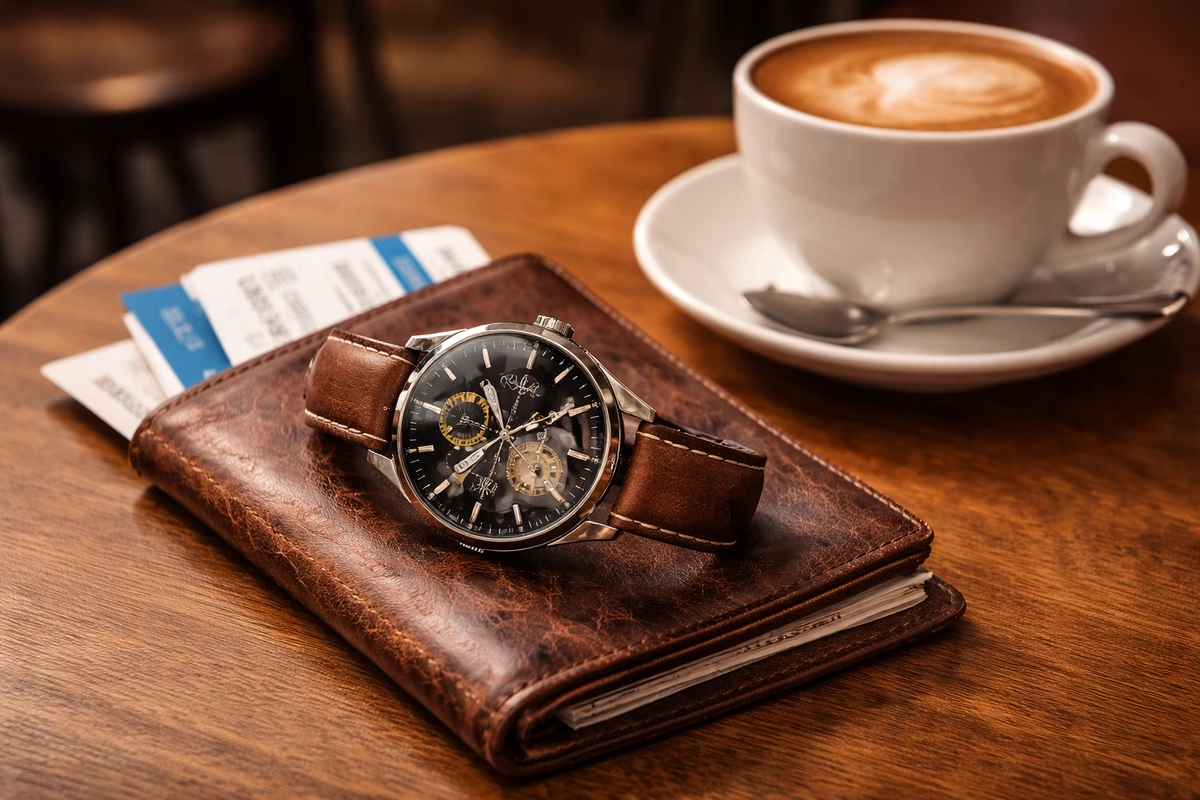
The first time I truly needed a second time zone wasn’t dramatic. I was sitting in a hotel room in Tokyo at 7 a.m., doing the math on my fingers—*it’s 7 here, so it’s minus fourteen, no wait, plus ten, or is it… *—trying to figure out whether calling home would wake my partner at 2 a.m. or catch her at a reasonable hour. I got it wrong. She answered in the voice of someone who had been deeply, peacefully asleep. She was gracious about it. The math was not.
That afternoon, jet-lagged and apologetic, I wandered into a watch shop in Ginza. I wasn’t looking for anything in particular. But the shopkeeper, sensing the look of a man who had recently committed a timezone crime, smiled and said: “You need a GMT.”
He placed a watch on my wrist. It had a familiar dial—hours, minutes, seconds—but with one addition: a fourth hand, painted orange, pointing to a separate set of numbers on a rotating bezel. He set it so the main hands showed Tokyo time and the orange hand showed home. I looked down and could see both times at once. No math. No fingers. No accidentally waking anyone at 2 a.m.
I didn’t buy that watch. But I bought one like it three months later. And the thing about a GMT watch is that once you wear one, you never want to go back to guessing.
What a GMT watch actually does
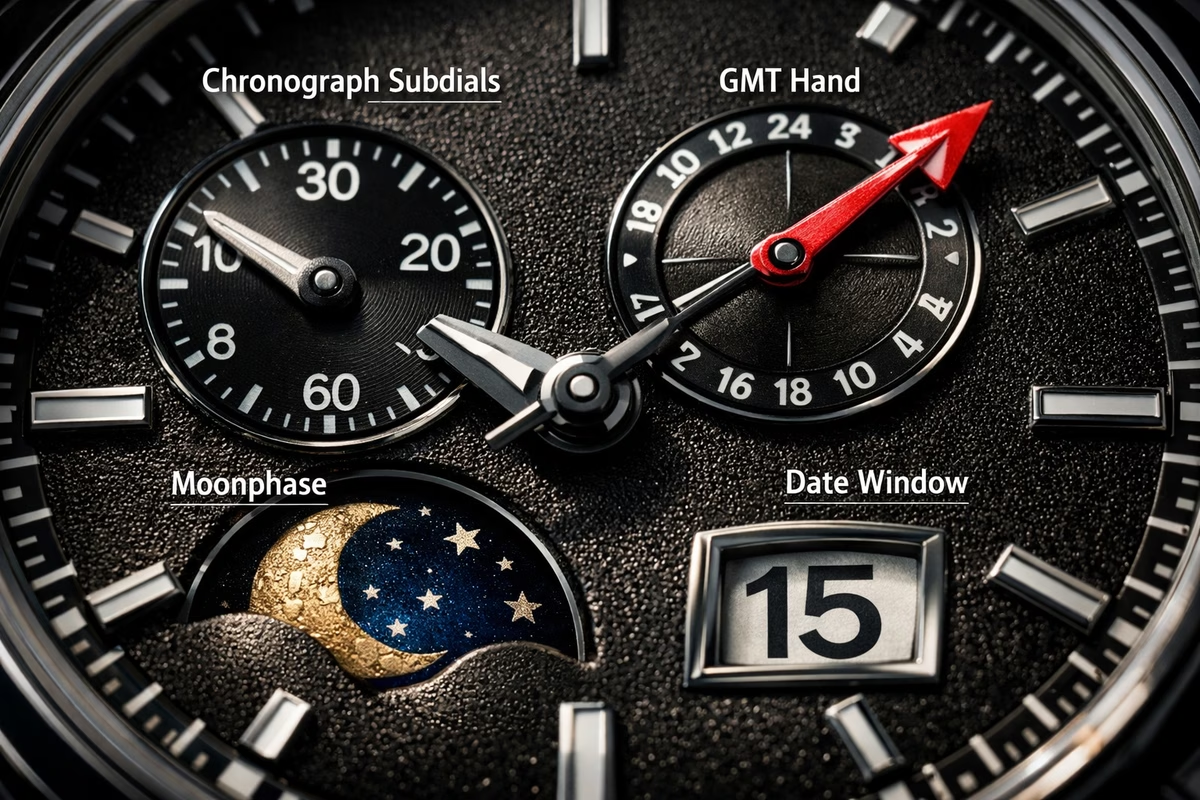
A GMT watch displays two (and sometimes three) time zones simultaneously. “GMT” stands for Greenwich Mean Time, the reference point for world time zones, but the complication itself is simply a second hour hand that completes one rotation every 24 hours instead of twelve.
This matters because a normal watch with a 12-hour dial is ambiguous—when the hour hand points to 7, you don’t know if it’s 7 a.m. or 7 p.m. somewhere else. A 24-hour GMT hand eliminates that ambiguity. If the GMT hand points to 19, it’s 7 p.m. If it points to 7, it’s 7 a.m. One glance. No math.
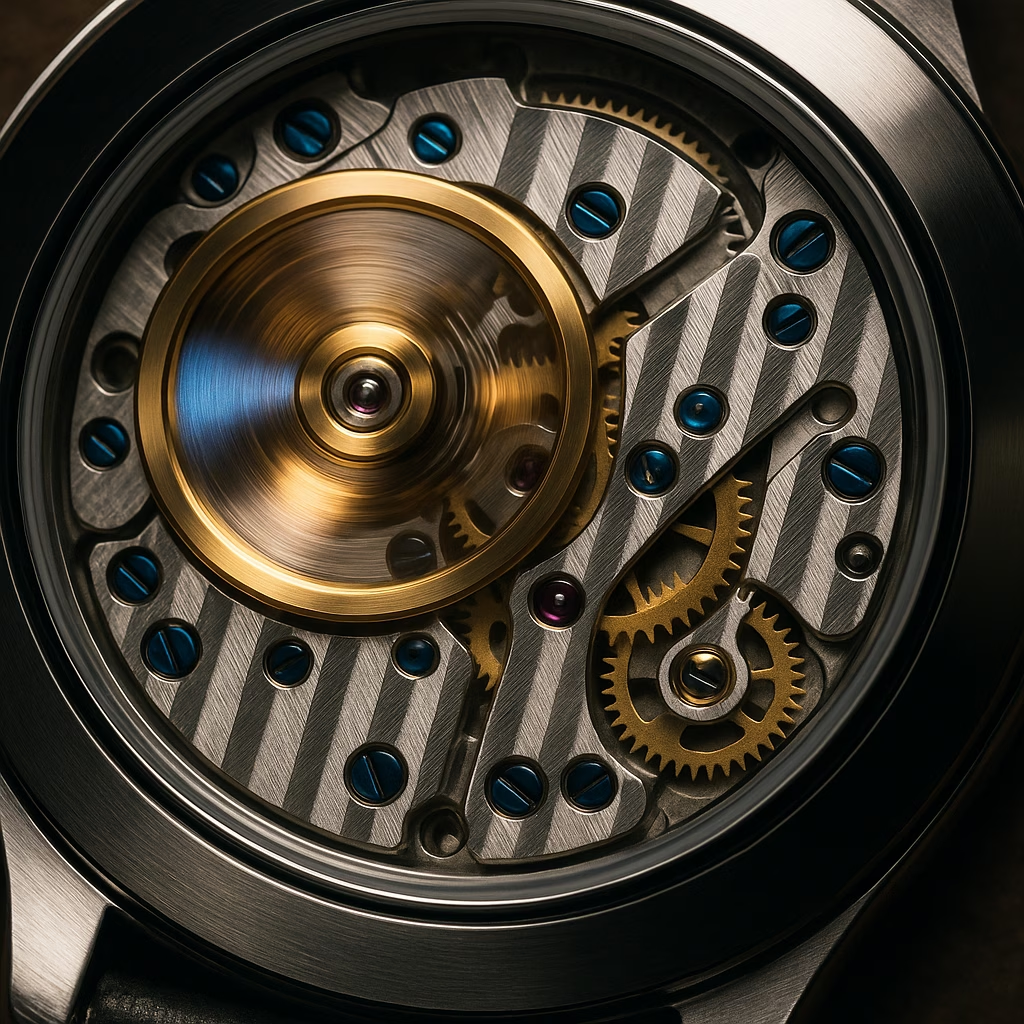
Inside the watch, the GMT hand is geared to the main movement but rotates at half speed—one full revolution every 24 hours instead of every 12 hours. The rotating bezel (or an internal rotating ring) lets you set a reference for additional time zones.
Caller GMT (true GMT): The main hour hand can be set independently in one-hour jumps without stopping the movement. This means you adjust local time when you land without disturbing the GMT hand, which stays on home time. The Rolex GMT-Master II and Tudor Black Bay GMT use this system.
Office GMT (flyer GMT): The GMT hand is the one that jumps independently. You set the GMT hand to track a second zone while the main dial stays on local time. The Omega Seamaster Planet Ocean GMT uses this approach.
True independents: Some watches let both the main hour hand and GMT hand be set independently. The Grand Seiko SBGE and Jaeger-LeCoultre Master Geographic offer this capability.
The pilot origin story
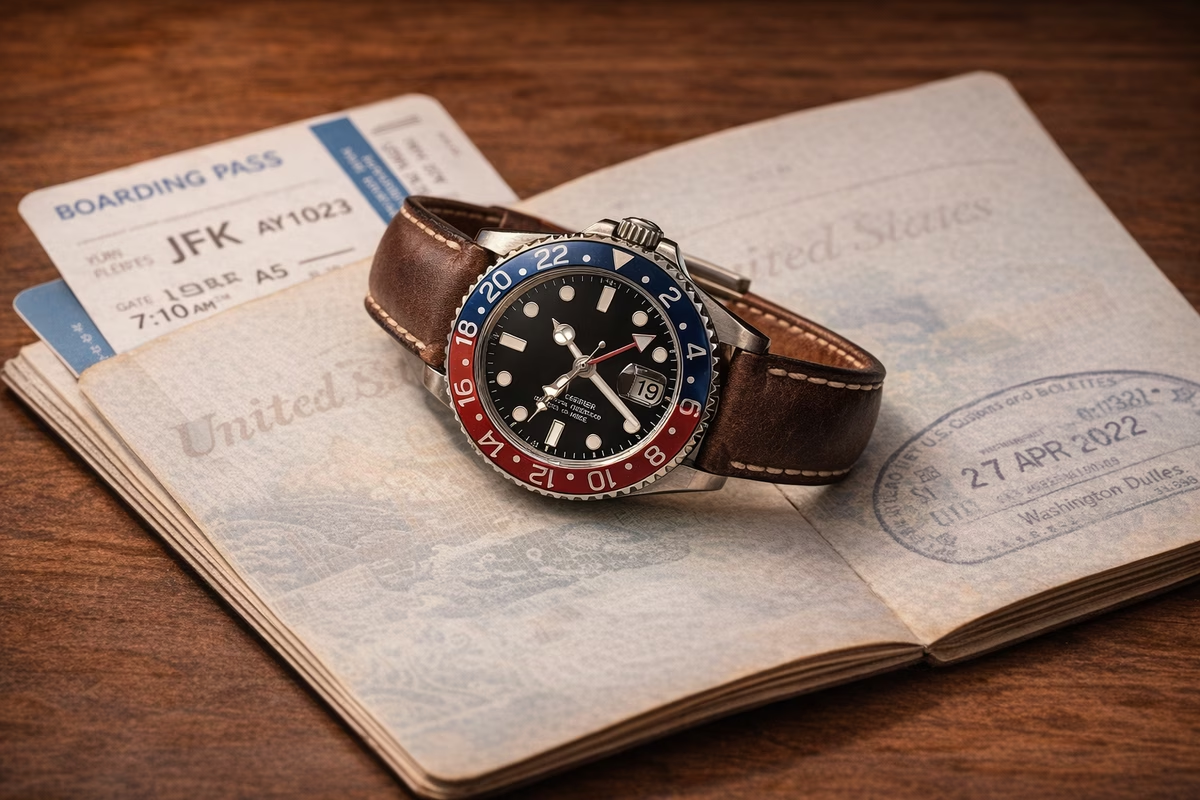
The GMT watch was born from a professional need. In 1954, Pan American World Airways approached Rolex with a problem: their pilots were flying long-haul routes across multiple time zones and needed to track both local time and Greenwich Mean Time (then the universal standard for aviation). Rolex responded with the GMT-Master, Reference 6542—a watch with a 24-hour hand and a rotating bezel in two colors (red for daytime hours, blue for nighttime).
Pan Am pilots wore it on the wrist. Air traffic controllers referenced it on the ground. And the distinctive two-toned bezel—later nicknamed the “Pepsi” bezel for its red-and-blue color scheme—became one of the most recognizable design elements in watchmaking.
The concept spread quickly. Glycine made the Airman for military pilots. Breitling refined their Navitimer with GMT variants. By the 1960s, the GMT complication had moved from cockpit tool to traveler’s companion, and every serious watch brand offered at least one version.
Today, the GMT is arguably the most useful complication for modern life. We don’t all fly planes, but we all have colleagues, family, or friends in different time zones. The GMT hand is a quiet tether to the people and places that aren’t where you are right now.
How to use a GMT watch in practice
Scenario 1: You live in New York and travel to London
Before departure: Both your main hands and your GMT hand show New York time (EST, UTC-5).
On landing: You rotate the bezel (or use the crown to jump the hour hand) to set the main dial to London time. The GMT hand continues to show 24-hour time on the original zone—so you can glance and see it’s 3 p.m. in London and the orange hand is pointing to 10 on the 24-hour scale (10 a.m. in New York).
The benefit: You never lose track of home. Meeting at 4 p.m. London time? A glance tells you it’s 11 a.m. in New York—your colleagues are probably at their desks.
Scenario 2: You don’t travel, but your family does
A GMT watch isn’t only for people who fly. If your child studies abroad, if your partner travels for work, if your best friend lives overseas—the GMT hand keeps their time visible on your wrist. You stop doing arithmetic and start just looking.
Scenario 3: Three time zones
With a 24-hour bezel, you can actually track three zones. The main dial shows local time. The GMT hand against the fixed bezel markers shows a second zone. And by reading the GMT hand against the rotated bezel, you get a third. It takes practice, but it works—and some watches (like the Patek Philippe World Time) are specifically designed to show all 24 time zones at once.
- Practice the 24-hour scale. After 12, just subtract 12 to get the familiar number: 15 = 3 p.m., 20 = 8 p.m., 23 = 11 p.m.
- Set the GMT hand to the zone you check most often. Usually home.
- Use the bezel colors as AM/PM hints. On a traditional “Pepsi” or “Batman” bezel, one color marks daytime hours and the other marks nighttime.
- When crossing the International Date Line, remember the date may differ between your two zones. Some GMT watches include a date complication that tracks the local date.
World timer watches: the maximalist approach
While a GMT watch shows two or three zones, a world timer shows all 24 at once. The dial includes a ring of city names—each representing a time zone—and a 24-hour ring that rotates continuously. To read any city’s time, you look at the 24-hour number aligned with that city name.
The most famous world timer is the Patek Philippe World Time (Ref. 5230/5231). It’s a dress watch that happens to contain the entire planet’s time on its face. Vacheron Constantin, Jaeger-LeCoultre, and Nomos also make excellent versions.
World timers are beautiful and impressive, but they’re also more complex to read than a simple GMT. For most travelers, the GMT is the practical choice. The world timer is for people who find beauty in complexity—or who genuinely need to coordinate across many time zones regularly.
What to look for when buying a GMT watch
Caller vs. Office GMT: If you travel frequently, a caller GMT (independently adjustable local hour hand) is far more practical. You can adjust for time zones without resetting the watch entirely.
Bezel type: A rotating bezel adds a third-zone capability. An internal rotating ring (adjusted by a second crown) is more protected but adds thickness. A fixed 24-hour printed bezel is the simplest option.
Legibility: The GMT hand should be immediately distinguishable from the main hands. Different color, different shape, or both. If you have to squint to find the GMT hand, the watch fails its primary purpose.
24-hour markers: The best GMT watches have a clear, readable 24-hour scale. Some use numbers on the bezel; some integrate them into the dial. Either works if it’s unambiguous.
Water resistance: If you’re a traveler, you’re encountering pools, rain, beach splashes. A GMT watch with at least 100m water resistance makes sense.
Price range: Excellent GMT watches exist at every budget:
- Under $500: Orient Star GMT, Seiko 5 GMT (SSK series)
- $500-$2,000: Tissot PRX Powermatic GMT, Mido Ocean Star GMT
- $2,000-$5,000: Tudor Black Bay GMT, Longines Zulu Time
- $5,000-$15,000: Omega Seamaster Aqua Terra GMT, Grand Seiko SBGE
- $15,000+: Rolex GMT-Master II, Patek Philippe World Time
The emotional case for a second time zone
I’ve worn a GMT daily for three years now. The orange hand is set to my mother’s time zone—she’s six hours ahead. When I glance at my wrist during a workday and see the GMT hand past 22, I know she’s winding down for the night. When I see it at 8, I know she’s having her morning coffee. It’s not a phone call. It’s not a text. It’s just an awareness—quiet, constant, ambient—that the people you love are living their day somewhere else on the planet, and you can feel the shape of their hours without asking.
That’s what a GMT watch really is. Not a pilot’s tool. Not a traveler’s gadget. It’s a way to keep someone else’s time on your wrist. And that’s a kind of love that ticks.
Next steps
- Read Watch Complications for the full landscape of what watches can do
- Explore Watch Complications Deep Dive for chronographs, calendars, and more
- See Watch Styles to understand how GMT watches fit into the style spectrum
- Read Buying Guide for practical purchasing advice
- Check Watch Travel Story for another perspective on watches and journey