I remember the exact moment I understood what an automatic watch was.
I was 26, standing in my grandfather’s study, holding a watch he’d left me. It was a modest thing—a steel case, cream dial, simple indices. It had been sitting in a drawer for months since his passing. When I picked it up, the second hand was still. The dial stared blankly back at me, frozen somewhere in the middle of an afternoon that had already passed.
My father showed me. “Put it on,” he said. “Move your wrist.”
I strapped it on and went about my afternoon. An hour later, I looked down. The second hand was sweeping—not ticking in one-second jumps like my digital watch, but sweeping, a smooth continuous glide around the dial. The watch had woken up. Not because I’d changed a battery or wound a crown, but because I’d moved. My motion—walking, reaching, gesturing—had wound a tiny rotor inside the case, which tensioned a mainspring, which released energy through a gear train, which drove the hands.
The watch was alive because I was alive. When I stopped wearing it, it would stop. When I put it on again, it would restart. We were, in a small mechanical way, connected.
That was fifteen years ago. I’ve owned quartz watches since then. They’re more accurate, cheaper, and require less attention. But I always come back to the automatic. There’s something in the idea of a machine that lives on your motion that a battery can never replicate.
How an automatic watch works
Every automatic watch contains the same fundamental system that watchmakers have refined for over two centuries:
The mainspring is a tightly coiled ribbon of special alloy steel stored in a barrel. When wound, it stores potential energy. As it slowly unwinds, it releases that energy at a controlled rate.
The gear train is a series of wheels and pinions that transmit the mainspring’s energy to the escapement. Each wheel increases the speed and reduces the torque, stepping the energy from the slow barrel to the fast balance wheel.
The escapement is the heart of the watch—a tiny mechanism that releases one tick of energy at a time, converting the continuous force of the mainspring into measured, regular pulses. The lever escapement, used in virtually all modern mechanical watches, does this with a pallet fork that alternately locks and releases the escape wheel.
The balance wheel oscillates back and forth at a precise frequency—typically 28,800 vibrations per hour (4 Hz) in modern watches. Each oscillation takes exactly the same time, giving the watch its accuracy. It’s the mechanical equivalent of a quartz crystal’s vibration, achieved entirely through physics and geometry.
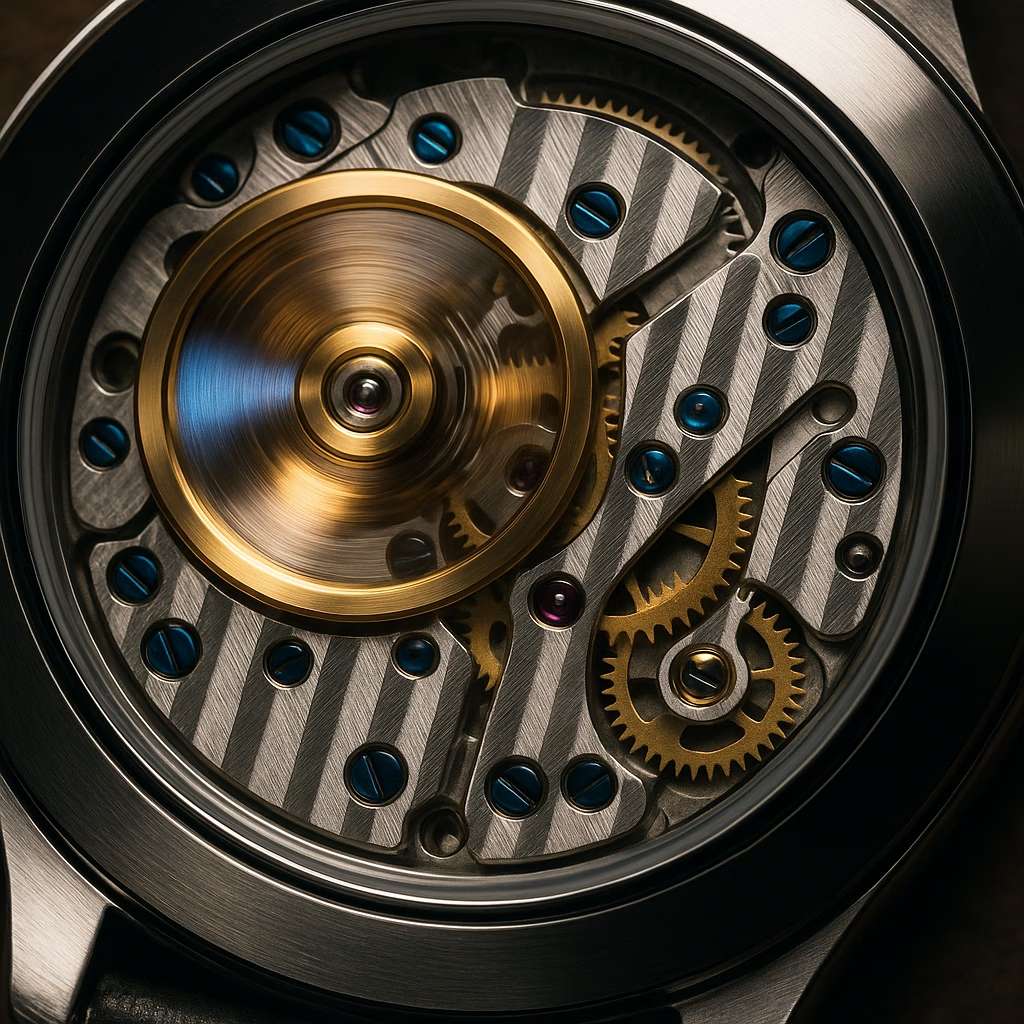
The rotor is what makes an automatic watch automatic. It’s a semicircular weight, mounted on a bearing at the center of the movement, that rotates freely when you move your wrist. As it spins, it winds the mainspring through a series of reduction gears. Walk to the kitchen, wave to a friend, type at your desk—every movement nudges the rotor, which nudges the mainspring, which keeps the watch running.
Automatic (self-winding): Has a rotor. Winds from wrist movement. Can also be wound manually via the crown. Most convenient for daily wear.
Manual wind (hand-wound): No rotor. You wind it by turning the crown each day (or every few days, depending on power reserve). Thinner cases are possible without the rotor. Some people prefer the daily ritual of winding.
Both are mechanical. Neither uses a battery. Both rely on a mainspring, gear train, escapement, and balance wheel. The only difference is how the mainspring gets wound.
Why mechanical when quartz is better (on paper)
This is the question every mechanical watch enthusiast gets, and the honest answer is that quartz is objectively superior by most measurable standards:
| Quartz | Mechanical | |
|---|---|---|
| Accuracy | ±15 seconds/month | ±5 seconds/day |
| Price for good quality | $50-$500 | $300-$50,000+ |
| Maintenance | Battery every 2-5 years | Service every 5-10 years ($200-$800) |
| Durability | Very resilient | Sensitive to shocks and magnetism |
So why does anyone choose mechanical? For the same reason people choose vinyl records, handmade furniture, or cooking from scratch when streaming, IKEA, and delivery exist. Because the experience of the thing matters beyond its function.
A mechanical watch is a tiny engine on your wrist. It has hundreds of components—springs, gears, jewels, screws—assembled by hand or precision machinery, all working together to do something that a $10 quartz chip does more accurately. But when you hold a mechanical watch to your ear and hear it ticking—that faint, rapid, living heartbeat—you’re hearing craftsmanship. You’re hearing physics. You’re hearing something that was designed and built to keep time through pure mechanical ingenuity, without a single electron.
And the sweep. The smooth sweep of a mechanical second hand—six or eight ticks per second blurred into continuous motion—is different from the tick-tick-tick of quartz. It’s a small thing. But it’s the small things that make something feel alive.
The power reserve question
Every automatic watch has a power reserve—the amount of time it will run after being fully wound without any additional wrist movement. Modern automatic watches typically have 40-80 hours of power reserve. Some high-end movements offer 5 days (120 hours) or more.
What this means in practice:
- If you wear your watch daily, the rotor keeps the mainspring wound, and you’ll never think about power reserve.
- If you take it off Friday night and put it on Monday morning, a 40-hour reserve watch will have stopped. A 70-hour reserve watch will still be running.
- If you rotate between multiple watches, you’ll need to reset the time each time you pick up a stopped one—or invest in a watch winder (a motorized stand that slowly rotates the watch to keep the rotor active).
The practical advice: For your first and only automatic watch, 40+ hours is fine because you’ll wear it daily. If you plan to collect multiple watches, look for 60-80 hour power reserves so weekend breaks don’t kill the movement.
- Wind it manually when you first put it on. Turn the crown clockwise 20-30 times to build an initial charge. Then let the rotor maintain it through the day.
- Don’t worry about overwinding. Modern automatics have a slipping clutch that prevents overwinding. You can’t damage it by winding too much.
- Set the time by pulling the crown out. Typically one click out adjusts the date, two clicks adjusts the time. Push it back in and you’re set.
- Expect ±5-10 seconds/day variation. This is normal for a well-regulated automatic. If you’re consistently off by 30+ seconds, it may need regulation.
- Avoid magnetic fields. Don’t store your watch on top of a laptop, tablet, or speaker. Magnetism can affect accuracy. Modern anti-magnetic alloys help, but caution is still wise.
The accuracy conversation
“But it loses five seconds a day!” is the most common objection to mechanical watches. And it’s true—compared to a $30 Casio that’s accurate to 15 seconds per month, a mechanical watch is wildly imprecise.
The reframe: you don’t buy a mechanical watch for accuracy. You buy it for everything else—the craft, the movement, the sweep, the inheritance potential, the connection to a tradition of engineering that stretches back to the 1700s.
If you truly need atomic-level accuracy for work or travel, wear a quartz watch or a GPS-synced Casio. If you want something on your wrist that was made with the same principles as a cathedral clock but miniaturized to fit behind glass the size of a thumbnail—wear a mechanical.
Many enthusiasts own both. One for precision, one for pleasure. There’s no contradiction.
What to look for in your first automatic
Budget tier ($150-$500):
- Seiko Presage: The best value in automatic watches. Beautiful dials, reliable 4R/6R movements, excellent finishing for the price.
- Orient Bambino: A dress watch classic. In-house movement, elegant design, remarkable for under $200.
- Tissot PRX Powermatic 80: Modern design, 80-hour power reserve, Swiss movement. A versatile daily wearer.
Mid-range ($500-$2,000):
- Hamilton Khaki Field: A rugged, versatile watch with strong heritage and excellent Swiss movements.
- Longines Conquest: Refined, well-finished, and from one of the oldest Swiss watch companies.
- Mido Baroncelli: Thin, elegant, and equipped with movements that punch above their price.
Entry luxury ($2,000-$5,000):
- Tudor Black Bay: Rolex’s sibling brand. In-house movement, excellent build quality, strong resale.
- Omega Seamaster: Iconic design, METAS-certified movements, robust water resistance.
- Grand Seiko (Spring Drive): Technically a hybrid (uses a mainspring but electronic regulation), offering quartz-level accuracy with mechanical soul.
The universal advice: Try watches on your wrist before buying. A watch that looks perfect online may feel wrong on your arm. Size, weight, thickness, and how the strap sits all matter more than specifications.
The inheritance question
A quartz watch lasts until the electronics fail—typically 10-20 years. A mechanical watch, properly serviced, lasts indefinitely. The Patek Philippe slogan—“You never actually own a Patek Philippe. You merely look after it for the next generation”—is marketing, but it’s also true of any quality mechanical watch.
My grandfather’s watch is a modest Seiko automatic from the 1970s. It was serviced once, in the 1990s. When I received it, a watchmaker cleaned and oiled the movement for $180. It now keeps time within 8 seconds a day and looks better on my wrist than anything I could buy new for ten times the price—not because of its specifications, but because of its story.
That’s the real difference between quartz and mechanical. A quartz watch tells you the time. A mechanical watch tells you a story—about the person who chose it, the hands that assembled it, the wrist that wore it, and eventually, the person who inherits it.
Next steps
- Read Quickstart Guide for the foundational watch knowledge
- Explore Movements for the full technical breakdown of watch mechanisms
- See Watch Brands for the landscape of manufacturers
- Read Buying Guide for practical purchasing advice
- Check Care Guide for keeping your automatic running beautifully