The power went out on a Thursday in November.
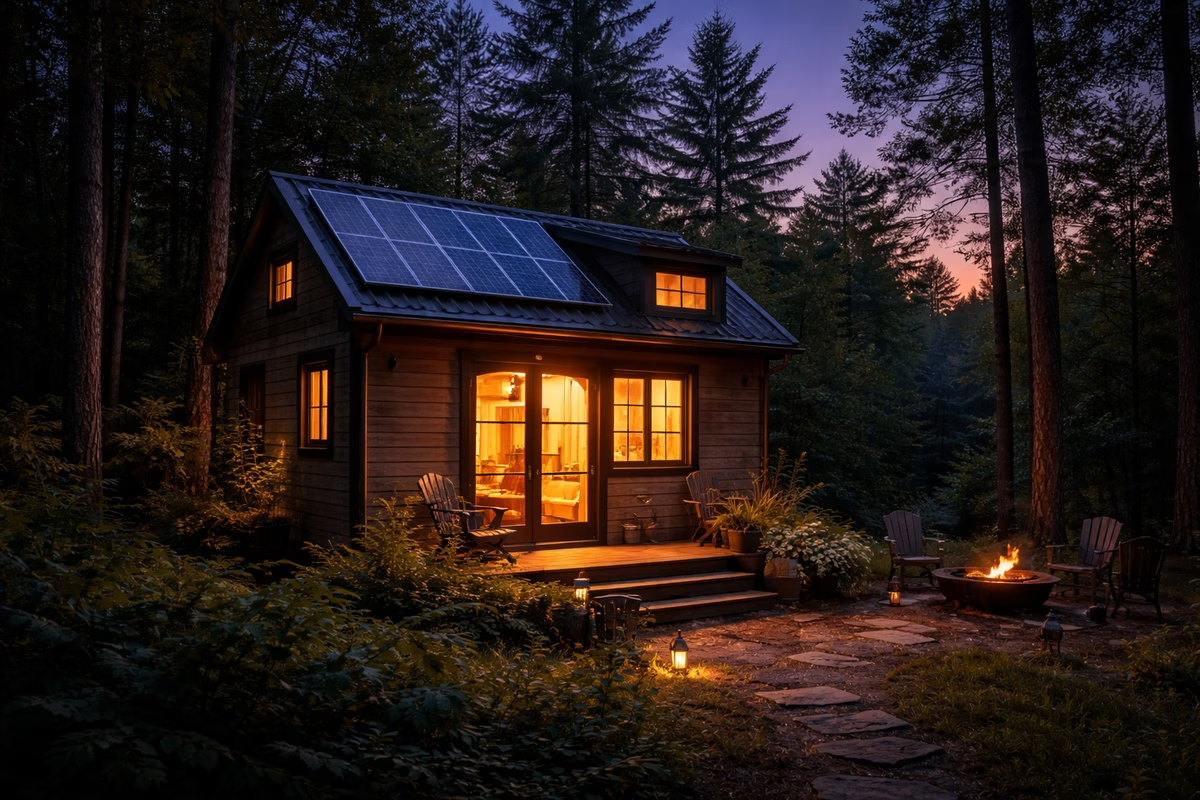
Not the neighborhood’s power—ours. Just ours. The tiny home sat perfectly still, perfectly dark, in a clearing where the nearest utility pole was half a mile away and not connected to anything we owned. Our 400 watts of rooftop solar and a 5-kilowatt-hour lithium battery bank were supposed to handle everything.
They did handle everything—for exactly two and a half days of overcast November sky.
Then the battery monitor hit 15%, the inverter chirped its low-voltage warning, and the fridge, the lights, and the water pump quietly gave up.
My partner, Ren, was in the loft reading. I was in the kitchen failing to make dinner by the light of my phone.
“Is this a problem?” Ren asked, leaning over the loft rail.
“Depends on your definition of problem,” I said.
“Can we fix it?”
“Not tonight.”
Ren came down the ladder with a headlamp, two candles, and the small propane camping stove we kept under the bench seat for emergencies we’d assumed would never happen.
We made soup on the stove. We ate by candlelight. We talked about what went wrong—not with anger, but with the careful curiosity of people who had chosen this life on purpose and were being tested by it for the first time.
That night taught us more about our home than the six months of living in it that came before.
What off-grid actually means (when the sun doesn’t shine)
Off-grid means your tiny home is its own utility. No power company, no water main, no gas line. Everything—electricity, water, heat, waste—comes from systems you’ve built, sized, and maintain yourself.
When those systems work, off-grid living feels like freedom. The power is silent. The bills are zero. The independence is real and quietly satisfying.
When those systems reach their limits, off-grid living feels like a math problem you didn’t study for.
Our solar system, when we installed it, seemed generous:
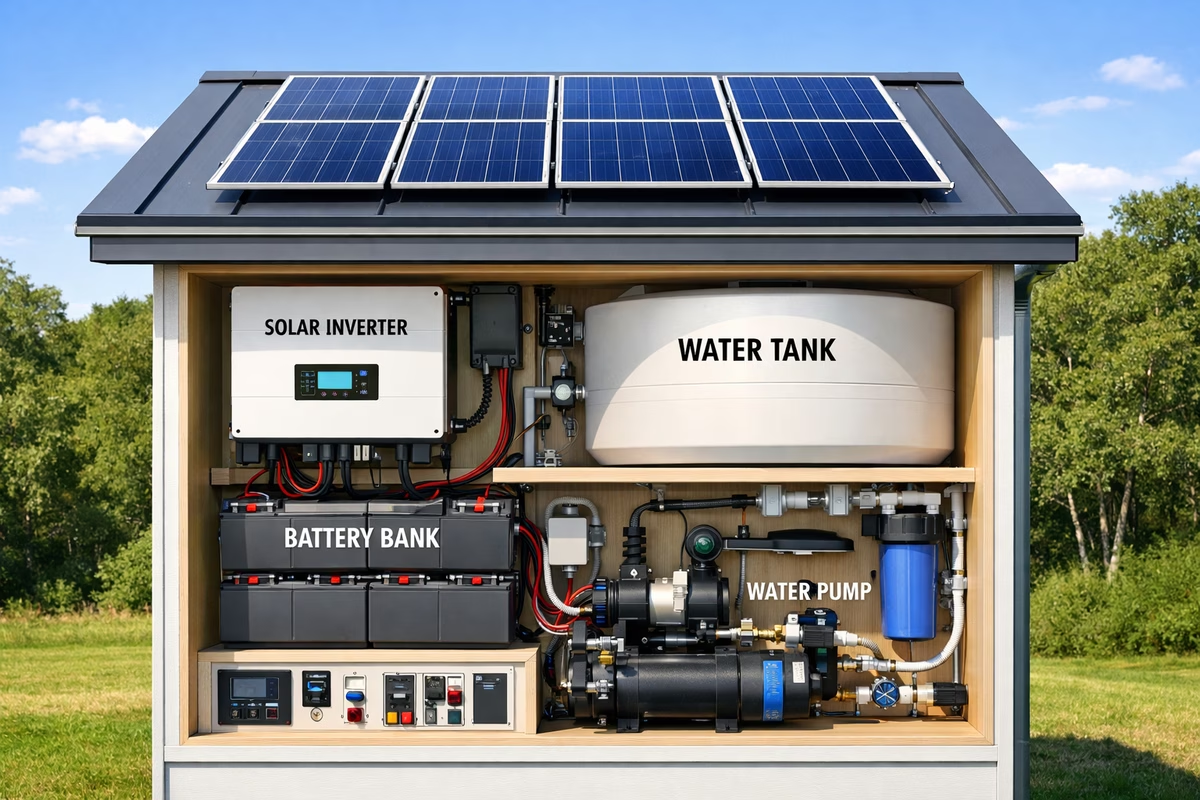
- 400 watts of panels (two 200W panels on the roof)
- 5 kWh lithium iron phosphate (LiFePO₄) battery bank
- A 2000W pure sine wave inverter
- A 30A MPPT charge controller
In summer, this was more than enough. The panels produced 2.5–3 kWh per day. Our daily consumption was about 2 kWh. The batteries stayed full. We sometimes ran a fan and a laptop simultaneously and still had power to spare.
November was different.
What went wrong (and what we should have calculated)
The failure wasn’t dramatic. It was arithmetic.
November sunlight: ~3.5 peak sun hours per day (vs. 6+ in summer) Daily solar production: ~1.4 kWh (400W × 3.5 hours × 0.85 efficiency factor) Daily consumption: ~2.0 kWh (fridge, lights, water pump, laptop, phone charging, router) Daily deficit: ~0.6 kWh
That 0.6 kWh shortfall drained the battery by about 12% per day. After two sunny days followed by two overcast ones, the bank hit its limit.
The math was simple. We just hadn’t done it for November.
When we designed the system, we’d sized it for summer—the season we moved in. The solar calculator we’d used had asked for “average daily sun hours,” and we’d entered the annual average (4.5 hours) instead of the winter minimum (2.5–3.5 hours). That single optimistic number cascaded through every downstream decision.
This is the most common mistake in off-grid solar sizing, and we made it on page one.
For the technical details, see Solar Power Sizing for Tiny Homes.
The candle-lit conversation: auditing our consumption
That evening, with soup warming on the propane stove and candles on the counter, we made a list.
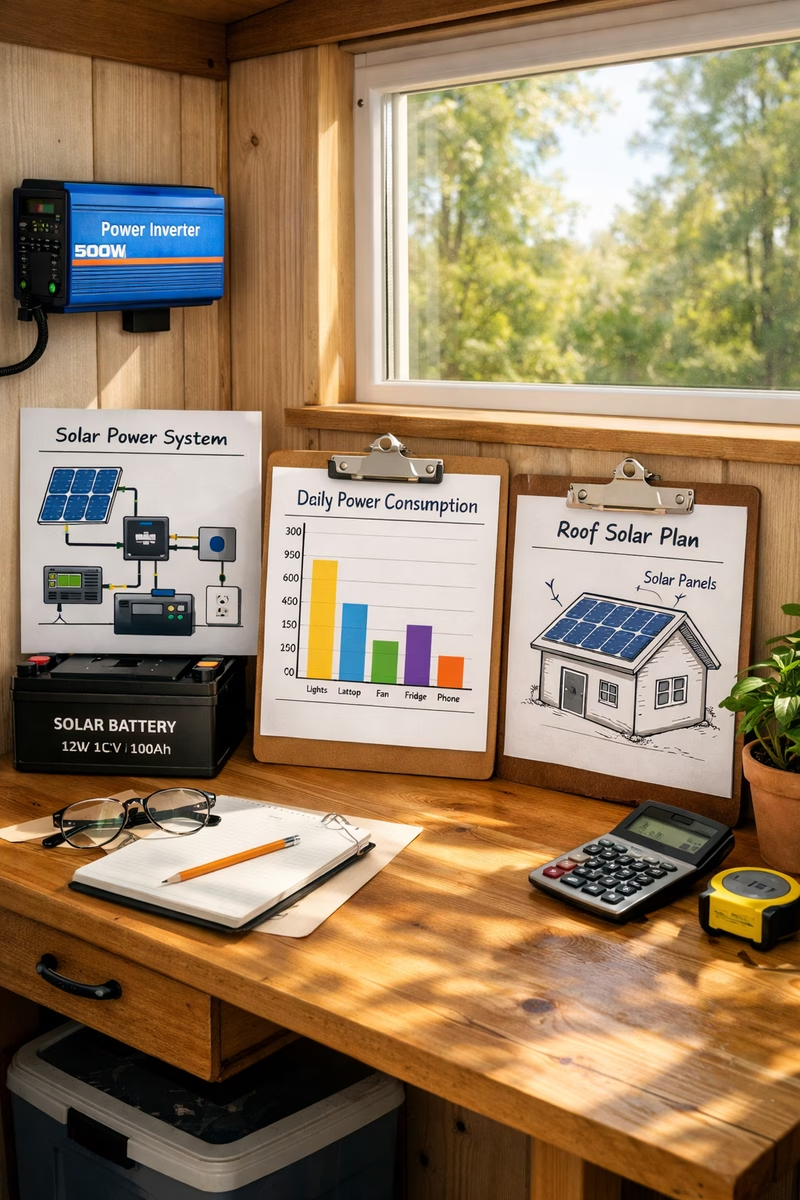
Every device we used, every watt it drew, every hour it ran. We wrote it on the back of a receipt because the notebook was somewhere we couldn’t find in the dark.
| Device | Watts | Hours/day | Wh/day |
|---|---|---|---|
| Fridge (compressor) | 45 | 8 (cycling) | 360 |
| LED lights (all) | 30 | 5 | 150 |
| Water pump | 60 | 0.5 | 30 |
| Laptop | 45 | 6 | 270 |
| Phone charging (×2) | 10 | 3 | 30 |
| WiFi router | 12 | 24 | 288 |
| Miscellaneous | — | — | ~100 |
| Total | ~1,228 |
Wait. Our estimate had been 2 kWh. The actual audit came to 1.2 kWh—which meant something else was drawing power we hadn’t accounted for. After more investigation (the next morning, with daylight), we found it: the inverter itself consumed roughly 25 watts at idle, 24 hours a day. That’s 600 Wh—nearly as much as the fridge.
The morning after: what 15% battery looks like
We woke up at dawn, which in November was 6:45. The battery monitor read 12%.
Ren made coffee on the propane stove. We sat on the step outside and watched the first sunlight hit the panels. By 9 a.m., the charge controller’s screen showed current flowing—0.8 amps, then 1.2, then 2.1 as the sun climbed. The battery crept up: 13%. 15%. 18%.
It was like watching a patient stabilize. Every percentage point felt earned.
By noon, the battery was at 35%. Not full, but enough to run the fridge and lights for the evening. We kept the laptop off, unplugged the router, and used our phones sparingly—the kind of rationing you associate with camping trips, not daily life.
“This is the part they don’t show on Instagram,” Ren said.
“What part?”
“The part where off-grid means doing math in the dark.”
The fixes: what we changed (and what we learned to accept)
Over the following two weeks, we made changes—some immediate, some requiring investment, some requiring only a shift in behavior.
1. Reduce the phantom load
We installed a simple DC disconnect switch on the inverter. At night, when we only needed DC-powered devices (LED lights on a 12V circuit, USB charging), we turned the inverter off entirely. This saved roughly 350 Wh per day—the single biggest improvement.
2. Add a small generator for backup
We bought a 2,000-watt inverter generator (Honda EU2200i, quiet enough to not disturb the neighbors or the owls). Running it for two hours on a cloudy day could replenish about 1.5 kWh in the battery—enough to bridge a bad-weather gap.
We don’t love the generator. It runs on gasoline, it makes noise, and it contradicts the off-grid ethos we’d built our life around. But it’s there, in the storage bay, like a fire extinguisher: you hope you never need it, and you’re glad it exists when you do.
3. Recalculate for winter
We reran the solar calculator using November sun hours (3.0 peak hours) instead of the annual average. The result was sobering: to achieve full self-sufficiency in winter without a generator, we’d need approximately 800 watts of panels and 10 kWh of battery storage—double what we had.
That upgrade was possible but expensive (~$3,000 for panels, charge controller upgrade, and additional batteries). We decided to plan for it the following spring and use the generator as a bridge for the rest of winter.
4. Shift energy-intensive tasks to sunny hours
This was the behavioral change. We started running the laptop, the water pump, and any heavy loads during the middle of the day—when solar production peaked and the panels could power the devices directly, bypassing the battery. At night, we drew only lights and the fridge.
This sounds obvious. It isn’t—until you’ve lived through a power failure that teaches you the difference between generating power and storing it.
What the power failure taught us about living small
1. Every watt is a decision
In a regular house, you flip switches without thinking. In an off-grid tiny home, every watt has a source (the sun), a cost (battery capacity), and a consequence (what you can’t run later). The power failure made this explicit. We started thinking about electricity the way a backpacker thinks about water: use what you need, don’t waste what you have, know where the next supply is coming from.
2. Redundancy isn’t luxury—it’s design
A second heat source (propane). A backup power source (generator). A way to pump water manually (gravity-fed tank). These aren’t signs of failure in an off-grid system. They’re signs of mature design. Every off-grid system has limits. Redundancy is what keeps those limits from becoming emergencies.
3. Seasons change the house
A tiny home in July and a tiny home in November are the same building with different math. Sun hours, heating loads, moisture levels, ventilation needs—everything shifts. The first year off-grid is really four first experiences, one per season, and each one reveals something the others didn’t.
For the winter-specific challenges, see Your First Winter in a Tiny Home.
4. The rhythm is the reward
After the fixes, something unexpected happened: we stopped noticing the system. Not because it was invisible—we still checked the battery monitor, still shifted loads to sunny hours, still turned off the inverter at night—but because those actions became rhythmic. Part of the day. Like feeding a woodstove or watering a garden.
Off-grid living isn’t about technology. It’s about rhythm. The power failure stripped away the illusion of unlimited electricity and replaced it with something better: a daily relationship with the energy that runs our home.
A practical checklist for off-grid power resilience
If you’re building or living off-grid, this is what we wish we’d done from the start:
- Size your solar for the worst month, not the average. Use your location’s winter peak sun hours, not the annual mean.
- Audit your actual consumption. Don’t estimate. Measure every device for a week. Include the inverter’s idle draw.
- Install a battery monitor with a display. Knowing your state of charge in real time is the difference between managing power and guessing.
- Plan a backup. Generator, shore-power hookup, or a second battery bank that you charge in town. Something for the day the math doesn’t work.
- Install DC circuits where possible. DC lights, DC fridge, USB charging—every device you can run without the inverter reduces your phantom load.
- Track your energy seasonally. A simple spreadsheet: daily production, daily consumption, battery state at dawn and dusk. After a full year, you’ll know your system’s personality intimately.
The ending: the candle we kept
We fixed the power problem. The system works through winter now with only occasional generator use. The battery stays above 40% even on overcast stretches. The fridge runs, the lights come on, the laptop charges.
But we kept one thing from that Thursday night: the candles.
Every evening, after dinner, we turn off the overhead lights and light the two candles from that first outage. It started as a joke—“remember when this was our only option?"—and became a habit. The candlelight is softer. The tiny home feels different by it: warmer, smaller, more held.
Ren says the candles are our reminder that the house is a system and we’re part of it. I say they’re just nice to look at.
We’re both right.
Next steps
- Read Solar Power Sizing for Tiny Homes for the full technical sizing guide
- Explore Sustainable Systems for the water, waste, and heating side of off-grid
- See Heating and Cooling for managing climate with limited power
- Check Tiny Home Maintenance for keeping all your systems healthy
- Read Your First Winter in a Tiny Home for the season that tests everything