I started downsizing on a Saturday in March, standing in front of a closet full of clothes I hadn’t worn in two years.
This was supposed to be the easy part. Clothes are the standard first category in every minimalism guide: pick up each item, decide if it sparks something, put it in the keep pile or the donate pile, move on. Simple. Clinical. Efficient.
I picked up a blazer I wore to my first real job interview. I hadn’t worn it in four years. It didn’t fit anymore. It would never fit again. And I stood there holding it for five minutes, not because I wanted to keep it, but because throwing it away felt like erasing a version of myself.
Nobody tells you this about downsizing: the hard part isn’t deciding what to keep. The hard part is discovering how much of your identity is tangled up in objects—and learning, slowly, that you are not diminished when the objects leave.
This is the story of what it actually feels like to reduce a three-bedroom life into a space smaller than most people’s living rooms. Not a decluttering tutorial. A human reckoning with stuff.
Phase 1: The Easy Stuff (Weeks 1–2)
Every downsizing guide says to start with the easy categories. They’re right. The first week is exhilarating.
I filled six garbage bags with clothes I hadn’t worn in over a year. I cleared out a bathroom cabinet that contained four expired bottles of sunscreen, seven hotel shampoo bottles, and a hairdryer from 2011. I recycled a stack of magazines I’d been “meaning to read” since approximately the Obama administration.
The donate pile grew with satisfying speed. The apartment felt lighter. I felt lighter. I texted a friend: “Why didn’t I do this years ago?”
The easy stuff—duplicates, obvious trash, expired products, clothes that don’t fit—accounts for maybe 30% of what most people own. Removing it feels like clearing deadwood. You lose nothing of value and gain visible space, immediate momentum, and the intoxicating illusion that the rest will be this simple.
It won’t.
Phase 2: The Kitchen (Week 3)
The kitchen was my first real test.
I owned: a stand mixer, a food processor, a blender, an immersion blender, a waffle iron, a panini press, a rice cooker, a slow cooker, an Instant Pot, a bread machine (used twice), four cutting boards, three sets of measuring cups (how?), and enough mugs to hydrate a small office.
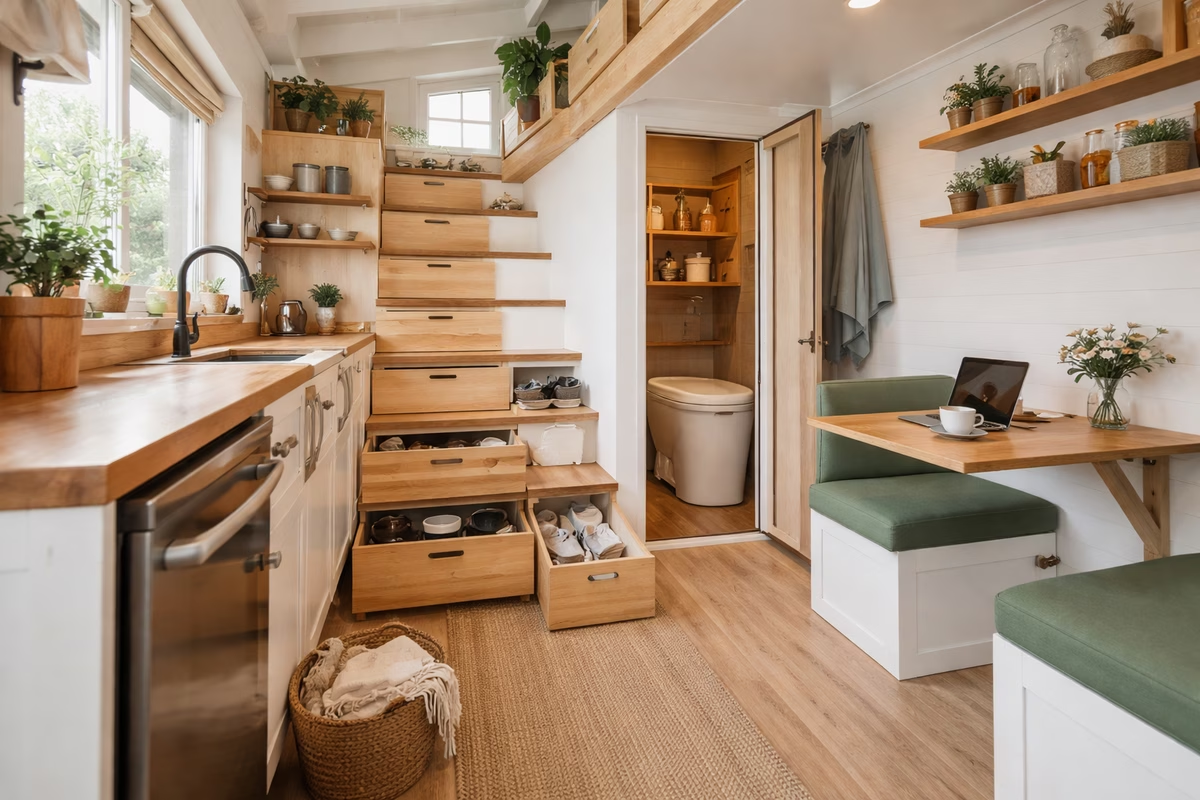
The tiny-home kitchen I was moving into had roughly 20 square feet of counter space and cabinet storage measured in cubic inches, not cubic feet. See the Tiny Home Kitchen Design guide for the spatial reality.
So I did what every tiny-home dweller eventually does: I looked at each appliance and asked, “Can I do this with a simpler tool?”
The stand mixer? I bake twice a year. A bowl and a whisk. The food processor? A good knife and a cutting board. The rice cooker? A pot with a lid. The bread machine? I never used it when I had a whole kitchen. I wasn’t going to start in 200 square feet.
I kept: one good knife, one small cutting board, one cast-iron skillet, one saucepan, one pot, a wooden spoon, a spatula, and—after agonizing deliberation—the immersion blender, because soup.
Giving away the stand mixer was harder than I expected. It was a gift from my mother. It was heavy and beautiful and represented a version of my life where I was a person who baked elaborate cakes on weekend afternoons. That person existed briefly in 2019. They were not coming back. But the stand mixer kept the fantasy alive, and selling it felt like admitting the fantasy was over.
I sold it to a woman who was genuinely excited to bake elaborate cakes. That helped.
Phase 3: The Books (Week 4)
Books are the sentimental minefield of downsizing.
I owned approximately 300 books. My tiny home had shelf space for maybe 30. The math was not ambiguous. The emotion was.
Books feel different from other possessions. A book on your shelf is not just a book—it’s a signal of who you are, who you’ve been, and who you aspire to be. The novel you read in college that changed how you thought about love. The reference book you’ll “definitely need someday.” The stack of unread books that represents your optimistic future self.
I developed a sorting system:
Keep: Books I will reread, books I reference actively, books with personal inscriptions, and a small number of books that are genuinely beautiful as objects.
Donate: Books I read once and don’t need to revisit, books I bought and never opened (honesty is required here), and books I kept because owning them felt intellectual.
Digitize: Some books I wanted to access but not physically own. I replaced them with e-book versions. This felt like cheating at first—like the digital version was somehow less real—but a tiny-home bookshelf doesn’t have room for philosophical objections to e-readers.
The hardest category was books I hadn’t read yet. Each one was a promise to my future self. Letting them go felt like breaking that promise. But I had made hundreds of reading promises, and at my actual reading pace, I would need approximately seven more lifetimes to honor them all. Letting go of unread books was not giving up on reading. It was accepting that I am one person with one life and finite hours.
I kept 28 books. They fit on one shelf, and every single one is a book I am genuinely happy to see every day.
Phase 4: The Sentimental Reckoning (Weeks 5–6)
After the easy stuff, the kitchen, and the books, what remains is the category that has no rational framework: sentimental objects.
My grandmother’s china set (twelve place settings, never used, taking up an entire cabinet). My college diplomas (framed, hanging on a wall that was about to not exist). A box of letters from a relationship that ended a decade ago. Childhood trophies. Travel souvenirs. The ticket stub from a concert that felt, at the time, like the most important night of my life.
These objects don’t serve a function. They serve a memory. And the fear—the real, visceral fear of downsizing—is that if you let go of the object, you let go of the memory.
Here is what I learned: you don’t.
I photographed the china set (close-ups of the pattern, the backstamp, the way light hit the glaze). I gave it to a cousin who actually uses china. The memory of my grandmother is not in the plates. It’s in me.
I kept one box—one small, deliberately chosen box—of objects that carry irreplaceable emotional weight. A few photos (physical, not digital). A letter. A small object from a trip. Everything else, I photographed and let go.
Phase 5: The Furniture Reckoning (Week 7)
Furniture is the final boss of downsizing.
A couch is not just seating. It’s the center of how you live. A dining table isn’t just a surface. It’s where meals happen, where work spreads out, where conversations land. A bed frame, a desk, a bookshelf—these objects define the geometry of daily life.
In a tiny home, most conventional furniture doesn’t fit. The couch is too wide. The table is too long. The bed frame is too tall. You don’t adapt your furniture to the tiny home. You reimagine how you use space.
I sold or gave away: a full-size couch, a dining table and four chairs, a queen bed frame, a desk, two bookshelves, a dresser, two nightstands, and a coffee table. Everything that had defined my living room, bedroom, dining room, and office—gone.
What replaced them was smaller, multifunctional, and deliberately chosen. A fold-down table. A loft bed with storage underneath. A bench with hidden compartments. The tiny-home interior design philosophy is not “less furniture.” It’s “every piece works harder.” See the Interior Design guide for specifics.
Selling the couch was the moment it felt real. A couch is civilization’s most comfortable compromise. Selling it meant I was actually doing this—not just talking about tiny living but physically removing the infrastructure of normal-sized life.
What I Learned
1. You own more than you think
I thought I was a relatively uncluttered person. I owned over 2,000 objects. Most tiny-home dwellers end up with 200–500. The gap between “I don’t have much stuff” and “I have stuff that will fit in 200 square feet” is enormous.
2. The hardest things to let go are the ones that represent who you wanted to be
Not who you are. Who you wanted to be. The guitar you never learned. The running shoes from the marathon you were going to train for. The kitchen tools for the cooking hobby you imagined having. Letting go of aspirational objects is not failure. It’s honesty—and honesty is lighter than pretense.
3. Regret is rarer than you expect
In the months after downsizing, I missed exactly three things: a specific cast-iron Dutch oven (I eventually bought a smaller one), a winter coat I gave away too hastily, and a book I donated that I wanted to reread. Three items out of roughly 1,500 that I released. The regret rate was less than 1%.
4. The freedom is real
I am not going to pretend that tiny living is effortless or that minimalism solves existential problems. But the feeling of owning only things you use and love—of opening a closet and seeing ten items you’re happy to wear instead of fifty that make you vaguely guilty—that feeling is genuine and sustained.
Downsizing is not deprivation. It’s editing. And like all good editing, it reveals what matters by removing what doesn’t.
Practical Downsizing Tips
If you’re preparing to move into a tiny home, here’s the compressed advice:
- Start three months before your move. Downsizing takes longer than you think—emotionally more than physically.
- Work in categories, not rooms. All clothes at once, all books at once, all kitchen items at once. This prevents decision fatigue from jumping between types.
- Use the 90-day rule. If you haven’t used it in 90 days and it’s not seasonal, you probably don’t need it.
- Photograph sentimental items before letting them go.
- Sell, donate, or gift—don’t trash. Objects that are useful to someone else deserve a second life. This also makes letting go emotionally easier.
- Keep a “maybe” box. Put uncertain items in a box. Seal it. Date it. If you don’t open it in 6 months, donate the whole box unopened.
Next Steps
- Read Tiny Home Interior Design for designing the space your downsized life will fit into
- See Tiny Home Budgeting for the financial side of going tiny
- Explore Design Principles for the philosophy behind small-space living
- Try The Summer We Moved In for the narrative of arriving in a tiny home
- Check The First Winter for what tiny living feels like when it gets cold