Nobody who has ever posted a tiny home on Instagram has included a photo of the composting toilet.
I know this because I’ve scrolled through thousands of tiny home posts—the cedar-clad exteriors, the lofted beds with fairy lights, the kitchen windows overlooking mountain meadows—and not one of them shows the small, ventilated box in the corner of the bathroom where you manage your own waste.
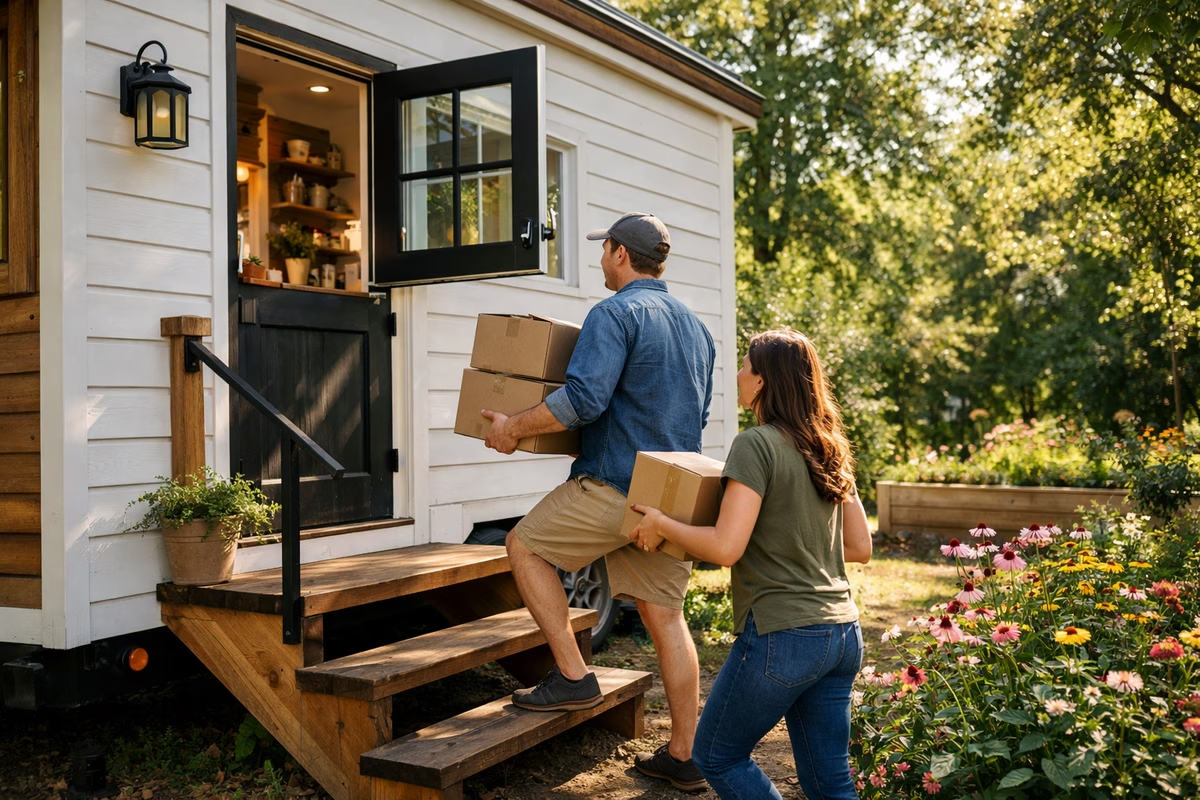
This is not a criticism of Instagram. It’s an observation about the gap between the tiny home dream and the tiny home reality, a gap that I fell into headfirst when I moved into 240 square feet with my partner and our unreasonable expectations.
This guide is about the things nobody warns you about. Not to discourage you—I still live tiny and I still love it—but to prepare you for the conversations you’ll need to have before, during, and after the move. Starting with the most literal one.
The composting toilet: a practical guide
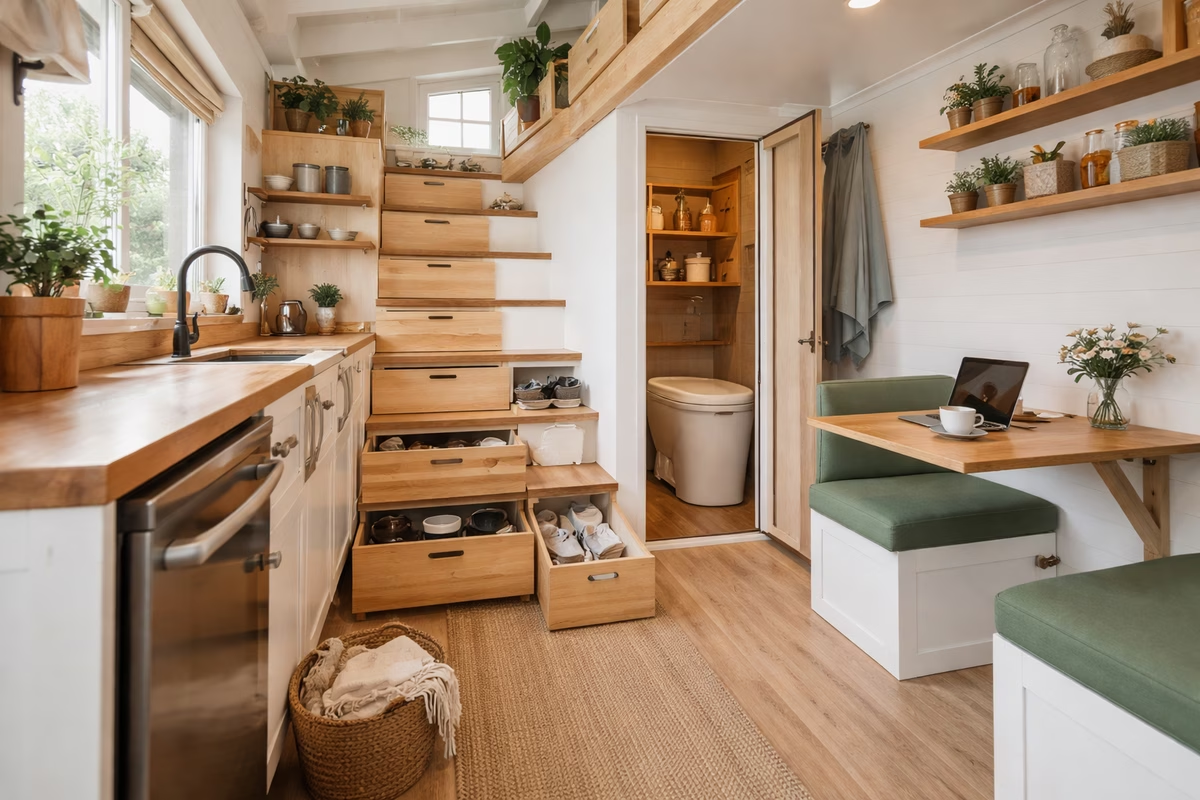
Let me save you the embarrassment of learning this the hard way: a composting toilet is not a hole in the ground. It’s a carefully engineered system that separates liquid from solid waste, uses aerobic decomposition to break down solids, and produces a finished compost that (in many systems) is safe for non-food-crop gardening.
How it works
Most residential composting toilets use a urine-diverting design:
- Liquid waste drains into a separate container or is plumbed to a small gray water system. Urine is sterile when it exits the body and, when diluted with water, makes an excellent nitrogen-rich fertilizer.
- Solid waste drops into a chamber with a carbon-rich cover material (coconut coir, peat moss, or sawdust). After each use, you add a scoop of cover material. The carbon absorbs moisture, controls odor, and provides the carbon-nitrogen ratio that composting bacteria need.
- Ventilation is critical. A small fan (usually 12V, running on solar) pulls air through the composting chamber and out a vent pipe. This airflow keeps the process aerobic (oxygen-rich, which prevents the anaerobic bacteria that cause foul odors).
The maintenance reality
Every 3-6 weeks (depending on usage and household size), you need to:
- Empty the solids chamber. This means removing a container of partially composted material and adding it to an outdoor compost bin for further curing. It looks like dark, crumbly soil. It does not look or smell like what went in—aerobic composting is remarkably effective at transformation.
- Empty the urine container. Every 2-3 days for a two-person household. Dilute with water and use on non-food plants, or pour into a designated area.
- Add fresh cover material. Refill the supply of coconut coir or sawdust.
The odor question (everyone’s first question)
A properly functioning composting toilet does not smell. The combination of urine separation (urine + feces together creates ammonia; separated, they don’t), aerobic ventilation, and carbon cover material eliminates odor at the source.
If your composting toilet smells, something is wrong: the fan isn’t running, the urine isn’t diverting properly, or you’re not adding enough cover material. Fix the system, and the odor disappears.
The storage conversation: where does everything go?
In a conventional home, you don’t think about storage. You buy something, you put it somewhere. Closets, drawers, cabinets, the garage, the basement, that one room you don’t talk about.
In a tiny home, every object needs an address. Not a general area—a specific, designated spot. If an item doesn’t have a home, it becomes clutter. And in 200-400 square feet, clutter isn’t just messy. It’s claustrophobic.
What I kept
When my partner and I downsized from a 1,200-square-foot apartment to a 240-square-foot tiny home, we got rid of roughly 70% of our possessions. Here’s the sorting framework that worked:
Category 1: Use daily. Kept. Plates, utensils, a single pan, coffee gear, laptops, phones, daily clothes.
Category 2: Use weekly. Kept, but stored efficiently. Cleaning supplies, seasonal spices, tools.
Category 3: Use monthly or less. Questioned hard. Books (kept 20, donated 200), hobby supplies (kept the essentials, stored the rest off-site), kitchen gadgets (kept the immersion blender, donated the stand mixer, the waffle iron, and the three different colanders).
Category 4: Sentimental. The hardest category. We kept one box of sentimental items stored under the bed. Everything else was photographed for memory and donated or gifted.
The storage solutions that actually work
After two years of living tiny, these are the storage strategies that make the biggest difference:
Vertical storage. Tiny homes have more wall space than floor space. Magnetic knife strips, wall-mounted shoe racks, pegboard tool walls, and floating shelves exploit the vertical dimension.
Under-stair drawers. If your tiny home has a loft with stairs, the space under each step can be converted into pull-out drawers. This is easily the highest-value storage in any tiny home—it’s hidden, accessible, and substantial.
Fold-down everything. A fold-down table doubles as kitchen counter and desk. A fold-down bed (Murphy style) converts the bedroom into a living room during the day. A fold-down drying rack inside the shower saves floor space.
The one-in-one-out rule. For every new item that enters the home, one item must leave. This isn’t minimalist ideology—it’s spatial reality. The home is full. Adding without subtracting creates overflow.
The relationship conversation: sharing 240 square feet
This is the one nobody talks about on Instagram.
Living tiny with a partner is an exercise in radical proximity. There are no separate rooms to retreat to. There is no “going to the den” or “spending time in the office.” You are always together, always visible, always within earshot.
For some couples, this is a feature. The enforced closeness builds communication skills and eliminates the passive avoidance that erodes many relationships.
For others, it’s a pressure cooker.
What we learned
Personal space has to be invented. In our tiny home, “personal space” isn’t a room—it’s a signal. Headphones on means “I’m in my space right now.” One of us at the loft desk, the other on the ground-floor couch, is our version of separate rooms. We agreed on these signals before moving in, and we enforce them gently.
Cleaning standards must be negotiated upfront. In a 1,200-square-foot apartment, a dirty dish in the sink is invisible. In a 240-square-foot home, a dirty dish is the dominant visual feature of the kitchen. We agreed on same-day dish cleaning, daily surface wiping, and alternating deep-clean days. The stakes of cleanliness are higher when the space is smaller.
Alone time is a scheduled activity. One of us leaves the house for at least two hours per day. A coffee shop, a walk, a library, a co-working space. This isn’t about not wanting to be together—it’s about not having to be together. The difference matters.
Arguments are louder in a small space. Not literally (though sometimes literally), but emotionally. There’s nowhere to cool down. If a disagreement heats up, the only cooling-off option is outside—which means you’re now having an argument that requires putting on shoes and leaving the house. This has actually been beneficial: the inconvenience of leaving motivates us to de-escalate faster.
The social pressure conversation: explaining yourself
When we told friends and family we were moving into a tiny home, the reactions were immediate and varied:
- “That’s so cool! Like those shows on TV?” (Optimistic but uninformed)
- “Where will you put everything?” (Practical)
- “Are you having financial problems?” (Concerned)
- “You’ll grow out of it.” (Dismissive)
- “What about kids?” (Loaded)
- “But where’s the bathroom?” (Eventually, everyone asks about the toilet)
The social pressure of tiny living is real and ongoing. Mainstream culture equates home size with success. A bigger house signals prosperity, stability, adulthood. Choosing to live small is read—often unconsciously—as a failure or a phase.
How I handle it now
I don’t evangelize. I used to try to convince people that tiny living was better. It’s not better. It’s different. It solves some problems (housing costs, environmental footprint, time spent cleaning) and creates others (storage constraints, relationship proximity, social stigma). Presenting it as a choice rather than a philosophy disarms most skeptics.
I give the honest answer about the toilet. People always ask about the bathroom. I tell them it’s a composting toilet, that it doesn’t smell, that I empty it every few weeks, and that it saves 6,000+ gallons of water per year. Then I ask if they have any other questions. Directness eliminates the awkwardness.
I acknowledge the trade-offs. Tiny living is not sacrifice-free. I can’t host large dinner parties. I don’t have a bathtub. My wardrobe is minimal. My book collection is digital. I can’t store bulk groceries. These are real losses. Acknowledging them makes the gains—financial freedom, environmental alignment, and design intentionality—more credible.
The maintenance conversation: things break differently
A tiny home has the same systems as a regular home—plumbing, electrical, HVAC, structure—but compressed into a much smaller space. This has maintenance implications:
Moisture is the enemy
In 240 square feet, cooking, showering, and breathing generate moisture that has nowhere to go. Without aggressive ventilation, condensation collects on windows, walls, and ceiling—leading to mold, wood rot, and that musty smell that announces “this home has a moisture problem.”
The fix: A vent fan in the bathroom and kitchen (both running during and after use), a dehumidifier in humid climates, and cracking a window when possible. Monitor humidity with a $10 hygrometer and keep it below 60%.
Everything is accessible (which is both good and bad)
In a traditional home, plumbing and wiring are hidden behind walls. In many tiny homes, they’re accessible through removable panels. This makes repairs easier—but it also means you see every drip, hear every pipe, and notice every electrical issue immediately.
Seasonal maintenance is critical
A tiny home on wheels faces weather challenges that a foundation home doesn’t:
- Winter: Pipes can freeze if exposed. Heat tape and insulation on water lines are essential below freezing.
- Summer: Heat builds fast in a small space. A reflective roof, shade positioning, and a mini-split AC unit make the difference between comfortable and unbearable.
- Year-round: Check tire pressure and wheel bearings (if on a trailer), inspect the roof for leaks, and clean gutters/drains.
For the complete maintenance schedule, see Tiny Home Maintenance.
The money conversation: what tiny living actually costs
The financial promise of tiny living is real—but it’s more nuanced than “save money by living small.”
What you save
- Mortgage/rent: A paid-off tiny home eliminates housing payments entirely. Even with a loan, payments are typically $300-$600/month vs. $1,500-$3,000+ for a conventional home.
- Utilities: Tiny homes use 30-50% less energy for heating and cooling. Solar panels can eliminate electricity costs entirely.
- Maintenance: Less square footage means less to repair, paint, and replace.
- Stuff: When you can’t store things, you buy fewer things. Our discretionary spending dropped 40% after the move.
What you still pay
- Land: You need somewhere to put the house. Renting land costs $200-$800/month depending on location. Buying land is a separate investment.
- Insurance: Tiny home insurance is available but often more expensive per square foot than conventional homeowner’s insurance.
- Off-grid systems: Solar panels ($3,000-$10,000), composting toilet ($800-$2,500), water systems ($1,000-$5,000). These are upfront costs that reduce long-term expenses.
- Depreciation: Tiny homes on wheels depreciate like vehicles, not like real estate. A $60,000 tiny home may be worth $35,000-$45,000 in 10 years. Foundation homes in good markets appreciate.
The real math
Our monthly expenses in a conventional apartment: ~$3,200 (rent, utilities, insurance, stuff). Our monthly expenses in a tiny home: ~$1,400 (land rent, insurance, solar maintenance, minimal utilities, less stuff). Monthly savings: ~$1,800—which goes to retirement savings and travel.
The savings are real. But they come with labor (maintenance, composting toilet duty, moisture management) that has a time cost. Tiny living trades money for time and attention.
The year-two honest assessment
Two years into tiny living, here’s where I stand:
What’s better than expected
- The financial freedom. Saving $1,800/month has changed our relationship with work and risk. We have options we didn’t have before.
- The cleaning. Twenty minutes and the house is spotless. Deep cleaning takes an hour. This is not a small joy.
- The outdoor connection. When your indoor space is small, you spend more time outside. I know my neighbors, my local parks, and my surrounding landscape in a way I never did in an apartment.
- The intentionality. Every object in our home is there because we chose it. There’s no junk drawer, no forgotten closet, no “we should organize that someday” pile.
What’s harder than expected
- Hosting. We can comfortably have two guests for dinner. Four is tight. A party is impossible inside.
- Illness. When one person is sick in a tiny home, the other person is sick in a week. There’s no quarantine option.
- Working from home. Both of us working remotely in 240 square feet requires headphones, schedules, and a higher tolerance for background noise than either of us naturally possesses.
- The social explaining. It never fully stops. Every new acquaintance eventually asks about the house, the toilet, the partner, the future.
What I’d tell someone considering it
Try it before you commit. Many tiny home communities offer short-term rentals. Spend a week—not a weekend—in a tiny home. Cook, clean, sleep, work, and have a disagreement in 200 square feet. If you can do all of that and still feel enthusiastic, you’re ready.
If you can’t, that’s fine. Tiny living is a specific lifestyle that solves specific problems. It’s not a moral imperative. The best home is the one that fits your life.
The toilet, revisited
Six months after moving in, a friend visited for the first time. She used the bathroom, came out, and said: “That’s the composting toilet?”
“That’s it.”
“I was expecting something… worse.”
“Everyone does.”
She paused. “It’s actually kind of elegant. The whole thing is just… thoughtful.”
That’s the best compliment a tiny home can receive. Not “cool” or “cute” or “Instagram-worthy.” Thoughtful. Every system, every storage solution, every compromised square inch—designed with intention rather than default.
Even the toilet.
Especially the toilet.
Next steps
- Read Design Principles for maximizing livability in small spaces
- Explore Ventilation & Moisture Control for the most critical tiny home system
- See Sustainable Systems for composting, solar, and water
- Try Tiny Home Budgeting for the real financial breakdown
- Check The Downsizing Story for more on letting go of possessions