The loft was supposed to take a weekend.
That was what the plan said—the plan I had drawn on graph paper after watching fourteen YouTube videos and reading three blog posts by people who made it look easy. Two days. A sleeping loft. How hard could it be?
It took three weekends, two trips to the lumber yard, one moment of genuine panic when we realized the header was an inch too low, and a Tuesday evening spent lying on the subfloor staring at the ceiling joists, trying to understand why nothing lined up with the drawing.
But when we finally climbed the ladder on that third Sunday evening and lay on the plywood platform—no mattress yet, just raw wood and the smell of cut lumber—and looked down at the tiny home below us, it felt like we had built a house. Not just a loft. A house.
This is the story of what actually happens when two people who have never framed a wall decide to build the most structural part of their tiny home. It’s also a guide to the mistakes, lessons, and small victories that turned us from people with a plan into people with a loft.
Why the loft matters more than you think
In most tiny homes, the sleeping loft isn’t an afterthought. It’s the architectural decision that makes everything else possible.
The loft reclaims the vertical space above the main living area. Without it, your bed sits on the main floor, consuming thirty to forty square feet—which, in a 200-square-foot home, is 15–20% of your total area. With a loft, that same floor space becomes a living room, an office, a dining area, or all three.
But the loft also introduces the most complex structural and comfort challenges in the build:
- It must support weight. Two adults, a mattress, and bedding. The framing needs to handle static and dynamic loads without flex.
- It must allow headroom. Too low and you can’t sit up. Too high and the living space below feels compressed.
- It must allow airflow. Heat rises. A loft without ventilation strategy becomes a sauna in summer and a cold pocket in winter when the heat escapes through the roof.
- It must be accessible. A ladder, a staircase with storage, or a ship’s ladder—each trades space for ease of use.
Getting the loft right shapes how the entire tiny home lives. Getting it wrong means you dread going to bed.
Before the first cut: what planning actually looks like
Our plan looked clean on graph paper. The reality was messier.
The measurements that matter
The critical number isn’t the loft’s length or width—it’s the distance from the loft platform to the ceiling. In a tiny home on a trailer, the total interior height from floor to roof peak is typically 11 to 13.5 feet. The main living area needs at least 6.5 feet of clearance for comfortable standing. The loft needs at least 3 feet for sitting.
That means the loft platform lands somewhere around 7 to 8 feet above the main floor.
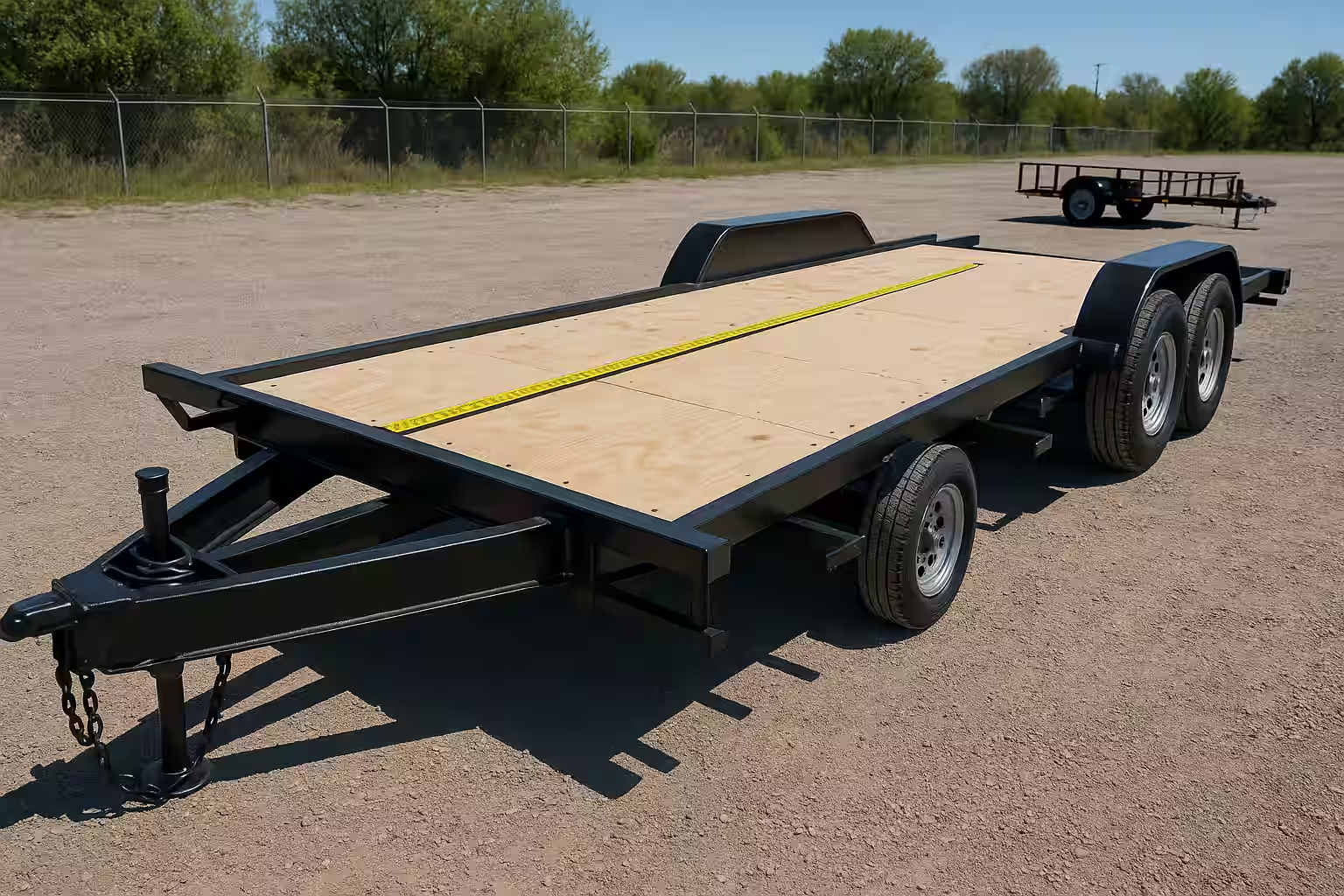
Here’s the problem we didn’t anticipate: the trailer itself consumes height. The trailer deck, the subfloor, the floor insulation, and the finished floor added up to nearly 10 inches before we even started framing walls. Those 10 inches had to come from somewhere—and they came from our headroom budget.
The lesson
Measure from the trailer up, not from the roof down. Stack every layer: trailer deck, insulation, subfloor, finished floor, wall height, loft framing, loft deck, mattress. Then see how much ceiling is left above the pillow. If it’s less than 30 inches, you’ll hate it.
We drew our plan from the roof down and assumed the floor was zero. The floor was not zero. It cost us an inch of loft headroom we had to claw back by using thinner loft joists.
Weekend one: framing the support
Friday evening we laid out the lumber in the driveway and reviewed the plan one more time. The loft would span the width of the tiny home—eight and a half feet—supported by a ledger board on each side wall and a header beam across the front face.
The ledger boards
A ledger board is a horizontal piece of lumber bolted to the wall studs. It’s what the loft joists sit on. Getting it level is the single most important step in the entire loft build.
We used a 4-foot level and checked every 16 inches. The first ledger went up in an hour. The second one, on the opposite wall, took two hours—because the wall studs on that side weren’t perfectly plumb, and we had to shim behind the ledger to keep it level.
The rule we learned: trust the level, not the wall. Walls in a DIY tiny home are often close to plumb but not perfect. The level doesn’t care about your feelings. Shim until the bubble centers.
The header beam
The header runs across the open face of the loft—the side you look up at from the living area. It’s the most visible structural member in the home, and it carries a significant portion of the loft’s load.
We used a doubled 2×8, which our span tables said was adequate for our 8.5-foot span and expected load. Lifting it into position was the first moment that felt genuinely difficult—not intellectually, but physically. Two people holding a heavy beam overhead while trying to secure it with lag bolts is a coordination test.
Weekend two: joists, blocking, and the panic
Saturday morning we started laying the loft joists across the ledger boards—2×6 lumber at 16-inch centers, just like a standard floor.
This is where the panic happened.
The first joist dropped into place. The second one was fine. The third one, near the center of the span, revealed that the ledger boards weren’t at exactly the same height. Off by about three-quarters of an inch.
Three-quarters of an inch sounds trivial. In a loft, it means the platform won’t be level, the mattress will slope, and you’ll feel it every night.
The fix
We could have pulled the ledger off and reattached it. Instead, we used tapered shims on the low side and sister-bolted a thin strip of plywood along the ledger top to bring everything to the same plane. It took two hours, a lot of checking with the level, and a brief argument about whose measurement was wrong.
(It was both of ours. We measured at different points and averaged, which is not how leveling works.)
Blocking and rigidity
Between the joists, we added solid blocking—short pieces of the same lumber nailed perpendicular between each joist bay. Blocking prevents the joists from rolling or twisting under load and dramatically stiffens the floor.
Without blocking, our loft platform had a slight bounce when we walked on it. With blocking, it felt solid—like a real floor, not a shelf.
The subfloor: when it starts to feel real
We used ¾-inch plywood for the loft subfloor, cut to fit and screwed to every joist. This is the moment the loft stops being framing and becomes a place.
Cutting plywood in a tiny home is a puzzle. The sheets are 4×8 feet. The loft opening is 8.5 feet wide. Nothing fits without a cut. We measured each piece individually because nothing in a tiny home is perfectly square—the walls aren’t parallel to the tenth of an inch, the joists aren’t perfectly spaced, and the header isn’t exactly where the drawing said it would be.
The rule: measure each piece in place. Don’t trust the plan. Don’t trust the previous piece. Trust the tape measure and the square.
By Sunday evening of weekend two, we had a plywood platform. We climbed up, sat down, and looked at the tiny home from above for the first time.
The living room looked bigger from up there. The kitchen looked more organized. The whole space made more sense once we could see it from the loft’s perspective.
It wasn’t finished—no railing, no ladder, no mattress. But it was a floor in the sky, and we had built it.
Weekend three: the railing, the ladder, and the lesson
The railing was the detail that turned the loft from a platform into a bedroom.
We kept it simple: a 2×4 frame with vertical dowels, 36 inches high along the open edge. High enough to prevent rolling out of bed, low enough to preserve sightlines from the loft down to the living area.
The ladder was a ship’s ladder—steeper than stairs, shallower than a vertical ladder. It takes less floor space than a staircase (which would have consumed precious square footage below) and is more comfortable than a straight ladder for daily use.
What we’d do differently
The railing should have been built before the subfloor was finished. Attaching the railing posts was harder with the plywood already down. We had to locate the joists by measurement instead of sight, and one of our lag bolts missed a joist on the first try.
The ladder angle matters more than we expected. We built it at 68 degrees. At 60 degrees, it would have been more comfortable but consumed more floor space. At 70 degrees, it would have felt like climbing a wall. If we could do it over, we’d test the angle with a temporary mock-up before committing.
What building teaches you that planning doesn’t
The loft took three weekends instead of one. It cost about $400 more in lumber than estimated because we wasted material on mis-cuts and changes. Our plan was good, but reality introduced variables the plan couldn’t anticipate: imperfect walls, lumber that wasn’t perfectly straight, measurements that drifted by fractions of an inch.
But here’s what those three weekends gave us beyond a sleeping loft:
Confidence with structure. After framing the loft, the rest of the build felt approachable. If we could handle load-bearing framing, we could handle shelving, cabinetry, and trim.
Respect for the level. The level is the arbiter of every disagreement. It doesn’t lie, it doesn’t compromise, and it doesn’t care about your plan. Check it constantly. Adjust without ego.
A relationship with the house. When you build something with your hands, you understand it differently. We know where every joist is. We know which wall was shimmed. We know that the header beam has a tiny pencil mark on the bottom where we measured wrong the first time and corrected. The house isn’t just where we live—it’s something we know.
A builder’s checklist for the sleeping loft
| Step | Key detail |
|---|---|
| Measure total height | Trailer deck to roof peak, subtract floor layers and desired standing height below |
| Set headroom target | Minimum 36 inches above loft platform, ideally 42+ |
| Install ledger boards | Level to within ⅛ inch across the full span, lag-bolted to studs |
| Raise the header | Doubled lumber, properly sized for span, three people recommended |
| Lay joists | 16-inch centers, check level at each one, shim if needed |
| Add blocking | Solid blocking between every joist bay for rigidity |
| Install subfloor | ¾-inch plywood, measure each piece in place, screw to every joist |
| Build railing | 36 inches minimum, secured through subfloor into joists |
| Install ladder or stairs | Test angle before committing, secure top and bottom |
Next steps
- Read the Tiny Home Building Guide for the full construction process from foundation to finish
- See Design Principles for space-planning strategies that work with loft layouts
- Explore Ventilation & Moisture Control for keeping the loft comfortable year-round
- Check Heating and Cooling for managing temperature differences between loft and main floor
- Read The Summer We Moved Into 200 Square Feet for what life feels like once the building is done