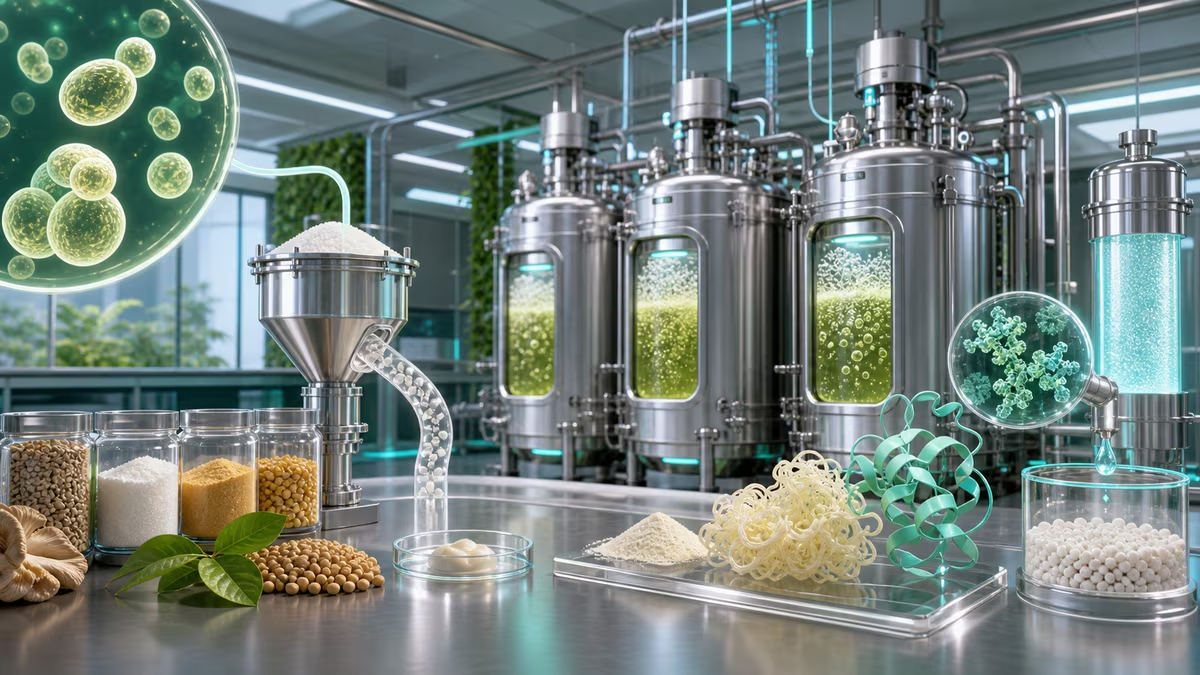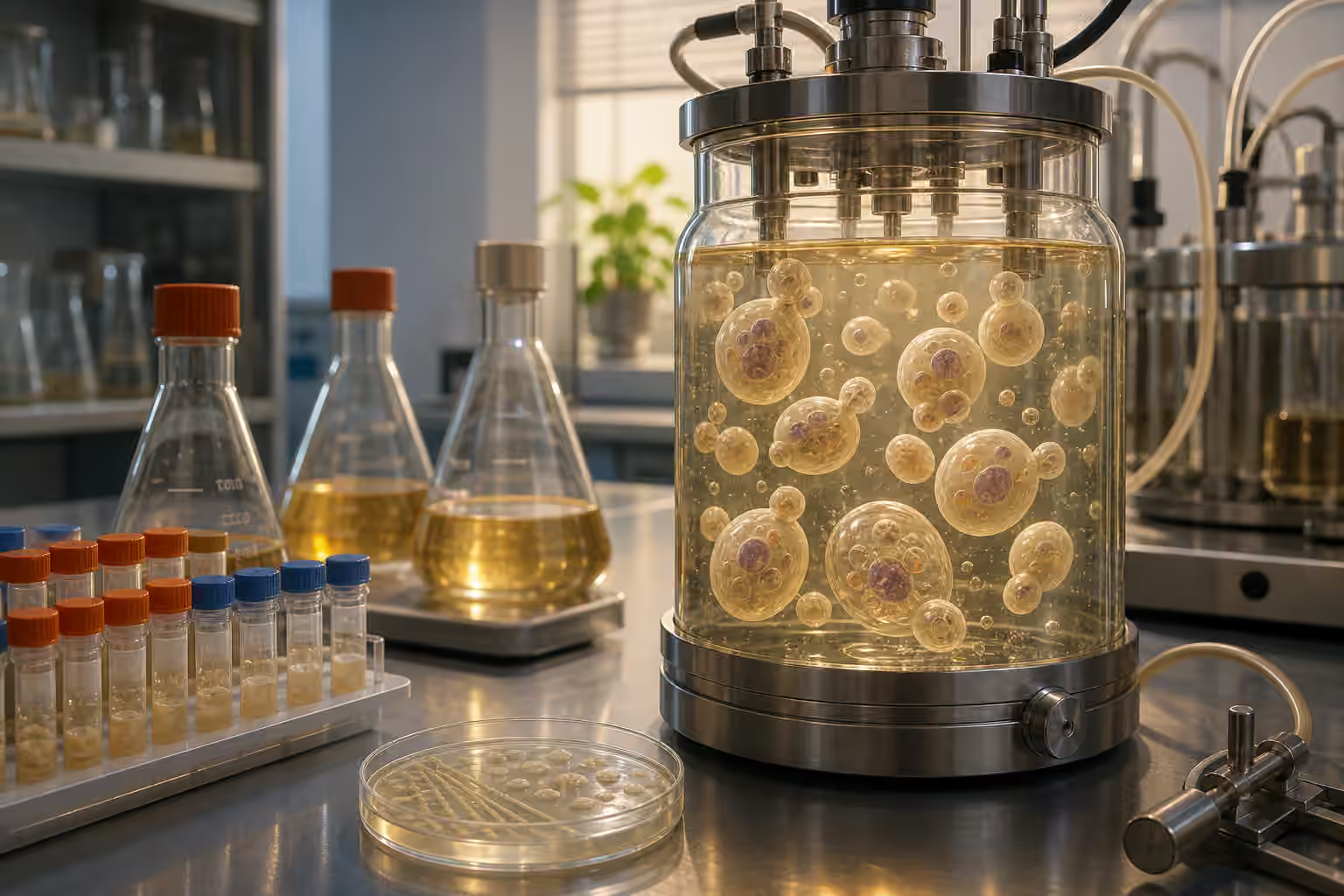
Yeast is easy to underestimate because people already know it from bread, beer, and wine. Familiarity makes it sound ordinary. In synthetic biology, that ordinariness is part of its strength. Yeast brings a long fermentation history, a eukaryotic cell plan, strong genetic tools, industrial experience, and a public story that is often easier to explain than a more obscure microbe. It is not the right chassis for every job, but it is one of the field’s most important workhorses. A related reference is A breakthrough in synthetic biology: industrial scaling-up flavonoid C-glycoside production in yeast .
Calling yeast a workhorse should not make it sound simple. A yeast cell is not a small bacterium with better branding. It has a nucleus, organelles, a secretory pathway, different protein processing habits, different stress responses, and a metabolism shaped by its own evolutionary history. Those features can make yeast valuable for producing enzymes, food proteins, flavors, fragrances, specialty chemicals, research materials, and pathway intermediates. They can also make it slower, more complex, or less convenient than a bacterial host for some tasks.
This guide expands the host-choice discussion in Chassis Organisms and connects it to Precision Fermentation . Chassis selection is not a beauty contest among organisms. It is a fit question. Yeast deserves its own close look because many synthetic biology products live or die on that fit.
Yeast sits between microbe and eukaryote
Yeast is microbial in the practical sense that it can grow as a single-celled organism in fermentation. It can be cultivated, sampled, scaled, banked, and engineered with many familiar bioprocess habits. At the same time, it is eukaryotic. Its internal organization is closer in some ways to plant, animal, and fungal cells than to bacteria. That middle position is why yeast can be so useful.
For some products, a bacterial host is fast, inexpensive, and adequate. For others, the protein needs folding, disulfide bonds, secretion, or processing that a yeast system may handle better. Yeast can sometimes provide a more suitable workplace for eukaryotic proteins while still retaining the convenience of microbial fermentation. That is not a universal rule. Some proteins still require mammalian cells. Some small molecules are easier in bacteria. Some products belong in cell-free systems or plants. Yeast is powerful because it occupies a practical middle ground, not because it replaces every other platform.
Protein Expression and Folding explains why the workplace matters. A protein is not only a sequence. It must fold, avoid degradation, find the right compartment, and remain active under process conditions. Yeast gives designers one set of cellular workplaces. Choosing it means choosing those workplaces with open eyes.
Fermentation history gives yeast a head start
Yeast has been cultivated by humans for a very long time. That history does not automatically solve modern synthetic biology, but it gives the field useful infrastructure. People understand many yeast growth conditions, fermentation behaviors, contamination risks, storage methods, and scale-up habits. Industrial teams know how to move from flask to seed train to larger vessels for certain yeast processes.
This matters because a synthetic biology product is not only a genetic construct. It is a process. Cell Banks and Seed Trains explains why production begins long before the main vessel. Yeast strains can be stored, revived, expanded, and monitored through staged growth. That operational familiarity can reduce some uncertainty, especially when compared with a promising but poorly characterized organism.
Still, history can create overconfidence. A yeast used for one kind of fermentation may not behave the same when carrying a heavy engineered pathway. A strain that makes ethanol well may not secrete a delicate protein well. A lab strain with convenient tools may not be robust under manufacturing conditions. The fact that yeast is familiar does not remove the need for strain development, measurement, and process design.
Secretion is a major reason to choose yeast
One reason yeast attracts synthetic biologists is its ability to secrete some proteins. If a product can be moved into the culture medium in a useful form, recovery may become easier than breaking cells open and separating the target from dense intracellular material. This is why yeast appears in conversations about enzymes, food proteins, and other extracellular products.
Secretion and Export Pathways explains the broader principle. Secretion can simplify recovery, but it can also create bottlenecks. The secretory pathway has limited capacity. Proteins may misfold, degrade, receive unwanted modifications, or stress the cell. A secretion signal that works for one protein may not work for another. The product may appear outside the cell but remain too dilute or heterogeneous for the intended use.
Yeast secretion is therefore a design area, not a guarantee. It asks for promoter choice, signal sequence choice, folding support, host background, product assay, and downstream thinking. A modest amount of well-folded, recoverable product can be more valuable than a loud expression system that fills the cell with damaged material.
Yeast metabolism can be borrowed and redirected
Yeast already makes many molecules people care about: alcohols, organic acids, lipids, aromas, storage compounds, and metabolic intermediates. Synthetic biology can redirect that metabolism toward target chemicals, flavors, fragrances, nutrients, pigments, or precursors. A pathway from another organism may be reconstructed in yeast because yeast can supply a helpful intracellular environment or because fermentation is a practical production route.
The guide to Metabolic Pathway Design is essential here. Adding enzymes is only the visible part of pathway engineering. The cell has to supply carbon, energy, cofactors, precursors, compartment access, and tolerance. Yeast may have useful native routes, but it also has native priorities. It may store carbon, route flux to growth, make byproducts, or respond to stress in ways that compete with the desired product.
Compartmentalization adds opportunity and difficulty. Some reactions may benefit from a particular organelle or redox environment. Some pathway intermediates may need transport between compartments. Some products may affect membranes or stress responses. Yeast gives designers more internal geography than a simple bacterial model, but geography only helps if the traffic is understood.
Strain behavior matters more than the species label
Saying yeast is not specific enough. Different yeast species and strains differ in growth, stress tolerance, substrate use, secretion, temperature preference, genetic stability, product tolerance, and regulatory familiarity. A familiar laboratory yeast may be easy to edit but not ideal for a harsh process. A more industrial strain may tolerate stress but be harder to engineer. A nontraditional yeast may offer attractive metabolism but less mature tooling.
This is where Strain Engineering becomes more important than the general label. The production organism is not chosen once and forgotten. It is adapted, measured, banked, challenged, and improved. A yeast project may require changes to pathway balance, copy number, promoter timing, secretion capacity, tolerance, feed strategy, or byproduct control.
Genetic stability also matters. An engineered yeast strain that carries a costly pathway may drift if cells that reduce or lose the burden grow faster. Genetic Stability and Drift explains why a strain can remain alive and vigorous while the intended function fades. For yeast, the form of the construct, integration strategy, copy number, selection pressure, and process length all influence that risk.
Manufacturing fit decides the claim
Yeast often appears in public stories about animal-free proteins, fermentation-derived ingredients, bio-based chemicals, and cleaner production. Some of those stories are fair. Some need more evidence. A yeast-made molecule still depends on feedstocks, energy, water, purification, waste handling, facility efficiency, quality control, transport, and what it replaces. The organism is only one part of the product claim.
Synthetic Biology Product Claims and Public Trust is the right lens. If a product is described as fermentation-derived, the explanation should make clear what yeast did, what remains in the final product, what has been purified, and what comparison supports any environmental or performance claim. Familiar yeast can help the explanation, but it should not be used as a blanket comfort word.
Yeast synthetic biology is valuable because it combines the craft of fermentation with the complexity of a eukaryotic cell. That combination is neither magic nor nostalgia. It is a practical platform with strengths, limits, and evidence demands. The best yeast projects understand the organism as more than a container. They treat it as a living production partner whose fermentation history, internal machinery, secretion routes, metabolism, and strain behavior all shape the final product.
The workhorse earns its place not by being ordinary, but by being understandable enough to engineer and demanding enough to keep the engineering honest.