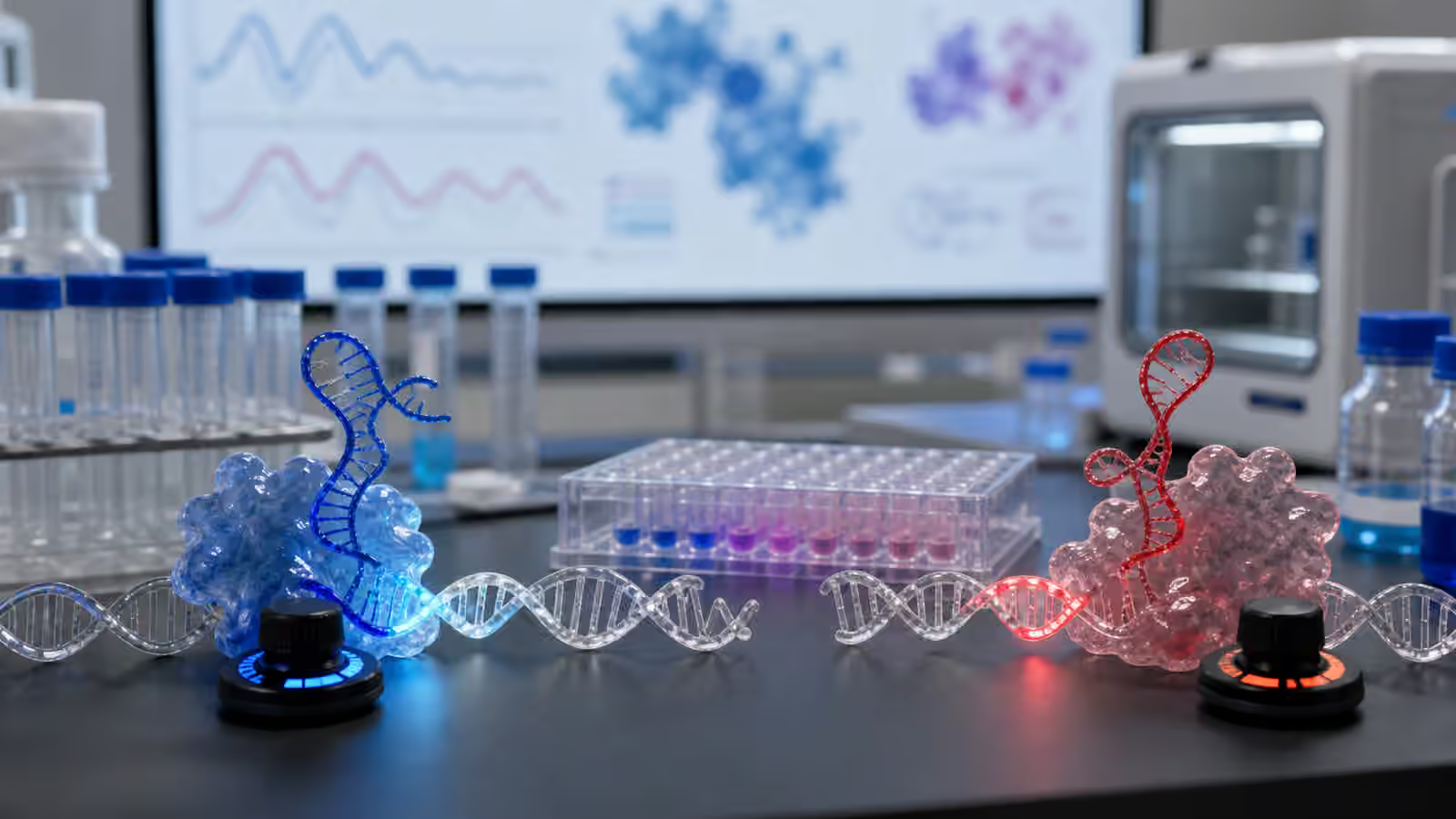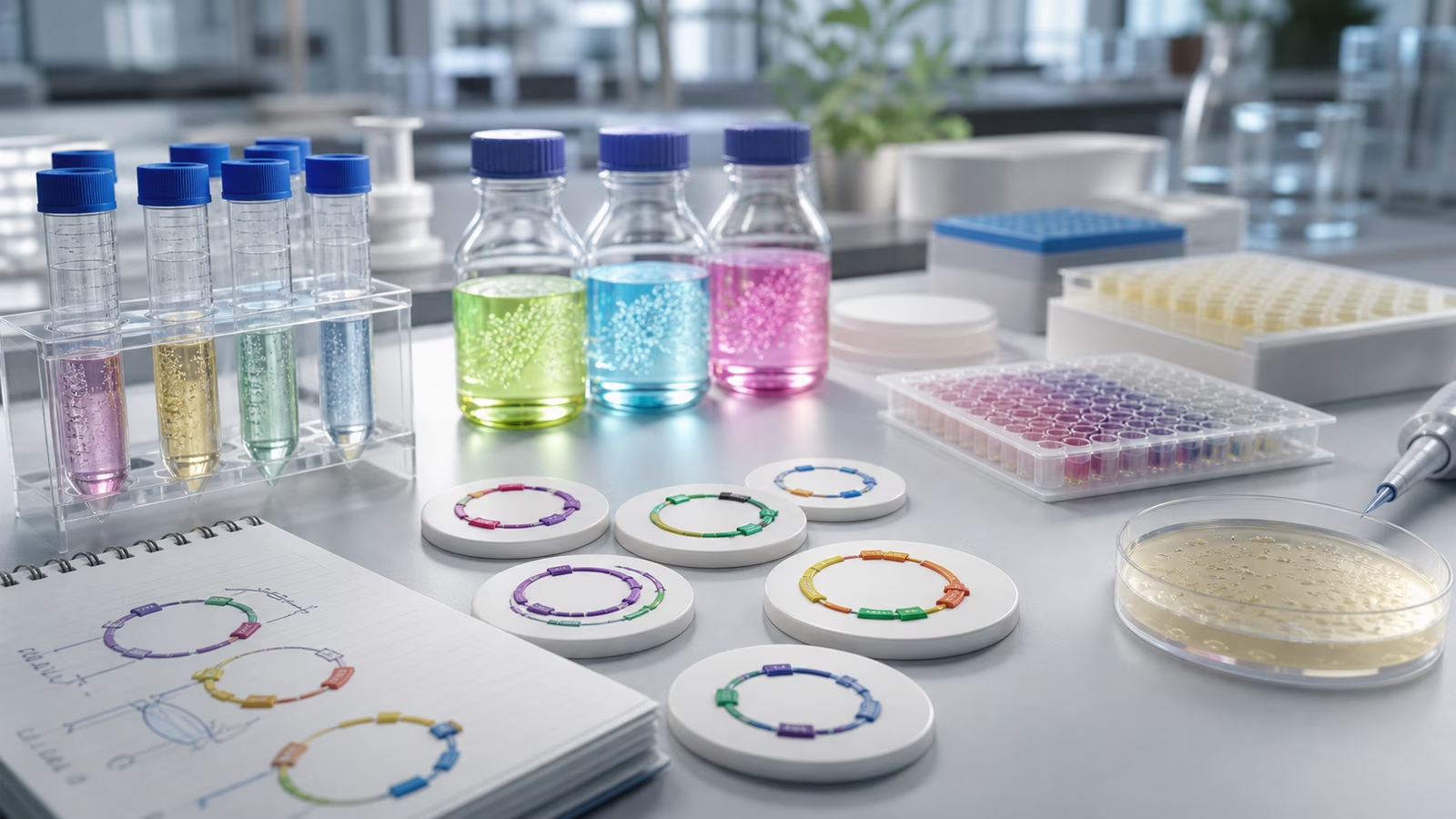
Synthetic biology often begins with a sentence that is both useful and misleading: cells can be programmed.
The useful part is that cells do read instructions. DNA carries information. Genes can encode proteins. Regulatory sequences can influence when those proteins are made. A cell can sense conditions, respond to signals, and route material through biochemical pathways. Researchers can design DNA sequences, place them into a biological context, and ask the cell to perform a new task.
The misleading part is the word programmed. A cell is not a blank computer waiting for commands. It is a living system with metabolism, history, stress responses, evolutionary pressure, limited resources, and many layers of control. A designed DNA circuit is not a script that executes line by line. It is a molecular suggestion placed inside a crowded, adaptive environment.
That tension is the heart of synthetic DNA design. The field borrows engineering language because it needs design discipline, but it survives only when it respects biology. If you have read the Synthetic Biology Quickstart , think of this guide as the closer look at the instruction layer: the parts, switches, circuits, hosts, measurements, and failure modes that sit between an idea and a working cell.
DNA Parts Are More Than Genes
The public story about DNA usually centers on genes, and genes do matter. A gene may encode an enzyme, a structural protein, a sensor, a fluorescent marker, or another molecule that changes what a cell can do. But synthetic biology design is rarely only about adding a gene. The surrounding instructions often decide whether the gene is useful, silent, burdensome, unstable, or harmful to the host cell.
A promoter is one of the easiest regulatory parts to picture. It helps control where transcription begins and how strongly a gene is read into RNA. A strong promoter can push a cell to make more of a protein, but more is not always better. Too much expression can drain energy, clog folding machinery, create toxic intermediates, or slow growth. A weaker promoter may produce less product in each moment while keeping the cell healthier over time.
Other DNA regions influence translation, termination, stability, copying, and compatibility with the host organism. Some designs are carried on plasmids, which are circular DNA molecules that can exist inside cells apart from the main genome. Others are integrated into a chromosome. Each choice changes stability, copy number, burden, inheritance, and how easy the system is to measure.
The important idea is that DNA parts are contextual. A part that behaves cleanly in one organism may perform differently in another. A promoter that works in one strain may be too weak, too strong, or poorly regulated in a different strain. A protein that folds well at one temperature may misfold under another condition. Synthetic biology uses parts, but it cannot treat them like screws in a drawer.
What a Genetic Circuit Means
A genetic circuit is a designed arrangement of biological parts that produces a response. The phrase comes from electronics, but the analogy has limits. An electronic circuit moves electrons through components with relatively predictable behavior. A genetic circuit depends on transcription, translation, protein folding, molecular binding, degradation, growth conditions, cellular resources, and noise.
A simple circuit might ask a cell to turn on a gene when a particular molecule is present. Another might repress one gene while activating another. A more complex circuit might combine signals, create a delay, remember a past exposure, or coordinate several enzymes in a production pathway. In each case, the circuit is an attempt to make the cell connect an input to an output.
Inputs can be nutrients, stress signals, light, temperature, small molecules, or cellular states. Outputs can be proteins, pigments, enzymes, chemical products, growth changes, or measurable reporter signals. A biosensor might produce a readable output when it encounters a contaminant. A microbial factory might activate a pathway only after the culture reaches a useful stage. A therapeutic cell might be designed to respond to a biological cue inside the body, although medical uses require far more evidence and oversight than a simple educational example.
The circuit metaphor becomes most helpful when it makes readers ask about control. When should the system turn on? When should it turn off? How strong should the output be? What happens if the input is weak, noisy, or similar to another molecule? What happens if the host cell mutates? What happens if the circuit consumes resources the cell needs for survival?
Those questions are more valuable than the diagram itself. They move the conversation from magic DNA to testable behavior.
The Host Cell Gets a Vote
Synthetic DNA does not work in empty space. It works inside a host, and the host changes the design.
Engineers choose hosts for many reasons. Some bacteria grow quickly and are easy to study. Yeast can handle certain proteins and fermentation workflows well. Mammalian cells can add modifications that some medicines require. Cell-free systems use biological machinery outside living cells, which can be useful when containment, speed, or toxicity makes whole-cell work difficult. Each host brings strengths, limits, costs, and safety considerations.
The host also has priorities. It wants to grow, repair itself, manage stress, balance energy, and survive. A designed circuit may ask the host to make a costly protein or redirect carbon through an unfamiliar pathway. If the burden is high, cells that lose or weaken the design may grow faster than cells that keep it. Over time, evolution can become an editor, cutting away the expensive instruction.
This is one reason engineered microbes can be both impressive and fragile. The guide to engineered microbes explains the factory metaphor, but the circuit layer explains why the factory must be negotiated into existence. The cell is not simply hired to do a job. It must be kept in a state where the job remains compatible with being alive.
Design Is Not Proof
It is now easier to design DNA on a computer than it is to prove that the design works in biology. That gap defines much of the field.
A design may look elegant because the parts are arranged logically. The promoter points toward the gene. The regulatory element appears to match the intended input. The pathway includes every enzyme needed on paper. The protein sequence seems plausible. But the living result may still disappoint. The gene may be expressed at the wrong level. The protein may fold poorly. An intermediate may accumulate. A reporter may respond to the wrong signal. The cell may grow slowly. The measurement may be misleading.
This is why the design-build-test-learn loop matters so much. Biofoundries exist partly because one biological design is rarely enough. Researchers need to build variants, test them under defined conditions, measure what happened, and use the evidence to redesign. The biofoundries guide covers that loop at the lab automation level. At the DNA circuit level, the lesson is smaller but sharper: a sequence is a hypothesis until the cell answers.
Measurement is where the answer becomes useful. A fluorescent signal may show that a gene turned on, but it may not show that the product is pure, active, stable, or valuable. A high product titer may look promising, but it may hide stress, byproducts, or scale-up problems. A circuit that works once may fail after many generations. Good measurement asks what success actually means for the intended use.
Why Biological Programming Feels Noisy
Cells are noisy because molecules are small in number, reactions are probabilistic, environments fluctuate, and growth itself changes the system. Two cells with the same DNA may not behave identically. One may express a gene earlier. Another may grow faster. A third may be in a different stage of its cycle. In a flask or bioreactor, millions or billions of individual cells create a population-level result, but the individual variation still matters.
Noise is not always bad. Biology uses variability. A population with varied responses may survive stress better than a perfectly uniform one. Synthetic biology sometimes tries to reduce noise, and sometimes tries to use it. The important point is that a designed circuit should be judged in the language of probabilities and distributions, not only in the language of neat diagrams.
Timing adds another layer. A circuit may need to turn on only after cells have grown enough. A production pathway may need early growth and later manufacturing. A biosensor may need a response that is strong enough to read but not so sensitive that it creates false alarms. A material-producing cell may need to coordinate growth, secretion, and structure. These are design problems, but they are also biological negotiations.
Safety Starts at the Design Layer
DNA circuit design is not only a performance question. It is also a safety question.
Responsible work considers the organism, the genetic change, the environment, the intended use, and the controls around it. Some circuits are meant for contained production. Some are meant for research measurement. Some are proposed for environmental sensing. Some are connected to medicine. The risk profile changes with each context.
At the design layer, safety may involve choosing a low-risk host, avoiding unnecessary persistence outside the intended setting, limiting access to sensitive capabilities, screening DNA synthesis orders, documenting materials, and designing for containment. The point is not to make every circuit sound dangerous. The point is to avoid treating DNA as a harmless file just because it begins on a screen.
The Synthetic Biology Safety guide covers biosafety and biosecurity more directly. For circuits, the practical habit is to ask what the design does if it works, what it does if it half-works, and what happens if it moves into a context the designer did not intend.
From Circuit to Product
Many synthetic biology products depend on circuits that ordinary customers never see. Precision fermentation may rely on tuned expression systems that help microbes make a target protein. AI-designed proteins still need cells or cell-free systems to produce and test them. Living materials may use biological regulation to influence growth, texture, or mineralization. Industrial strains may include controls that balance growth with production.
This hidden layer explains why synthetic biology can move slowly even when headlines sound fast. Designing a molecule is one task. Getting a host to make it reliably is another. Scaling the process is another. Purifying the product, proving quality, and earning trust are still others. The guide to AI-designed proteins is useful here because it separates computational promise from laboratory validation. The guide to Bioprocess Scale-Up shows what happens after the circuit works in small vessels.
Synthetic DNA circuits are therefore not the whole story. They are the grammar underneath many stories. They shape when cells sense, make, pause, amplify, repress, remember, or fail. They make programmable biology possible, but they also reveal why the phrase needs caution.
The most grounded way to read a synthetic biology claim is to look for the circuit and then look past it. What instruction was designed? Which host received it? What was measured? How stable was the behavior? What burden did the design create? What controls keep the system in its intended context? What changes when the work leaves the bench?
Those questions do not drain the wonder from the field. They put the wonder where it belongs: not in the fantasy that cells are machines, but in the harder fact that living systems can sometimes be persuaded, carefully and measurably, to do new work.