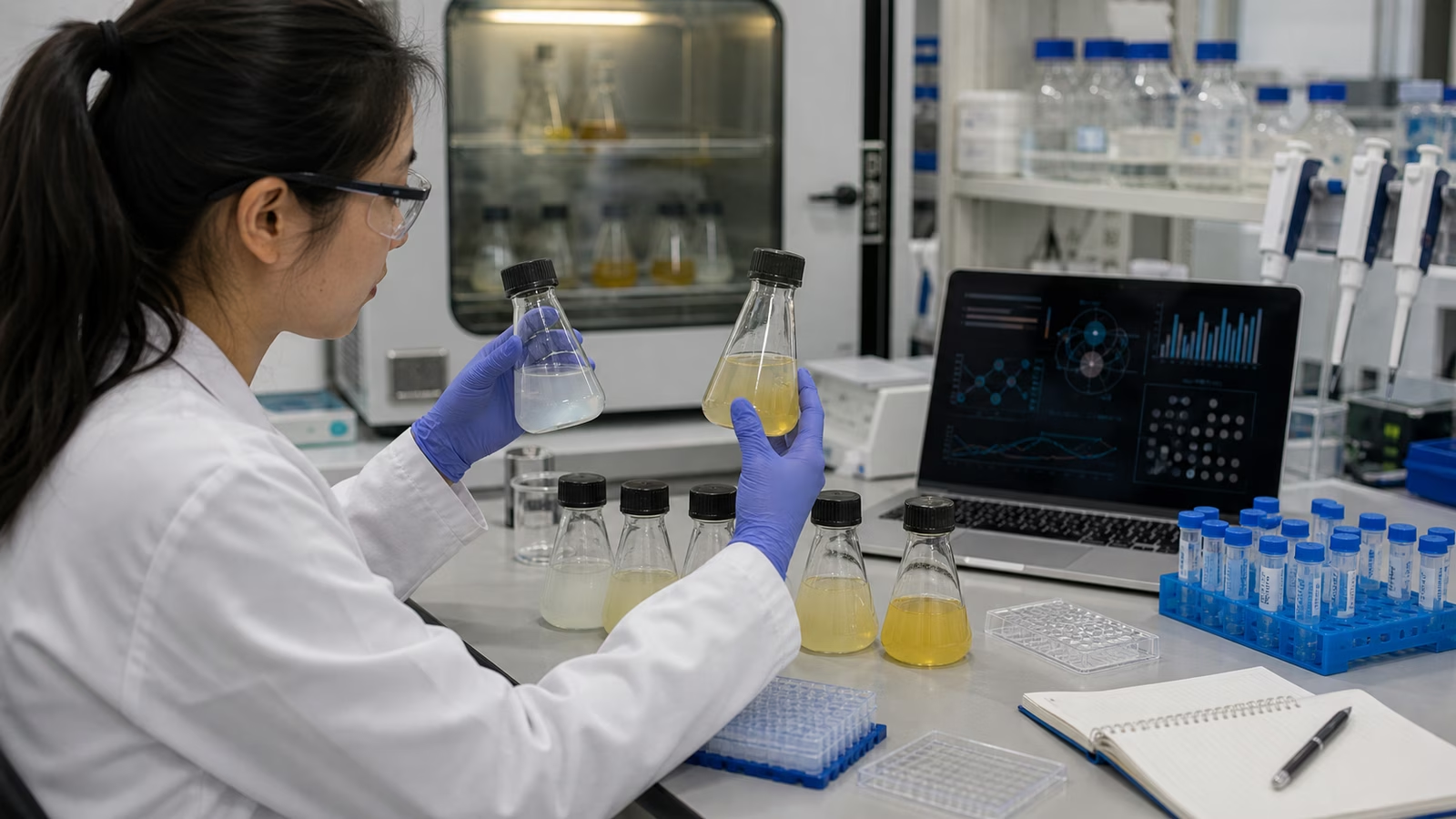
Synthetic biology often begins with a tempting phrase: program the cell. It sounds clean, almost like opening a laptop and changing what a machine does. In practice, the work is less like typing commands into a obedient device and more like training a stubborn living workshop to spend its energy on something it was not born to make.
That is the heart of strain engineering. A strain is a particular version of a microbe or cell line. It may be a familiar laboratory organism, a production workhorse, or a specially chosen chassis that already has useful traits. Engineering the strain means changing its genes, regulation, metabolism, growth behavior, and operating conditions so it can make a product reliably enough to matter.
The product might be an enzyme, flavor molecule, material precursor, therapeutic protein, pigment, oil, organic acid, or research reagent. The first working cell is only the beginning. A cell that makes a trace amount in a small flask is not yet a production strain. It is a proof of possibility.

The chassis is not an empty shell
Engineers sometimes use the word chassis to describe the host organism that receives the new design. The metaphor is useful because it reminds you that the product does not float in air. It needs a body to make it. But the metaphor can also mislead. A cell is not an empty frame waiting for parts. It already has priorities.
A cell wants to grow, repair itself, manage stress, maintain membranes, use nutrients, control waste, and survive changing conditions. When synthetic biology asks it to make a new compound, the cell has to redirect resources. Carbon, nitrogen, energy, enzyme capacity, cofactors, transport, and time all become part of the negotiation.
This is why strain engineering often starts with choosing the host carefully. A microbe that is easy to edit may not be best for secretion. A host that grows quickly may not tolerate the product. A strain that performs beautifully in a small flask may behave differently in a fermenter. The chassis matters because biology always brings history into the design.
Engineered Microbes explains the broad idea of asking bacteria, yeast, or other organisms to make useful things. Strain engineering is the narrower craft of making that request practical.
Pathways are promises the cell may not keep
Many products require a pathway: a chain of biological steps that turns starting materials into the desired molecule. On paper, a pathway can look straightforward. Enzyme A makes intermediate B. Enzyme B makes intermediate C. Another enzyme finishes the product. The diagram is clean because diagrams are patient.
Inside the cell, every step has context. One enzyme may work slowly. Another may need a cofactor that is scarce. An intermediate may be toxic. A side pathway may steal material. A product may leak poorly through the membrane. The cell may respond to stress by shutting down the very machinery the engineer hoped to use.
The strain engineer therefore spends a great deal of time on balance. Too little expression and the pathway does not produce enough. Too much expression and the cell becomes burdened. One enzyme may need to be strengthened while another must be weakened. A competing pathway may need to be reduced, but not so aggressively that the cell becomes sick.
This is where synthetic biology stops looking like simple insertion and starts looking like tuning. The question is rarely whether one gene can be added. The question is whether the whole living system can carry the new job without falling apart.
Burden is the hidden tax
Biological production is not free to the cell. Making extra proteins uses energy and ribosomes. Moving metabolites through a pathway uses carbon and cofactors. Exporting a product can stress membranes. Accumulating the wrong intermediate can slow growth or trigger defensive responses.
This cost is often called burden. It is one of the reasons a strain that works once may fail after repeated growth. Cells that stop making the burdensome product may grow faster than cells that keep making it. Over time, the culture can select against the very trait the engineer wanted.
Good strain engineering respects burden early. It asks whether the production pathway can be stable, whether expression should be induced only after growth, whether the product can be secreted, whether the host can tolerate the molecule, and whether the design will survive enough generations to be useful.
Synthetic DNA Circuits helps explain the regulatory side. A circuit can turn expression on, tune timing, or respond to signals. In strain engineering, regulation is not decorative. It is a way to keep the cell from being crushed by the job too soon.
Screening is where hope meets numbers
The first engineered strain is rarely the best one. Teams build variants, measure them, compare them, and build again. A small difference in promoter strength, enzyme version, gene copy number, transport, media, or growth condition can change performance. The work becomes a cycle of design, build, test, and learn.
This is why biofoundries matter. Biofoundries Explained describes the automation and measurement culture behind modern synthetic biology. Strain engineering benefits from that discipline because the search space is large. A human can have a clever idea, but the lab still needs reliable data to know which variant actually improved.
Measurement also keeps the team honest. A strain may look promising because the culture changed color, grew quickly, or produced a nice signal in one assay. But production work asks harder questions. How much product was made? How fast? Under which conditions? With what byproducts? Was the result reproducible? Did the strain stay stable? Did the measurement itself interfere with the process?
The best strain is not always the one with the most exciting single result. It is often the one that behaves predictably enough to build on.
The flask is not the factory
A strain that works in a small flask enters a new world when it moves toward scale. Oxygen transfer changes. Mixing changes. Heat removal changes. Nutrient gradients appear. Cells experience shear, foam, pH shifts, and timing differences that were not obvious at the bench.
Bioprocess Scale-Up exists because this transition is one of the most humbling parts of biotechnology. Strain engineering has to anticipate it. A beautiful pathway in a fragile strain may become useless if the cell cannot handle the production environment. A slightly less glamorous strain that tolerates the fermenter may win.
This is why industrial biology is not only genetic design. Media, feeding strategy, fermentation control, downstream purification, waste handling, contamination prevention, and cost all shape whether the strain matters. The production cell is part of a process, not a standalone miracle.
Safety is part of the engineering brief
Strain engineering also carries safety questions. What organism is being used? What genes are being introduced? What product is being made? What containment is appropriate? What happens to waste streams? How is accidental release prevented? How are workers protected? How are claims about safety documented rather than assumed?
The answer depends heavily on the organism and product. A familiar production microbe making an ordinary enzyme raises different questions from a novel organism, a toxic intermediate, or a strain designed for environmental release. Responsible synthetic biology does not treat all engineered life as equally risky, but it also does not wave risk away because the design is clever.
Synthetic Biology Safety belongs beside this guide because strain engineering is where imagination becomes a living system in a lab, pilot plant, or factory. Safety has to follow the work from the first design through scale-up and disposal.
Strain engineering is slow because cells are real. They push back. They compensate. They mutate. They surprise. They also make possible forms of production that ordinary chemistry or extraction cannot easily match. The mature view holds both truths at once. Biology can be engineered, but not commanded like a simple machine.
The production strain is what remains after the slogan has been tested against metabolism, burden, measurement, scale, and safety. It is less magical than the phrase “programming life.” It is also far more interesting.