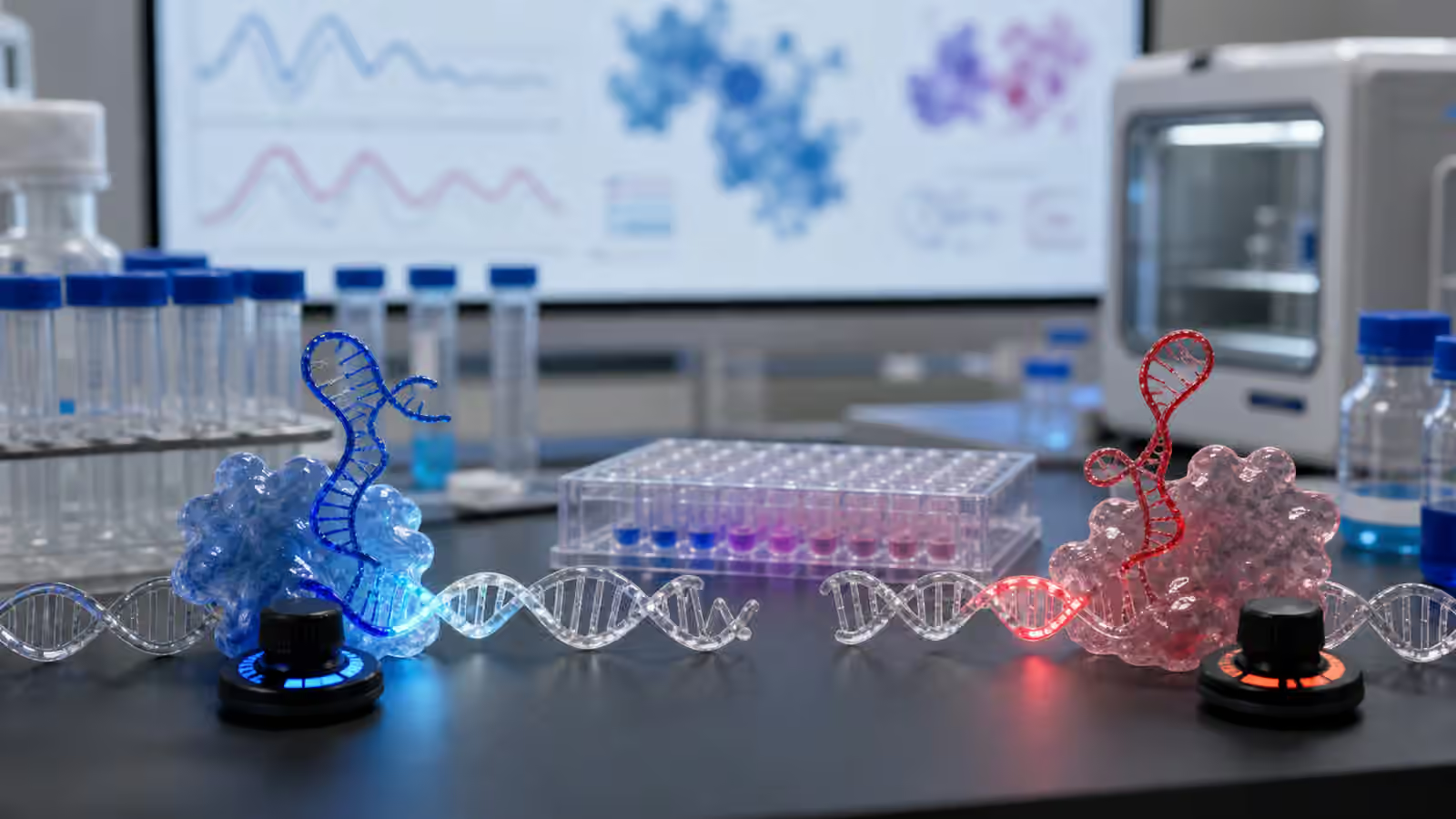
Synthetic biology often starts its explanation with DNA and ends it with proteins. DNA stores the designed instruction. Proteins do much of the work. Between those two, RNA is sometimes treated like a temporary copy, a messenger that carries information from one place to another before disappearing. A related reference is Designing RNA switches for synthetic biology using inverse-RNA-folding .
That picture is too small.
RNA can be a message, but it can also be a sensor, a switch, a guide, a scaffold, a timing device, and a regulator. It folds into shapes. It binds other molecules. It can hide or reveal parts of itself. It can recruit enzymes, block translation, expose a start signal, mark a sequence address, or change how long a message lasts inside a cell. In synthetic biology, RNA is not merely the hallway between DNA and protein. It is one of the control rooms.
This guide sits between Synthetic DNA Circuits and Gene Expression Tuning . DNA circuits explain how designed instructions are arranged. Expression tuning explains why output level has to be balanced against burden, stability, and measurement. RNA switches explain one of the most useful ways those instructions can become conditional, temporary, and responsive without treating the cell like a simple machine.
RNA Is Information With Shape
DNA is often described as a stable archive, and RNA as a working copy. That distinction is useful as a first pass. In many cells, a gene is transcribed into messenger RNA, and ribosomes read that messenger RNA to make a protein. If the message is abundant, stable, and easy for the ribosome to read, the cell may make more protein. If the message is rare, degraded quickly, folded awkwardly, or blocked by another molecule, the output may be lower.
Synthetic biology cares about that middle layer because RNA is both readable and physical. Its sequence matters, but so does the shape it folds into. A stretch of RNA can pair with another stretch from the same molecule, forming a hairpin. It can leave a region exposed or tucked away. It can change shape when it binds a small molecule, protein, ion, or another RNA. It can become more or less available to the cellular machinery that reads it.
That makes RNA a natural place to build control. A DNA-level change may be inherited for many generations. A protein-level control may require making and degrading a comparatively expensive molecule. RNA sits in between. It can respond quickly, disappear quickly, and adjust output without permanently rewriting the genome. That does not make it simple. It makes it useful in a different way.
A Switch Can Hide a Signal Until Conditions Change
The simplest way to imagine an RNA switch is to picture a folded note. The information is present, but part of it is hidden. A condition changes, the fold changes, and a previously hidden region becomes visible. In biology, the visible region might be a place where a ribosome can begin translation, a sequence that encourages degradation, a binding site for another RNA, or a structural shape that changes how the message behaves.
Natural cells already use RNA control. Riboswitches are RNA elements that can bind small molecules and change gene expression in response. A cell may use this kind of control to adjust metabolism when a nutrient or metabolite is present. Synthetic biology borrows the principle: an RNA element can connect a molecular input to a biological output.
The attraction is directness. If a designed RNA changes shape when it sees a target, the cell may not need a separate protein sensor for that first recognition step. In some systems, that can reduce burden and simplify the circuit. In other systems, RNA control can be layered with protein regulators and DNA-level design to create more nuanced behavior.
The caution is that folding is context-sensitive. A switch that behaves in a test tube may behave differently inside a living cell. Temperature, salts, host proteins, RNA-degrading enzymes, expression level, neighboring sequences, and growth state can all change the result. As with any synthetic biology design, the switch is a hypothesis until measurement shows what it actually does.
Riboswitches, Toehold Switches, and the Logic of Exposure
Riboswitches and toehold switches are two common examples of RNA control, and they show why RNA attracts circuit designers.
A riboswitch usually combines a sensing region and a regulatory region in the same RNA. When the sensing region binds its target molecule, the RNA can fold differently. That folding change can alter expression. The target might be a metabolite or another small molecule relevant to the cell’s state. In a synthetic biology setting, a riboswitch can help connect a chemical condition to a genetic response, but its success depends on whether binding, folding, and output all remain reliable in the chosen host.
A toehold switch is often discussed in the context of RNA-triggered detection. In a simplified view, the switch RNA folds in a way that keeps translation blocked. A matching trigger RNA binds to an exposed starting region, opens the fold, and allows the output to turn on. The concept is powerful because sequence recognition can be designed with a high degree of programmability. It also makes toehold systems attractive for biosensors and living diagnostics , especially when paired with cell-free synthetic biology where the machinery can respond outside a living cell.
The important lesson is not the name of any single switch. It is the design logic. RNA can control output by exposing or hiding a functional region. A biological signal does not have to be converted into a protein regulator before anything happens. Sometimes the molecule carrying information can also be the molecule making the decision.
Guide RNAs Give Biology an Address
RNA switches are not only about turning expression up or down. Some RNAs guide biological machinery to a specific address. Guide RNAs are best known through genome editing systems, where an RNA sequence helps direct an associated protein complex toward a matching nucleic acid target. The details vary by system, and responsible work belongs in trained, controlled settings, but the conceptual point is evergreen: RNA can provide programmable recognition.
That recognition layer matters far beyond the public shorthand of “gene editing.” A guide RNA is a way to make a biological tool conditional on sequence identity. It can help a system find a location, report on a sequence, regulate a message, or recruit an activity to a specific molecular address. In Genome Editing in Synthetic Biology , the goal is often to make a designed change stick. In RNA-guided control, the broader idea is that base pairing can be used as a search function inside biology.
This is one reason RNA feels closer to software than many other biological layers. A short sequence can redirect a system toward a different target. But the analogy should not be pushed too far. Specificity, off-target binding, delivery, expression level, host context, and measurement all decide whether the address is useful. A guide that looks exact on a screen still has to behave inside a crowded molecular environment.
RNA Control Is Fast, But It Can Be Fragile
RNA’s temporary nature is a strength and a weakness. Because many RNAs turn over quickly, an RNA-based design can respond faster than a design that depends on building up or removing stable proteins. That makes RNA useful for sensing, timing, screening, and prototype circuits where researchers want to observe changes without waiting for a permanent cellular commitment.
The same turnover can make RNA hard to manage. Messages can be degraded before they act. Structures can misfold. The host can process or modify RNA in ways the designer did not intend. A switch can leak, producing output even when it is supposed to be off. A switch can fail to turn on strongly enough when the input appears. A trigger can bind a near match, creating a false signal. A beautiful design can become weak when moved from a cell-free reaction into a living organism, or from one organism into another.
None of this makes RNA switches unreliable by definition. It means they have to be treated as biological devices rather than decorative sequences. The same habits that support Biological Measurement and Controls apply here: compare against appropriate controls, track context, check repeatability, measure timing, and avoid trusting a single bright signal without asking what produced it.
Cell-Free Systems Make RNA Easier to Study
Cell-free synthetic biology is one of the clearest places to understand RNA switches. When cellular machinery is extracted or reconstituted outside living cells, researchers can sometimes test RNA designs with fewer complications from growth, inheritance, and long-term evolution. A cell-free reaction can still be complex, but it narrows the question. Does this RNA design respond under these reaction conditions? Does the output rise above background? Does it distinguish the intended trigger from related signals?
That is why RNA switches often appear in sensing conversations. A cell-free system can be paired with designed RNA elements to detect a nucleic acid signal or small molecule signal, then produce a readable output. This does not remove the need for validation, sample preparation, controls, or careful interpretation. It does create a useful prototyping space between a pure diagram and a living engineered organism.
The connection to Biofoundries Explained is also natural. RNA designs can be varied, built, tested, and compared in families. A biofoundry mindset helps because the question is rarely whether one perfect switch exists. The practical question is which version performs with enough specificity, dynamic range, timing, and robustness for the intended use.
RNA Adds a Middle Layer to Product Thinking
For biomanufacturing, RNA control can help separate growth from production, reduce burden, tune pathway steps, or create conditional responses. A production strain may need to grow first and make product later. A pathway may need one enzyme held back until an intermediate is available. A biosensor strain may need a low background signal until a target appears. RNA is one possible layer for that kind of timing and control.
It is not always the right layer. DNA-level changes may be more stable. Protein regulators may offer stronger amplification or richer logic. Process conditions may be easier to control than a genetic switch. A mature production system may prefer the boring option if it is easier to measure, scale, and document. The value of RNA control is not that it replaces other tools. It adds another design surface.
This matters because synthetic biology products often fail in the middle, not at the headline. A molecule can be useful, a pathway can be plausible, and a host can be familiar, while the control strategy remains too noisy or burdensome. RNA switches give designers another way to ask for conditional behavior without assuming that maximum expression is always progress.
The Switch Has to Earn Trust
An RNA switch should be judged by behavior, not elegance. Does it respond to the intended input? How much does it leak when the input is absent? How quickly does it turn on and off? Does it remain specific in the presence of similar molecules? Does it behave the same across batches, temperatures, growth states, or reaction conditions? Does the output mean what the reader thinks it means?
Those questions sound plain because they are the foundation of trustworthy synthetic biology. A switch that works only under one narrow condition may still be useful for research. A switch proposed for manufacturing, diagnostics, environmental sensing, or therapeutic work carries a heavier burden of evidence. The technical design has to be paired with controls, safety review, documentation, and honest claims about uncertainty.
RNA switches are exciting precisely because they make biology feel more programmable while reminding us that programmability is not certainty. They operate in the slippery space between sequence and structure, signal and noise, design and host context. That is why they deserve their own place in the synthetic biology map. DNA may hold the instruction, and proteins may do much of the labor, but RNA often decides how, when, and whether the instruction is heard.