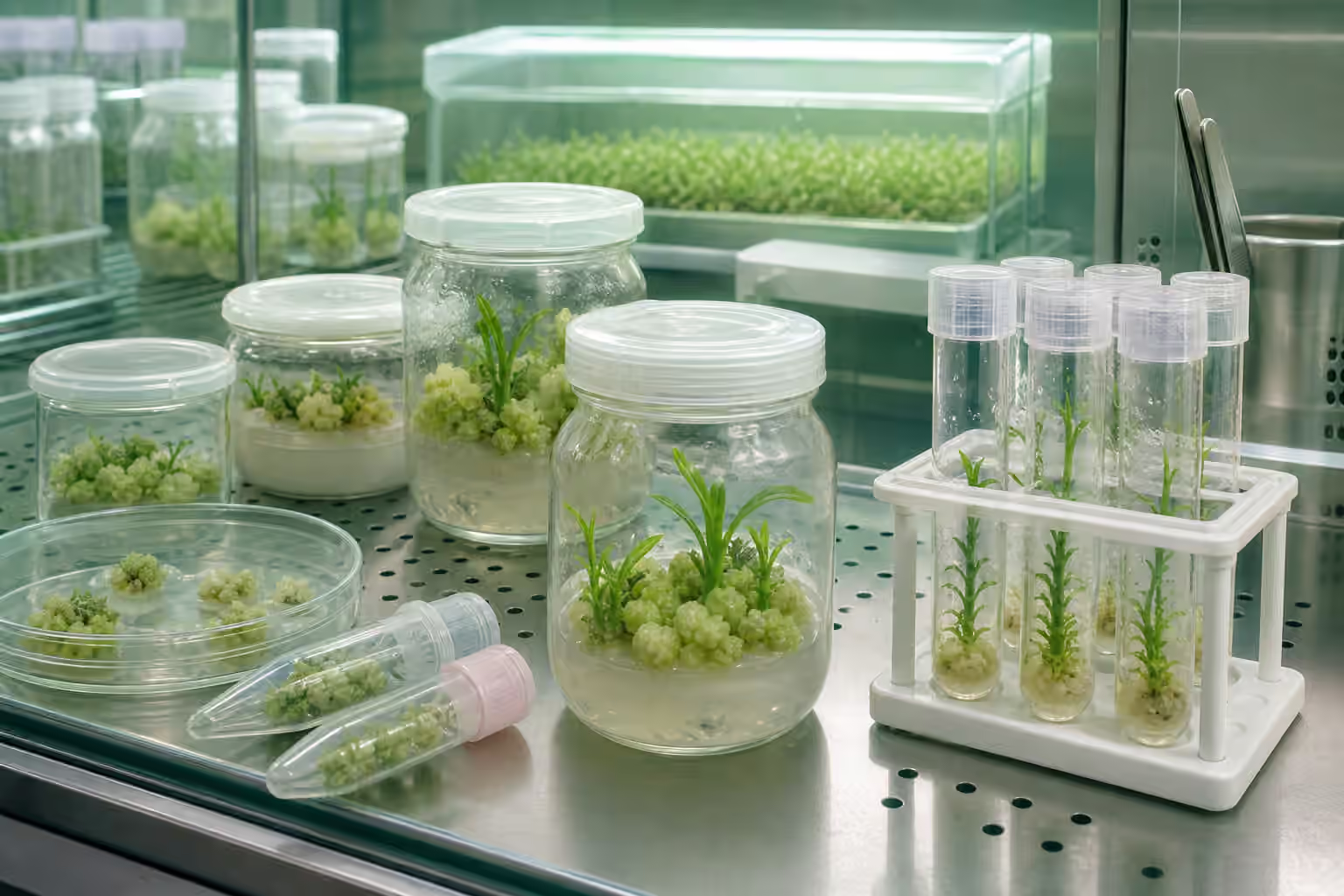
Synthetic biology is often introduced through microbes. A bacterium or yeast cell is easier to picture as a tiny production vessel: add a pathway, tune expression, feed the culture, measure the output, and scale the process if the biology holds up. Plants belong to the same map, but they change the conversation. They are not stirred tanks with leaves attached. They are multicellular organisms with roots, stems, leaves, flowers, seeds, storage tissues, seasonal rhythms, and a life cycle that can stretch far beyond a microbial batch. A related reference is Synthetic biology unlocks programmable control of complex plant glycan metabolism .
That makes plant synthetic biology slower in some ways and richer in others. Plants already know how to harvest light, build complex cell walls, produce oils and starches, make pigments and scents, interact with soil, defend themselves, and turn carbon dioxide into biomass. A plant is not only a possible product. It is also a living manufacturing system, a sensor, a material platform, and an ecological participant.
This guide fits beside Chassis Organisms because a plant is a very different chassis from a microbe, mammalian cell line, algae strain, or cell-free reaction. It also connects to Genome Editing in Synthetic Biology , because plant engineering often depends on making durable changes and then asking whether those changes survive development, inheritance, measurement, and real growing conditions.
A Plant Is a Whole-Body Platform
Engineering a microbe usually means changing a single-celled organism and watching a population of similar cells grow. Engineering a plant means working with an organism whose tissues do different jobs. A root absorbs water and minerals, communicates with soil organisms, and anchors the plant. A leaf captures light, exchanges gases, and performs photosynthesis. A seed stores energy and carries the next generation. A flower may shape reproduction. A stem moves water, sugars, and signals between places.
The same engineered instruction can behave differently across those tissues. A protein that is useful in a seed may be wasteful in a leaf. A pigment pathway that belongs in a petal may burden a root. A defense signal that helps under one condition may slow growth under another. Plant synthetic biology therefore spends a great deal of attention on where and when a design should act, not only on what sequence should be inserted.
This tissue context is one reason plant engineering should not be explained as simply adding a trait. A trait is a visible behavior of the whole organism. It emerges from genes, regulation, development, environment, and measurement. A plant can carry a correct genetic change and still fail to show the desired trait if timing, tissue specificity, expression level, or growth conditions do not line up.
Chloroplasts Make the Platform Distinct
Chloroplasts are one of the reasons plants attract synthetic biologists. They are the compartments where photosynthesis takes place, but they are also biological systems with their own history, DNA, ribosomes, membranes, and protein machinery. To an engineer, that makes them both valuable and demanding. A chloroplast can be seen as a specialized production compartment inside a plant cell, but it is not an empty reactor. It is tied to light, energy flow, carbon fixation, redox balance, and plant development.
Engineering chloroplasts can be attractive because the compartment may support high local expression for some products, separate certain activities from the rest of the cell, and connect biological production to photosynthetic tissue. It can also raise different inheritance and containment questions depending on the plant and design. Those details matter too much to be reduced to a slogan. Chloroplast engineering is not automatically safer, cleaner, or easier. It is a design option whose value depends on the organism, product, use, and evidence.
The broader lesson is that plant cells are compartmentalized. A molecule may need to be made in a chloroplast, cytosol, vacuole, endoplasmic reticulum, seed storage body, or cell wall environment. The right address can decide whether a design works at all. This is the same principle described in Plasmids, Vectors, and Delivery , but plant cells add walls, organelles, regeneration, and development to the delivery problem.
Metabolism Is Already Specialized
Plants are remarkable chemists. They make sugars, oils, fibers, lignin, pigments, scents, bitter compounds, signaling molecules, and defensive chemicals. Some of those molecules are valuable because they are hard to obtain in large quantities from their original source. A fragrance compound may appear in tiny amounts in a flower. A medicinal precursor may be made by a plant that grows slowly. A pigment may depend on tissue and season. Synthetic biology asks whether these pathways can be understood, redirected, or moved into a more practical production context.
Sometimes the practical answer is not to engineer the plant directly. A plant pathway may be rebuilt in yeast or another microbe, then run in a contained fermentation process. That route can make sense when the goal is a purified molecule and the pathway can be made to work in a microbial host. In other cases, the plant itself may be the better platform because the product belongs in a seed, fiber, leaf, fruit, or growing material.
Metabolic Pathway Design explains why pathways behave like traffic rather than simple plumbing. Plant pathways make that lesson vivid. Carbon flow, light, cofactors, storage tissues, transport, enzyme location, and developmental timing all shape the result. Raising one compound may lower another. Strengthening one pathway may weaken growth. A plant may respond to a new pathway as stress, not progress.
The mature question is therefore not whether a plant can make a molecule. Many plants already make astonishing molecules. The useful question is whether the pathway can be adjusted without breaking the organism, confusing the measurement, or creating a product story that only works under narrow conditions.
Traits Need Measurement, Not Just Hope
Plant traits are tempting because they are visible. A plant grows taller, stays greener, roots differently, produces a colored tissue, stores more oil, changes fiber quality, or responds differently to stress. Visible differences are useful, but they can also mislead. A plant that looks healthier in one tray may have had better light, water, soil, spacing, or handling. A seed trait may change with maturity. A stress response may help under one condition and hurt under another.
This is why the measurement habits in Biological Measurement and Controls matter in plant synthetic biology. Controls, calibration, repeatability, metadata, and careful comparisons are not paperwork. They are how a team separates an engineered trait from ordinary biological variation. Plant experiments often need attention to growth stage, environment, genotype background, sampling position, and time. Without that context, a promising trait can become a story that cannot be repeated.
The same caution applies to yield and sustainability claims. A plant engineered to make more of one product may still need land, water, nutrients, harvest logistics, storage, processing, and quality checks. A greenhouse result may not predict a field result. A field result in one climate may not travel to another. A product made in leaves may need different recovery steps from a product stored in seeds. Plant biology does not remove the ordinary work of production. It moves that work into a living organism with roots and weather around it.
Delivery, Regeneration, and Time Change the Pace
Plant engineering often moves more slowly than microbial engineering because a plant is harder to edit, regenerate, grow, and evaluate. Plant cells have walls. Many projects involve tissue culture or regeneration from transformed cells. Some species and varieties are easier to work with than others. A change may need to pass through development before its effect can be judged. If inheritance matters, the work may have to follow seeds and generations rather than overnight cultures.
That slower pace changes the design culture. In a microbe, a weak construct can sometimes be rebuilt quickly and tested again. In a plant, the cost of a poor design can be weeks or months of waiting before the result becomes clear. This puts pressure on careful planning, good part choice, strong measurement, and realistic claims about uncertainty. It also makes intermediate systems valuable. Transient expression, model plants, cell cultures, and contained greenhouse studies can answer some questions before a full plant line is treated as meaningful.
The point is not that plant synthetic biology is less programmable. It is programmable under a different clock. Development, tissue identity, season, environment, and inheritance all participate in the result. A design that ignores those layers may look elegant on a screen and still become weak when asked to grow.
Containment Is Different When the Organism Has Pollen and Seeds
Safety in plant synthetic biology is not only a lab question. Plants can make pollen, seeds, roots, residues, and biomass. They may interact with insects, soil organisms, neighboring plants, animals, farm workers, processing equipment, and food or material supply chains. A contained laboratory plant raises one set of questions. A greenhouse plant raises another. A crop, tree, or environmental plant raises a broader set.
That does not mean all plant engineering carries the same risk. The organism, trait, location, reproductive biology, intended use, containment plan, and oversight matter. A contained model plant used for research is not the same as a plant intended for open cultivation. A non-food industrial plant is not the same as an edible crop. A trait that changes a leaf pigment is not the same as a trait that affects toxicity, persistence, or ecological interactions.
Synthetic Biology Safety is the broader reference because plant systems make safety concrete. The question is not whether engineered plants are good or bad as a category. The better question is what this plant, carrying this design, in this place, with this route of exposure and this containment plan, could plausibly do. Responsible plant synthetic biology asks that question early rather than after the exciting image has already become a claim.
Plants Expand the Meaning of Biomanufacturing
Most biomanufacturing guides focus on tanks, feedstocks, purification, and process control. Plants broaden that picture. A plant can be a production organism in the ground, in a greenhouse, in a vertical farm, in a contained growth room, or in a tissue culture system. It may make a molecule for extraction, a food ingredient inside edible tissue, a fiber with altered properties, a biosensor signal, or a living material precursor.
This expansion is powerful, but it should not be romanticized. A plant-based production system still has batch variation, contamination risks, identity checks, harvesting constraints, downstream processing, storage conditions, and product specifications. It may also carry agricultural uncertainties that a stainless-steel fermenter avoids. The comparison is not a contest between natural and artificial. It is a choice among production contexts, each with different evidence demands.
That is where plant synthetic biology earns its place on the shelf. It reminds synthetic biology that not every chassis is a microbe, not every factory is a tank, and not every engineered output is a purified molecule. Leaves, roots, seeds, chloroplasts, and growth environments can become part of the design. They also become part of the burden of proof. A plant can be engineered, but it has to be understood as a plant: developmental, environmental, reproductive, and alive at the scale of an organism.