Plant synthetic biology often brings to mind greenhouses, engineered seeds, altered leaves, and crops growing under carefully managed conditions. That picture is important, but it is not the whole plant story. Sometimes the useful platform is not the whole plant at all. It is plant cells growing in contained culture, separated from roots, weather, pollination, field logistics, and the long life cycle of a mature organism. A related reference is Plant cell cultures for the production of recombinant proteins .
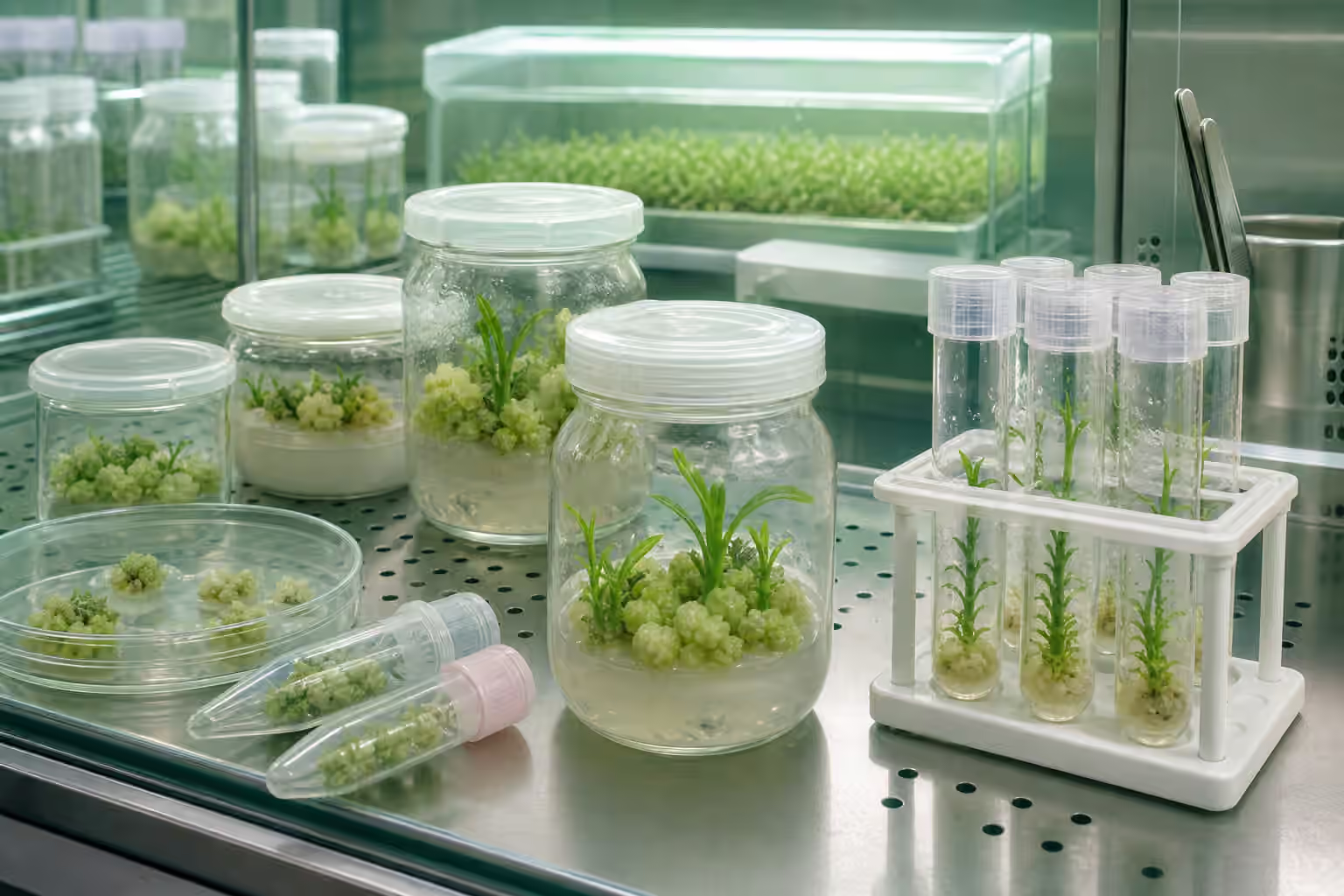
Plant cell culture biomanufacturing uses the fact that plant cells can sometimes grow as callus, suspension cultures, hairy roots, or other contained systems that still carry plant chemistry. These cultures can make pigments, fragrances, flavors, defense compounds, proteins, specialty metabolites, research materials, or pathway intermediates. They can also disappoint when growth is slow, yields drift, cells change state, or downstream recovery becomes harder than the green promise suggested.
This guide extends Plant Synthetic Biology by focusing on contained plant cells rather than whole organisms. It also connects to Biomanufacturing Feedstocks and Downstream Processing , because a culture system is only useful if it can be fed, monitored, recovered, and explained honestly.
A plant cell is not a tiny leaf
A cultured plant cell carries plant biology, but it is not simply a miniature version of the whole plant. A leaf cell in a plant lives inside tissue architecture, light gradients, vascular connections, developmental signals, mechanical context, and environmental rhythms. A callus culture or suspension culture lives in a different world. It may be fed sugar rather than relying on photosynthesis. It may grow in liquid or gel media. It may lose some tissue identity while retaining parts of the plant’s metabolic potential.
That difference is the point and the challenge. Removing the whole plant can make production more contained and controllable. It can reduce dependence on field seasons, land, pests, and harvest timing. It can keep the production organism inside vessels and clean benches. But removing the whole plant can also remove signals that normally help the desired chemistry occur. A compound made in a specialized root, leaf, seed, or flower may not appear at useful levels in undifferentiated culture unless the system is carefully developed.
Synthetic biology has to respect that gap. The useful question is not only whether a plant species naturally makes a molecule. It is whether the relevant cells, culture state, pathway, and process can make it reliably enough for the intended use.
Containment changes the safety conversation
One reason plant cell culture is attractive is containment. A culture vessel does not produce pollen, spread seed, or behave like a field crop. For certain products, that can simplify the environmental part of the discussion. The production system can be managed more like a bioprocess, with defined inputs, cleaning, waste handling, strain or line identity, and controlled access.
Containment is helpful, but it is not a slogan that settles every concern. The culture may still involve engineered cells, biological waste, media components, product impurities, and facility practices that need oversight. A product intended for food, cosmetics, medicine, research, or industrial use has its own safety and quality questions. If the product is purified away from the cells, that distinction matters. If living cells or cell-derived material remain in the product, the questions change.
Synthetic Biology Safety provides the broader frame. The risk profile depends on organism, construct, product, process, exposure, and use. Plant cell culture changes some of those variables, especially environmental release routes, but it does not remove the need for evidence.
Plant chemistry is the attraction
Plants make a remarkable range of molecules. Some attract pollinators. Some defend against insects or microbes. Some store energy. Some give color, scent, bitterness, texture, or medicinal activity. Many are produced in low amounts, in specific tissues, or under specific conditions. Harvesting them from whole plants can be limited by land, season, slow growth, low concentration, ecological pressure, or inconsistent quality.
Plant cell culture offers another route. Instead of growing a whole organism to harvest a small amount of material, a company or lab may try to grow the relevant cells in a contained system and encourage the pathway of interest. Synthetic biology can help by identifying pathway genes, tuning expression, adjusting regulators, improving precursor supply, or moving parts of the pathway into a more controllable context.
This connects to Genome Mining for Biosynthetic Pathways . Discovering a pathway is only the first step. The pathway has to be expressed in the right cellular setting. Plant cell cultures may keep some plant-specific machinery that a microbial host lacks, but they may also grow more slowly or produce less predictably than microbes. The best platform depends on the molecule and the evidence, not on a romantic preference for plants.
Culture state can drift
Plant cell cultures are living populations. Over time, they can change. Growth rate, product formation, cell aggregation, differentiation state, pigment, viscosity, and stress responses may drift across passages or batches. A culture line that performed well under one condition may lose productivity if handled differently, grown too long, exposed to stress, or selected unintentionally for faster-growing but lower-producing cells.
This makes Genetic Stability and Drift relevant even when the culture is not a microbe. The engineered or selected function has to remain useful across the production window. A fast-growing cell population that quietly stops making the desired molecule is not a successful production system. It is a reminder that evolution and selection are always present.
Measurement has to follow both growth and product. A healthy-looking culture may not be chemically productive. A productive culture may be fragile. A signal measured at one passage may not represent the next. Biological Measurement and Controls matters because plant cell systems can be visually reassuring while chemically variable.
Scale-up is not just bigger jars
Scaling plant cell culture is different from scaling a microbial fermentation. Plant cells can be larger, more shear-sensitive, more prone to clumping, and slower to grow. They may change behavior with mixing, aeration, light exposure, vessel geometry, oxygen transfer, nutrient gradients, or mechanical stress. A culture that looks good in a small jar may behave differently in a stirred vessel or wave bag.
Bioprocess Scale-Up explains why physical conditions reshape biology. In plant cell culture, those conditions can decide whether cells remain viable, whether aggregates form, whether oxygen reaches the culture, whether product accumulates, and whether sampling represents the vessel. Scale-up has to preserve the cell state that makes production possible, not only increase volume.
The medium also matters. Plant cells may depend on sugars, minerals, vitamins, hormones, elicitors, or other supplements. Those inputs carry cost, consistency, sourcing, and quality questions. If a product claim depends on sustainability, the culture medium and facility energy belong in the claim. A contained plant route can be attractive, but it still needs a life-cycle story grounded in real inputs.
Recovery can be easy, hard, or both
Where the product accumulates shapes recovery. Some products remain inside cells, which may require harvesting biomass, disrupting cells, and separating the target from complex plant material. Some products are secreted or released into the medium, which may simplify one step while creating dilution, stability, or impurity problems. Some are stored in vacuoles, bound to structures, modified by enzymes, or produced alongside related compounds that are hard to separate.
Analytical Chemistry and Bioproduct Identity is essential here. A plant-derived or plant-cell-derived product must be shown to be what the claim says it is. Similar molecules can differ in function, safety profile, taste, scent, color, or regulatory meaning. A culture that produces a family of related compounds may still need careful purification and identity checks.
Downstream processing can decide whether the platform makes sense. A culture route with modest yield may be viable for a high-value molecule if recovery is manageable and consistency is strong. A route with impressive biology may fail commercially if extraction, purification, or quality control consume the advantage.
The product story needs precision
Plant cell culture products can be described in confusing ways. They may be plant-derived, plant-cell-made, fermentation-grown, cultivated, bio-based, or produced with synthetic biology. Each phrase suggests something slightly different to ordinary readers. The product may not come from a field, but it may still come from plant cells. It may avoid harvesting rare plant material, but it may require controlled facilities and refined media. It may match a natural compound, but it may be purified from an engineered or selected culture.
Synthetic Biology Product Claims and Public Trust is the right closing lens. The label should not use plant as a fog machine. It should explain the relationship between the source organism, the cultured cells, the process, the final product, and the evidence behind any environmental or safety claim.
Plant cell culture biomanufacturing is valuable because it gives plant chemistry another production context. It can make rare or delicate biological work more contained, measurable, and repeatable. It can also inherit the complexity of plant cells without the visible intuitions of whole plants. The promise is real when the culture, process, measurement, recovery, and claim all hold together. Without those pieces, the green vessel is only another beautiful way to hide uncertainty.