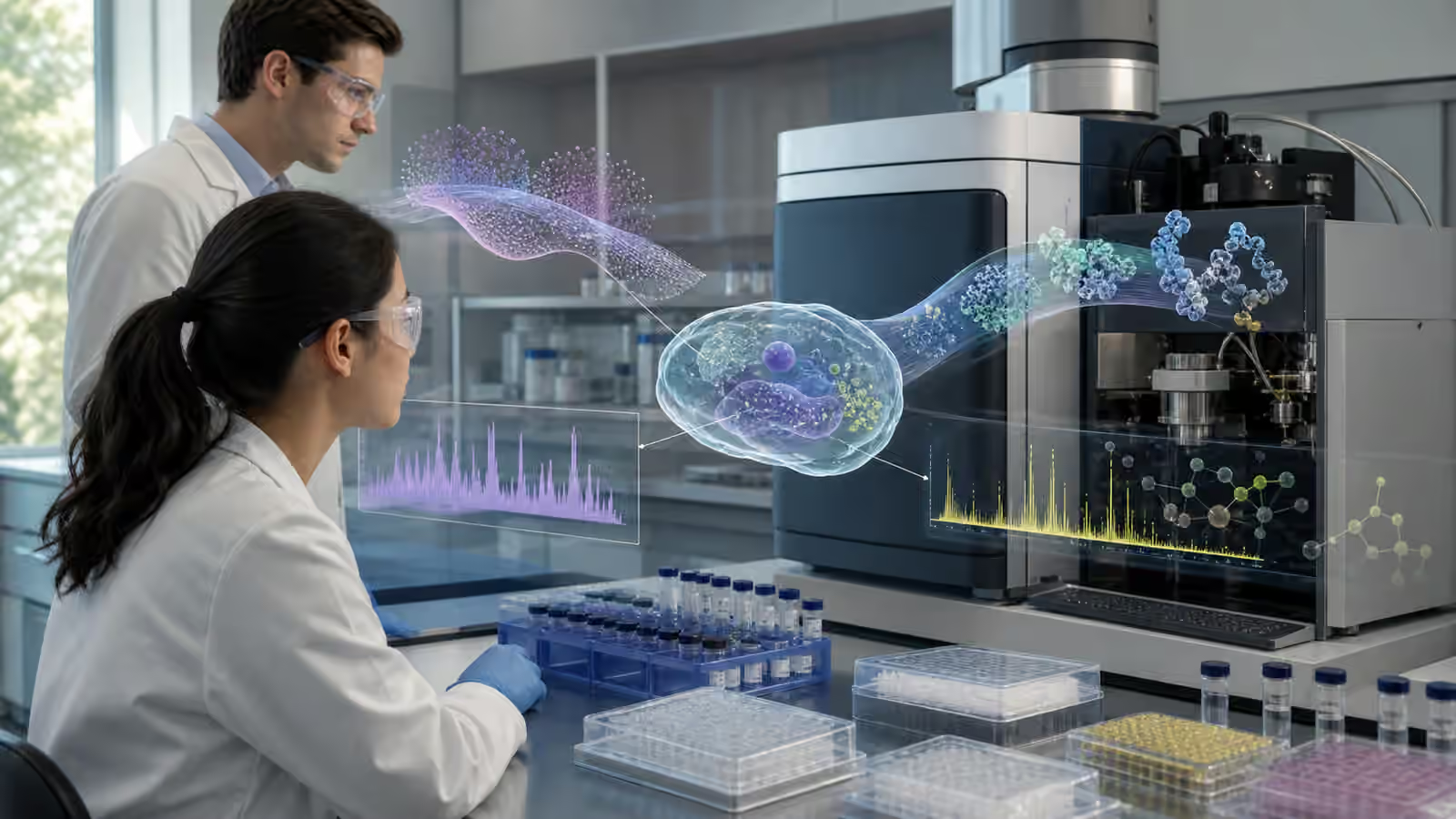
A designed cell can pass the first test and still be poorly understood.
The intended product appears. The sensor turns on. The edited pathway shows activity. The culture grows well enough to continue. At the level of the headline result, the design worked. But a cell is not a single output device. It is a crowded, adaptive system that responds to the engineered design with changes in transcription, translation, metabolism, stress, allocation, transport, and regulation. A related reference is AI-Assisted Spatial Metabolic Engineering in Plants: Integrating Flux Design, Spatial Omics, and Synthetic Biology .
Omics methods try to read those broader responses. Transcriptomics looks at RNA messages. Proteomics looks at proteins. Metabolomics looks at small molecules and pathway traffic. Other layers can examine lipids, glycans, chromatin state, single-cell variation, or spatial organization. In synthetic biology, omics can turn a surprising result into a map of what the cell may be doing around the engineered part.
This guide connects Strain Engineering with Synthetic Biology Modeling . Strain engineering changes the cell. Modeling tries to reason about the system. Omics can provide evidence that the changed cell is not behaving exactly as the design sketch implied.
Big Data Does Not Replace a Good Question
Omics can produce thousands of measurements, which makes it tempting to treat the dataset as a discovery machine that will explain everything. It rarely works that way by itself. A large dataset without a clear question can become a scenic pile of differences.
The useful questions are specific. Did the engineered pathway create a stress response? Did the host reduce expression of native pathways that supply precursors? Did a cofactor limitation appear? Did the burden show up as slower ribosome production, protein-folding stress, membrane stress, or energy imbalance? Did a product accumulate near a toxic intermediate? Did a mutation or process change push the strain into a different state?
Cellular Burden and Resource Allocation is one of the best companions to omics work because burden can hide behind a successful output. A strain may make the desired molecule while also diverting resources so aggressively that it becomes unstable, slow, or fragile. Omics can help reveal that cost, but only if the experiment is designed to ask about it.
Transcriptomics Shows Intentions and Responses
RNA measurements can reveal which genes are more or less active under a condition. For an engineered strain, that can help answer whether the intended construct is being transcribed, whether native pathways respond, whether stress programs turn on, and whether regulatory changes match the design.
The caution is that RNA is not the final product of most designs. A high RNA level does not guarantee a high protein level. A low RNA level does not always mean a pathway is inactive. RNA can be unstable, condition-dependent, and sensitive to timing. Sampling a culture at one moment may miss a short response or exaggerate a transient state.
That timing problem matters in bioprocess work. Fermentation Monitoring explains how a living process changes while it runs. Omics adds a deeper but usually slower layer. A sample taken during early growth may tell a different story from one taken during production, nutrient limitation, oxygen stress, induction, or late decline. The design of the sampling plan shapes the story the dataset can tell.
Proteomics Follows the Working Machinery
Proteomics moves closer to function by measuring proteins. It can show whether an engineered enzyme is present, whether host proteins shift, whether chaperones or stress proteins rise, and whether pathway enzymes appear in a useful balance. For designs involving Protein Expression and Folding , proteomics can reveal that the cell made the protein but struggled to process it.
Still, protein abundance is not the same as activity. An enzyme can be present but misfolded, poorly modified, missing a cofactor, inhibited by a metabolite, trapped in the wrong compartment, or degraded into fragments. A transporter can be detected but not placed correctly in the membrane. A pathway enzyme can be abundant but limited by substrate supply. Proteomics is powerful because it shows the machinery, not because it makes interpretation automatic.
The most useful proteomics work often sits beside targeted assays. If the product drops, proteomics may suggest that a pathway enzyme declined. A follow-up enzyme assay, activity measurement, localization check, or targeted quantification can then test whether that explanation holds.
Metabolomics Shows Chemical Traffic
Metabolomics is especially valuable for metabolic engineering because it follows the small molecules that pathways consume, produce, and disturb. A design may redirect carbon toward a target product, but the pathway may also create bottlenecks, toxic intermediates, cofactor shortages, overflow byproducts, or unexpected branch routes.
Metabolic Pathway Design explains why rerouting cell chemistry is difficult. Metabolomics can reveal where that rerouting actually went. A precursor may be depleted. An intermediate may accumulate. A competing pathway may pull material away. A cofactor pair may shift. A product may form but then degrade or leave the cell poorly.
Interpreting metabolomics requires careful sample handling because metabolism can change quickly. Quenching, extraction, storage, and normalization can shape the result. A sloppy sample can describe the handling procedure more than the living state. That is why Lab Data Provenance matters. Omics datasets need sample identity, timing, growth state, process conditions, extraction method, instrument run, and analysis choices attached to them.
Reference Conditions Matter
An omics result is usually comparative. The engineered strain is compared with a parent strain, a different design, a time point, a medium condition, a process state, or a control. Choosing that reference is not a minor detail. It decides what counts as a difference.
If the control grows faster, many apparent differences may reflect growth rate rather than engineering. If the control lacks the same plasmid burden, differences may reflect vector maintenance rather than the product pathway. If the sampling time is matched by clock time but not by growth phase, the comparison may mix development state with design effect. If the medium changes, the dataset may describe nutrient response rather than construct behavior.
Biological Measurement and Controls gives the broader rule: controls are part of the claim. Omics does not escape that rule. It magnifies it because a weak control can produce thousands of misleading differences at once.
Integration Is Useful but Risky
The real promise of omics is integration. RNA, protein, metabolite, process, growth, product, and genotype data can be read together. A production problem may become clearer when a metabolite bottleneck, reduced enzyme abundance, stress response, and oxygen signal all point in the same direction.
But integration can also encourage storytelling too quickly. A dataset may contain enough patterns to support a pleasing explanation that is not actually tested. Correlation across omics layers does not prove causation. A pathway drawing can make a weak inference look tidy. A model can fill gaps with assumptions that need to be challenged.
The best use of omics in synthetic biology is iterative. Use the dataset to form sharper hypotheses. Test those hypotheses with targeted experiments. Redesign the strain, process, assay, or model. Then measure again. In that cycle, omics is not decoration. It is a way of listening to the cell after the design has entered the living system.
The Cell Gets a Vote
Synthetic biology begins with intention. A designer writes a sequence, assembles parts, chooses a chassis, tunes expression, or edits a genome. Omics is one way to see how the cell responded to that intention. Sometimes the response confirms the design. Sometimes it exposes stress, compensation, leakage, bottlenecks, or drift. Sometimes it shows that the designer was asking the wrong question.
That humility is useful. A cell is not a passive container for engineered instructions. It has its own history, priorities, limits, and repair habits. Omics helps because it broadens the view from the engineered output to the living system around it. The goal is not to drown in data. It is to make the next design more honest about the cell it has to inhabit.