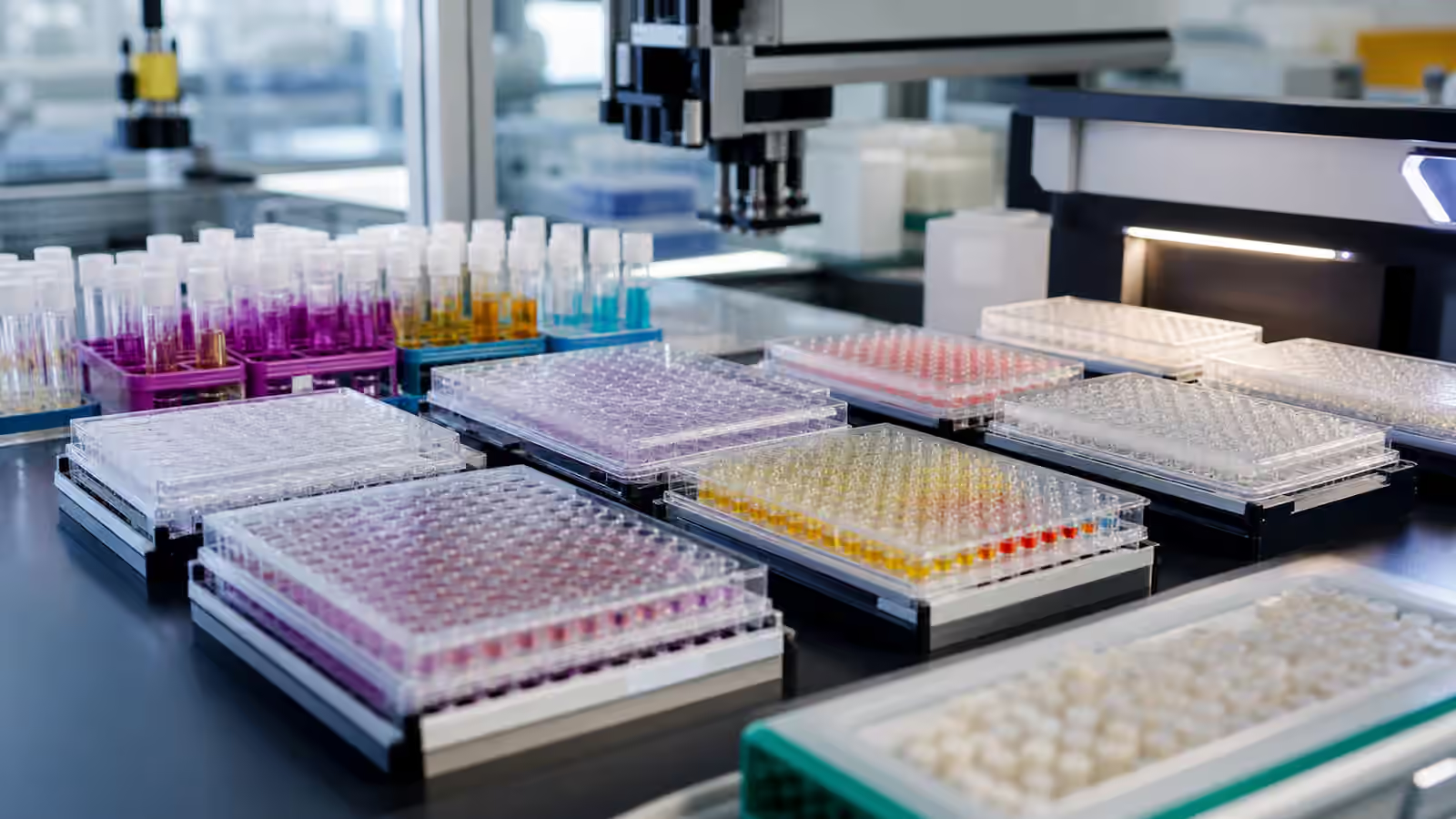
Microfluidics makes synthetic biology feel smaller and faster, but its real value is not the tiny scale itself. It is the way small volumes can turn a biological question into many careful comparisons. A channel on a chip can hold a stream of cells, droplets, extracts, reagents, or samples in a form that is easier to handle in large numbers. A droplet can become a miniature test chamber. A patterned surface can expose cells to a controlled gradient. A small reaction can conserve material while making it possible to compare many designs side by side. A related reference is [Microfluidics-driven synthetic biology and biomanufacturing: research progress in methods and applications and future perspectives] .
That promise matters because synthetic biology rarely improves through one perfect design. Teams build variants, measure them, learn from failures, and build again. The design-build-test-learn rhythm described in Biofoundries Explained depends on measurements that are fast enough to guide the next round and careful enough to mean something. Microfluidics can help with the first requirement. It does not automatically satisfy the second.
This guide sits beside Assay Design for Engineered Cells and Biological Measurement and Controls . Those pages explain why controls, timing, normalization, and artifacts shape interpretation. Microfluidics changes the physical format of the experiment, but it does not remove the need for those habits.
Small Volumes Change the Search
In a conventional bench experiment, each variant may need a tube, well, flask, or plate position. That can be enough for many questions, especially when the biology is slow or the measurement is demanding. But some synthetic biology problems create huge search spaces. A pathway may have many enzyme versions. A promoter library may create many expression levels. A biosensor may need to distinguish related inputs. A protein design may require screening many variants before a useful signal appears.
Microfluidic formats can shrink each test so more candidates can be observed with less reagent and less space. Droplet systems are especially attractive because they can isolate reactions or cells into many tiny compartments. A cell, genetic construct, enzyme mixture, substrate, or reporter can be paired with a small environment and then read for a signal. The result may be a way to find rare useful behavior that would be expensive or slow to discover at larger scale.
The important word is may. A miniature screen is not automatically a better screen. It asks a narrower question under a different physical condition. A strain that looks strong in a droplet may not behave the same way in a flask, a stirred tank, a cell-free cartridge, or a product assay. The small format can reveal candidates, but the later evidence has to show whether those candidates remain useful outside the chip.
Droplets Are Experiments, Not Confetti
A droplet can be a powerful experimental unit because it can keep a cell or reaction linked to its own signal. If an engineered microbe secretes a product, a droplet may help keep the product near the producing cell long enough to measure it. If an enzyme variant changes a substrate, the droplet can preserve the association between variant and outcome. If a cell-free reaction produces a reporter, the compartment can make many parallel tests possible.
Yet droplets also create their own questions. Their size, formation history, contents, interfaces, evaporation behavior, mixing, and compatibility with cells or reagents can affect the result. Some molecules stick to surfaces or move between droplets. Some cells respond to confinement, oxygen, nutrient limits, or surfactants. A signal that looks clean may reflect droplet physics as much as engineered biology.
That is why microfluidic screening belongs with measurement discipline rather than apart from it. Biological Measurement and Controls is relevant because controls need to follow the biology into the new format. A host-only droplet, a no-input droplet, a known positive system, a media control, or a format control may answer different doubts. The right control depends on what could be confused with success.
The Chip Is Part of the Biology
It is tempting to imagine a microfluidic chip as a neutral container. In practice, the chip becomes part of the experimental environment. Channel geometry affects flow. Surface chemistry affects adsorption. Residence time affects exposure. Shear affects some cells more than others. Temperature and gas exchange can differ from open culture. A gradient can be precise on paper and still become biologically uneven if cells settle, clog, grow, or change the chemistry around them.
This matters for engineered cells because the host is already sensitive to context. The guide to Chassis Organisms explains why bacteria, yeast, mammalian cells, algae, plants, and cell-free systems bring different constraints. Microfluidics does not flatten those differences. It can amplify them. A robust bacterium may tolerate a small channel well. A mammalian cell line may need gentler handling. A cell-free system may avoid growth but still depend on reagent stability and surface compatibility.
The right interpretation is practical. A chip can make a question sharper when the format matches the biology. It can make a question misleading when the format becomes the hidden stress. Good microfluidic work asks not only what signal appeared, but what the chip might have done to create, suppress, or distort that signal.
Throughput Needs Identity
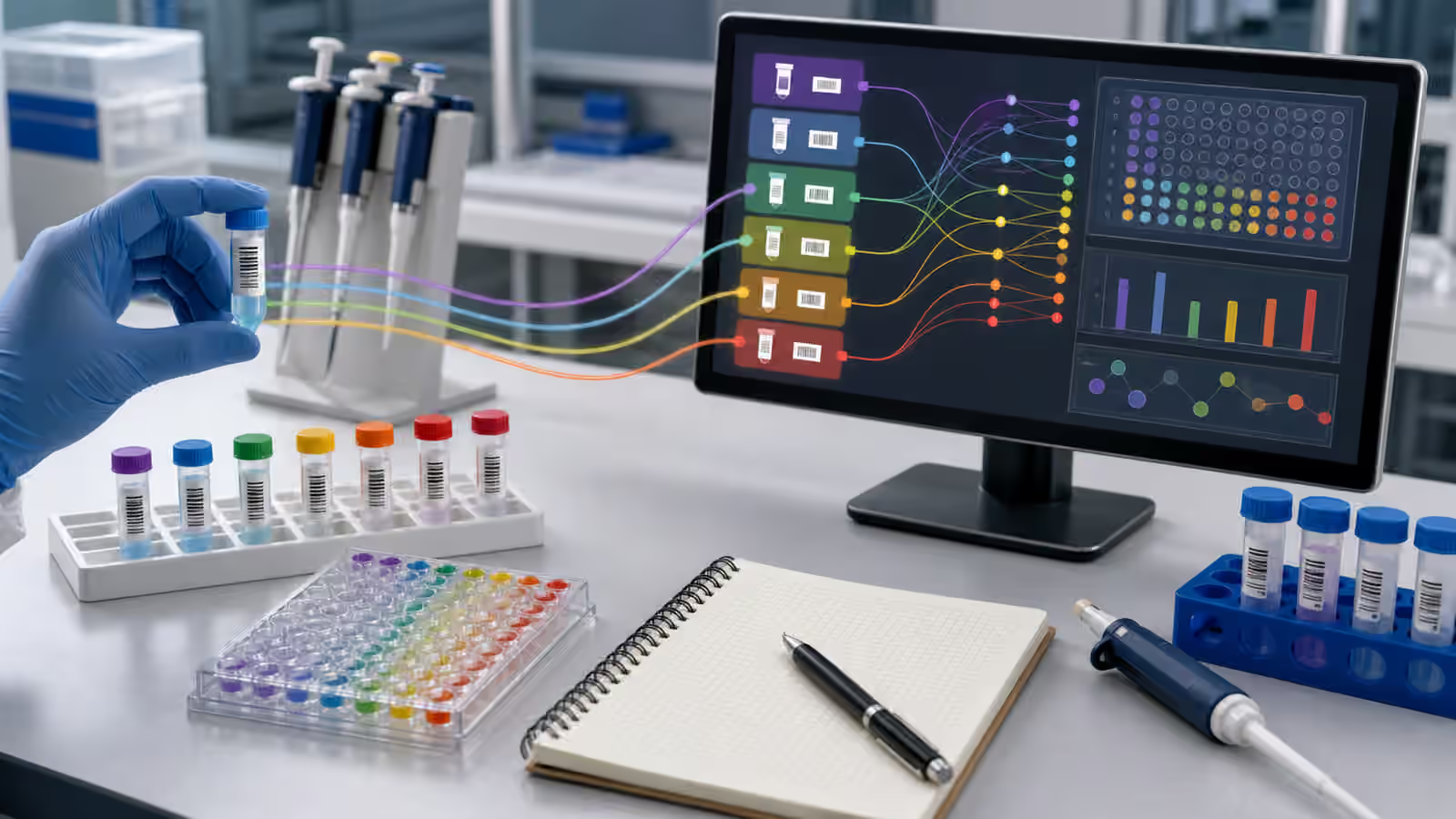
High-throughput screening is useful only if each result remains connected to the design that produced it. In synthetic biology, that identity may include a DNA construct, a host strain, a barcode, a growth condition, a droplet history, a sample source, an instrument setting, and an analysis step. Losing that connection turns a fast screen into a pile of untraceable signals.
Lab Data Provenance and Sample Tracking becomes especially important when experiments shrink and multiply. A small manual mistake can scale up with the workflow. A mislabeled library, a swapped sample, a sorting threshold applied to the wrong population, or a broken link between image and construct can create convincing but unusable data. Automation can reduce some handling variation, but it can also repeat a mistaken rule with great consistency.
Microfluidics often pairs with imaging, fluorescence, droplet sorting, sequencing, or downstream recovery. Each step needs identity to survive the handoff. If a droplet is selected because it looks bright, the team still has to know which cell, construct, enzyme, or condition created that brightness. If a pooled library is screened, the analysis has to connect the recovered sequence to the measured behavior without pretending that the screen observed every relevant property.
Screening Is Not the Same as Proof
Microfluidic screening is strongest when used as a filter. It can find candidates worth deeper testing. It can reveal patterns across a design space. It can compare variants under a controlled condition. It can help a team avoid spending larger assays on designs that clearly do not work. Those are valuable jobs.
Proof usually requires more. A pathway candidate found in droplets may need analytical chemistry to confirm product identity. A biosensor candidate may need testing in messy samples, related inputs, and longer time windows. A production strain may need flask and bioreactor data. A cell-free design may need stability, storage, and interference checks. A signal that survives the microfluidic screen enters the next stage of evidence; it does not skip it.
This connects to Metabolic Pathway Design and Bioprocess Scale-Up . The tiny compartment is far from the manufacturing environment. Oxygen transfer, nutrient gradients, waste accumulation, product toxicity, recovery, and stability can change as the format grows. A useful screen acknowledges that distance instead of hiding it.
Miniaturization Can Improve Safety Thinking
Smaller experiments can reduce material use and may limit some exposures, but safety is not measured by volume alone. A tiny droplet can still contain a relevant engineered system, genetic material, sample, or product. The safety question depends on the organism, construct, material, containment, handling, waste, and use case. Synthetic Biology Safety remains the broader frame.
Microfluidics can support safer practice when it encourages closed handling, smaller quantities, clearer tracking, and earlier detection of failure. It can weaken safety if high throughput makes people casual about identity, disposal, aerosols, device failure, or the meaning of selected variants. A screen that generates thousands of candidates also generates thousands of records that need appropriate care.
The best use of microfluidics is not to make synthetic biology look effortless. It is to ask many small questions without forgetting that each one is still biology. Tiny channels can make the search sharper, faster, and more material-efficient. They can also introduce artifacts, stress, and identity problems that only careful controls will reveal. Microfluidics is most useful when it is treated as a measurement environment with its own behavior, not as a miniature stage where every bright droplet automatically tells the truth.