Synthetic biology often sounds as if a designer simply gives a cell a new instruction. Add a gene, make a product, improve the strain, move toward a fermenter. That shorthand is useful for a first conversation, but it hides the crowded chemistry inside the cell. A cell is not an empty vessel waiting for a recipe. It is already running thousands of reactions, spending energy, balancing materials, repairing damage, sensing stress, and deciding where its resources should go. A related reference is Co-Directional Chromosomal Clustering of Metabolic Pathway Genes as a Layout Prior for Synthetic Construct Design .
Metabolic pathway design is the craft of working inside that living economy. Instead of asking only whether a cell can contain a genetic instruction, it asks whether carbon, nitrogen, energy, cofactors, enzymes, transport, and tolerance can line up long enough to make a useful molecule. The product might be a flavor compound, an organic acid, a pigment, a polymer precursor, a lipid, an amino acid, a fragrance molecule, or an intermediate that another process will finish. The design challenge is not just to draw a path from raw material to product. It is to make that path behave in a living system.
This guide sits between the design guides and the manufacturing guides. DNA Synthesis and Assembly explains how designed sequences become constructs. Plasmids, Vectors, and Delivery explains how designs get into cells. Strain Engineering shows how a production cell is improved. Metabolic pathway design is the chemical middle of that story: the part where the cell’s internal traffic must be redirected without causing a pileup.
The Cell Already Has a Budget
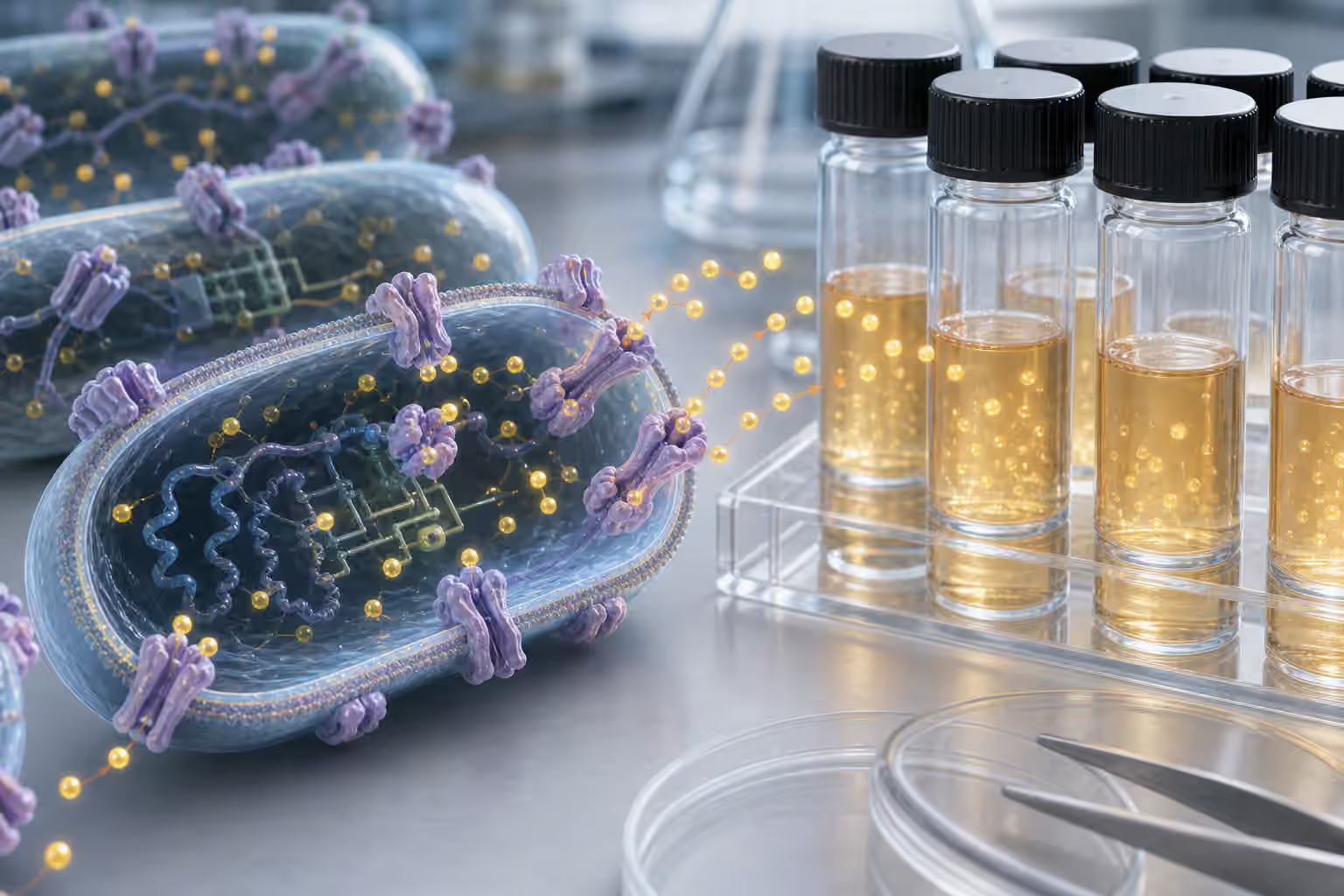
Every cell has a metabolic budget. It takes in materials, breaks some down, builds others up, stores energy, makes proteins, repairs structures, and keeps enough balance to remain alive. The budget is not written in money. It is written in molecules such as sugars, amino acids, nucleotides, cofactors, ATP, reducing power, and membrane capacity.
When synthetic biology asks the cell to make a new product, that product has to come from somewhere. A carbon atom in a target molecule was once part of a feedstock, an intermediate, or a cellular pool. Energy spent on a new enzyme is energy not spent elsewhere. A cofactor used by one engineered reaction may be needed by native metabolism. A transport protein that moves product out of the cell may change membrane stress. None of these tradeoffs automatically prevent success, but they decide whether a pathway is practical.
This is why the first pathway drawing is only a hypothesis. On paper, a series of arrows can look simple. Inside the cell, each arrow is a negotiation with metabolism. The cell may route material into biomass instead of product. It may turn an intermediate into a side product. It may slow growth when a pathway drains too much energy. It may mutate away from a burdensome design if cells that produce less can grow faster.
The mature question is not “Can we add the steps?” It is “Can the cell afford to run these steps, often, under the conditions where the product is supposed to be made?”
Pathways Are Traffic, Not Plumbing
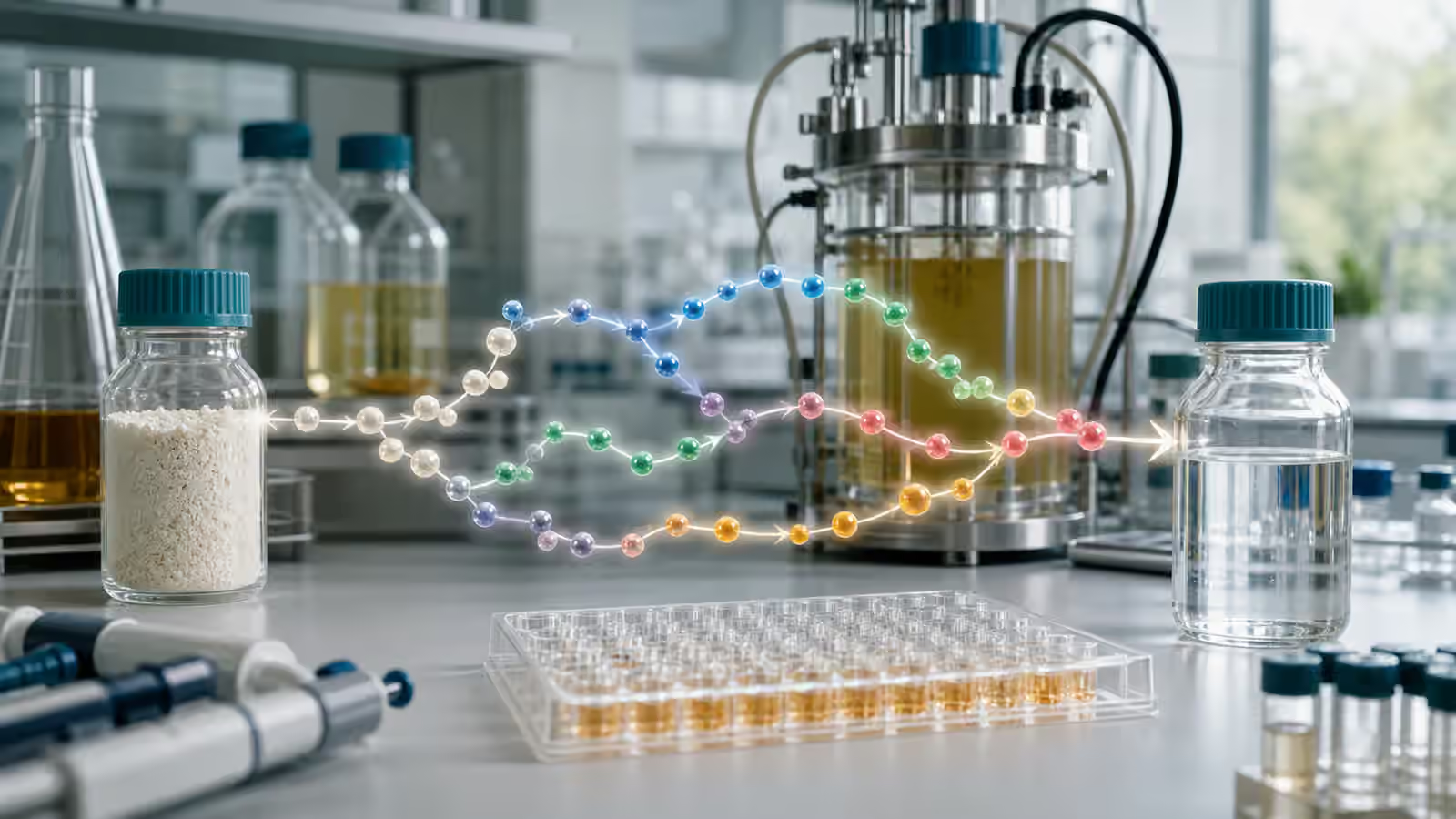
Pathways are often drawn like plumbing: one pipe enters, another pipe exits, and each enzyme opens the next valve. The metaphor breaks down quickly. Metabolism is more like traffic in a busy city. Roads intersect. Side streets exist. Some routes are congested at certain times. A change in one district can cause pressure somewhere else. A fast new road may help one journey and make another worse.
In a production pathway, one enzyme may convert a starting molecule efficiently while the next enzyme struggles. The intermediate then accumulates. If that intermediate is toxic, reactive, unstable, or attractive to a native side pathway, the whole design can suffer. Another pathway may look clean but starve for a cofactor. A third may work only when the cell grows slowly, or only when oxygen is plentiful, or only before the product reaches a concentration that stresses the host.
Pathway design therefore involves balance. Enzyme expression can be tuned so one step does not overwhelm another. Native reactions can sometimes be reduced when they steal material from the intended route. Transport can be improved when product export matters. Timing can be adjusted so the cell first builds enough biomass and later spends more effort on production. These choices connect directly to Synthetic DNA Circuits , because regulation is often the difference between a pathway that is merely present and a pathway that runs at the right moment.
The useful pathway is not always the shortest one. A longer route may avoid a toxic intermediate, use a cofactor the host can supply, or produce fewer unwanted byproducts. A route borrowed from a different organism may need heavy adaptation before it fits a new chassis. A route invented by combining enzymes from several sources may look elegant in a diagram and awkward in a cell. Design is partly about chemistry, partly about host compatibility, and partly about accepting that living systems reward routes that are robust, not just clever.
Cofactors Are the Quiet Constraint
Many metabolic conversations focus on carbon flow, but cofactors often decide whether a pathway runs well. Cofactors are helper molecules that carry electrons, chemical groups, or energy between reactions. They are part of the cell’s internal accounting system. If a pathway demands more reducing power than the host can provide, the pathway may stall even when the carbon atoms are available. If it creates an imbalance between oxidized and reduced forms, the cell may respond in ways that lower productivity or increase byproducts.
This is one reason oxygen, pH, feeding strategy, and growth state matter. A pathway is not isolated from the rest of the process. The same genetic design can behave differently under different culture conditions because the cell’s redox state, energy supply, and stress responses change. A small flask can hide these effects. A bioreactor can expose them through gradients in oxygen, nutrients, mixing, heat, and time.
Bioprocess Scale-Up describes why the flask is not the factory. Metabolic pathway design has to respect that lesson early. A pathway that only works under delicate conditions may be difficult to scale. A design that tolerates ordinary process variation may be more valuable than one with a dramatic result under narrow conditions.
Toxicity Shapes the Design
The product itself may be hard on the cell. Some molecules disrupt membranes, inhibit enzymes, change pH, damage proteins, or interfere with growth. Intermediates can be worse than the final product because they are reactive or unfamiliar to the host. Even a harmless product can become a problem if it accumulates in the wrong compartment or at the wrong time.
Toxicity changes the design strategy. The team may need to keep concentrations low by exporting product, converting intermediates quickly, separating growth from production, choosing a more tolerant host, or changing the pathway route. Sometimes the best improvement is not a more active enzyme but a cell that survives the product better. Sometimes downstream recovery improves when the product is secreted, but secretion itself burdens the host. Every apparent solution moves pressure somewhere else.
This is where pathway design and Downstream Processing meet. A product trapped inside cells may require harsher recovery. A product secreted into the broth may be easier to access but mixed with media components and byproducts. A cleaner pathway may save purification cost even if the peak titer is lower. Manufacturing cares about the product that can actually be recovered, not only the amount detected inside an experiment.
Measurement Turns a Pathway Into Evidence
A pathway that looks plausible still needs measurement. The cell may contain the DNA, express the enzymes, and show a hint of the target product, yet the result may not be strong enough to matter. Good measurement asks how much product was made, how fast it appeared, how much feedstock was consumed, how much ended as biomass or byproduct, and how consistently the result repeated.
The familiar manufacturing terms titer, rate, and yield are helpful because they force different questions. Titer asks how much product accumulates. Rate asks how quickly production happens. Yield asks how efficiently inputs become product. A pathway can have a high titer but take too long. It can be fast but wasteful. It can look efficient at small scale while producing impurity patterns that make recovery hard.
Measurement also protects against false comfort. A color change may signal pathway activity without proving useful production. A strong analytical peak may belong to a related molecule. A single successful culture may reflect a lucky condition. A strain may perform well once and drift after repeated growth. Biological Measurement and Controls is essential here because pathway design depends on evidence that can survive controls, calibration, repeat runs, and careful metadata.
The design-build-test-learn loop is only as strong as the test. If measurements are weak, the learning will be weak. If the data captures side products, growth burden, product location, and run-to-run variation, the next design has a better chance of improving the actual process instead of only improving a story.
The Host Is Part of the Pathway
It is tempting to treat the host cell as a container and the pathway as the important addition. In practice, the host is part of the pathway. A yeast, bacterium, algae, mammalian cell line, or cell-free system brings its own metabolism, stress tolerance, editing tools, secretion ability, growth behavior, safety profile, and manufacturing history.
A host that naturally makes related molecules may offer useful precursors and tolerance. A host that is easy to engineer may speed early experiments. A host with industrial familiarity may simplify later process development. A host that secretes proteins well may be better for one product and poor for another. No host is universally best because pathway fit depends on the product, process, and intended use.
This is why Cell-Free Synthetic Biology can be so useful for some work. Running biological machinery outside living cells can simplify certain tests and remove some survival constraints, although it introduces its own limits around cost, stability, replenishment, and scale. Cell-free systems do not replace cellular production across the board. They show how much the living host shapes the problem.
Better Pathways Make Better Claims
Metabolic pathway design rarely produces a simple heroic moment. More often, it produces a trail of adjustments: a promoter changed, an enzyme swapped, a competing reaction reduced, a cofactor imbalance noticed, a toxic intermediate lowered, a feed strategy revised, a recovery problem traced back upstream. That slow work is what turns a biological possibility into a manufacturing candidate.
It also makes product claims more honest. A company or research team may say a molecule is made by fermentation, from sugar, from waste carbon, with engineered microbes, or through a lower-impact route. The pathway behind that claim matters. What feedstock does it use? What byproducts appear? How much purification is needed? How stable is the strain? What quality data supports the final material? Synthetic Biology Product Claims and Public Trust is easier to read critically when the pathway is visible as an engineering system rather than a slogan.
The strongest pathway designs are not the ones that make biology sound effortless. They are the ones that respect the cell’s existing economy and still find a workable route through it. They turn feedstocks into products while managing burden, balance, toxicity, measurement, recovery, and scale. That is less tidy than the phrase “programming life,” but it is closer to the real achievement. Synthetic biology becomes useful when a designed pathway can live inside a cell long enough, clearly enough, and repeatably enough for the product to leave the lab with its identity intact.