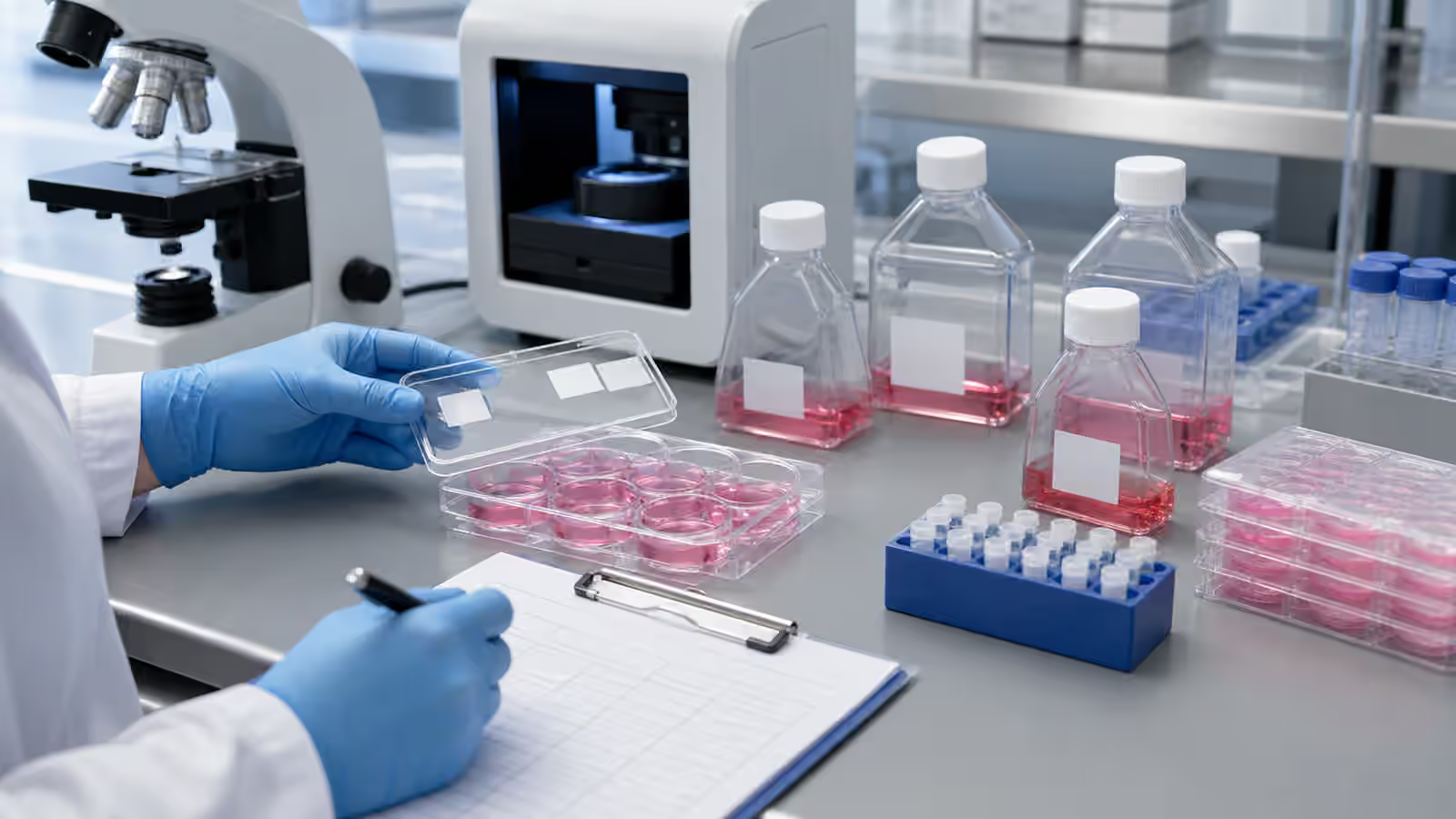
Synthetic biology often introduces itself through microbes because bacteria and yeast are fast, familiar, and easy to imagine as tiny factories. Mammalian cells tell a different story. They grow more slowly, demand gentler handling, respond strongly to their environment, and carry molecular machinery that can be essential for certain proteins, models, sensors, and cell-based systems. They are not better than microbial platforms. They are different enough to deserve their own design logic. A related reference is Engineering TPT1-mediated apoptosis resistance for improved mammalian cell biomanufacturing .
Mammalian cell engineering is the use of synthetic biology tools to change how animal-derived cell lines sense, express, process, communicate, survive, or produce. The field includes high-level research on gene regulation, protein production, cell models, biologic manufacturing, and engineered cellular functions. It should not be confused with medical advice or a shortcut to clinical use. In this guide, the focus is on the engineering principles that make mammalian cells distinctive.
The guide to Chassis Organisms compares bacteria, yeast, fungi, algae, plants, mammalian cells, and cell-free systems as possible platforms. This guide zooms in on the mammalian branch. A mammalian cell is not only a container for DNA. It is a complex workplace with compartments, signaling pathways, stress responses, quality-control systems, and culture needs that shape every design.
A Cell Line Is a Context, Not a Blank Page
Mammalian cell engineering begins with host context. A designer may be working with a production cell line, a research model, a stem-cell-derived system, an immune-cell-like model, or another established culture. Each one carries a history. It may have been selected for growth in suspension, adapted to serum-free medium, optimized for protein expression, chosen for a biological pathway, or maintained for a specific assay. Those traits affect what an engineered design can do.
The same construct can behave differently across cell lines. Promoters may be strong in one context and weak in another. A delivery method may work efficiently in one culture and poorly in another. A reporter may be clean in one background but noisy in another. A product may be folded, modified, secreted, retained, degraded, or stressful depending on the host’s machinery. This is why mammalian cell engineering is rarely a simple extension of microbial engineering with slower growth.
Plasmids, Vectors, and Delivery is a useful companion because getting a design into cells is part of the design itself. Transient expression, stable integration, episomal systems, targeted edits, and delivery carriers answer different questions. A fast exploratory experiment may accept temporary expression. A production or long-term model may need stable behavior, traceable identity, and evidence that the change remains interpretable over time.
Protein Processing Is Often the Reason
Many mammalian cell projects exist because some biological products need processing that simpler hosts do not naturally provide. Proteins may require disulfide bond formation, careful folding, secretion, assembly into complexes, or sugar modifications that influence stability and recognition. The guide to Protein Expression and Folding explains the general problem. Mammalian systems make it especially visible because the cell’s internal quality-control machinery can decide whether a designed protein becomes a useful molecule or a stressed, degraded burden.
Glycosylation is one example. Mammalian cells add and remodel sugar structures in ways that can matter for complex proteins. Glycoengineering Cell Factories covers that landscape in more detail. The important point here is that choosing a mammalian host may be about molecular finish, not prestige. A host is valuable when its machinery fits the product’s job.
That fit is never automatic. A protein may overload the secretory pathway, misfold, aggregate, trigger stress responses, or produce heterogeneous forms. Increasing expression can make the problem worse. Gene Expression Tuning matters because mammalian cells often reward balance over brute force. A lower expression level that preserves cell health and product quality may be more useful than a dramatic burst that creates noise, stress, and inconsistent output.
Circuits Meet Signaling Biology
Mammalian cells are rich signaling systems. They respond to growth factors, nutrients, contact with surfaces, oxygen, waste products, cell density, stress, and internal state. Synthetic circuits placed into that environment do not operate in isolation. A promoter, sensor, RNA regulator, or feedback loop may interact with pathways the cell already uses to decide whether to divide, differentiate, secrete, pause, or die.
This makes mammalian cell circuits attractive and difficult. They can be designed to read biological states that microbial cells do not have. They can help build research models that report pathway activity, control expression windows, or study cellular decisions. Yet their behavior can be context-dependent, slow, and hard to separate from ordinary cell physiology. A clean circuit diagram may hide a messy cellular negotiation.
Synthetic DNA Circuits introduces the idea that cells read designed instructions in noisy ways. Mammalian cells add more layers to that noise. Chromatin state, copy number, cell cycle, culture conditions, and stress can all change output. The mature question is not only whether the circuit turns on. It is whether the measured response means what the experiment says it means.
Culture Conditions Are Part of the Design
Mammalian cells are physically delicate compared with many microbes. Shear, oxygen, pH, nutrient balance, waste accumulation, surface attachment, agitation, and temperature can all shape cell health. A design that looks promising in a small dish may behave differently in a suspension culture, a perfusion system, a microcarrier process, or a larger bioreactor. Scale changes the environment the cells experience.
This connects mammalian cell engineering to Bioprocess Scale-Up and Cell Banks and Seed Trains . The starting cell population, passage history, recovery from storage, seed culture quality, and process timing can influence the final result. In mammalian systems, those operational details are not a separate manufacturing afterthought. They can determine whether an engineered function remains stable and useful.
Cell banking is especially important because cell lines can drift. They may change growth rate, expression, productivity, morphology, or response to selection over repeated culture. Genetic Stability in Synthetic Biology explains the broader issue for engineered systems. Mammalian cell work adds the need to track culture history with discipline. A cell line name alone is not enough if the living material has been handled differently over time.
Measurement Needs More Than a Bright Signal
Mammalian cell experiments often use reporters, imaging, secretion assays, omics readouts, product measurements, and viability checks. A bright signal can be persuasive, but it may not prove the intended mechanism. A reporter can respond to stress rather than the designed input. A product assay can include degraded or misprocessed material. A growth change can reflect delivery toxicity rather than the engineered function. A mixed population can hide the fact that only a subset of cells behaves as expected.
Biological Measurement and Controls is the right habit here. Controls, calibration, metadata, repeatability, and clear comparison groups keep a mammalian cell result from becoming a beautiful but ambiguous picture. The more complex the host, the more important it becomes to ask what else could explain the observation.
Single-cell variation also matters. Two cells in the same culture may carry different copy numbers, cell-cycle states, expression levels, or stress histories. An average measurement can hide that spread. Sometimes the spread is the point, especially in models of differentiation or signaling. Other times it is a problem because production or interpretation depends on uniform behavior.
Safety and Use Case Shape the Boundary
Mammalian cell engineering carries different safety and governance questions depending on the cell type, genetic change, use, scale, exposure route, and oversight context. A contained research cell line used to express a protein is not the same as a live-cell product concept, a diagnostic model, an environmental proposal, or a clinical manufacturing setting. The word mammalian does not settle the risk. The specific system does.
Responsible work includes appropriate containment, identity tracking, waste handling, access control, documentation, and review. It also includes avoiding casual claims. A cell model can be useful without being a body. A promising engineered function in culture is not proof of safety or benefit in people. A manufacturing cell line can produce an important molecule while still requiring careful quality control. Synthetic Biology Product Claims and Public Trust is useful because mammalian cell work often sits close to claims people care about.
The value of mammalian cell engineering is not that it makes biology feel more advanced. Its value is that some questions need cells with mammalian machinery, compartments, signaling, and processing. The cost is that those same features make design, measurement, stability, and scale more demanding. A good mammalian cell project respects the cell as a living context. It does not treat the culture as a slower microbe or a miniature patient. It treats it as a platform whose power comes from its specificity and whose evidence has to be built with care.