Synthetic biology often improves by searching. A designer may understand the pathway, the promoter, the host, and the product well enough to make a reasonable first strain, but biology rarely rewards the first version forever. A better enzyme variant may sit one mutation away from the obvious candidate. A gentler expression setting may outperform the loudest construct. A different junction, signal peptide, ribosome binding site, terminator, integration site, or host background may turn a weak design into one that survives contact with the process. A related reference is Emerging biosensor and assay-enabled high-throughput screening solutions for enzyme and strain engineering .
High-throughput strain library screening is the practice of making many related biological variants, measuring them under a structured assay, and deciding which ones deserve deeper attention. It is one of the reasons Biofoundries Explained matters: automation can build and test more candidates than a small manual workflow can comfortably handle. Yet speed alone does not make a screen good. A fast screen can also multiply mistakes, plate effects, labeling errors, weak assays, and false confidence.
This guide sits beside Strain Engineering , Assay Design for Engineered Cells , and Design of Experiments for Synthetic Biology . Strain engineering explains why a production cell has to be shaped through many choices. Assay design explains why the measurement must match the real question. Design of experiments explains why layout and comparison structure matter. Strain library screening brings those habits together at scale.
A Library Is a Hypothesis About Where Improvement Lives
A strain library is not just a pile of variants. It is a search strategy made physical. The variants reveal what the team believes might matter. A promoter library asks whether expression strength is limiting or burdensome. An enzyme library asks whether catalytic behavior, stability, or substrate fit can improve. A transporter library asks whether product movement is holding the pathway back. A host-background library asks whether native biology is helping or resisting the design. A combinatorial pathway library asks whether several settings need to be balanced together.
That structure matters because the screen can only find what the library contains. If the true bottleneck is product toxicity, a library that varies only the first enzyme may produce many beautiful comparisons that never touch the real problem. If secretion is limiting, a library focused on intracellular expression may reward variants that look productive in one assay but create a downstream problem later. The guide to Transporters and Membrane Engineering shows how moving molecules can become the hidden constraint. The guide to Secretion and Export Pathways makes the same point for proteins and extracellular products.
Good library design therefore begins with a model of uncertainty. The model can be formal, but it does not have to be ornate. The team should be able to say what the library is trying to learn, which biological choices it varies, which choices it holds steady, and what kind of outcome would change the next design decision. Without that clarity, a screen can become a fishing trip where any bright signal looks meaningful because no one decided what meaning would look like beforehand.
The Assay Defines the Winner
Screening pressure is measurement pressure. Whatever the assay rewards will become the definition of success for that stage. If the assay rewards color intensity, bright variants win. If it rewards growth, fast growers win. If it rewards product concentration in a small vessel, variants that behave well in that vessel win. If it rewards a reporter that only loosely tracks the product, the screen may select reporter behavior rather than production behavior.
This is not a reason to avoid proxies. Synthetic biology often needs proxies because direct product measurement can be slow, expensive, destructive, or low throughput. A reporter, fluorescence signal, growth-coupled selection, colorimetric readout, mass-spectrometry snapshot, or biosensor response can all be useful. The danger is forgetting that a proxy is a bargain. It buys speed by accepting the risk that the measured signal is not the same as the real objective.
Assay Design for Engineered Cells is the natural companion here. A strain library screen needs controls, dynamic range, repeatability, and enough biological context to know when a signal is misleading. A screen that cannot distinguish a true high producer from a stressed cell, a leaky reporter, an edge well artifact, or a growth-rate advantage is not ready to carry a design decision.
Plate Effects Can Pretend to Be Biology
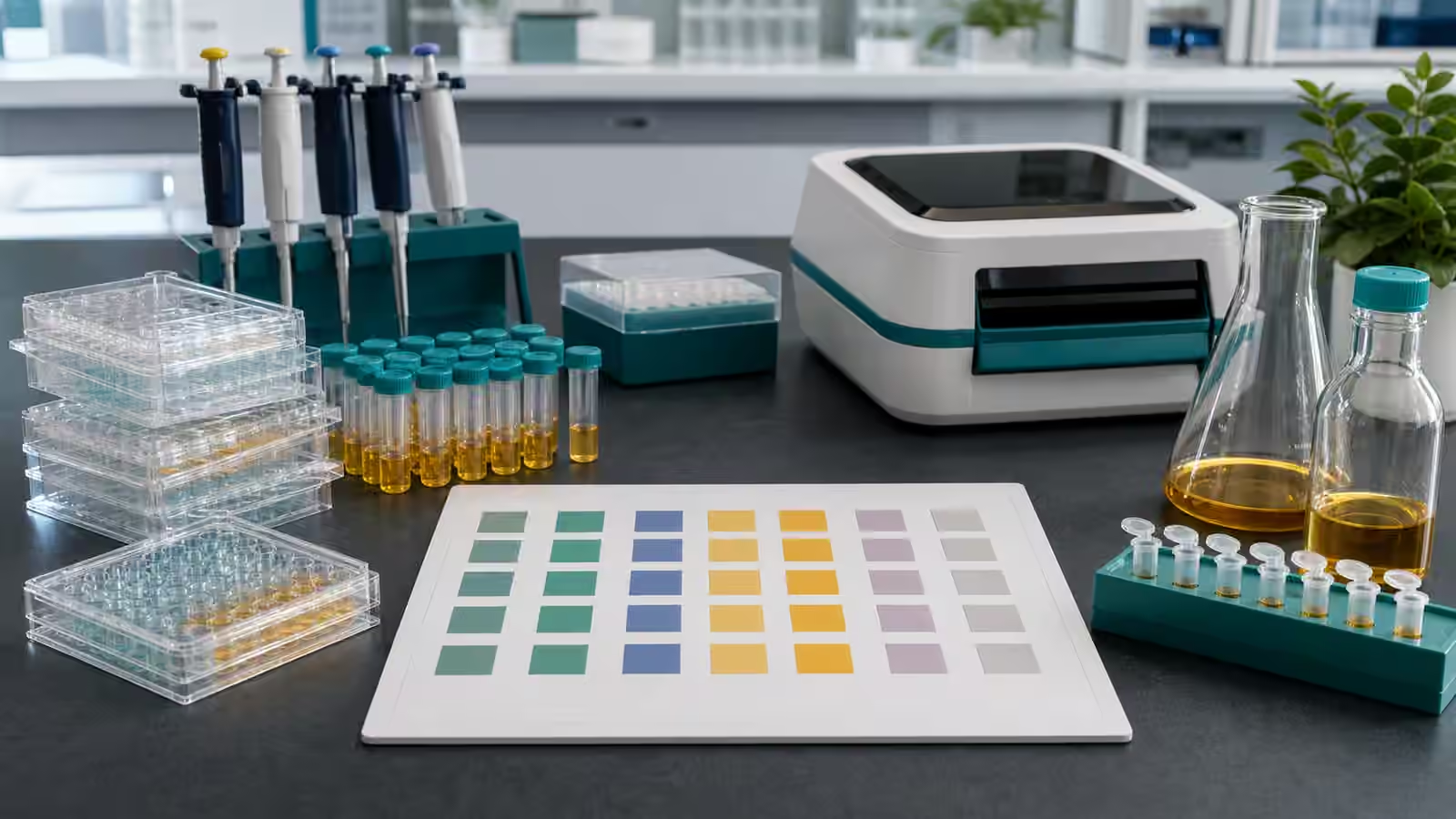
High-throughput screening often happens in microplates, and plates have personalities. Edge wells can evaporate differently. Temperature may vary across an incubator. Timing may differ between rows if liquid handling or reading takes long enough. Pipetting order, source plate position, shaking, sealing, humidity, and storage can all leave patterns that are not biological in the way the designer hopes.
These patterns matter because library screens are comparative. A variant looks better or worse relative to its neighbors. If the best candidates cluster along one edge, on one plate, or in one processing batch, the team should ask whether the library discovered better biology or simply mapped the workflow. A screen that ignores location can let geography impersonate performance.
Design of experiments helps by making layout visible. Replicates can be separated across plates. Controls can appear in enough positions to expose drift. Randomization can keep one variant family from being trapped in one corner of the workflow. Blocking can acknowledge known sources of variation instead of pretending they do not exist. These habits can feel unglamorous, but they often decide whether a screen teaches biology or teaches how the plate was handled.
False Hits Are Normal
Every large screen produces temptations. A few variants rise above the background. A graph shows a clean top tier. A candidate looks dramatically better than the parent strain. It is easy to call those winners and move on. The mature response is slower. The first screen identifies possible hits. It does not prove that the hits are real, stable, transferable, or useful.
False hits appear for ordinary reasons. A well may have been misassigned. A cell may have grown faster while making less product per cell. A reporter may have responded to stress. A mutation may have improved the assay signal while hurting the desired product. A high value may reflect evaporation, contamination, or an instrument artifact. A variant may perform well only because it landed in a favorable microenvironment. None of this means the screen failed. It means screening is a first filter, not a final verdict.
Hit triage asks the obvious questions before the story becomes too attractive. Can the candidate be recovered and retested? Does the construct sequence match the intended design? Does the signal survive a fresh transformation or fresh isolate? Does it hold across days, operators, or plate positions? Does direct product measurement agree with the proxy? Does the strain remain genetically stable long enough to matter? The guide to Construct Verification and Sequencing belongs in this moment because physical identity has to catch up with the data.
A Hit Must Reenter Biology
The goal of screening is not to worship the screen. The goal is to choose candidates for deeper biological work. Once a hit emerges, the team has to ask why it worked. Did it reduce burden? Improve folding? Balance pathway flux? Change transport? Avoid toxicity? Shift growth phase timing? Alter cofactor use? Produce less byproduct? Or did it simply exploit the assay?
That explanation matters because a hit without a mechanism can be hard to improve. If a promoter variant wins because it lowers expression to a healthier level, the next design path differs from a hit that wins because it increases enzyme abundance. If an enzyme variant wins because it tolerates process temperature, the next question differs from a variant that changes substrate specificity. If a host background wins because it grows better, the team still has to know whether product per biomass improved.
Cellular Burden and Resource Allocation is useful here because many hits are really burden stories. The cell may prefer a design that asks for less, asks at a better time, or routes resources more gracefully. A high-throughput screen can reveal that preference, but interpretation has to explain it.
Scale Can Reorder the Ranking
A plate-scale winner is not automatically a process winner. Small cultures are easier to feed, mix, oxygenate, heat, cool, and read. A variant that looks excellent in a microplate may struggle in a shake flask, and a shake-flask winner may fail in a bioreactor. Oxygen demand, product toxicity, pH drift, foam, secretion behavior, nutrient gradients, and harvest timing can all change the ranking.
This is why screening should connect to Scale-Down Models before a candidate is treated as mature. A scale-down model does not have to reproduce a factory perfectly, but it should expose the stresses that matter for the next decision. If the screen rewards a strain that only performs under unrealistically gentle conditions, the team may be selecting away from the eventual process.
The right screen depends on the stage. Early discovery can accept rougher proxies because the question is broad. Later screening should become less forgiving because the cost of a false winner rises. By the time a candidate is being considered for process development, its evidence should include more than one convenient readout.
Data Discipline Keeps the Search Usable
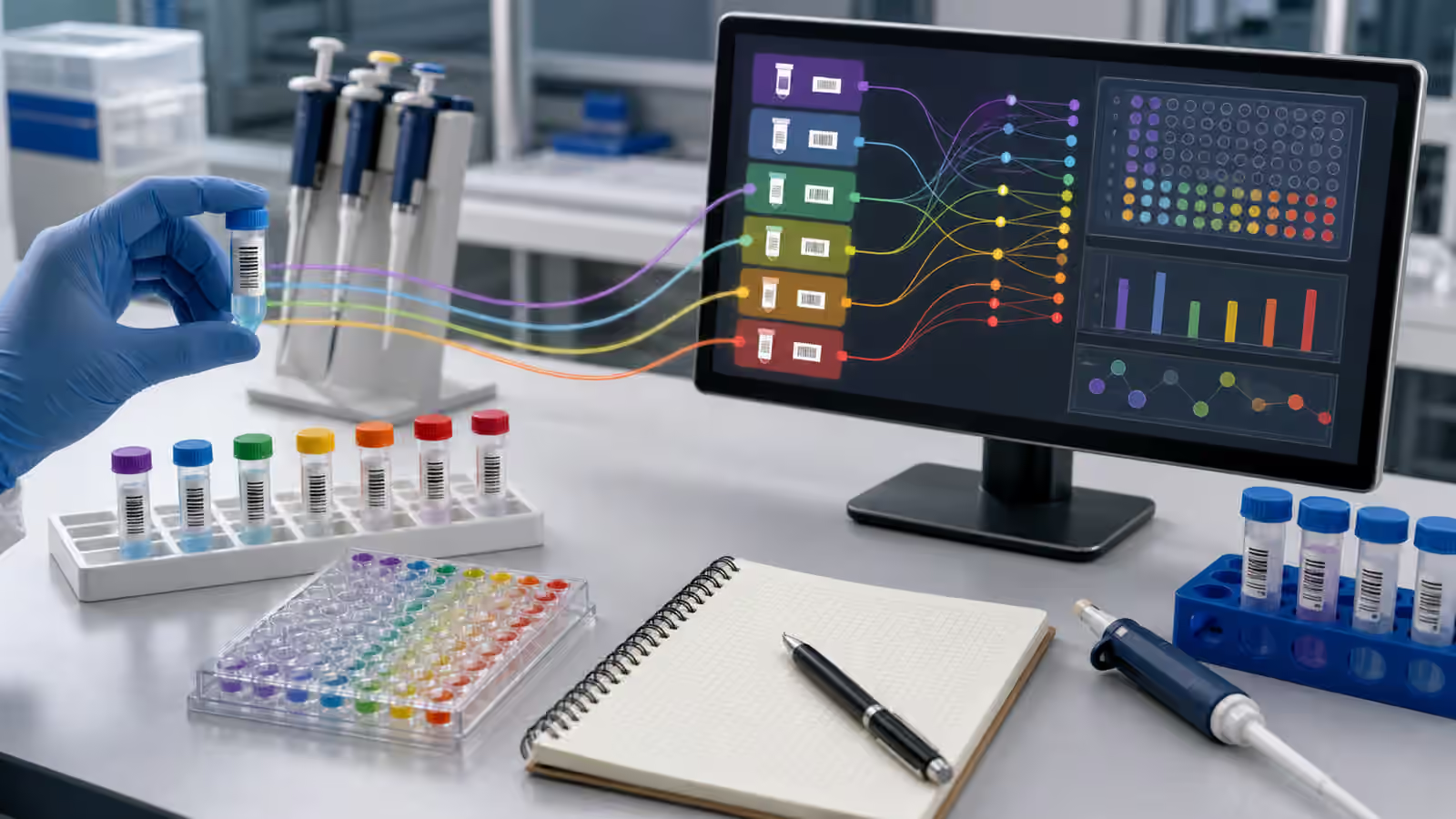
High-throughput screening generates many files, samples, plates, layouts, construct records, instrument exports, and analysis steps. The biology may be rich, but the evidence becomes fragile if the identity trail breaks. A hit whose sample cannot be traced is not a hit the team can trust.
Lab Data Provenance and Sample Tracking explains why sample identity is part of the claim. In strain screening, that identity spans design version, physical construct, plate position, growth condition, instrument run, analysis method, and retest history. A clean plot is not enough if the team cannot reconstruct which living material produced each point.
The best screens make skepticism easy. They preserve raw data, plate maps, metadata, controls, excluded wells, instrument context, and analysis logic. They do not hide failed plates or ambiguous candidates. They let future readers see how the hit became a hit.
High-throughput strain library screening is powerful because it gives synthetic biology a disciplined way to search. It can reveal variants that no one would have chosen by intuition alone. It can turn design space into evidence. But the method earns trust only when the library asks a real question, the assay measures the right thing, the layout resists artifacts, and the hits are treated as candidates that must survive retesting. The screen is where better biology may first appear. Triage is where the field learns whether it actually appeared.