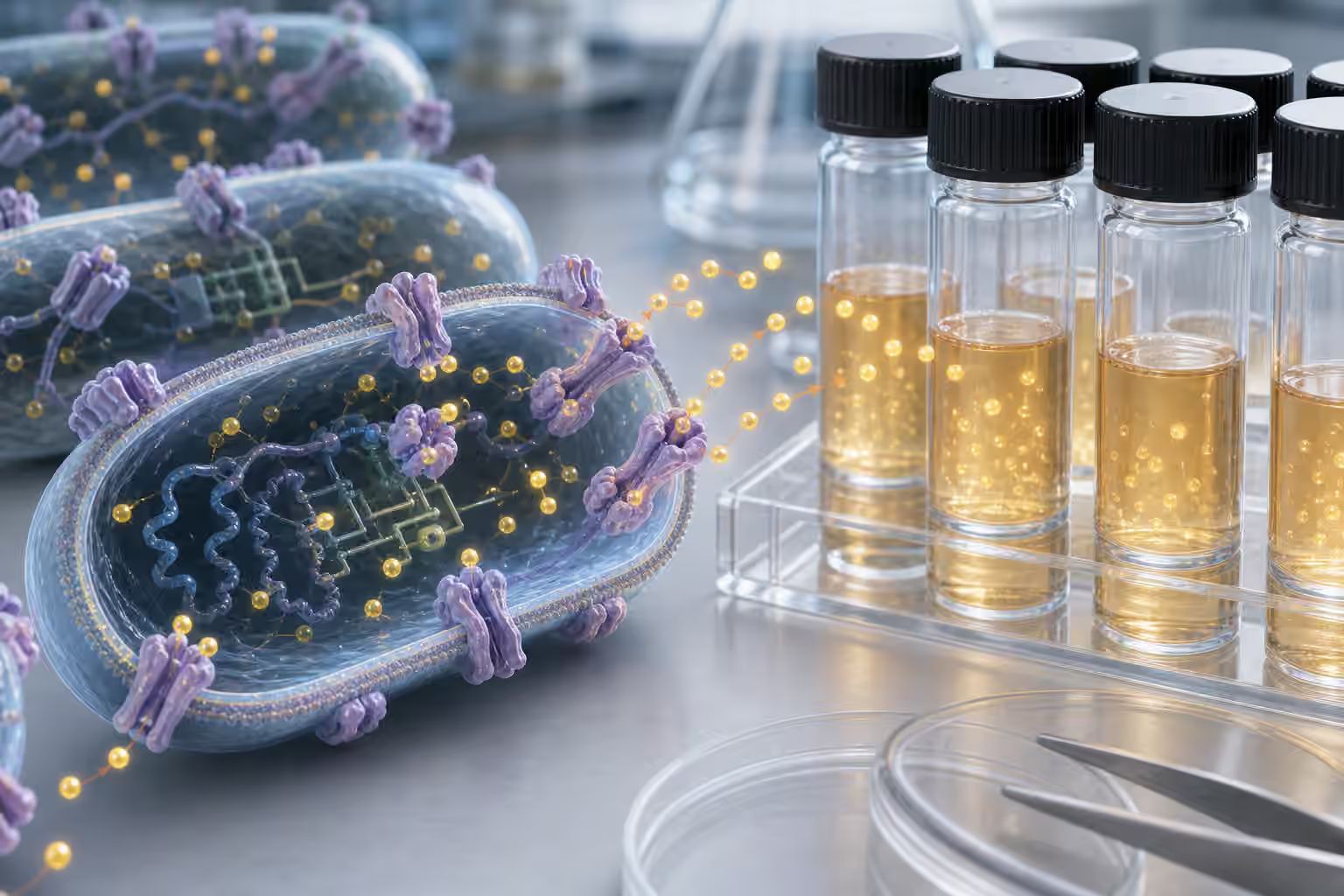
Synthetic biology is often described as a field that writes new biological instructions. That is true, but it can make the work sound more invented than it really is. Many useful designs begin with a quieter act: looking carefully at what biology has already learned to do. Microbes, plants, fungi, algae, and environmental communities carry long records of chemistry inside their genomes. Genome mining is the practice of searching those records for enzymes, pathways, and biological hints that might become useful design material. A related reference is Genome mining and metabolomics reveal context-dependent biosynthetic potential in a core poplar dark septate endophyte .
The phrase can sound like a database shortcut, as if a promising pathway simply appears after enough sequence search. The reality is more patient. Genome mining turns sequence data into educated guesses, not finished products. It asks which genes might work together, what molecules they might build or modify, which hosts might express them, which measurements would prove activity, and what safety or access questions surround the source material.
This guide sits upstream of Metabolic Pathway Design and Industrial Enzymes . Those guides explain how pathways and proteins become engineered systems. Genome mining asks where many of those candidate parts come from before anyone starts tuning expression, assembling constructs, or scaling a process.
Nature Leaves Chemical Clues in Genomes
Cells make chemistry for practical reasons. They need to capture energy, build membranes, communicate, defend themselves, tolerate stress, sense neighbors, compete for resources, and adapt to changing environments. Those needs create enzymes and pathways with useful shapes. Some enzymes clip, join, oxidize, reduce, transfer, decorate, or rearrange molecules in ways that industrial chemists may value. Some pathways produce pigments, scents, antibiotics, signaling molecules, polymers, toxins, or protective compounds. Some only make sense in a narrow ecological setting, but still reveal a catalytic idea that can be studied more broadly.
Genome mining begins from the observation that related enzymes often leave recognizable sequence patterns. A newly sequenced organism may contain a gene that resembles a known enzyme family. A microbial genome may contain neighboring genes that look like a coordinated biosynthetic pathway. A metagenomic sample may contain fragments that suggest a community has chemical capabilities not yet studied in cultured isolates. None of this proves function, but it gives researchers a map of where to look.
The map is especially useful because many organisms are hard to grow, slow to study, or poorly represented in old laboratory collections. Sequence data can reveal possibilities before a team has a full biological system in hand. That does not remove the need for experiment. It changes the starting point from random searching to informed searching.
A Gene Cluster Is a Neighborhood, Not a Product Claim
One important idea in genome mining is the biosynthetic gene cluster. In many microbes, genes that participate in making a complex molecule may sit near each other in the genome. That neighborhood can include core enzymes, tailoring enzymes, transporters, regulatory elements, resistance features, or assembly helpers. Seeing such a cluster can be a strong clue that the organism has a specialized chemistry program.
But a cluster is not the same as a finished explanation. The genes may be silent under ordinary lab conditions. The predicted product may be wrong. A key enzyme may need a partner, cofactor, compartment, or growth condition that is not obvious from sequence alone. The same cluster may behave differently in a native organism, an engineered host, and a cell-free system. A database match can show resemblance, but resemblance is not proof of activity.
That uncertainty is why genome mining belongs beside Synthetic Biology Modeling rather than outside it. Models help prioritize candidates, compare enzyme families, predict pathways, and estimate likely products. Their value comes from making experiments sharper, not from replacing experiments. A good prediction narrows the search. It does not earn trust until biology answers back.
Discovery Becomes Engineering Slowly
Once a candidate enzyme or pathway is found, synthetic biology begins turning it into a testable object. The sequence may need to be synthesized, assembled, cloned, recoded, expressed, or moved into a more convenient host. That transition is not trivial. A gene that belongs naturally in a soil microbe may not express well in yeast. A pathway that works in a native cluster may lose balance when separated from its regulatory context. A protein that looks promising in sequence may fold poorly, require a rare cofactor, or produce a side reaction under new conditions.
DNA Synthesis and Assembly covers the step where a digital sequence becomes physical DNA. Codon Optimization explains why translating a gene into a new host is not a mechanical copying exercise. Genome mining makes both guides more concrete because it often imports biological ideas from one context into another. The design has to respect where the part came from and where it is being asked to work now.
The path from candidate to proof often includes several kinds of evidence. A team may check that the DNA was built correctly, that the gene is expressed, that the protein is present, that the expected activity appears, and that the product is really the molecule being claimed. It may also compare the candidate against a control, a known enzyme, an inactive variant, or a host without the pathway. Without that discipline, genome mining can become a story about interesting sequences rather than a reliable discovery process.
Host Context Can Change the Answer
The choice of host matters at every stage. A bacterium may be fast and convenient but lack the folding environment or precursor supply needed for a pathway. Yeast may handle some eukaryotic enzymes better while changing glycosylation, compartment behavior, or secretion. A filamentous fungus may be attractive for secreted enzymes but harder to engineer cleanly. A plant or mammalian cell may fit certain biological contexts while bringing longer timelines and tighter measurement burdens. A cell-free system may help test difficult pieces without committing to living growth.
That is why Chassis Organisms is a useful companion to genome mining. A mined sequence is not a free-floating ingredient. It enters a chassis with its own metabolism, stress responses, transport limits, and safety profile. The same candidate may look inactive in one host, weak in another, and useful in a third. A disappointing result can mean the enzyme is wrong, but it can also mean the host never gave it a fair setting.
Pathway discovery also depends on precursor supply. An enzyme may be active only if the cell provides the right starting molecule. A mined cluster may require building blocks that the test host does not naturally accumulate. Adding those precursors may create burden, byproducts, or toxicity. This is where genome mining becomes metabolic engineering: the discovery is not only the enzyme, but the system that can feed, express, measure, and tolerate it.
Measurement Turns a Hint Into Evidence
Genome mining produces many candidates. The limiting question is not only how many can be found, but how many can be evaluated well. A weak assay can make an inactive candidate look promising or hide a real activity. A background signal from the host can be mistaken for product. A molecule with a similar mass or color can be misidentified. A pathway intermediate can appear without proving the full route works.
Assay Design for Engineered Cells explains why measurement begins with the right comparison, timing, normalization, and artifact control. For genome mining, this discipline is central. Discovery work can generate seductive diagrams, but the evidence lives in careful measurements: product identity, enzyme activity, host background, repeatability, and the conditions under which the result appears.
There is also a data provenance question. Sequence records, sample metadata, strain histories, lab notes, construct versions, and analysis choices all shape interpretation. Lab Data Provenance and Sample Tracking matters because a mined pathway can pass through many hands before it becomes a production or research claim. If the trail breaks, confidence breaks with it.
Discovery Has Boundaries
Genome mining can touch natural diversity, environmental samples, public databases, private collections, Indigenous knowledge, and commercial strain libraries. That makes responsible use more than a technical issue. Teams need to think about access, benefit sharing, ecological context, biosafety, biosecurity, and whether a sequence should be used at all. A useful enzyme candidate does not erase the obligations attached to where knowledge or material came from.
The safety layer is also practical. Some biosynthetic clusters are connected to toxic compounds or organisms that require special oversight. Some sequence combinations should not be casually synthesized or shared. Some discoveries are best studied through safer fragments, inactive comparisons, or non-replicating systems. Synthetic Biology Safety is the broader guide because discovery is not separate from responsibility.
Genome mining is powerful because it expands the imagination of synthetic biology without pretending that design begins from nothing. It treats nature as a vast archive of working and half-understood chemistry. The mature version of the field does not merely collect exciting sequences. It asks which clues are real, which hosts can test them honestly, which measurements prove function, and which responsibilities travel with the discovery. A mined genome is the beginning of a conversation with biology, not the end of one.