The genetic code is often described as a dictionary that translates DNA and RNA into proteins. Most living cells use three-letter codons to specify amino acids, and proteins are built from a familiar set of biological building blocks. That system is ancient, elegant, and deeply conserved. It is also not the only code synthetic biology can imagine. A related reference is Advances in the Biosynthesis of Noncanonical Amino Acids for Genetic Code Expansion .
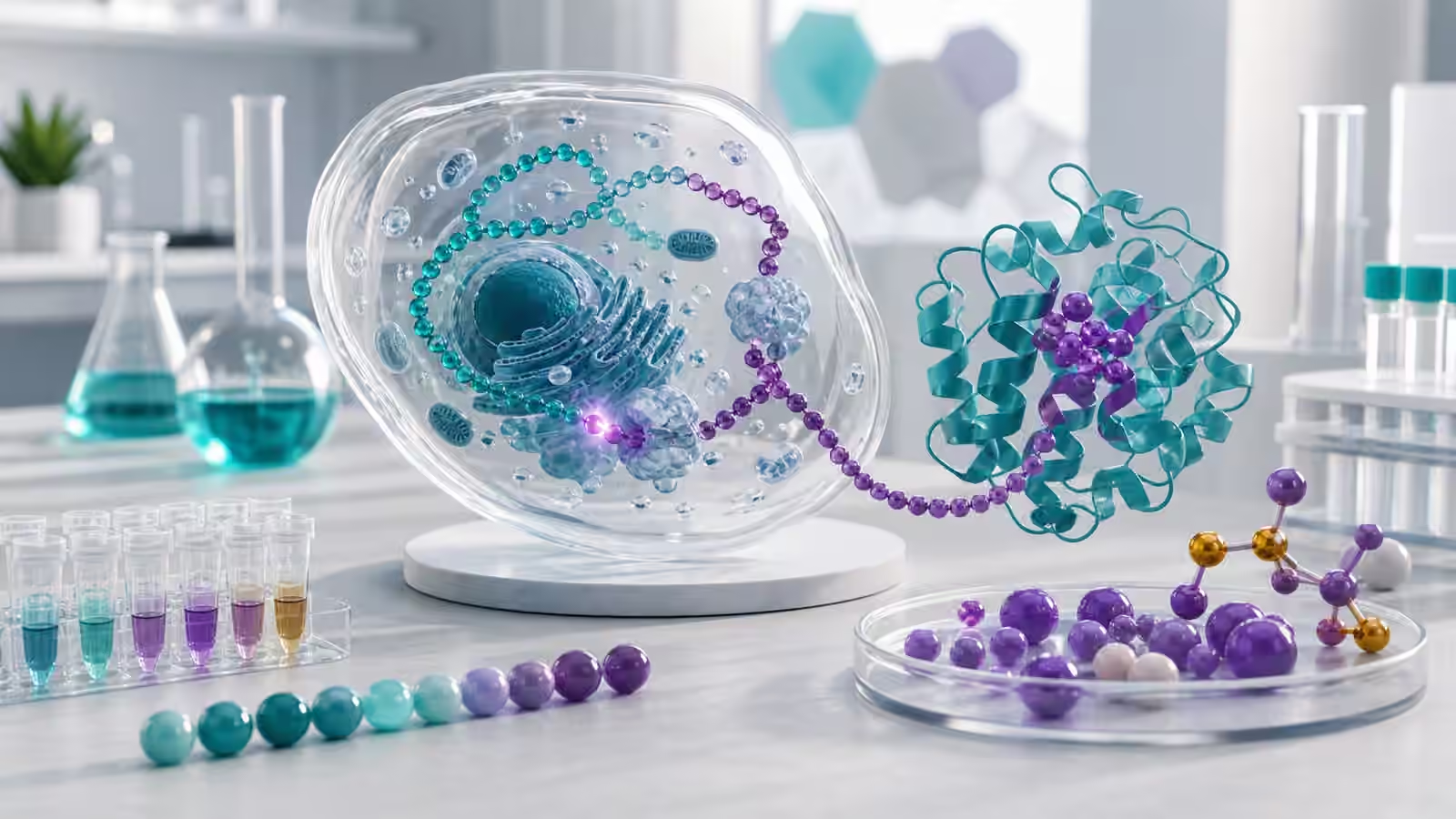
Genetic code expansion asks what happens when engineered biology is given access to building blocks that ordinary cells do not normally use. A protein might receive a nonstandard amino acid with a chemical handle, a light-sensitive group, a reactive site, or a physical property that natural amino acids do not provide. A cell might use an engineered translation component that reads a reserved codon differently from the host’s normal machinery. In more speculative work, researchers explore biological systems that depend on altered chemistries or genetic polymers outside ordinary DNA and RNA.
This guide sits near AI-Designed Proteins , Protein Expression and Folding , and Synthetic Genomes and Minimal Cells . Protein design imagines useful molecules. Expression and folding ask whether those molecules can be made. Genetic code expansion asks whether the cell’s translation system can be extended to build molecules with chemistry beyond the usual set.
Orthogonal Means Separate Enough to Be Useful
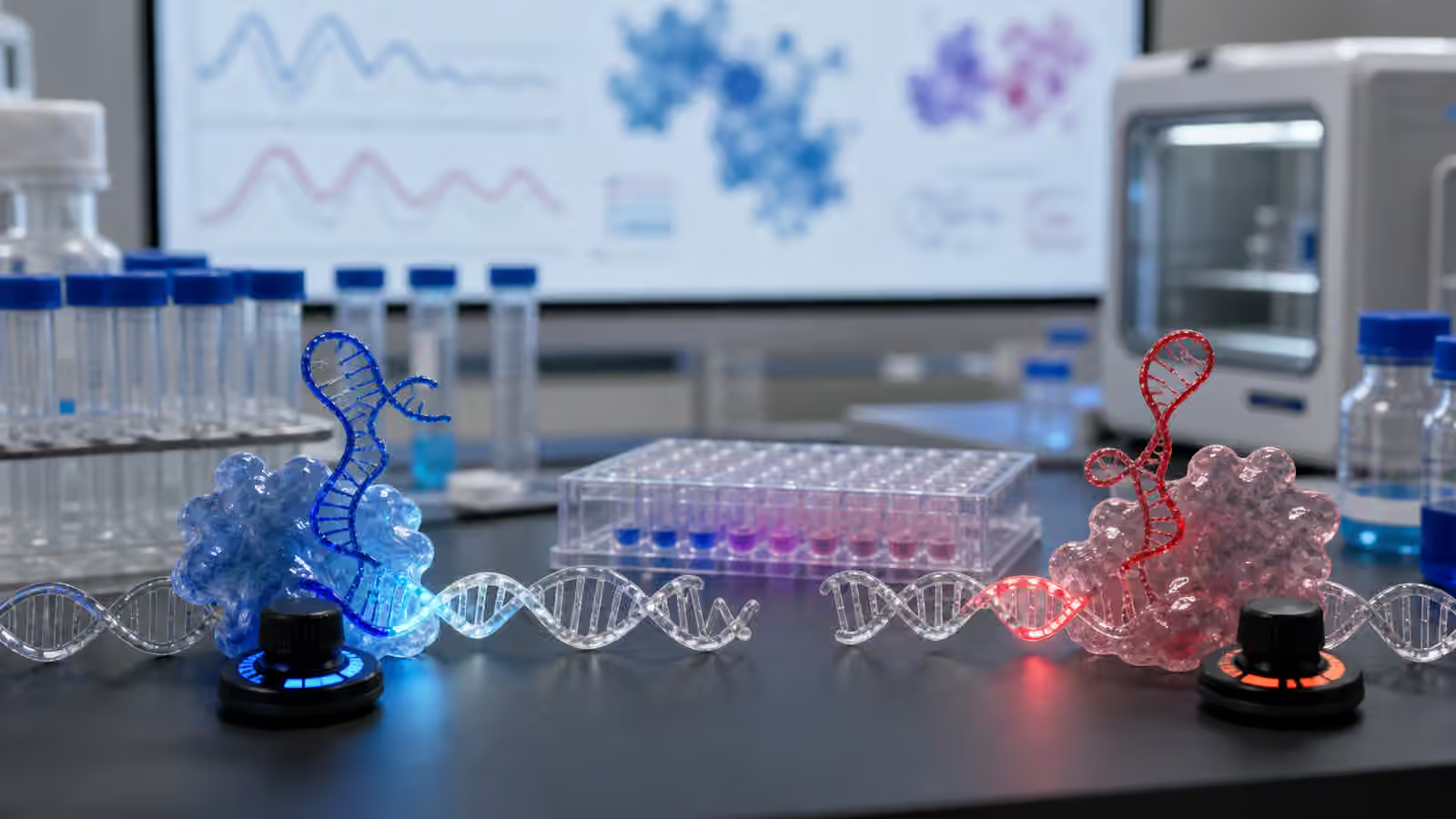
The word orthogonal appears often in synthetic biology. In this context, it means that an engineered system operates separately enough from the host’s native systems to perform a new task without creating too much cross-talk. For genetic code expansion, the key idea is usually an orthogonal translation pair: a transfer RNA and a matching aminoacyl-tRNA synthetase that work together to place a chosen nonstandard amino acid at a chosen site in a protein.
The pair has to be selective in both directions. The engineered synthetase should load the engineered tRNA with the desired nonstandard amino acid rather than a natural one. The host’s native synthetases should not load the engineered tRNA incorrectly. The engineered tRNA should be read in the intended way during translation without disrupting too much of the cell’s ordinary protein production.
That separation is never magical. It has to be engineered and tested. Translation is one of the cell’s central activities, so small mistakes can have broad effects. Misincorporation can create mixed protein products. Low efficiency can leave too little target protein. Cellular stress can reduce growth or expression. A system that works in one host or protein context may need adjustment in another.
This is why genetic code expansion belongs to practical synthetic biology, not only to speculative biology. It is a design problem, a measurement problem, a host-context problem, and a protein-quality problem at the same time.
Why Add New Building Blocks?
Natural proteins already do extraordinary chemistry. Enzymes accelerate reactions, antibodies bind targets, structural proteins organize cells, and signaling proteins coordinate life. Genetic code expansion does not replace that natural richness. It adds chemical options.
A nonstandard amino acid might carry a chemical handle that lets a protein be linked to another molecule at a precise position. It might introduce a fluorescent group for studying structure or location. It might change stability, reactivity, binding, or responsiveness to light. It might let researchers probe how a protein works by placing a distinctive group at one site and watching what changes.
For synthetic biology, this matters because many products depend on proteins behaving in exact ways. Industrial Enzymes shows how protein function shapes manufacturing. Glycoengineering shows how molecular details around proteins can change product identity. Genetic code expansion adds another layer: the protein backbone itself can carry chemistry that ordinary translation would not place there.
The promise is precision. Instead of modifying a protein randomly after expression, a team may aim to install a specific building block at a specific position during translation. That can make the product more uniform and the experiment easier to interpret. The challenge is that the cell must cooperate, and the added chemistry must still produce a protein that folds, functions, and can be measured.
Reserved Codons and Cellular Context
A common strategy in genetic code expansion is to assign new meaning to a codon that can be separated from ordinary translation. Stop codons are often discussed because they normally signal the end of a protein. If an engineered tRNA reads one of those signals in a controlled context, a nonstandard amino acid can be inserted before translation ends. Other approaches involve recoding genomes, reducing competing codon uses, or designing systems with more room for reassignment.
The details can become technical quickly, but the principle is simple. The cell’s translation system is crowded. If a codon has a normal job, changing that job can create confusion. A useful expansion strategy has to carve out a reliable channel for the new instruction.
Host context matters. A bacterium, yeast, mammalian cell, or cell-free system may differ in translation machinery, codon use, protein quality control, uptake of the nonstandard amino acid, growth conditions, and tolerance of the engineered components. Chassis Organisms is relevant because the right platform depends on the intended protein, product, and experiment.
Cell-free systems can be especially useful for some genetic code expansion work because they remove certain survival constraints and make components easier to control. Cell-Free Synthetic Biology explains that freedom and its limits. A cell-free reaction can be a powerful testbed, but it does not automatically solve scale, cost, stability, or product recovery.
Expanded Codes Can Support Containment Ideas
Genetic code expansion sometimes appears in discussions of biological containment. One idea is to make engineered organisms dependent on a nonstandard amino acid or altered genetic system that is not available in ordinary environments. If the organism cannot make essential proteins without that supplied building block, it may be less likely to persist outside controlled conditions.
The concept is appealing, but it should be treated with care. Biological containment is never a single switch that makes risk vanish. Cells mutate, environments vary, and laboratory claims have to be tested under relevant failure modes. A dependency can weaken, escape routes may exist, and manufacturing conditions can impose selection pressure. Biocontainment and Kill Switches is the natural companion guide because it explains why safeguards need evidence, layering, and realistic assumptions.
Genetic code expansion can contribute to containment thinking because it changes the relationship between an organism and its chemical environment. It may make an engineered strain more dependent on a supplied molecule or more isolated from natural genetic exchange. But the word may is important. A containment claim should be supported by stability data, escape-rate thinking, environmental context, and independent review appropriate to the use case.
Product Quality Is Harder Than Novelty
It is easy to be impressed by the idea of a protein with a new building block. The harder question is whether the product is consistent. Did the nonstandard amino acid enter the intended position? How much full-length protein was made? How much truncated or misincorporated product appeared? Did the protein fold correctly? Did the added chemistry change activity, stability, aggregation, purification, or storage?
These questions connect genetic code expansion to Analytical Chemistry for Bioproduct Identity and Bioprocess Quality Control . Novel chemistry increases the need for good measurement. A strong expression signal is not enough. A product with mixed forms may be difficult to interpret, recover, regulate, or trust.
The host also pays a price. Orthogonal translation components require expression, substrates, and cellular resources. Nonstandard amino acids may need transport or feeding. Protein quality-control systems may respond to unusual products. Cellular Burden and Resource Allocation helps explain why added functions can change cell behavior even when the design looks modular.
The Edge of Familiar Biology
Genetic code expansion sits at the edge of familiar biology. It uses the cell’s translation machinery, but asks it to recognize an added instruction. It uses proteins, but gives them chemistry from outside the usual set. It can serve practical protein engineering, research probes, materials, therapeutics development, and containment research, while also raising questions about how far engineered life should move from natural templates.
The most useful way to read the field is neither hype nor fear. Expanded genetic codes are not a simple path to any molecule a designer can imagine. They are also not just science fiction. They are careful negotiations with translation, host physiology, chemical supply, product quality, and safety evidence.
Synthetic biology often starts with the phrase “write DNA,” but genetic code expansion reminds us that writing is only part of the story. The cell must read the instruction, translate it through machinery that evolved for other purposes, and produce a molecule whose identity can be proven. When that works, the achievement is not merely a new code word. It is a new agreement between designed chemistry and living translation.