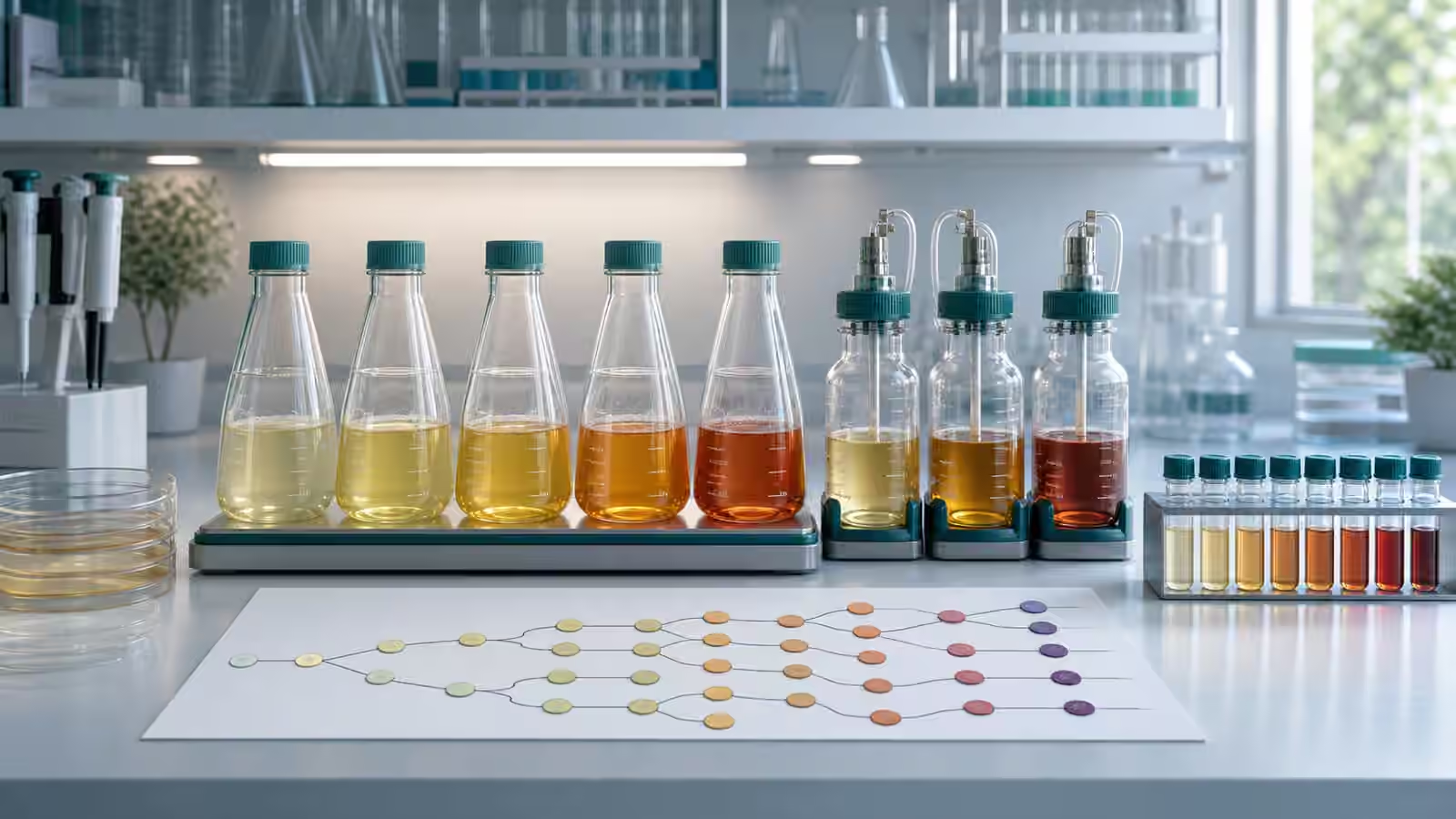
One of the easiest mistakes in synthetic biology is to imagine a cell as a machine with a simple volume knob. If a gene makes a useful protein, turn the gene up. If a pathway makes too little product, push the pathway harder. If a biosensor signal is faint, make the signal brighter. The instinct is understandable, because many designs begin as diagrams where stronger arrows look like progress. A related reference is The synthetic biology toolbox for tuning gene expression in yeast .
Living cells do not experience those arrows as decoration. They experience them as work.
Every extra molecule has to be transcribed, translated, folded, transported, repaired, diluted, degraded, or tolerated. Every engineered function competes with growth, maintenance, stress responses, nutrient use, and the cell’s own priorities. A design that looks too weak may need more expression, but a design pushed too hard can collapse into noise, toxicity, instability, or disappointing scale-up behavior.
Gene expression tuning is the craft of asking for enough biological activity without asking for more than the system can carry. It sits between Synthetic DNA Circuits , where designed instructions are arranged, and Strain Engineering , where those instructions have to live inside a production cell. It is not a single trick. It is a way of thinking about biological limits.
Expression Is a Budget, Not a Volume Knob
Gene expression is the process by which information in DNA becomes a functional product, often through RNA and then protein. In a simple diagram, a promoter sits before a gene, the gene is read, and the product appears. In a real cell, that flow depends on polymerases, ribosomes, nucleotides, amino acids, energy, folding helpers, membranes, cofactors, degradation systems, and the local state of the organism.
That is why expression is better imagined as a budget than as a knob. A cell has limited capacity. It can spend some of that capacity on growth, repair, movement, stress management, storage, secretion, and housekeeping. When synthetic biology asks the same cell to make a sensor protein, an enzyme, a scaffold, a pathway intermediate, or a fluorescent reporter, the new request enters the same budget.
The budget changes with the host, the medium, the growth phase, the temperature, the oxygen level, the product, and the process. A bacterial culture growing quickly in a small vessel may tolerate a burst of expression that would be costly in a longer production run. A yeast strain might fold a secreted protein better than a bacterium, but more slowly. A mammalian cell line may offer the right processing for a complex protein while bringing a very different cost and control story. Tuning begins by respecting that expression is not free.
Promoters Set the First Guess
Promoters are DNA regions that help determine when and how strongly a gene is transcribed. They are often the first tools people imagine when thinking about expression strength. A stronger promoter can increase output. A weaker promoter can reduce burden. An inducible promoter can let the cell grow first and make the product later. A regulated promoter can connect expression to a signal, a condition, or a timing window.
The promoter choice is only a first guess. It can be useful, but it rarely tells the whole story. A promoter that behaves strongly in one host may behave differently in another. The same promoter can look different when placed near another sequence, carried on a high-copy plasmid, integrated into a chromosome, or used in a stressed production strain. The measured output may depend as much on RNA stability, translation, folding, and degradation as on transcription.
This is where the design language of Synthetic DNA Circuits becomes practical. Promoters, genes, regulators, terminators, and other parts have to work together. A circuit can fail because a promoter is too weak, but it can also fail because one part is too strong. A sensor may leak before it sees its input. A controller may saturate. A reporter may overwhelm the subtle signal it was meant to reveal.
Good tuning treats promoter strength as a hypothesis. The question is not simply which promoter is strongest. The question is which expression pattern gives interpretable behavior in the chosen host under the conditions that matter.
Copy Number Changes the Whole Conversation
Expression is also shaped by how many copies of the genetic instruction the cell carries. A gene on a high-copy plasmid may be present many times in each cell. A gene integrated into a chromosome may be present in far fewer copies. Temporary expression may create yet another state, where the design appears for a limited window rather than becoming a stable inherited feature.
The guide to Plasmids, Vectors, and Delivery explains the carrier side of that story. For expression tuning, the key point is that copy number is not a neutral detail. More copies can produce more RNA and protein, but they also increase the load on the cell. They can make selection pressure stronger, because cells that lose or silence the burdensome design may grow better. They can also make measurements harder to interpret if the population does not carry the design uniformly.
Lower copy number can be gentler and more stable, but it may not provide enough output. Chromosomal integration can reduce variation and improve inheritance, but it may require careful redesign to reach useful expression. There is no universal winner. A fast screening workflow may benefit from plasmids, while a mature production strain may need a more stable arrangement. A biosensor may need low background more than high brightness. A pathway may need several genes expressed at different levels rather than one blunt increase everywhere.
Translation, Folding, and Location Can Become the Bottleneck
Even when transcription looks right, the protein may not. Translation depends on how the host reads the RNA, how often ribosomes initiate, how quickly they move, and whether the coding sequence fits the host’s preferences. A sequence that looks correct can still be awkward for a particular organism. The product may be made slowly, misfolded, clipped apart, stuck in the wrong compartment, or toxic before it ever helps the design.
Protein folding is a common limit because proteins are physical objects, not just outputs. They need the right shape. Some require cofactors, disulfide bonds, metal ions, partner proteins, membrane insertion, or secretion. Pushing expression harder can flood the cell with half-folded material. That can trigger stress responses, reduce growth, create aggregates, or lower the amount of active product even while the total amount of protein rises.
Location matters too. An enzyme needed in the cytoplasm, a protein meant to be secreted, a membrane transporter, and a surface display construct all place different demands on the cell. A production strain that makes a protein successfully inside the cell may still create a difficult downstream process if the product must be recovered from disrupted cells. A strain that secretes the product may simplify recovery, but secretion machinery can become the limiting step. Expression tuning therefore reaches beyond the gene and into the process.
Pathways Need Balance More Than Maximums
Many synthetic biology projects involve pathways rather than single genes. A pathway may use several enzymes to turn a feedstock into a product through intermediate molecules. In that setting, tuning becomes a balancing problem. If the first enzyme works too hard and the next one lags, an intermediate can build up. That intermediate may be wasted, toxic, unstable, or diverted into side reactions. If a later enzyme is abundant but the upstream supply is weak, the extra protein may add burden without increasing product.
Metabolic Pathway Design follows this problem through carbon flow, cofactors, toxicity, and host fit. Expression tuning is one of the main ways a pathway designer tries to bring the pieces into rhythm. The goal is not to make every enzyme as abundant as possible. The goal is to place enough activity at each step so the pathway moves material cleanly while the host remains healthy enough to keep working.
This is why a pathway can improve when one gene is turned down. A weaker step may reduce toxic buildup. A slower production phase may allow cells to reach more biomass before carrying the full burden. A modest expression level may give a higher final titer than an aggressive one because the culture remains stable longer. Biology often rewards designs that cooperate with the host rather than designs that simply demand more.
Populations Add Noise
Synthetic biology often talks about a strain or a cell as if every member of a culture is identical. In practice, a culture is a population. Individual cells can differ in plasmid copy number, growth state, stress level, expression level, mutation history, and local environment. Some cells may carry the design exactly as intended. Others may express it weakly. Others may lose it, silence it, or acquire changes that reduce burden.
Noise can matter in different ways. For a biosensor, noise can create false signals or hide real ones. For a production process, a small number of low-producing cells may not matter at first, but cells that grow faster because they produce less can take over with time. For a circuit, variable expression can turn a clean diagram into a mixed population where only some cells behave as expected.
Tuning can reduce noise, but it cannot pretend noise does not exist. Sometimes lower expression gives a tighter population. Sometimes integration is more predictable than a plasmid. Sometimes a reporter reveals that the average result hides two very different subpopulations. Averages are useful, but they can be deceptive when the population structure is doing the important work.
Measurement Makes Tuning Real
Expression tuning is only meaningful when it is measured well. A bright color, a stronger band, a larger peak, or a higher product number may look persuasive, but the interpretation depends on controls, calibration, normalization, timing, and context. Was the output compared against a suitable baseline? Was cell growth measured alongside product formation? Was the signal normalized to cell density or biomass when appropriate? Did the assay distinguish active product from inactive material?
The guide to Biological Measurement and Controls is a useful companion because tuning is mostly a measurement discipline. A team may build several promoter variants, plasmid designs, translation contexts, or integration sites. The data only helps if the variants are tracked, verified, and compared under conditions that answer the intended question.
Measurement also guards against the false comfort of a single impressive result. A design may look best at an early time point because it produces quickly, then fall behind because the culture stops growing. Another design may look modest at first and stronger later because it preserves cell health. Without time, controls, and process context, expression tuning can become a contest for the brightest first signal instead of a search for the most useful behavior.
Scale-Up Changes What Good Tuning Means
A tuning decision made in a small vessel may not survive scale-up unchanged. In a flask, the culture may see relatively even conditions. In a larger bioreactor, cells move through gradients of oxygen, nutrients, waste, pH, pressure, and shear. Expression that was tolerable in one setting may become stressful in another. A product that was harmless at small scale may accumulate differently. A burden that seemed manageable may interact with feeding strategy, oxygen transfer, foam, or downstream recovery.
Bioprocess Scale-Up makes this point for the whole manufacturing process. For expression tuning, the practical lesson is that the best lab construct is not always the best production construct. A strain that wins a fast screen may lose in a long run. A design optimized for maximum output per cell may underperform a design optimized for healthy culture behavior, clean broth composition, easier purification, or genetic stability.
This does not mean early tuning is wasted. It means early tuning should leave room for process reality. A useful expression design is one that can be measured, adjusted, and explained as the work moves from construct to strain to process.
Safety and Stability Prefer Honest Limits
Responsible synthetic biology does not treat expression level as only a productivity variable. It can also affect safety and stability. A highly expressed product may stress cells, increase mutation pressure, change waste streams, complicate containment assumptions, or create more material that needs careful handling. A fragile design may select for variants that escape the intended function, which can undermine both performance and interpretation.
The relevant safeguards depend on the organism, construct, product, setting, and scale. The evergreen habit is to ask what higher expression changes besides output. Does it change growth? Does it change the product mixture? Does it change persistence? Does it make the system harder to shut down, clean, verify, or explain? Does it make the claim more fragile because the population can only hold the design briefly?
Synthetic biology is strongest when it can state its limits plainly. Tuning is one place where those limits become visible. The honest design may not be the loudest design. It may be the one that produces enough, stays interpretable, and remains compatible with the host, the process, and the evidence.
The Useful Level Is the Level That Holds
Gene expression tuning teaches a quiet lesson about engineering with biology. The cell is not an empty stage for human instructions. It is an active system with history, constraints, defenses, and tradeoffs. Stronger expression can help, but it can also spend the cell’s budget too quickly. Weaker expression can disappoint, but it can also preserve the conditions that make useful production possible.
The craft is finding the level that holds. That level may come from promoter choice, copy number, integration site, translation context, timing, host selection, process conditions, or a redesign of the pathway itself. It may change as the project moves from a quick proof to repeated measurement and then to scale-up.
For readers trying to understand a synthetic biology claim, expression tuning offers a practical question. Did the team merely make the cell produce something once, or did it learn how much expression the system can carry while still behaving like a usable biological platform? The difference is often where a promising idea begins to become trustworthy engineering.