An enzyme is often introduced as a tiny specialist. It recognizes a substrate, lowers an energy barrier, and helps a reaction happen under conditions that may be milder than ordinary chemistry would require. Synthetic biology expands that story by changing which enzymes are available, how they are expressed, how they are evolved, and how they fit into engineered pathways. A related reference is Decoding MOF-Enzyme-Substrate Compatibility for Universal Biocatalyst Immobilization .
But a useful enzyme is not automatically a useful process. It may be fragile, expensive to replace, difficult to separate from product, sensitive to heat, inhibited by its own reaction mixture, or hard to use continuously. Enzyme immobilization tries to solve part of that problem by holding the catalyst in place while reactants and products move around it.
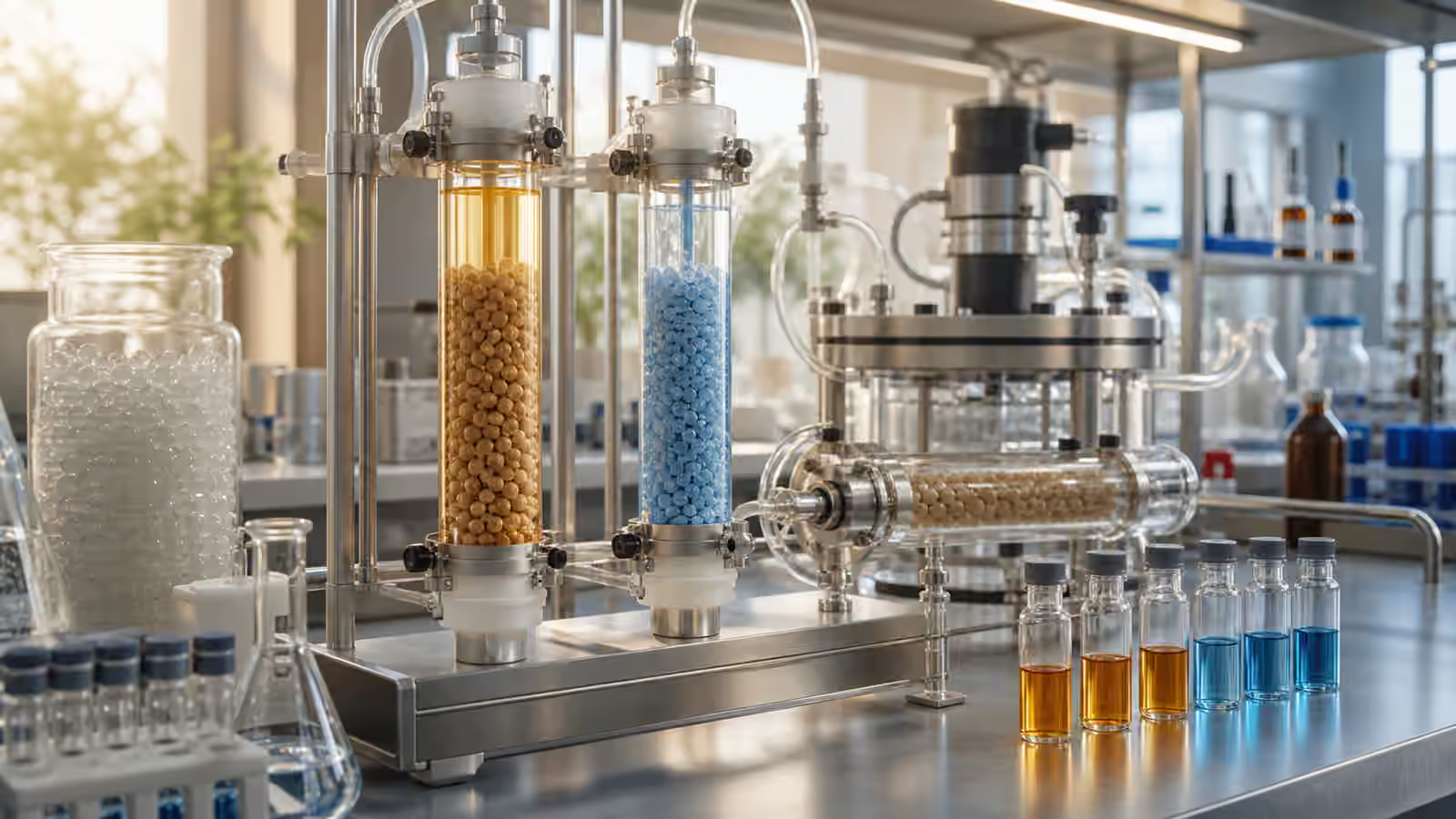
The idea is simple enough to picture. Instead of dissolving the enzyme freely in a tank and losing it with the broth, the process attaches, traps, crosslinks, or confines the enzyme on a support. Liquid can pass through or around the supported catalyst. The enzyme may be reused, protected, separated more easily, or arranged inside a flow process.
This guide builds on Industrial Enzymes and Directed Evolution . Industrial enzymes explain why proteins can become manufacturing tools. Directed evolution explains how enzyme performance can be improved. Immobilization asks how that performance behaves when the enzyme is placed into a real process format.
Immobilization Changes the Enzyme’s World
The support is not an inert stage. It becomes part of the enzyme’s environment. A porous bead, membrane, fiber, gel, resin, particle, surface, or encapsulated matrix can change local pH, water activity, substrate access, product removal, mechanical stress, and exposure to inhibitors. A support may protect an enzyme from unfolding, or it may distort the enzyme enough to reduce activity. It may make separation easy while slowing diffusion so much that the reaction becomes limited by transport rather than chemistry.
That is why immobilization is not only a materials choice. It is an enzyme engineering question, a process question, and a measurement question. The same enzyme can behave differently when it is free in solution, attached by one chemistry, trapped in a gel, or packed into a column. Activity measured in a small vial may not predict activity in a flowing bed.
Protein Expression and Folding is relevant because an enzyme’s useful shape is delicate. Immobilization can stabilize that shape by reducing movement or protecting against harsh interfaces. It can also block an active site, hide a needed surface, or place the enzyme in a microenvironment that changes its behavior. The support is a design variable, not a neutral container.
Reuse Is Attractive but Not Free
One of the main reasons to immobilize enzymes is reuse. If the catalyst remains in the reactor, the process may run multiple cycles or continuously without adding fresh enzyme each time. That can improve economics when the enzyme is costly, difficult to produce, or hard to separate from product.
Reuse, however, has to be measured rather than assumed. The enzyme may lose activity over time through unfolding, chemical damage, product inhibition, fouling, leaching, microbial contamination, or physical breakdown of the support. A column may channel flow so some catalyst is underused. A bead may trap material that later interferes with product quality. A support that works well in clean buffer may struggle in a real process stream containing salts, solvents, proteins, cell debris, sugars, pigments, antifoam, or byproducts.
This connects directly to Bioprocess Quality Control . A reusable catalyst creates a history. The tenth run is not the first run repeated. It is a run with a catalyst that has already experienced time, substrates, products, cleaning, storage, and mechanical stress. Quality systems need to know when reuse remains valid and when replacement is required.
Diffusion Can Become the Bottleneck
Free enzymes in solution meet substrates by molecular motion in a liquid. Immobilized enzymes may sit inside pores, gels, packed beds, or films. The substrate has to reach them, and the product has to leave. If those movements are slow, the apparent enzyme performance may decline even when the enzyme itself is active.
This is one reason small molecules and large molecules create different immobilization problems. A small substrate may enter pores easily, while a bulky protein substrate may not. A product may accumulate near the enzyme and inhibit the reaction. A hydrophobic molecule may interact with the support. A gas substrate may need careful transfer. A reaction that looks limited by enzyme amount may actually be limited by transport through the support.
Transporters and Membrane Engineering covers movement inside living cells. Immobilized biocatalysis faces a process version of the same theme: location matters. Chemistry can fail not because the enzyme is wrong, but because the right molecules do not reach the right place at the right rate.
Flow Reactors Make the Promise Concrete
Immobilized enzymes are often associated with flow processes. A liquid stream enters a reactor, passes through or along the immobilized catalyst, and exits with product. Flow can make residence time, temperature, mixing, and separation more controllable than repeated batch handling. It can also fit continuous manufacturing strategies, where a stable catalyst bed supports steady production.
The promise is attractive, but the engineering is demanding. The reactor must avoid clogging, channeling, pressure problems, uneven residence time, and hard-to-clean zones. The feed stream must be compatible with the catalyst and support. Product recovery must make sense. The process must know how activity changes over time and how to detect a failing bed before product quality suffers.
In Situ Product Recovery shows a related idea from living processes: removing product while cells keep working. Immobilized enzyme systems can follow a similar logic, keeping the catalyst in place while moving product away. In both cases, the separation strategy changes the biology or chemistry rather than arriving afterward as an afterthought.
Immobilization Can Compete With Whole-Cell Catalysis
Synthetic biology often uses whole cells to make products because cells can regenerate cofactors, run multi-step pathways, protect enzymes, and use feedstocks. Immobilized enzymes offer a different bargain. They remove growth, genetic stability, containment, and cell physiology from the reaction, but they may require enzyme production, purification, cofactor supply, and support design.
Neither approach is automatically better. A whole-cell process may be ideal when many reactions need native metabolism, when cofactors are difficult to supply externally, or when the cell handles toxic intermediates better than a purified system. An immobilized enzyme process may be better when the desired reaction is narrow, the product needs cleaner recovery, the enzyme can be reused, or living cells introduce unwanted complexity.
Cell-Free Synthetic Biology sits near this decision. It shows what changes when useful biological machinery operates outside living cells. Immobilized enzyme systems are another version of that move. They keep part of biology’s catalytic power while leaving behind some of the uncertainty of growth.
The Support Should Match the Claim
A process claim about immobilized enzymes needs more than a picture of beads or a statement that reuse is possible. It needs evidence of activity, stability, leaching, product quality, mass transfer, fouling, cleaning, storage, and run-to-run behavior under relevant conditions. The right evidence depends on the product and process. A food enzyme, a fine-chemical catalyst, a textile treatment, a diagnostic cartridge, and a waste-treatment step do not ask the same question.
This is where Techno-Economic and Life-Cycle Thinking becomes practical. Immobilization can reduce enzyme consumption, simplify separation, and support continuous operation. It can also add support costs, preparation steps, pressure drop, disposal burdens, and validation work. The only honest answer is system-specific.
Enzyme immobilization is powerful because it turns a biological catalyst into a process object. The enzyme is still molecular, sensitive, and specific, but it is also part of a column, bead, membrane, reactor, cleaning cycle, and cost model. Holding chemistry in place can make biology easier to use, as long as the support is treated as part of the design.