Environmental synthetic biology is easy to imagine and hard to do responsibly. The appealing version is simple: engineer microbes, plants, or cell-free systems to sense pollution, clean waste, capture useful molecules, improve soil, or report hidden changes in water. The practical version is slower. It asks where the engineered system will be used, what it can contact, how it will be contained, how long it will remain active, how it will be monitored, and what happens when the environment behaves less like the lab. A related reference is Synthetic biology and genome engineering in support of human, agricultural, and environmental security .
The field matters because many environmental problems are chemical and biological at once. Waste streams, contaminated water, nutrient runoff, soil health, industrial side streams, and greenhouse agriculture all involve living systems and molecular signals. Synthetic biology offers tools for sensing, transformation, and production, but those tools do not become safe or effective simply because the intention is environmental.
This guidebook connects to Biosensors and Living Diagnostics , Synthetic Biology Safety , and Plant Synthetic Biology . Those guides explain sensing, guardrails, and plant context. Environmental synthetic biology adds the field reality: weather, mixed communities, variable samples, retrieval, ecology, and public trust.
The Environment Is Not a Large Flask
A lab flask is controlled enough that a scientist can pretend most variables are fixed. A field setting refuses that comfort. Temperature changes. Light changes. Water flow changes. Nutrients arrive unevenly. Native organisms compete, cooperate, inhibit, consume, or ignore the engineered system. Surfaces bind molecules. Soil and sediment hide gradients. Rain dilutes signals. Organic matter interferes with assays. A sample that looked simple on the bench becomes a crowded chemical and biological world.
This is why environmental work cannot be judged only by whether a design functions in a clean laboratory medium. A biosensor that responds beautifully in buffered solution may fail in muddy water. A microbe that degrades a compound in a flask may struggle when the compound is bound to soil particles or mixed with other chemicals. A plant trait that performs in a growth chamber may behave differently in a greenhouse or field where pests, drought, microbes, and weather interact.
The first reality of environmental synthetic biology is context. The intended setting must shape the design from the beginning, not appear as a final test after the organism or system has already been built.
Many Useful Systems Are Field-Adjacent, Not Freely Released
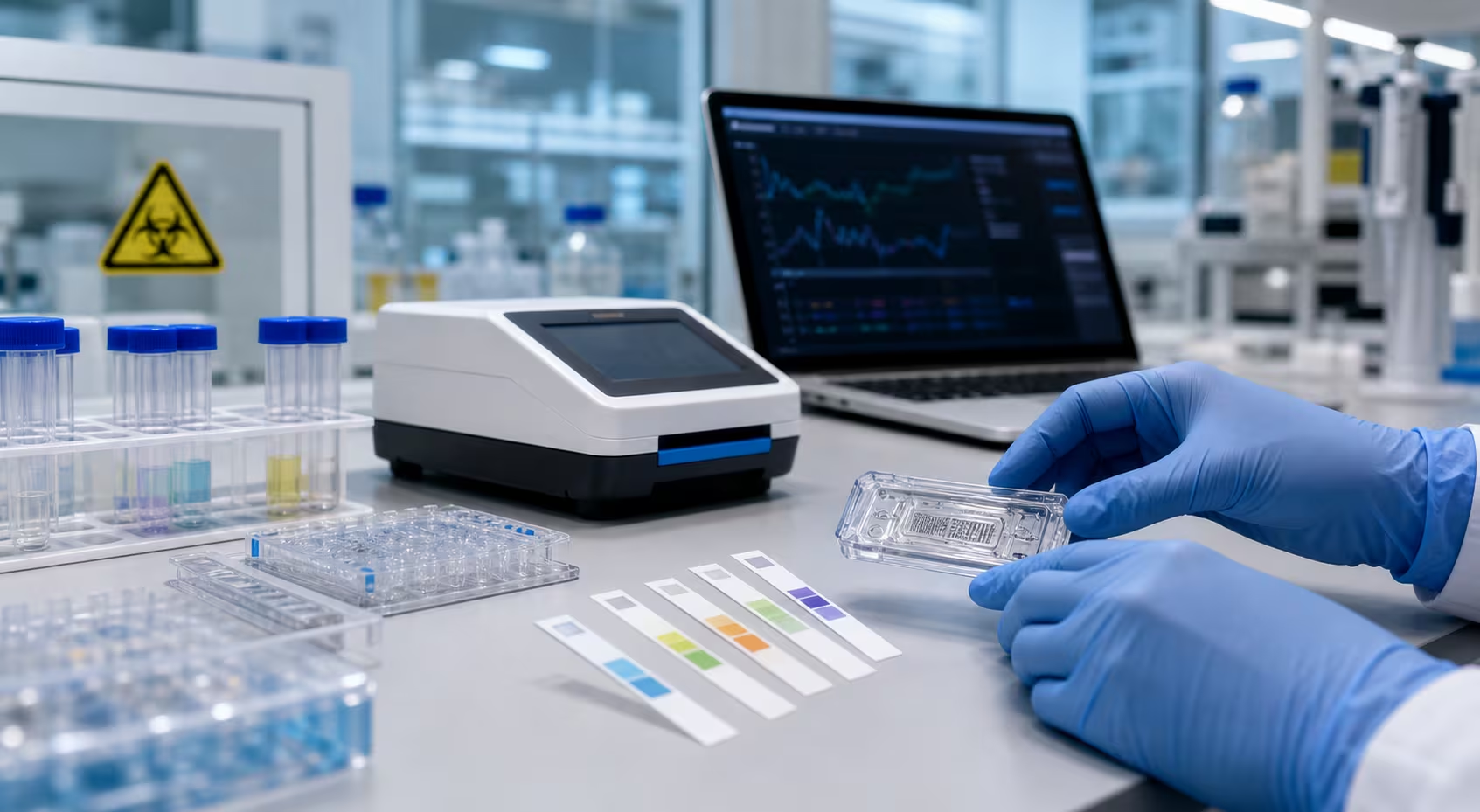
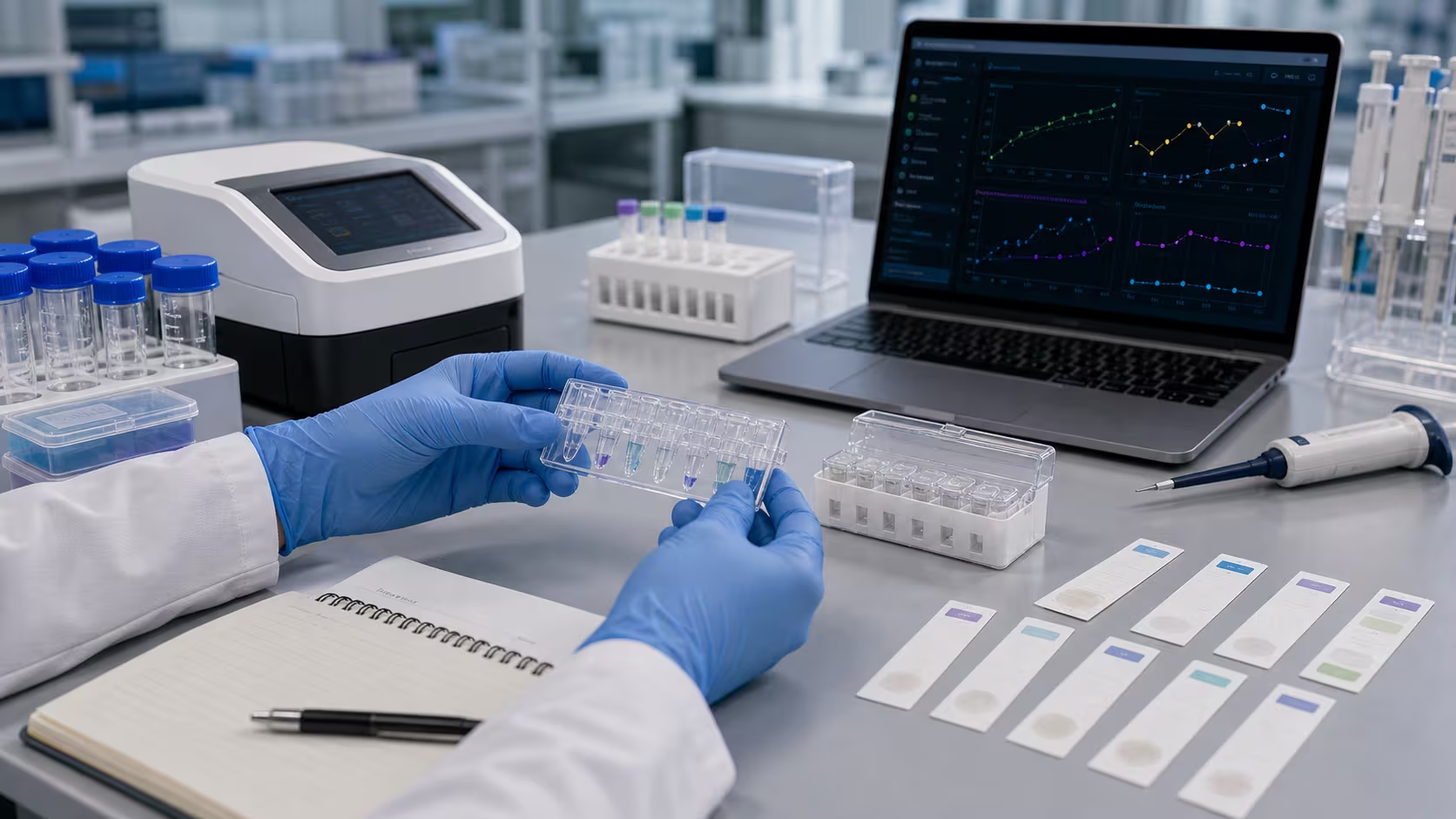
Environmental synthetic biology does not always mean releasing engineered organisms into open ecosystems. Many practical designs are field-adjacent. They may use contained cartridges, sealed biosensor devices, immobilized enzymes, closed bioreactors near waste streams, greenhouse systems, retrieved sampling kits, or cell-free reactions that never contain living engineered cells.
That distinction matters. A contained biosensor used to test water is different from an organism intended to persist in a stream. A bioreactor that treats an industrial side stream is different from a microbe spread through soil. A plant grown under controlled agricultural oversight is different from a wild population. Each use case has its own evidence burden, containment strategy, monitoring plan, and failure modes.
Cell-free systems are especially important here. Cell-Free Synthetic Biology shows how biological machinery can be used outside living cells. For some environmental sensing tasks, a cell-free test can reduce the challenges of keeping a living engineered organism alive, contained, and stable. It still needs validation, but the deployment question is often simpler.
Biosensors Need Specificity More Than Drama
Environmental biosensors can sound dramatic because they promise living systems that notice invisible signals. The hard part is not making something respond. The hard part is making it respond to the right signal, at the right concentration, in the right sample, with an understandable false-positive and false-negative profile.
In an environmental sample, many molecules can look similar to a sensor. pH, salts, organic matter, temperature, turbidity, and microbial activity can change the readout. A sensor may respond indirectly to stress rather than to the target. A color change may be hard to interpret in a colored sample. A fluorescence signal may be blocked or mimicked by the sample itself.
This makes controls and calibration essential. Biological Measurement and Controls is not a side topic for environmental work. It is the difference between a useful signal and a story. A responsible biosensor claim should explain what the sensor was compared against, what sample types were tested, what interfered with it, and how uncertain results are handled.
Bioremediation Is a Process, Not a Miracle
Bioremediation is the use of biological systems to reduce, transform, capture, or help manage contaminants. Synthetic biology can imagine organisms or enzymes that improve such processes, but the word cleanup can hide complexity. A contaminant may be spread unevenly. It may exist in several chemical forms. It may be toxic to the organism meant to transform it. It may become more mobile or create byproducts that also need attention.
An engineered pathway that works in a controlled assay is only one part of the question. The system also needs access to the contaminant, survival or activity under site conditions, a way to avoid unwanted spread, measurement of transformation products, and a plan for stopping, retrieving, or containing the biological agent where appropriate. Sometimes the better design is not an organism released into the environment, but an enzyme, immobilized cell system, contained reactor, or monitored treatment step.
The practical mindset is closer to Bioprocess Quality Control than to a rescue fantasy. What enters the process? What leaves? What is measured? What can drift? What would count as failure? What happens to residues? Environmental benefit depends on the whole process, not only the engineered biological function.
Containment Is More Than a Switch
Synthetic biology discussions often mention kill switches, dependencies, auxotrophy, genetic safeguards, physical containment, and retrieval. These tools matter, but none should be treated as magic. A genetic containment feature can fail, mutate, or behave differently outside its test condition. A physical barrier can leak or be mishandled. A retrieval plan can miss material. A dependency can be weakened by environmental chemistry or microbial exchange.
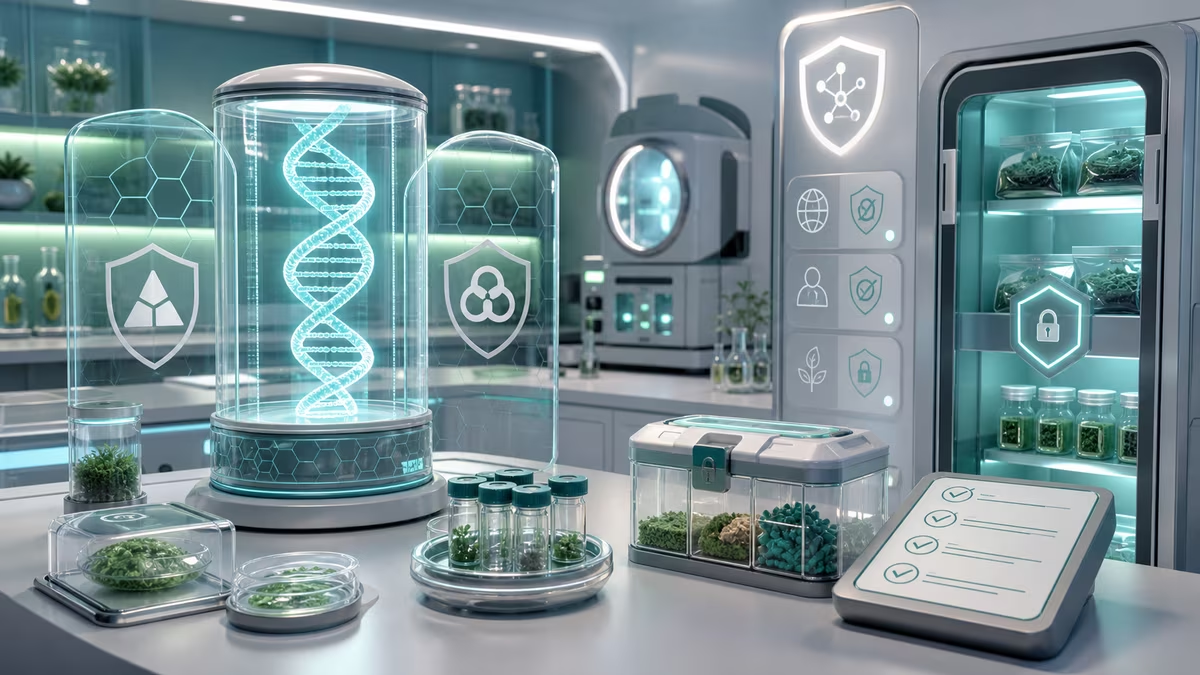
Containment is strongest when layers work together. A contained device may combine physical separation, limited lifetime, non-replicating or cell-free biology, tracking, operator procedures, waste handling, and post-use verification. A greenhouse system may combine facility controls, reproductive barriers, monitoring, and disposal practices. A closed reactor may combine process containment, sampling checks, and cleaning validation.
Synthetic Biology Safety covers the broader guardrails. Environmental work adds a practical question: if the system leaves the bench, how will people know where it is, what it is doing, and when it is no longer doing what it was designed to do?
Ecology Notices What Engineering Ignores
An engineered environmental system enters a web of relationships. Native microbes may consume the engineered organism’s product. A designed pathway may change nutrient availability. A plant trait may alter root exudates and soil communities. A biosensor organism may be stressed by competitors. A microbe that performs well alone may lose out in a mixed community. A harmless lab behavior may matter differently when scaled or repeated.
Ecology does not make environmental synthetic biology impossible. It makes simple claims suspect. A good design asks how the system interacts with existing communities, not only whether it performs a function in isolation. It also asks what time scale matters. A one-day signal, a one-month treatment, and a multi-season agricultural trait are different ecological stories.
This is where environmental synthetic biology overlaps with Microbial Consortia . Sometimes a community can perform work that one strain cannot. Sometimes a community adds instability and measurement difficulty. The design has to match the setting rather than assuming more biological complexity is automatically better.
Public Trust Depends on Plain Claims
Environmental applications invite public concern because they touch shared spaces: water, soil, air, food systems, and landscapes. Trust depends less on confident language than on plain claims. What is engineered? Where is it used? Is it living, cell-free, immobilized, or contained? What evidence supports the claim? What are the boundaries of use? How is performance measured? How are unintended outcomes monitored?
Synthetic Biology Product Claims and Public Trust applies strongly here. Environmental projects should avoid vague promises such as natural, clean, harmless, or permanent unless those words are carefully defined and supported. A project can be promising and still have limits. Explaining those limits is not weakness. It is part of responsible deployment.
Field Reality Is the Design Constraint
Environmental synthetic biology becomes more convincing when it stops treating the environment as the final exam and starts treating it as the design constraint. The sample matrix, climate, containment pathway, monitoring plan, retrieval method, ecological context, and public explanation should shape the design as early as the genetic circuit or pathway.
The most useful systems may be modest. A contained sensor that helps operators notice a problem earlier. An enzyme process that improves a waste-treatment step. A greenhouse trait that is monitored under controlled conditions. A cell-free assay that travels to field sites without introducing living engineered cells. These are not less interesting because they are bounded. They are more credible because the boundary is part of the engineering.
Environmental synthetic biology asks living systems to work near the places people care about most. That makes the field worth studying and worth slowing down for. The goal is not to make biology seem tame. It is to design with enough evidence, containment, monitoring, and humility that the environmental setting is treated as real from the first sketch.