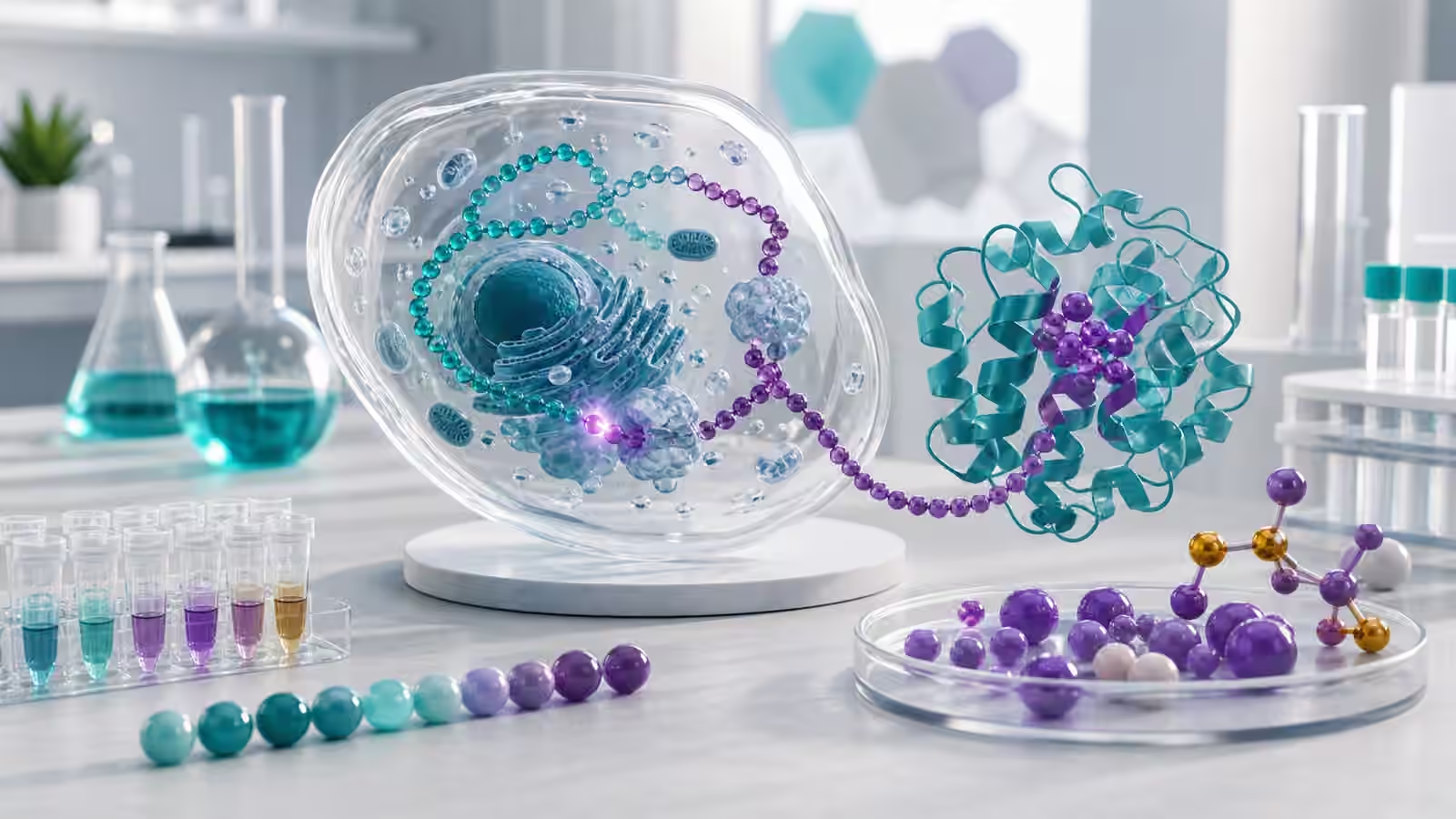
Directed evolution begins with a modest admission: the best biological design may be easier to find than to invent from first principles.
A scientist may understand a protein’s shape, a pathway’s purpose, or a cell’s rough operating logic, yet still be unable to predict exactly which sequence change will make the system better. Biology is too crowded for that kind of confidence. Proteins move. Cells reroute resources. A mutation that looks sensible in a diagram may do nothing. A change that seems minor may alter folding, stability, expression, or activity in a way nobody expected.
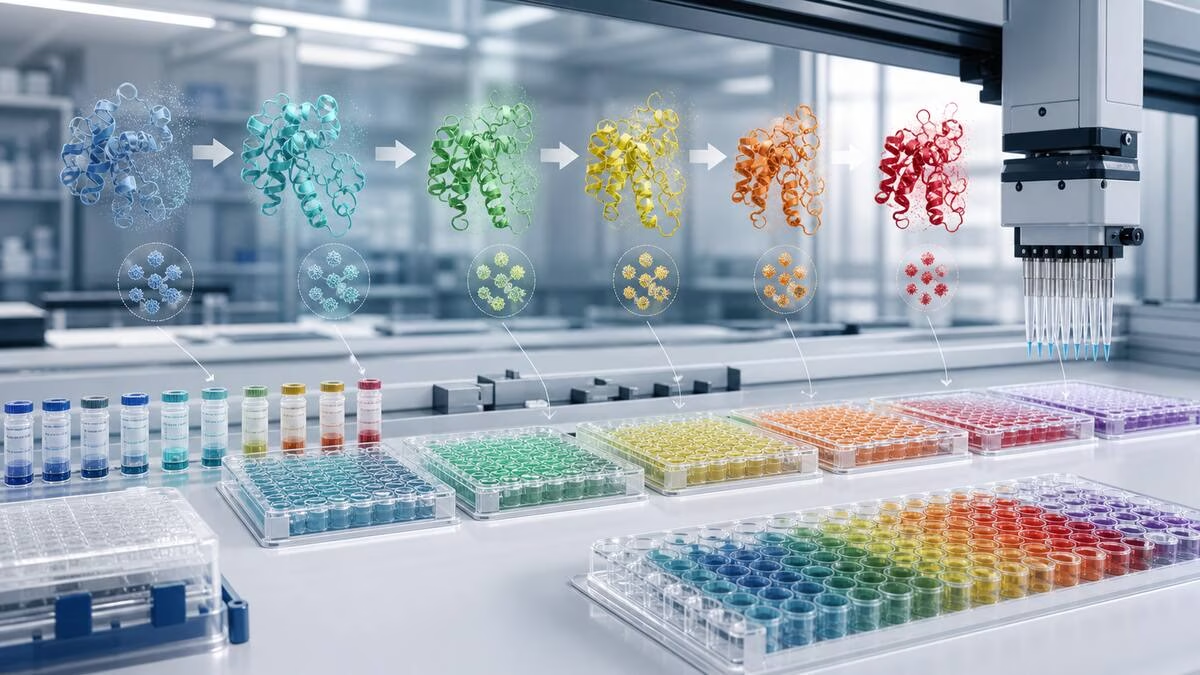
Directed evolution turns that uncertainty into a search strategy. Instead of betting everything on one perfect design, researchers create many related variants, test them, keep the ones that perform better for a chosen job, and repeat the cycle. The method borrows the logic of natural evolution without pretending to copy nature exactly. Natural evolution rewards survival and reproduction in messy environments. Directed evolution rewards a laboratory goal: a faster enzyme, a more stable protein, a clearer sensor signal, a useful binding behavior, or a production strain that handles its engineered task with less stress.
The result is one of the most important practical ideas in synthetic biology. It sits between design and discovery. It accepts that human reasoning matters, but it also lets biology search places human reasoning would miss.
What Directed Evolution Actually Means
Directed evolution is not a single machine or one narrow protocol. It is a family of approaches built around variation and testing. A starting molecule or system is chosen, often a protein such as an enzyme. Variants are produced with small sequence differences. Those variants are evaluated for the property that matters. The best performers become parents for the next round, or they reveal information that guides a new design.
The word directed is doing important work. The process is not random wandering. Researchers choose the starting point, decide what kind of variation to explore, define the test, and interpret the results. If the test rewards heat stability, the search moves toward variants that tolerate heat. If the test rewards activity on a particular substrate, the search moves toward variants that improve that activity. If the test is poorly chosen, the search can improve the wrong thing with impressive efficiency.
That last point is central. Directed evolution does not know what people truly want. It only knows what the assay rewards. A variant may look better because it creates a stronger color signal, grows faster in a screening condition, survives a shortcut, or behaves well in a simplified environment. If the real application is a fermentation tank, a food formulation, a diagnostic cartridge, or a textile process, the screen has to be honest enough to matter.
This is why directed evolution belongs beside Biological Measurement and Controls , not only beside protein design. The search is only as good as the measurement that steers it.
Evolution as a Search Tool
Natural evolution explores biological possibility through mutation, recombination, inheritance, and selection over generations. It has produced enzymes, receptors, pigments, toxins, fibers, immune systems, and metabolic pathways of astonishing subtlety. But natural evolution does not optimize for human industrial goals. It does not care whether an enzyme survives a detergent, a textile bath, a hot reactor, or a new feedstock. It cares whether organisms leave descendants in their own circumstances.
Directed evolution narrows the arena. The laboratory supplies the goal and the pressure. The biological system supplies variation and surprises. A protein that evolved for one natural substrate may be pushed toward another. An enzyme that works at body temperature may be improved for a warmer process. A binding protein may be refined to recognize a target more tightly. A sensor may be tuned to respond with less background noise.
This makes directed evolution especially useful when the design space is huge. Even a small protein can have an overwhelming number of possible sequences. No team can test all of them. A good directed evolution campaign does not search everything. It samples intelligently, learns from what worked, and uses each round to make the next round less blind.
That practical search mindset connects to AI-Designed Proteins . AI can propose candidates, predict structures, or suggest promising regions of sequence space. Directed evolution can then test and improve real molecules under real conditions. The two approaches are not enemies. Computation can make the search less wasteful, while experiments keep the search attached to biology.
Why Enzymes Are a Natural Fit
Enzymes are among the clearest examples because their jobs are often measurable. An enzyme speeds a reaction. A laboratory can compare variants by asking which one makes more product, works faster, tolerates stress, or behaves more specifically. Those properties matter in medicine, food, textiles, detergents, paper, agriculture, research tools, and chemical manufacturing.
The guide to Industrial Enzymes describes enzymes as quiet workhorses because they often improve ordinary processes without drawing attention. Directed evolution is one way those workhorses are trained for harder jobs. A naturally occurring enzyme may be useful but fragile. It may work in a narrow temperature range. It may prefer the wrong substrate. It may fall apart during storage. It may be produced poorly by the chosen host organism. Evolutionary search can sometimes improve one of those traits without requiring a complete theory of every atom in the protein.
The word sometimes matters. Improving one property can weaken another. A more active enzyme may become less stable. A more stable enzyme may lose specificity. A variant that looks excellent in a clean lab assay may struggle in a dirty industrial mixture. Protein engineering often becomes a negotiation among traits rather than a march toward a single perfect score.
Directed evolution is powerful because it can reveal those tradeoffs early. Instead of treating a protein as an idealized shape on a screen, it asks the molecule to perform. The answer may be inconvenient, but it is useful.
The Screen Becomes the Compass
Every directed evolution project has a compass, and that compass is the screen or selection. A screen measures many variants and reports how each one performed. A selection sets up conditions where only variants with a desired behavior continue. The distinction matters technically, but the deeper lesson is the same: the search follows the pressure applied to it.
If the compass points in the wrong direction, the project can become beautifully wrong. A sensor might evolve to respond strongly, but not specifically. An enzyme might evolve to create a convenient assay signal, but not the intended product. A cell might evolve to grow well while dropping the costly engineered function. A protein might look better because the measurement system favored easy expression instead of real performance.
Good directed evolution therefore begins before the variants are made. Researchers have to ask what success means. Is the goal catalytic speed, stability, tolerance, expression, selectivity, binding, lower background, easier purification, or better behavior in a full process? Which conditions resemble the eventual use? Which controls reveal false positives? Which measurements distinguish the desired function from a misleading substitute?
These questions make the field less glamorous and more trustworthy. They also explain why Biofoundries Explained is relevant. Biofoundries can help build and test large numbers of variants, but automation does not remove the need for judgment. A robot can pipette variants quickly. It cannot decide by itself whether the assay is asking the right biological question.
Variation Is Useful, But Not Free
Creating variation is easy to describe and hard to manage. Too little variation may miss better designs. Too much variation can bury useful signals under a mountain of weak candidates. Some changes damage folding. Some reduce expression. Some help only in combination with other changes. Some look neutral until the environment changes.
This is one reason directed evolution often proceeds in rounds. A first round may reveal a few useful mutations or regions worth exploring. Later rounds may combine changes, narrow the search, or test variants under harsher conditions. The process can feel like listening to the protein. The scientist proposes possibilities; the measurements answer; the next proposal becomes more informed.
DNA synthesis and assembly make this kind of work easier than it used to be because designed variants can be created more deliberately. The guide to DNA Synthesis and Assembly explains how sequences become physical constructs for testing. Directed evolution uses that build layer as a way to turn search ideas into real biological material.
Yet the physical work remains grounded. Samples must be tracked. Variants must be identified. Measurements must be linked back to sequences. Contamination, labeling mistakes, edge effects, instrument drift, and growth differences can all distort the search. The more variants a team tests, the more important the data discipline becomes.
Cells Add Another Layer
Directed evolution is often introduced through proteins, but synthetic biology also uses evolutionary thinking at the level of genetic circuits, pathways, and production strains. A cell engineered to make a molecule may need more than one improved enzyme. It may need balanced expression, reduced toxicity, better tolerance of an intermediate, less metabolic burden, or a way to keep producing over many generations.
This connects naturally to Strain Engineering . A production strain is not just a chassis carrying a useful pathway. It is a living system with priorities of its own. If the engineered job slows growth, the cell may favor variants that reduce or silence that burden. From the cell’s perspective, dropping a costly function can be an advantage. From the engineer’s perspective, it can ruin the process.
Directed evolution at the cellular level therefore needs careful pressure. The goal is not simply to make cells grow. It is to make them grow while preserving or improving the function people need. That distinction becomes crucial in biomanufacturing, where a strain must behave consistently across development, scale-up, and production. A strain that performs once in a small experiment is not the same as one that supports a reliable process.
This is where Bioprocess Quality Control becomes part of the story. Evolution does not stop when a product leaves the research phase. Living production systems can drift. Cells can change. Processes can select for traits nobody intended. Quality control watches whether the organism and product still match the claim.
What Directed Evolution Does Not Promise
Directed evolution can sound almost magical because it has produced remarkable improvements. That reputation should not become a blank check. The method does not guarantee success. It does not remove the need to understand biology. It does not prove that a product is safe, scalable, sustainable, or commercially useful. It does not turn a weak assay into a strong result.
It also does not search every possibility. It searches the possibilities that the project creates and tests. A campaign can get stuck on local improvements while missing a more distant design. It can optimize a proxy instead of the real goal. It can produce variants that are hard to manufacture or unsuitable for the final environment. It can reveal a better molecule without solving purification, formulation, regulation, cost, or public trust.
Those limits do not make directed evolution less impressive. They make it a real engineering tool. Good tools have domains where they work well and failure modes that mature teams respect.
Why It Matters
Directed evolution matters because synthetic biology lives between ambition and ignorance. The field wants to design useful biological systems, but it often cannot calculate the best answer directly. Evolutionary search offers a disciplined way to learn from variation. It turns uncertainty into experiments, experiments into data, and data into better next questions.
The method is especially valuable in the parts of synthetic biology where performance must be proven rather than imagined: enzymes that work in harsh processes, proteins that bind with precision, sensors that respond cleanly, strains that keep producing, and pathways that survive contact with manufacturing reality. It is not the opposite of design. It is design that has learned to ask biology for feedback.
That humility is one of the field’s best habits. Synthetic biology can write DNA, model proteins, automate labs, and build larger datasets than earlier generations could manage. Directed evolution reminds the field that living systems still have their own search logic. The clever move is not to replace that logic with human confidence. It is to aim it carefully, measure it honestly, and learn from what it finds.