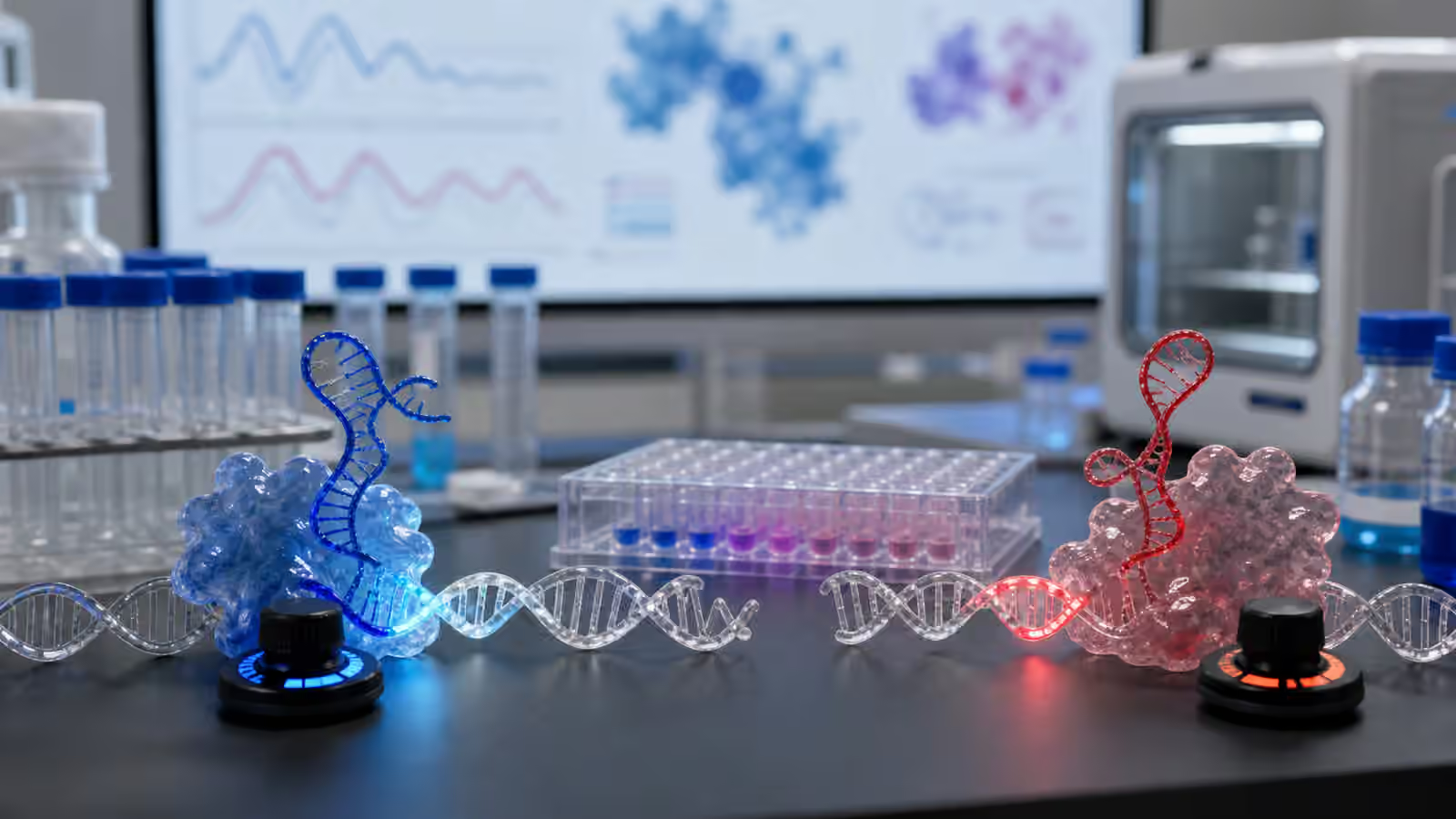
CRISPR is often introduced through genome editing, where a guide RNA helps direct a molecular system to a DNA address and a cell’s genome can be changed. That story is important, but it is not the whole CRISPR story in synthetic biology. Sometimes the goal is not to cut the genome at all. Sometimes the goal is to turn a gene down, turn a gene up, compare many regulatory settings, or probe how a cell responds when one part of its network is gently shifted. A related reference is Generating Labeled Low-Heterogeneity Transcriptomes Using CRISPRa and CRISPRi Can Improve Phenotype Prediction by Deep Learning .
CRISPR interference, usually shortened to CRISPRi, is the use of an RNA-guided system to repress gene expression without making a genome cut. CRISPR activation, usually shortened to CRISPRa, uses the same basic address logic to increase expression. In both cases, the guide RNA provides a programmable route to a target region, while the associated protein machinery is repurposed as a regulator rather than a cutter. The result is a control layer that feels unusually direct: change the guide, and the system can be aimed at a different genetic address.
This guide belongs beside Genome Editing in Synthetic Biology , RNA Switches in Synthetic Biology , and Gene Expression Tuning . Genome editing explains the public-facing version of CRISPR as a way to make durable sequence changes. RNA switches explain why RNA can be a programmable control layer. Expression tuning explains why more or less output is never a simple good or bad. CRISPRi and CRISPRa connect those ideas without assuming a permanent edit is always the right tool.
Regulation Can Be a Better First Question Than Editing
Genome editing is powerful, but a permanent change can be a blunt first move. If a team does not yet know whether a gene should be removed, weakened, strengthened, delayed, or left alone, a reversible or tunable regulatory approach can be more informative. CRISPRi can reduce expression enough to reveal whether a pathway, stress response, competing reaction, or host function matters. CRISPRa can increase expression enough to test whether a quiet native function could help a designed system.
This matters in Strain Engineering . A production cell is shaped by many choices, and not every useful change requires rewriting DNA. A pathway bottleneck may be eased by turning down a competing gene. A sensor may become clearer when background activity is repressed. A tolerance trait may appear when a protective response is activated. A metabolic route may improve when several native genes are adjusted together.
The value is exploratory as much as operational. CRISPRi and CRISPRa let synthetic biologists ask how much a gene’s activity matters before committing to a more durable edit. They can reveal direction, sensitivity, timing, and interaction. A permanent deletion may answer whether a gene can be lost. A regulatory dial can ask what happens across intermediate levels.
The Guide RNA Is an Address, Not a Guarantee
The programmable charm of CRISPRi and CRISPRa comes from guide RNAs. A guide RNA can direct the regulatory complex toward a matching sequence. That addressability makes the system attractive for libraries, pooled screens, and modular design. Yet an address on a screen is not the same as behavior in a cell.
The target sequence must be accessible enough. The host context matters. The regulatory machinery must be expressed at a useful level. The guide RNA must be stable and specific enough. A nearby sequence may attract partial binding. A target region may sit in a chromatin state, DNA structure, or transcriptional context that changes the effect. The same guide can behave differently across organisms, strains, growth phases, or genomic locations.
Chassis Organisms explains why host context is not a footnote. CRISPRi and CRISPRa are no exception. A design that works cleanly in one bacterium may not behave the same way in yeast, a mammalian cell line, plant cells, algae, or a cell-free test system. The guide provides an address. The cell decides how that address is read.
Repression and Activation Have Different Personalities
CRISPRi is often conceptually easier to picture. An RNA-guided complex binds near a gene or regulatory region and interferes with expression. It may block transcription machinery, reduce initiation, or prevent productive elongation, depending on the system and target. The result is lower expression, but lower expression is not a single biological state. A partial reduction may be useful. A strong reduction may slow growth, change metabolism, or cause indirect effects that obscure the original question.
CRISPRa asks a different kind of question. It brings activation machinery toward a target region to increase expression. That can reveal hidden capacity in the host, but it can also create burden or network effects. A gene that helps under one condition may become costly under another. A native pathway that looks beneficial when activated may compete with the engineered pathway for cofactors, precursors, or energy. Activation is not simply the positive version of repression. It has its own noise, ceiling, timing, and context.
Both approaches connect to Cellular Burden and Resource Allocation . Regulation changes what the cell spends. Turning one gene down may free resources or create a shortage. Turning one gene up may improve a bottleneck or overload a system. A regulatory screen that ignores cell fitness may select a setting that looks strong in a short assay and weakens the strain later.
Screens Need Triage, Not Just Rankings
CRISPRi and CRISPRa are powerful screening tools because guide libraries can test many regulatory targets. A pooled or arrayed screen can ask which genes change a phenotype, improve product formation, alter tolerance, shift growth, or modify a circuit response. That search can be faster than building one permanent edit at a time.
The same screening cautions apply. A guide that ranks highly may affect the intended target, a nearby target, a growth advantage, an assay artifact, or a stress response that looks useful only under the screening condition. A low-ranking guide may fail because the target was irrelevant, but it may also fail because the guide was weak, the region was inaccessible, or the readout could not see the relevant biology.
High-Throughput Strain Library Screening is the broader habit. A screen identifies candidates for retesting. It does not settle the biological explanation. Strong CRISPRi and CRISPRa work follows up promising guides with independent guides, direct expression measurements, phenotype checks, and enough controls to separate guide behavior from true target biology.
Measurement Has to Notice Indirect Effects
Gene regulation rarely changes only one number. A repressed gene may reduce a pathway flux, but it may also slow growth, change stress responses, affect product degradation, or alter the cell’s timing. An activated gene may raise a desired enzyme level while creating a new byproduct or pulling a cofactor away from another reaction. The measured output can move for several reasons at once.
This is why Biological Measurement and Controls matters. A CRISPRi result should not be trusted only because the final product increased. The team should ask whether biomass changed, whether product per cell changed, whether byproducts shifted, whether guide expression created burden, whether the target gene actually moved in the expected direction, and whether the result repeats outside the first assay.
In mammalian or plant systems, interpretation can become even richer because regulation may interact with chromatin, development, cell state, or differentiation. In microbes, the apparent simplicity can also mislead because growth advantages can quickly dominate. In every host, the question is not only whether the guide changed the readout. It is whether the explanation survives additional evidence.
Non-Cutting Does Not Mean Risk-Free
Because CRISPRi and CRISPRa do not aim to cut DNA, they may avoid some concerns associated with genome editing. But non-cutting does not mean consequence-free. Changing expression can alter metabolism, stress tolerance, persistence, product profile, containment assumptions, or measurement interpretation. A system that represses a native safeguard, activates a survival trait, or changes a pathway producing a sensitive compound still deserves careful review.
The guide to Synthetic Biology Safety is the right frame. Safety depends on organism, design, product, containment, scale, exposure route, and evidence. A regulatory perturbation in a contained research strain is not the same as a proposal involving environmental use, food production, or living therapeutic concepts. The word non-cutting should not be used as a shortcut around context.
Responsible claims also matter. A team can say a CRISPRi system reduced expression under tested conditions. It should be more cautious about saying the target has no role, the guide has no off-target effects, or the phenotype is fully explained. Synthetic biology earns trust when it describes what was shown and what remains uncertain.
A Dial Still Lives in a Cell
CRISPRi and CRISPRa are sometimes described as genetic dials. The metaphor is useful because these systems can tune expression rather than only break or install genes. But a dial in biology is not like a knob on a bench instrument. The setting interacts with growth, host context, delivery, copy number, guide stability, target accessibility, product burden, and process conditions.
That is why CRISPRi and CRISPRa are especially valuable when treated as part of a larger engineering loop. They can test targets before permanent edits. They can map sensitive nodes in a pathway. They can help tune production strains. They can build regulatory circuits that respond to design needs. They can generate evidence that guides future edits, pathway balancing, or process choices.
The strongest use of these tools is not the most dramatic one. It is the disciplined one: ask a clear biological question, choose guide designs that can answer it, measure direct and indirect effects, retest promising signals, and avoid claiming more precision than the cell has demonstrated. CRISPRi and CRISPRa show how programmable recognition can become programmable regulation, but the living context still has the final vote.