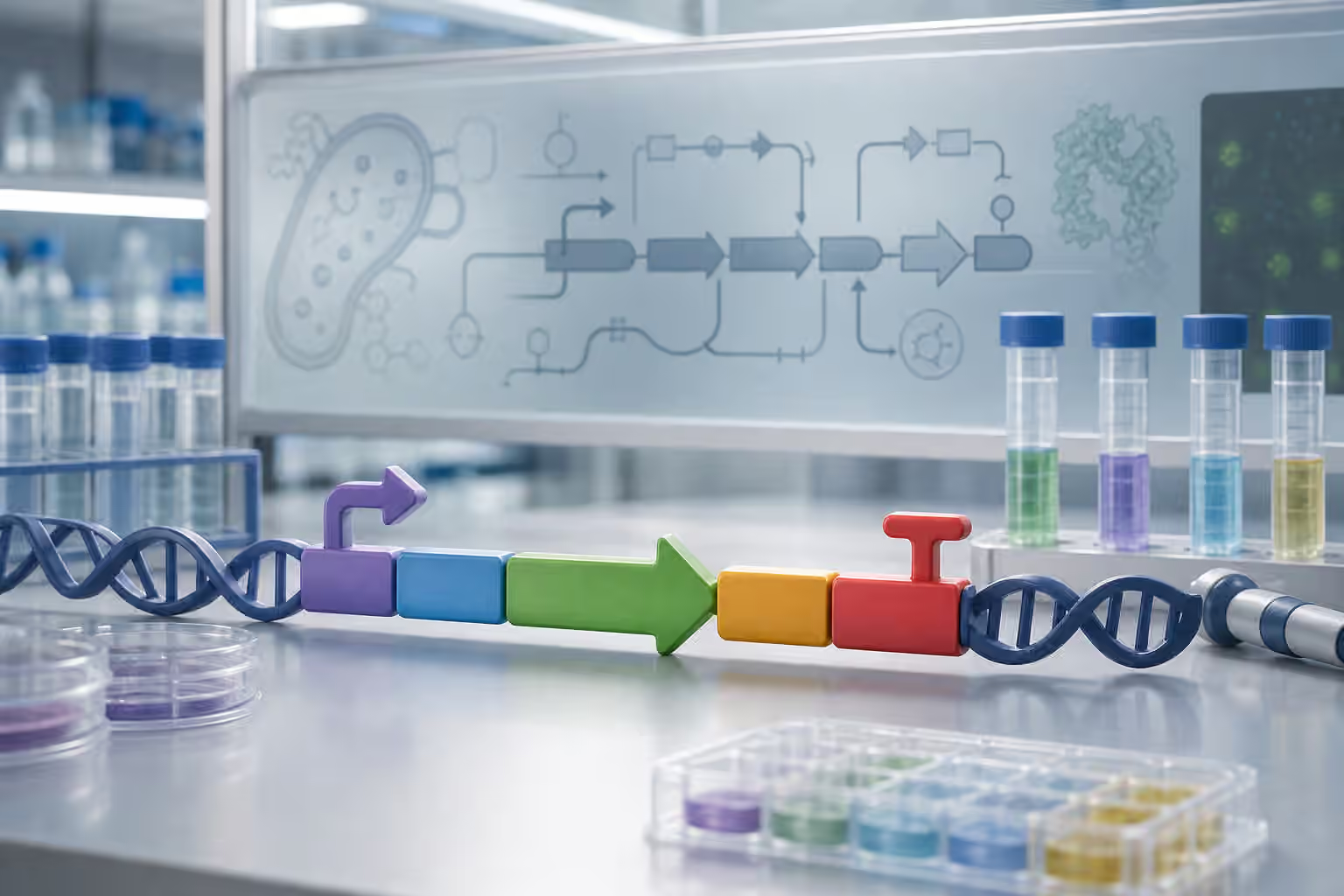
A designed gene can look finished long before a cell is ready to use it. On a screen, the sequence may have the right protein-coding information, the right start and stop points, and a clean place inside a larger construct. Once that sequence enters a living host, the design has to pass through a translation system that was not built as a neutral reader. It belongs to a particular organism, with particular tRNA pools, growth habits, stress responses, RNA enzymes, folding helpers, and evolutionary history. A related reference is From codon optimization to AI-guided sequence design for engineered biological functions .
Codon optimization is the attempt to rewrite a protein-coding DNA sequence so a chosen host can express it more usefully. The protein sequence may stay the same, but the DNA words that encode it change. That idea sounds simple because the genetic code is redundant. Most amino acids can be encoded by more than one codon, so a designer can often choose among synonymous alternatives. The hard part is that synonymous does not mean identical to the cell.
This guide sits between DNA Synthesis and Assembly , where designed sequences become physical constructs, and Gene Expression Tuning , where those constructs are adjusted inside living systems. Codon optimization is one of the places where the tidy language of sequence design meets the messier language of host biology.
The same protein can be written many ways
Proteins are built from amino acids. DNA encodes those amino acids in three-letter units called codons. Because several codons can encode the same amino acid, two DNA sequences can produce the same protein while looking very different at the nucleotide level. A human gene, a bacterial gene, and a yeast gene may encode similar protein domains while using different codon patterns.
Cells do not treat those patterns as invisible. Translation depends on transfer RNAs, ribosomes, messenger RNA structure, initiation signals, elongation speed, quality control systems, and the metabolic state of the host. A codon that is common in one organism may be rare in another. A sequence that translates smoothly in one host may stall, misfold, or produce low yield in another. The protein sequence alone does not tell the whole expression story.
That is why codon optimization became a common tool in synthetic biology. If a designer wants a plant enzyme expressed in yeast, a bacterial reporter expressed in a mammalian cell, or a synthetic pathway distributed across a microbial chassis, the original coding sequence may not be the best sequence for the new host. Rewriting the codons can improve expression, simplify synthesis, remove unwanted sequence motifs, or make a construct easier to manage.
The important word is can. Codon optimization is not a magic cleanup step. It is a design choice with tradeoffs.
Host context is the real target
The phrase codon optimization can make it sound as if there is one best version of a gene. In practice, optimization is always for something. It is for a host, a product, a process, a measurement, and a purpose. A sequence optimized for fast bacterial expression may not be right for yeast secretion. A sequence intended for a small screening assay may not be right for a long production run. A sequence that maximizes total protein may not maximize active protein.
Chassis Organisms explains why bacteria, yeast, fungi, algae, plants, mammalian cells, and cell-free systems behave as different platforms rather than interchangeable containers. Codon optimization is one consequence of that difference. Each platform brings its own translation machinery and its own tolerances.
Even within a host family, context matters. A lab strain and an industrial strain may not behave the same way. A slow-growing condition may change the available resources. A high-copy plasmid may create a different burden than a chromosomal integration. A protein that is harmless at modest expression may become stressful when translation is pushed too hard. A design that looks optimized according to a codon table may still fail because the host was not the true unit of design.
Good codon optimization therefore starts with humility. It asks what the host is being asked to do, what expression level is needed, where the protein must fold or travel, and how success will be measured.
Faster translation is not always better
A common beginner explanation says rare codons slow translation and common codons speed it up. That is partly useful, but too crude. Translation speed can influence protein folding. Some proteins appear to benefit from pauses that allow domains to emerge and fold in a workable order. Replacing every rare codon with the most common alternative can sometimes increase the amount of protein made while decreasing the amount of protein that works.
This connects directly to Protein Expression and Folding . A protein is not useful because a sequence was translated quickly. It is useful when the resulting molecule reaches the right shape, location, activity, and stability for the job. A badly folded protein can burden the cell, form aggregates, trigger stress, or complicate purification. More protein can become less product.
Some codon choices can also affect ribosome movement, local translation rhythm, and the way emerging protein segments encounter folding helpers. Designers may care about avoiding extreme bottlenecks, but they may also preserve certain pauses when they seem biologically meaningful. The goal is not always the fastest possible translation. It is the most useful translation for the system.
That lesson echoes across synthetic biology. Biological engineering often fails when it treats every limit as an enemy. Some limits are part of how the host keeps a molecule usable.
RNA structure can change the outcome
The coding sequence does more than name amino acids. Once transcribed, it becomes RNA with physical structure. The RNA can fold back on itself, expose or hide important regions, interact with regulatory machinery, and influence how easily translation begins. A synonymous change that looks harmless at the protein level can change the RNA shape near the start of the gene or around important regulatory elements.
This is especially important near translation initiation, where local RNA structure can make a large difference in how often ribosomes begin reading. A coding sequence that forms a stubborn structure at the wrong place may reduce expression even if its codons look statistically friendly to the host. Another sequence may improve initiation while keeping later translation moderate.
The guide to RNA Switches in Synthetic Biology shows how RNA can act as a control layer rather than a passive messenger. Codon optimization has to respect that same idea. RNA is not merely a temporary copy of DNA. It is a molecule with shape, timing, interactions, and consequences.
Designers may also remove unwanted motifs, repeats, restriction sites, cryptic splice-like signals, premature termination features, or sequence patterns that make synthesis and verification harder. Those changes can help, but every change still belongs to the whole construct. A neat sequence on paper can still behave oddly once placed next to promoters, terminators, untranslated regions, tags, linkers, or neighboring genes.
Pathways need balanced translation
Codon optimization becomes more complex when a project involves several genes. A metabolic pathway may include enzymes from different organisms, each rewritten for a host cell. If every enzyme is optimized aggressively, the pathway may become unbalanced. One step may flood the cell with an intermediate, while another remains limiting. The result can be toxicity, waste, side products, or lower final yield.
Metabolic Pathway Design explains why pathways need rhythm more than brute force. Codon choices can be part of that rhythm. A designer might want one enzyme made abundantly, another made modestly, and another kept low because it burdens the cell or diverts material. The best sequence for one gene may depend on the expression behavior of the genes around it.
This is where codon optimization overlaps with promoters, copy number, ribosome binding, protein stability, compartment targeting, and process conditions. It is rarely the only lever. Sometimes changing codons improves a weak step. Sometimes a weaker promoter or lower copy number solves the problem more cleanly. Sometimes the host needs a different pathway, a different product target, or a different feed strategy.
Optimization can be seductive because it appears precise. Biology reminds the designer that precision in one layer does not guarantee balance across the system.
Measurement decides whether it helped
A codon-optimized sequence is only better if the evidence says it is better for the intended purpose. That evidence should distinguish between more RNA, more total protein, more soluble protein, more active protein, healthier cells, cleaner product, and better process behavior. These are not the same outcome.
A bright reporter may show stronger expression while hiding folding problems in the real protein. A gel band may show more material while saying little about activity. A product assay may improve at small scale while a longer run reveals instability. A sequence may help one batch and disappoint in another because the measurement context changed.
Biological Measurement and Controls is a natural companion here. Codon optimization should be tested with controls, verified sequence identity, comparable construct context, and measurements that match the claim. If the claim is improved enzyme function, expression alone is not enough. If the claim is better manufacturing fit, a short expression test is only an early signal.
Good measurement also protects against overfitting. A sequence can be tuned to win a narrow assay while becoming fragile elsewhere. The useful question is not whether the software called the sequence optimized. The useful question is what changed in the cell, how it was measured, and whether that change supports the project’s real goal.
A translation layer, not a guarantee
Codon optimization is powerful because it acknowledges that genes travel across biological contexts. Synthetic biology often borrows enzymes, sensors, regulators, and protein domains from many organisms. Rewriting a coding sequence for a new host can make those borrowed parts more practical.
It is also limited because translation is only one layer. A protein may still need cofactors, partners, secretion signals, post-translational modifications, or a gentler expression regime. A cell may still experience burden. A pathway may still need balancing. A construct may still drift. A process may still fail during scale-up.
The best use of codon optimization is therefore neither casual nor mystical. It is a way to make a designed gene more compatible with a chosen host while remembering that compatibility has to be proven. The optimized sequence is not the finish line. It is a better question placed into a living system.
When a synthetic biology claim says a gene was optimized, ask what optimized means. Optimized for which host? For expression, activity, solubility, stability, secretion, or scale-up? Compared with what? Measured how? Those questions turn a vague promise into an engineering conversation, which is exactly where codon optimization belongs.