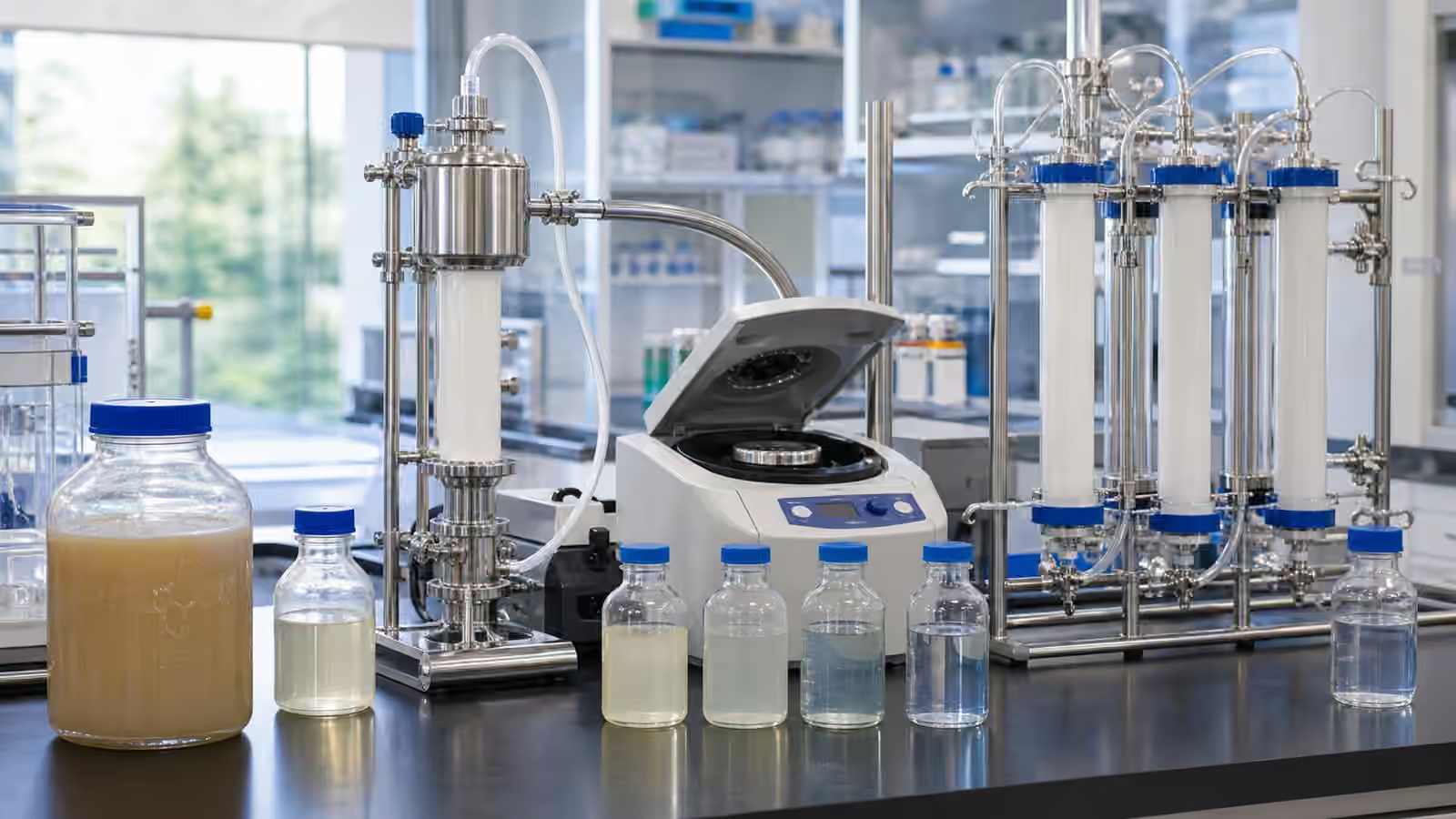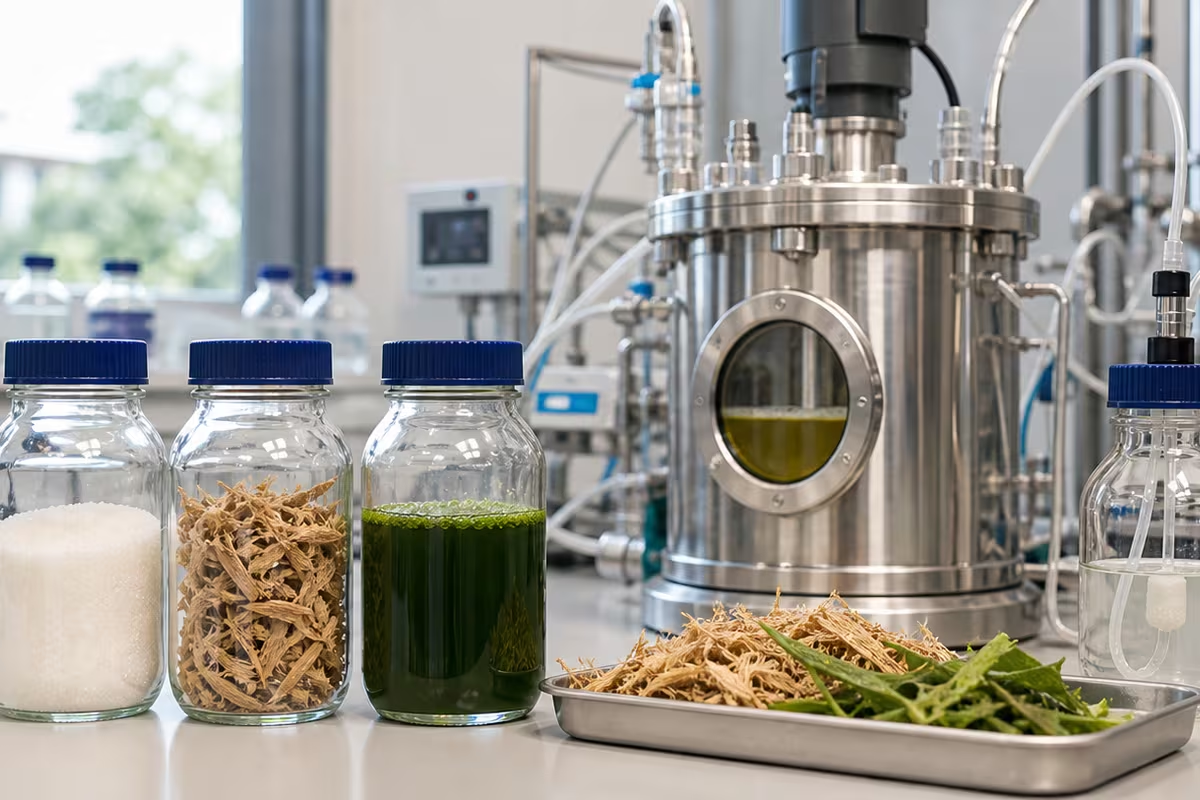
Synthetic biology often talks about what cells can make. A microbe can make a protein. A yeast strain can make a flavor molecule. A cell-free system can make a sensor. An engineered organism can turn a pathway into a product. That story is true as far as it goes, but it leaves out the question every factory eventually asks: what does the system eat, where does that input come from, and what does it cost to keep growth going?
A feedstock is the material that feeds a production process. In biomanufacturing, it may be refined sugar, corn dextrose, cane sugar, glycerol, agricultural residue, food-processing side streams, methane, carbon dioxide, methanol, plant oils, minerals, nitrogen sources, trace nutrients, water, or some carefully controlled mixture. The feedstock is not background. It shapes price, sustainability, contamination risk, geography, scale, public trust, and the kinds of products that can make economic sense.
This guide stays high-level on purpose. It is not a laboratory protocol or a recipe for growing organisms. The useful lesson is strategic: biology may be programmable, but growth still needs matter, energy, infrastructure, and logistics.
Sugar is easy to imagine and hard to ignore
Many industrial fermentation processes begin with sugar because many production organisms know how to use it. Sugar is familiar, transportable, measurable, and compatible with decades of fermentation experience. It can come from corn, cane, beets, or other crops. For some products, that makes sugar a practical starting point. The organism grows, the process behaves, and the company can focus on yield, purification, quality, and market fit.
The challenge is that sugar is not free in any sense. It uses land, water, fertilizer, harvesting, transport, processing, and money. If a synthetic biology product claims to reduce environmental impact, the feedstock has to be part of the claim. A tank that makes a useful ingredient may still depend on agricultural systems with their own footprint. The question is not whether sugar is good or bad. The question is whether the whole system makes sense for the product being made.
This is why Bioprocess Scale-Up cannot be separated from feedstock thinking. A strain that performs beautifully on a refined input in a small setting may become expensive at industrial scale. A feedstock that is easy to buy for pilot runs may be harder to secure when the plant needs steady supply. Biology can be flexible, but factories dislike surprises.
Waste streams are tempting but uneven
The phrase “waste into value” is powerful because it sounds like a perfect loop. Food-processing leftovers, agricultural residues, used oils, glycerol from biodiesel, dairy side streams, brewery outputs, and other industrial byproducts can look like low-cost inputs waiting for biology to upgrade them. Sometimes that promise is real. A side stream that was once a disposal problem can become a useful feedstock if it is consistent, safe, available, and close enough to the facility.
The hard word is consistent. Waste streams vary by season, supplier, geography, previous processing, contamination, moisture, storage, and transport. A microbe or bioprocess may not care about the marketing story. It cares about what is actually in the tank. If the input changes too much, the process may need extra pretreatment, monitoring, blending, or quality control. Those steps add cost and complexity.
There is also competition. A material called waste by one industry may already be animal feed, soil amendment, fuel, compost input, or another company’s raw material. Calling it waste does not mean it has no current use. Responsible feedstock planning asks what is displaced when a new buyer arrives.
Gases change the geography
Some biomanufacturing concepts look beyond sugar and ask whether organisms can use gases such as carbon dioxide, carbon monoxide, methane, or hydrogen-linked systems. The appeal is obvious. If a process could make useful products from gases, industrial emissions, captured carbon, biogas, or other non-food inputs, the feedstock story changes dramatically.
The practical story is more demanding. Gas fermentation and gas-fed systems need transfer from gas to liquid, safe handling, reactor design, energy input, organism fit, and careful process control. Carbon dioxide is abundant, but it is also very stable. Turning it into useful products requires energy and reducing power from somewhere. Methane is energy-rich but brings safety, leakage, and sourcing questions. Hydrogen can help some systems, but it has its own production and infrastructure story.
The point is not to dismiss gas feedstocks. They may matter deeply in parts of the future bioeconomy. The point is to keep the carbon story honest. A carbon source is not a climate solution by itself. The energy, equipment, conversion efficiency, product lifetime, and displaced alternative all matter.
Water and minerals are feedstocks too
People talk about carbon sources because they are obvious. Cells also need water, nitrogen, phosphorus, sulfur, salts, trace metals, vitamins, buffers, and other nutrients depending on the organism and product. These inputs may be small compared with the main carbon source, but they can shape cost, wastewater, regulation, and plant siting.
Water deserves special attention. Fermentation is a wet process. Facilities need water for media, cleaning, cooling, steam, and downstream processing. Water use may be manageable, but it should not be invisible. A process that looks clean in a diagram still needs utilities. In a water-stressed region, that matters.
Downstream processing can also dominate the footprint. Making the molecule is one part of the system. Separating, purifying, drying, formulating, and shipping it may require energy and materials. A feedstock analysis that stops at the moment the organism grows has stopped too early.
Feedstock choice shapes product truth
The feedstock can change what a product honestly is. A fermentation-derived ingredient made from refined sugar has one story. The same ingredient made from an agricultural side stream has another. A product made near its feedstock source has different logistics from a product that ships inputs across oceans. A material marketed as circular needs evidence that the loop is real and not only attractive language.
This connects to Synthetic Biology Product Claims and Public Trust . Consumers and customers do not need every detail of a fermentation plant, but they deserve claims that survive contact with the supply chain. If a company says lower land use, lower emissions, animal-free, waste-based, carbon-derived, local, renewable, or circular, the feedstock is part of the proof.
Public trust can be damaged when the input story is vague. People may accept complexity if it is explained plainly. They are less forgiving when a product sounds cleaner than its actual inputs allow. The bioeconomy will need better language for this middle ground: promising, useful, improving, but still physical.
Local supply beats perfect theory
At industrial scale, geography becomes practical. A facility near sugar production, forestry residues, dairy side streams, biogas, renewable power, water, ports, or customers may have advantages that a generic process diagram cannot show. Feedstock logistics can decide where a plant belongs.
This is one reason the future may not have one universal biomanufacturing model. Some products may be made in large centralized facilities with refined inputs and strict quality systems. Others may be tied to regional agricultural streams. Others may sit near industrial gas sources or renewable energy. Others may remain specialty products because the input and purification costs do not support commodity scale.
Scale-up is not only bigger tanks. It is supply contracts, storage, quality testing, utilities, transportation, regulation, waste handling, and resilience when a harvest is poor or a supplier changes. The living production system sits inside a nonliving supply chain.
The feedstock question makes biology more real
Feedstocks can make synthetic biology feel less magical, which is a good thing. The field becomes more credible when it admits that cells are not tiny wish machines. They are living systems embedded in material flows. They need inputs, and those inputs have histories.
That realism does not weaken the promise. It clarifies it. A well-chosen feedstock can make a product more resilient, more affordable, and more defensible. A poorly chosen feedstock can make an elegant strain irrelevant. The best biomanufacturing ideas consider the organism, the product, the tank, the purification train, the customer, and the input supply together.
Synthetic biology begins with the ability to ask cells for new work. Biomanufacturing succeeds when the whole system can keep that work fed, measured, cleaned, powered, explained, and trusted.