Synthetic biology safety often becomes visible only when something sounds dramatic: an engineered organism, a proposed environmental use, a new gene circuit, a living material, or a product claim that reaches beyond the lab. Biocontainment is the quieter design layer behind those conversations. It asks how an engineered biological system is kept in the intended place, under the intended conditions, for the intended amount of time, and with enough evidence that people do not have to rely on reassurance alone. A related reference is Biocontainment of genetically modified organisms by synthetic protein design .
Kill switches are one part of that story. The phrase usually refers to engineered genetic systems that reduce survival or function when a cell leaves a desired condition or encounters a designed trigger. They are important, but they are easy to overstate. A kill switch is not a magic word that turns living uncertainty into certainty. It is a biological control that must survive mutation, growth, stress, environmental variation, measurement limits, and human handling.
The broader Synthetic Biology Safety guide separates biosafety, biosecurity, containment, DNA screening, governance, and responsible practice. This guide goes deeper into the containment design itself. It is not a protocol for building safeguards. It is a way to read containment claims carefully and understand why layered evidence matters.
Containment Is a Stack, Not a Feature
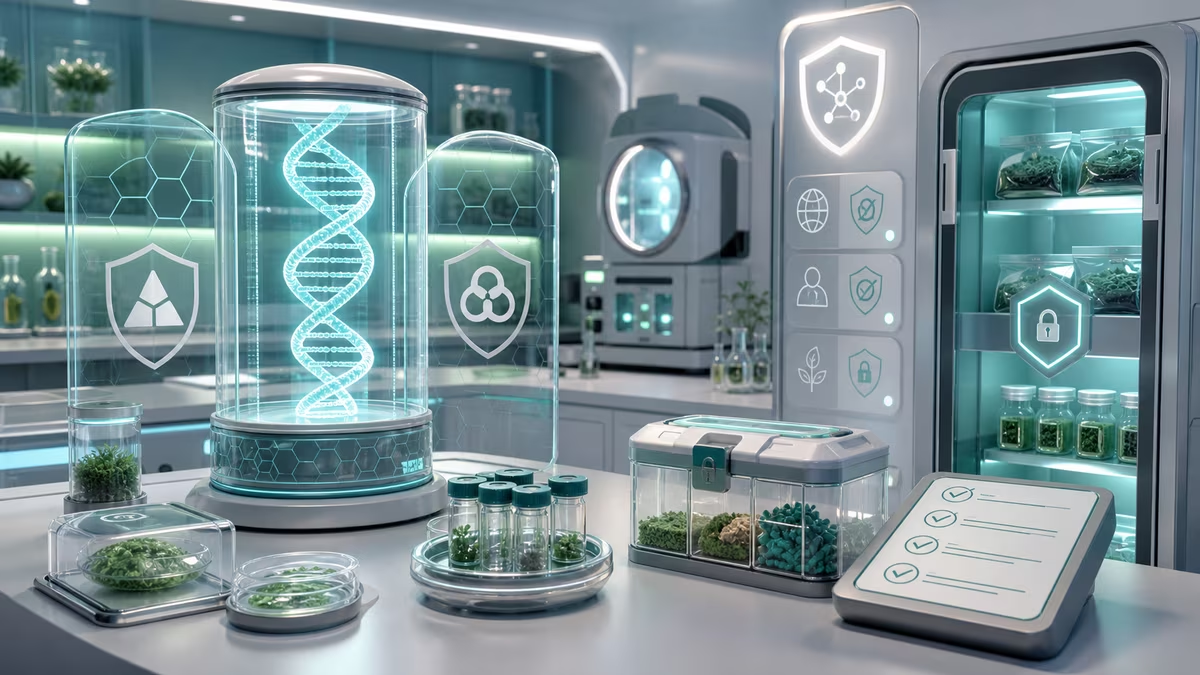
The most reliable containment thinking begins with layers. Physical containment includes vessels, filters, sealed devices, facilities, barriers, access control, waste systems, and cleaning practices. Procedural containment includes training, labeling, inventory, transfer rules, incident reporting, and supervision. Biological containment includes host choice, dependencies, limited survival traits, genetic safeguards, and designs that make persistence outside the intended context less likely.
No layer deserves blind trust by itself. A physical barrier can leak, break, be bypassed, or be used incorrectly. A procedure can be forgotten or misunderstood. A biological dependency can fail if the missing nutrient appears in an unexpected environment. A genetic control can mutate, impose burden, become silent, or behave differently under stress. The strength of a containment plan comes from asking how layers support each other when ordinary imperfection appears.
This is why containment belongs beside Chassis Organisms . A contained laboratory bacterium, a yeast production strain, a plant system, a cell-free device, a mammalian cell line, and a proposed environmental biosensor raise different questions. The organism’s survival behavior, exchange with other organisms, growth requirements, exposure route, and use case decide which safeguards are relevant.
Biological Dependencies Can Help, But They Are Contextual
One common containment idea is dependency. An engineered organism may be designed or selected so it needs a supplied nutrient, chemical, temperature range, growth condition, or synthetic component that is available in the intended setting but scarce elsewhere. In theory, leaving the intended setting makes the organism less able to grow or function. In practice, the strength of that dependency depends on biology and context.
The outside world is chemically and biologically varied. A compound assumed to be absent may appear in waste, soil, food residue, industrial side streams, or neighboring organisms. A pathway assumed to be broken may be bypassed by mutation, gene exchange, metabolic flexibility, or community support. A strain that is fragile in one test condition may persist longer in another. Dependency is a useful containment idea because it can reduce survival, not because it guarantees disappearance.
Environmental Synthetic Biology makes this point especially clear. Field-adjacent systems face sample complexity, weather, surfaces, microbial communities, retrieval limits, and public exposure. A safeguard tested in a controlled vessel may not mean the same thing in soil, wastewater, a greenhouse, or a portable device. The environment is not a blank negative control.
Kill Switches Carry Their Own Burden
A genetic kill switch has to be maintained by the cell. That means it can impose burden, interact with growth, and create selection pressure for variants that weaken or remove it. If the switch is costly while the engineered function is useful to people rather than to the cell, a variant that disables the safeguard may grow better. Over time, the population can shift toward cells that no longer match the safety claim.
This connects directly to Genetic Stability in Synthetic Biology . A containment feature is only as useful as its persistence under the relevant growth conditions. A switch that works immediately after construction may not work after repeated passages, scale-up, storage recovery, process stress, or environmental exposure. The relevant evidence is not only whether the design exists on day one, but whether it remains present and functional when the claim needs it.
Kill switches can also create interpretation problems. If a circuit reduces survival under a test condition, is that because the intended safeguard worked, because the cells were generally unhealthy, because the measurement was noisy, or because the trigger condition affected the host in another way? Strong containment evidence needs controls that separate the safeguard from ordinary toxicity, stress, poor growth, or assay artifacts.
Escape Is Not One Scenario
Containment discussions sometimes imagine one simple escape path: a cell leaves a vessel and grows somewhere else. Real scenarios are more varied. Material can leave through liquid waste, aerosols, surfaces, contaminated tools, mislabeled samples, shipping errors, insects, plant material, accidental mixing, or incomplete inactivation. Genetic material can move differently from living cells. A product can persist after cells are gone. A device can be used outside its intended conditions.
The relevant paths depend on the project. A closed fermentation process has different concerns from a living material, a plant greenhouse, a phage design, a biosensor, or a cell-free diagnostic. Phage Synthetic Biology raises host range and ecological context. Living Materials raises product use, disposal, and whether the material is meant to remain alive. Cell-Free Synthetic Biology changes the replication question while keeping questions about inputs, outputs, and waste.
Good containment design maps plausible paths before choosing safeguards. It asks where living material, genetic material, product, waste, equipment, data, and people move. It also asks what happens when the first plan fails in a boring way: a valve is mishandled, a sample is mislabeled, a culture is older than expected, a device is stored too warm, a cleaning step is incomplete, or a strain behaves differently after scale-up.
Monitoring Is Part of Containment
A containment claim is weak if no one can tell whether it held. Monitoring can include identity checks, viability tests, environmental sampling, process measurements, waste verification, strain stability checks, product testing, and documentation of handling. The exact methods depend on the system, but the principle is stable: containment should be observable enough that failure does not remain invisible.
Bioprocess Quality Control is useful here because quality control is not only about final product purity. It also watches the living production system, the process, and the records that support trust. If a safeguard is part of the safety case, then its status belongs in the quality story. A feature that is never checked becomes a hope, not evidence.
Monitoring also helps distinguish containment from cleanup. Cleanup responds after material has moved or a run has ended. Containment tries to limit movement and survival from the start. Both can be necessary. A responsible plan may include engineered dependencies, physical barriers, recovery procedures, waste treatment, and post-use verification. The layers are strongest when each has a job and none is asked to do everything.
Public Claims Should Be Specific
The phrase contained can be too vague. A stronger claim explains what is contained, where, by which layers, for what use, under which evidence, and with what uncertainty. A production strain inside a closed facility is a different claim from an organism intended for open environmental deployment. A genetic dependency is a different claim from a sealed device. A kill switch validated over a short lab test is a different claim from a safeguard expected to work after long growth or varied conditions.
Synthetic Biology Product Claims and Public Trust argues that people deserve language that matches the evidence. Biocontainment is one of the places where careful language matters most. Overclaiming safety can damage trust even when the underlying work is thoughtful. Underexplaining safeguards can make useful systems sound more mysterious than they are.
Biocontainment is not a promise that biology can be made perfectly still. It is a discipline for reducing plausible movement, survival, misuse, and confusion while measuring whether those reductions hold. Kill switches and dependencies can be valuable tools inside that discipline, but they gain meaning only through context, stability, monitoring, and layers. The most credible containment story is not the one with the most elegant genetic diagram. It is the one that expects ordinary failure modes, tests its assumptions, and makes its limits visible before the biology leaves the drawing board.