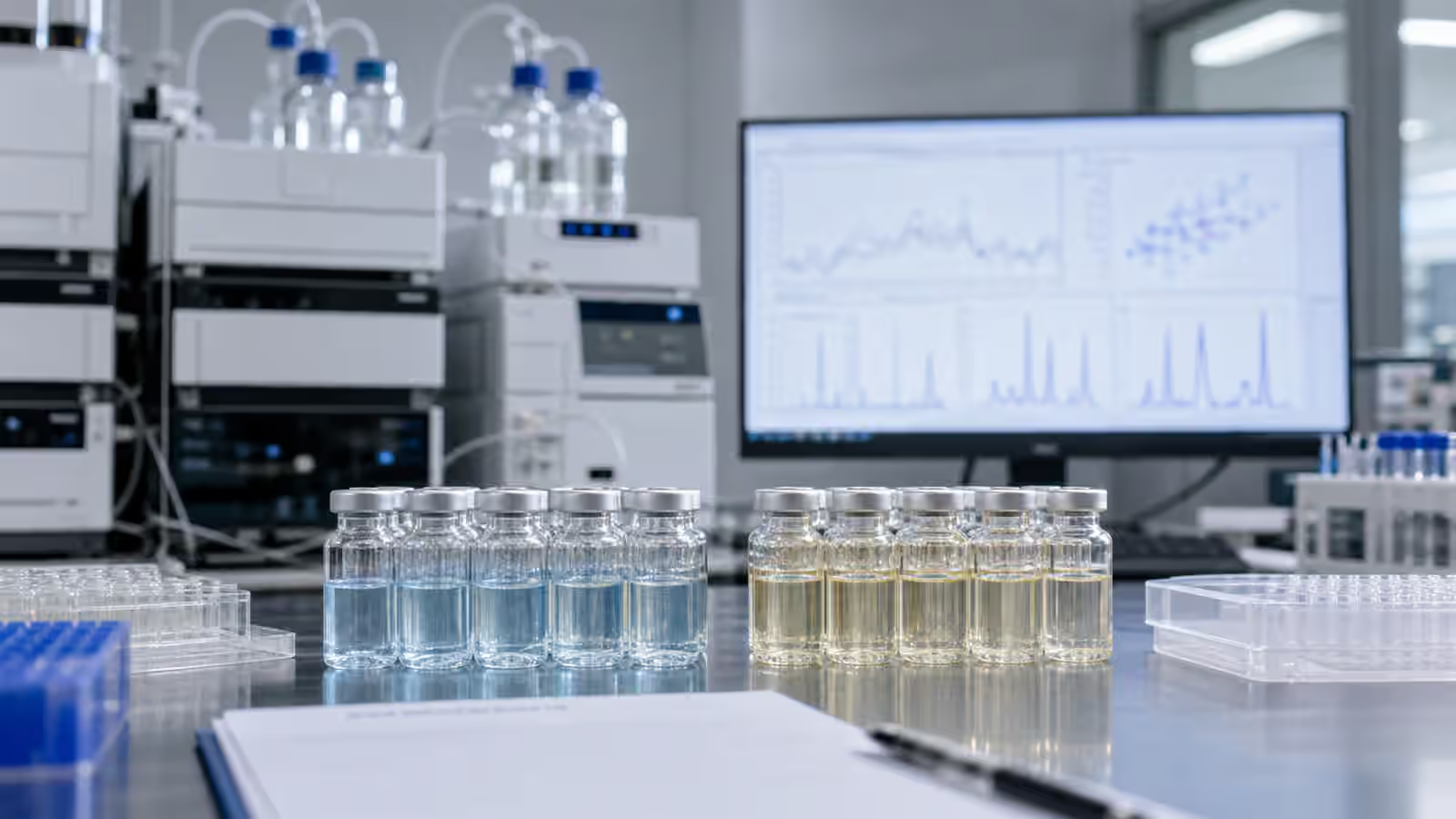
When engineered biology makes a product, the first question is often whether the product appeared at all. That question matters, but it is only the beginning. A flask, plate, or bioreactor can contain the target molecule, related molecules, host proteins, media components, salts, pigments, fragments, side products, degradation products, and compounds that came from the feedstock rather than the engineered pathway. Synthetic biology needs analytical chemistry because “the product is there” is not the same as “we know what biology made.” A related reference is ICH Q6B — Specifications: Test Procedures and Acceptance Criteria for Biotechnological/Biological Products .
Analytical chemistry gives bioproducts their identity. It asks whether the molecule is the intended one, how much is present, what else is present, how consistent the material is, and whether the measurement is strong enough to support the claim being made. For a research prototype, the evidence may be modest. For a manufactured ingredient, material, enzyme, diagnostic reagent, or therapeutic candidate, the evidence has to become much more disciplined.
This guide connects Bioprocess Quality Control , Downstream Processing , and Synthetic Biology Product Claims and Public Trust . Quality control asks whether a process stays inside its intended bounds. Downstream processing recovers and purifies the product. Analytical chemistry decides whether the recovered material is what the story says it is.
Identity Comes Before Excitement
Synthetic biology can make familiar molecules in unfamiliar ways. A fragrance compound, pigment, protein, lipid, polymer precursor, food ingredient, or enzyme may be produced by engineered cells rather than extracted from plants, animals, petroleum, or traditional fermentation. That shift can be important, but the product still needs identity evidence.
Identity means more than a name. A small molecule may need a matching retention time, mass, fragmentation pattern, spectrum, or comparison with a reference material. A protein may need sequence confirmation, molecular weight, folding or activity evidence, modification analysis, aggregation checks, and impurity profiling. A polymer or material may need composition, chain length, mechanical behavior, residual contaminants, and batch consistency.
The right method depends on the product. Chromatography can separate components in a mixture. Mass spectrometry can provide molecular mass and structural clues. Spectroscopy can reveal patterns of absorption, vibration, or magnetic environments. Activity assays can show whether an enzyme or protein does what it is supposed to do. No single method is universally sufficient because products differ and claims differ.
This is why identity testing should be tied to the decision. Early research may ask whether a pathway produced a detectable target. Process development may ask whether yield and impurity patterns are moving in the right direction. Manufacturing may ask whether a batch meets specification. Public-facing claims may ask whether the product can be described plainly without overstating what has been proven.
Purity Is a Story About What Else Is There
Purity sounds like a single percentage, but it is really a story about mixture. What else is present, how much of it is present, whether it matters, and whether the method can see it all are separate questions.
A fermentation broth is complex. It contains cells or cell debris, nutrients, salts, metabolites, proteins, nucleic acids, byproducts, antifoams, media impurities, and product-related variants. Downstream Processing explains how recovery steps separate the desired material from that mixture. Analytical chemistry checks whether the separation worked.
Impurities can be harmless, useful, annoying, costly, or unacceptable depending on the use case. A trace side product may be irrelevant for a research sample and important for a food ingredient or high-purity reagent. A protein variant may retain activity or change stability. A pigment impurity may alter color. A residual solvent, salt, host-cell protein, nucleic acid, or media component may matter because of safety, performance, regulation, or customer specification.
Purity data can also feed back into strain and pathway design. If a pathway creates a difficult side product, the best solution may not be more purification. It may be a better enzyme, a different route, a changed feed strategy, or a host that makes fewer interfering compounds. Metabolic Pathway Design becomes more practical when analytical data shows where carbon actually went.
Standards Keep Measurements From Floating
A measurement becomes stronger when it is anchored. Reference standards, calibration curves, internal standards, blanks, controls, and system-suitability checks help prevent analytical numbers from floating free of reality.
For a small molecule, a reference standard can help confirm identity and quantity. For a protein, well-characterized reference material may help compare activity, purity, or modifications. Internal standards can compensate for losses or variability during sample preparation. Blanks can reveal background contamination. Spiked samples can show whether the matrix interferes with detection.
The matrix is especially important in bioproduct work. A target molecule measured in clean solvent may behave differently from the same molecule measured in spent medium or partially purified broth. Proteins can stick to surfaces, degrade, aggregate, or hide inside complex mixtures. Small molecules can co-elute with similar compounds. Salts and media components can affect ionization in mass spectrometry. The method has to work in the sample that actually exists, not only in the ideal sample.
Biological Measurement and Controls covers the broader measurement culture. Analytical chemistry brings that culture down to molecular evidence. A beautiful peak means less if the method lacks controls. A clean-looking spectrum means less if the sample preparation discards the impurity of concern. A precise number means less if it is precise around the wrong thing.
Method Fit Matters More Than Instrument Prestige
Analytical instruments can look authoritative. A chromatogram, mass spectrum, or polished report can make a result feel settled. Instrument prestige is not the same as method fit.
A method must separate the product from likely interferents, detect it at relevant concentrations, remain stable across sample types, and answer the decision at hand. A fast screen may be valuable during early pathway engineering even if it is not the final release method. A slower, more specific method may be needed when a candidate process matures. Orthogonal methods can be useful when one technique alone could mislead.
The word orthogonal in analysis means that different methods test the question through different physical principles. If chromatography, mass spectrometry, and an activity assay all support the same conclusion, confidence improves. If they disagree, the disagreement is information. Perhaps the molecule is present but inactive. Perhaps a related compound shares a signal. Perhaps the protein is pure by one measure but aggregated by another.
This matters for Genetic Code Expansion and other advanced engineering. Novel or modified products can defeat assumptions built around natural molecules. A protein with a nonstandard amino acid, an unusual glycan pattern, or an engineered modification may require more careful identity work because standard shortcuts may not prove the claim.
Analytical Data Shapes Trust
Synthetic biology products often carry process claims. They may be described as fermentation-made, animal-free, bio-based, lower-impact, precision-made, identical to a natural molecule, or engineered for consistency. Some of those claims can be meaningful. Some can be vague. Analytical data helps separate a claim with evidence from a claim that leans on the aura of biotechnology.
Synthetic Biology Product Claims and Public Trust explains why plain language matters. Analytical chemistry supplies the factual base. If a company says a molecule is identical to one found in nature, identity testing matters. If it says a protein is highly pure, impurity methods matter. If it says a process is consistent, batch-to-batch data matters. If it says a product avoids certain contaminants, the test method and detection limits matter.
Trust also depends on humility. Analytical chemistry rarely proves everything in one step. It builds a case from fit-for-purpose methods, controls, standards, repeatability, documentation, and honest boundaries. The evidence needed for a classroom demonstration is not the evidence needed for a commercial ingredient, and the evidence needed for a commercial ingredient is not the evidence needed for a medicine.
The Molecule Gets the Final Word
Designed DNA, elegant pathways, automated biofoundries, and carefully tuned strains all point toward a product. Analytical chemistry asks the product to identify itself. That question can be sobering. The cells may have made less than expected, a related molecule, a mixture, a degraded form, or a product that is harder to purify than the pathway diagram suggested.
That sobriety is useful. It prevents synthetic biology from confusing intention with material reality. A pathway is not successful because the plan was clever. A bioproduct is not trustworthy because the story is appealing. The recovered material has to be examined, compared, quantified, and understood.
In the best projects, analytical chemistry is not a gate at the end. It is part of learning from the beginning. It tells strain engineers which byproducts matter, tells process developers which recovery steps work, tells product teams which claims are supportable, and tells readers why “made by biology” is only the opening line. The molecule gets the final word, and good analysis gives it a clear voice.