
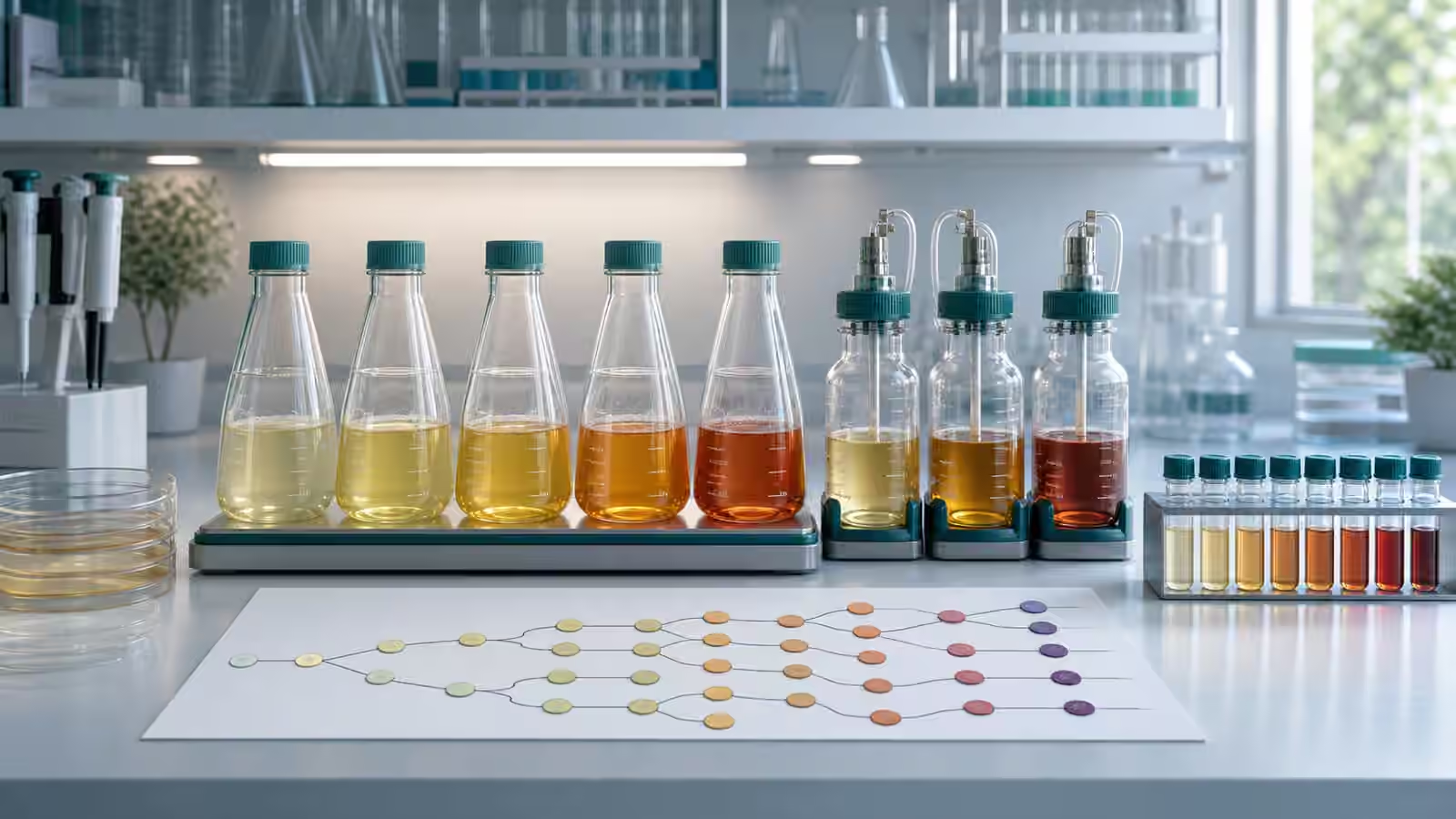
Synthetic biology often begins with intentional design. A team chooses a host, writes or edits DNA, introduces a pathway, tunes expression, and measures whether the engineered system behaves as hoped. That design-first mindset is powerful, but it is not the only way biology can search. Cells also search by evolving. A related reference is Improved acetate tolerance and astaxanthin productivity in Haematococcus pluvialis through adaptive laboratory evolution .
Adaptive laboratory evolution is a way to use that search deliberately. Instead of designing every improvement directly, researchers grow populations under conditions that favor a desired trait, then study the lineages that survive or perform better. In synthetic biology, that trait might be tolerance to a product, faster growth on a feedstock, improved survival under a process stress, better use of an engineered pathway, or a more balanced relationship between growth and production.
This guide complements Directed Evolution , which often focuses on proteins or genetic parts, and Strain Engineering , which follows the broader work of turning a host into a production cell. Adaptive laboratory evolution sits between them. It lets whole cells reveal tradeoffs that a designer may not have predicted.
Evolution Is a Search, Not a Wish
The most important thing to understand about adaptive laboratory evolution is that evolution optimizes for the selection condition, not for the researcher’s full dream. If the condition rewards growth in the presence of a stressful molecule, the cells may become more tolerant. They may also reduce production of the very molecule that caused the stress, change transport, alter metabolism, mutate regulatory pathways, or find a shortcut that looks helpful under the test but hurts the intended process.
That is not a flaw in evolution. It is the nature of selection. Cells that leave more descendants under the imposed condition become more common. The reason they do so has to be investigated. A lineage that grows better may be solving the problem the team cares about, or it may be escaping the engineered task.
This is why adaptive laboratory evolution needs careful framing. The selection condition should resemble the desired pressure closely enough to matter, but it also needs safeguards against rewarding the wrong behavior. A production strain that evolves to stop producing product may look healthier while becoming less useful. A strain that grows on a feedstock in a laboratory medium may not be robust in the process environment. A lineage that tolerates one stress may carry a cost elsewhere.
Adaptive evolution can be a powerful design partner, but it is not a vending machine for better strains.
Why Designers Invite Evolution In
There are problems that rational design handles well. If a pathway needs a known enzyme, a team can add the gene. If expression is too high, promoters or copy number can be changed. If a construct is wrong, sequencing can reveal the error. Other problems are harder because the cell’s response is distributed across many genes and regulatory layers.
Tolerance is a common example. A product may disrupt membranes, drain cofactors, damage proteins, alter pH, or interfere with growth in several ways at once. A designer can propose transporters, stress-response changes, membrane modifications, or pathway timing, but the full tolerance landscape may be hard to map. Adaptive laboratory evolution can reveal combinations the team would not have chosen first.
Feedstock use is another example. A host may need to grow on a less familiar carbon source or tolerate impurities from a side stream. The useful changes may involve transport, catabolism, stress response, regulation, and allocation. Biomanufacturing Feedstocks explains why feedstock reality matters. Evolution can expose how a host adapts to that reality, although the result still needs verification under relevant process conditions.
The method is also valuable when engineered biology creates a burden. A cell carrying a pathway may grow slowly because the pathway competes for energy, precursors, protein synthesis capacity, or redox balance. Evolution may find compensatory mutations that make the burden easier to carry. The team then has to ask whether those mutations preserve the engineered function or merely reduce its cost by weakening it.
Selection Pressure Shapes the Answer
Every adaptive evolution experiment is a conversation with selection pressure. If the pressure is too weak, the population may drift without meaningful improvement. If it is too harsh, useful diversity may disappear or the population may crash. If the pressure is poorly chosen, the selected lineages may solve an irrelevant problem.
For synthetic biology, the most interesting pressures often involve tradeoffs. A strain may need to grow while making product. It may need to tolerate the product without abandoning the pathway. It may need to use a feedstock while maintaining quality. It may need to survive a process stress without becoming genetically unstable. The pressure should make the desired compromise visible.
There is a subtle difference between selecting for survival and selecting for production. Survival is easy for evolution to understand. Production is often not directly beneficial to the cell. If making the product slows growth, cells that make less may outcompete better producers unless the experiment links production to fitness in a thoughtful way. This is one reason biosensors, selections, or screening assays are sometimes paired with evolution work, but those tools bring their own limits.
Assay Design for Engineered Cells becomes important here. If the assay rewards the wrong signal, evolution will follow it. A sensor that responds to a related impurity, a proxy that does not track product, or a growth condition that ignores production burden can steer the population toward a misleading answer.
Sequencing Turns Survivors Into Evidence
At the end of an adaptive evolution run, a better-growing population is only the beginning. The team still needs to know what changed. Genome sequencing, construct verification, expression data, metabolic measurements, and process tests can all help turn a survivor into evidence.
Sequencing may reveal obvious mutations in transporters, regulators, enzymes, repair pathways, or stress-response genes. It may also reveal multiple changes that are hard to separate. Some mutations may matter. Others may be passengers that rose with the lineage. A mutation that appears in several independent lineages is more suggestive than one seen only once, but even repeated patterns need biological interpretation.
This is where Construct Verification and Sequencing connects to evolution work. If the engineered construct changed, was lost, rearranged, or silenced, the improvement may not mean what the team hoped. If the host genome changed while the construct stayed intact, the result may point toward useful host adaptation. If both changed, the story becomes more complex.
The strongest interpretations usually require rebuilding or separating candidate changes. A mutation discovered by evolution can become a design hypothesis. The team can introduce it into a clean background, compare it with the parent strain, and ask whether it reproduces the useful trait without unwanted costs.
Evolution Can Improve Robustness, But It Can Also Hide Fragility
Adaptive evolution is often used to improve robustness, yet it can also hide fragility if the tests are narrow. A lineage adapted to one temperature, medium, vessel, oxygen condition, or product concentration may perform poorly elsewhere. A strain that looks strong after many generations may carry mutations that reduce long-term stability in a production setting. A lineage that tolerates a stress may have become slower, less productive, harder to recover, or more variable.
For biomanufacturing, the evolved strain has to be judged as a process candidate, not only as a laboratory winner. Bioprocess Scale-Up explains why small-scale success does not guarantee larger-scale behavior. Evolution done in one format may not capture gradients, mixing, oxygen transfer, feeding, heat, or run length. It can still be useful, but the result has to be challenged under conditions that resemble the intended use.
Genetic stability is another concern. Genetic Stability in Synthetic Biology shows why engineered designs can drift when they impose costs. Adaptive evolution may produce lineages that are better at carrying a design, or lineages that found a way around it. Distinguishing those outcomes is essential before celebrating improvement.
Evolution and Rational Design Work Better Together
Adaptive laboratory evolution is sometimes presented as the opposite of rational design. That framing is not very useful. In practice, they strengthen each other.
Rational design can create the starting strain, define the pathway, choose the host, build the sensor, and decide which traits matter. Evolution can search through cellular adjustments that are hard to predict. Sequencing and measurement can turn evolved changes back into design knowledge. The next rational design can then incorporate what evolution revealed.
This loop can also temper overconfidence. A designer may believe a pathway bottleneck is obvious, but evolution may point toward membrane stress. A team may focus on enzyme activity, while selected lineages show regulatory changes. A model may predict a carbon-flow constraint, while evolved strains reveal product toxicity as the dominant issue. None of these surprises makes design pointless. They make the cell a participant in the design process.
The careful synthetic biology team does not ask evolution to bless a vague hope. It asks evolution a constrained question, watches how populations answer, and then verifies the answer with measurement, sequencing, and process tests. Adaptive laboratory evolution is valuable because cells are not passive containers. Given pressure and time, they reveal what the engineered system costs them. That knowledge can turn a clever construct into a strain that is better understood, more robust, and less surprising when the work moves beyond the first encouraging flask.


