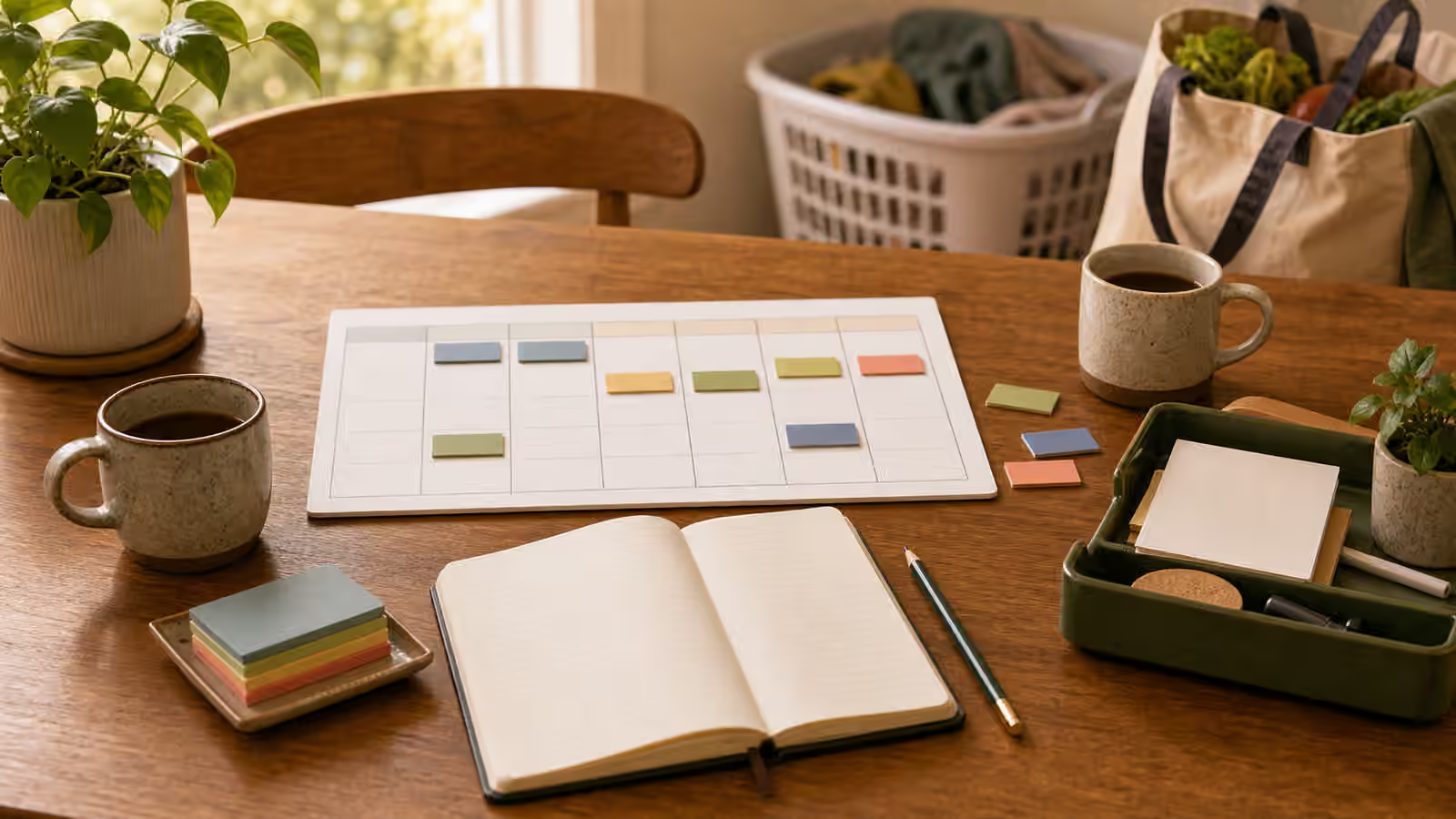
Time blindness is the plain-language phrase people reach for when time refuses to behave. You sit down to answer one email and stand up an hour later. You are certain the drive takes fifteen minutes and it has always taken twenty-five. You feel like there is plenty of runway right up until the moment there is none. None of that is a moral failing, and none of it, on its own, is a diagnosis. Plenty of people lose the thread of passing time, and the reasons range widely: fatigue, a novel task, an anxious morning, a room with no clock, a stretch of work so absorbing that the outside world goes quiet. What these situations share is that time was being asked to live inside your head, where it is slippery, and the fix is to move it somewhere your eyes can find it.
That is the whole idea behind visible time. Willpower is a poor clock. If the only reminder that a meeting starts soon is a feeling you are supposed to summon, the feeling will arrive late. A timer sitting across the room, a calendar block with padding built in, a strip of afternoon light that always falls in the same place before you have to leave, all of these do the noticing for you. They turn an internal guess into an external fact, and facts are much easier to obey than intentions.
Why the clock on your phone does not count
Most people already own a dozen clocks, so the obvious question is why time still slips. The answer is that a clock only helps if you look at it, and the clocks you own are mostly hidden. The phone clock lives behind a lock screen and a wall of notifications, each of which is more interesting than the time. The laptop clock sits in a corner your eyes stopped registering weeks ago. To actually change behavior, a clock has to be where the task happens and impossible to ignore while you work. A cheap analog wall clock in your line of sight often outperforms every device you own, because an analog face shows time as shrinking pie, a quantity you can feel dwindling, rather than a number that changes without any sense of motion.
The same logic applies to countdown timers. A visual timer that drains a colored wedge as the minutes pass gives you a moving picture of how much runway is left. You are no longer asked to imagine the gap between now and the deadline; you can see it closing. The point is not to race the timer or to punish yourself when it runs out. It is simply to keep the passage of time in the room with you, so that arriving at the edge of a block is something you watch approaching rather than something that ambushes you.
Turning estimates into evidence
The second half of time blindness is the estimate problem: tasks routinely take longer than you expect, and expecting wrong is not a habit you can scold away. The way out is to stop treating your estimates as promises you failed to keep and start treating them as first drafts you are allowed to revise. Guess how long a familiar task will take, then time the next real attempt without changing anything about how you do it. Write down the actual number. Do this a handful of times and you will have a small, honest record that quietly corrects the optimistic voice in your head.
What usually surprises people is not the task itself but everything wrapped around it. The thirty-minute email pass needs ten more minutes afterward to jot down what you decided and what is still open. Leaving the house is never just the two minutes it takes to walk to the car; it is finding the keys, the last bathroom trip, the doubling back for the thing you forgot. These wrapping costs, setup, switching, travel, recovery, are real parts of the task, and the honest move is to name them and schedule them rather than pretend they will happen in the seams. A calendar that shows tasks pressed edge to edge is a calendar that has hidden all of its transition time, which is exactly the time that makes you late.
Anchors and buffers you can actually see
Once you have a rough sense of true durations, buffers stop feeling like laziness and start feeling like accuracy. A buffer is not slack you are indulging in; it is the difference between the fantasy version of the day and the one that keeps happening. Padding a block by ten or fifteen minutes is often the entire fix, because it converts the recurring small emergency into an ordinary handoff.
Anchors do similar work at the other end. Instead of scheduling a routine to a bare clock time you will not feel arriving, tie it to something that already happens on its own: the kettle clicking off, a class letting out, the lunch plate going in the sink, the laptop lid closing. The anchor is an event you cannot miss, and hanging the next action on it means you no longer depend on catching an abstract time. When a student learns that starting homework at seven really means a snack at six-forty-five, the table cleared at six-fifty-five, and the first problem opened at seven-oh-five, they have replaced a single fragile deadline with a short chain of visible cues, each one pulling the next along.
Practicing without the shame
The temptation with any of this is to build the elaborate version, the color-coded schedule and the four timers, and then feel like a failure when the elaborate version collapses on a tired Tuesday. So try it small and try it on an ordinary bad day. Pick one repeating task that tends to run late. Put a visible clock or timer where you actually do it. Write your honest guess, time one real attempt, and let the evidence set the buffer instead of your idealized self. Place a single cue where the transition begins, and leave it at that. If a timer makes you anxious rather than oriented, drop it and use a plain clock or a progress marker instead; the goal is orientation, not a countdown that raises your heart rate. After each attempt, notice one thing that made the start easier and one thing that still snagged, and let those two observations, not guilt, steer the next small adjustment.
None of this claims to explain why time is hard for you, and it should not be asked to. Making time visible is a practical support, not an account of causes. If time trouble is genuinely damaging your work, your studies, your finances, your safety, or your relationships, that is worth bringing to a qualified professional who can look at the whole picture. For the ordinary friction of a normal week, the move is smaller and kinder: choose one task, make only its next start line more visible than it was yesterday, and see what changes. You can visit Transition Routines for the art of moving cleanly from one task into the next, and the Sleep Setup Lab for the evening and morning cues that quietly shape how time feels all day.