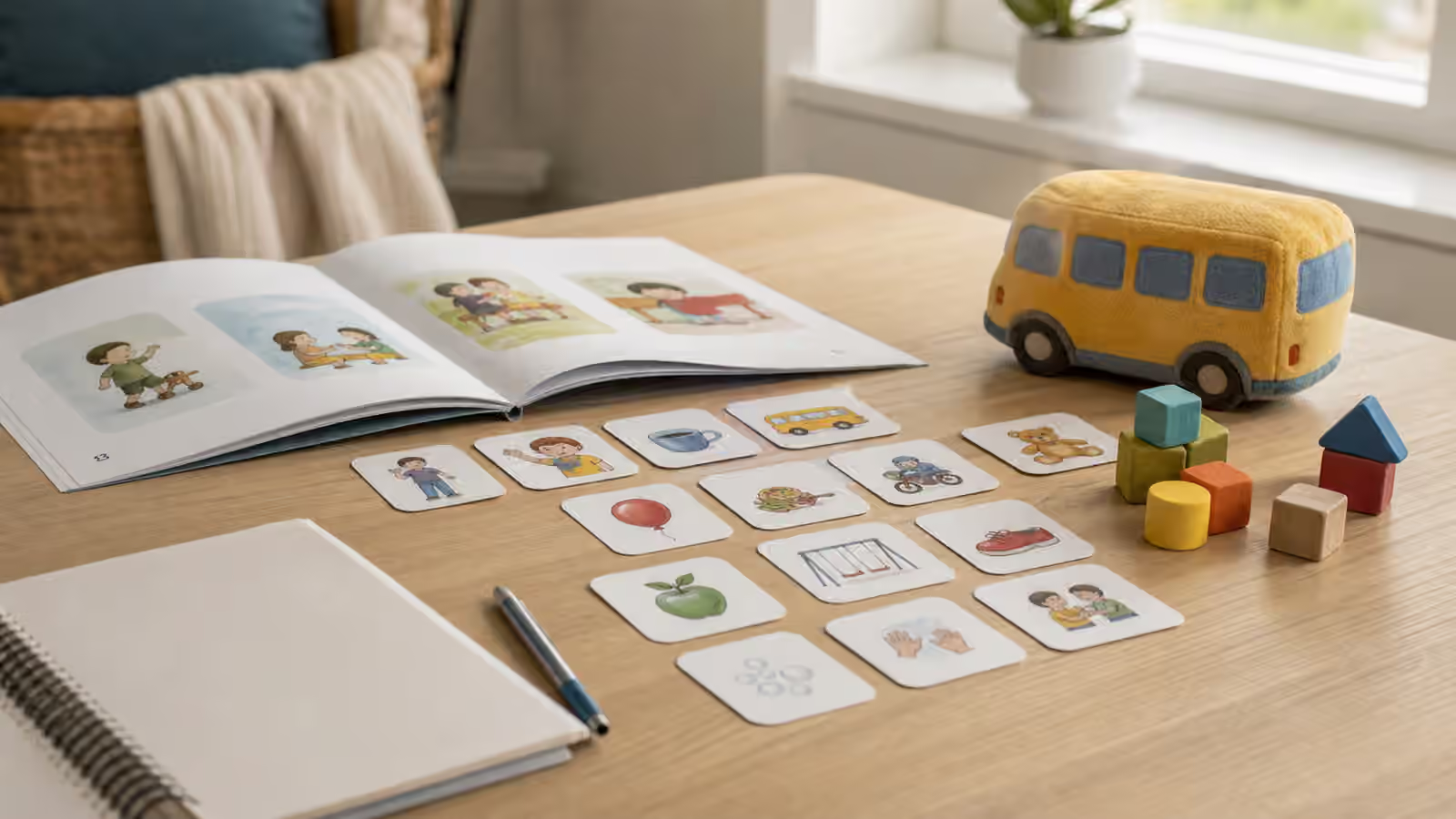
This guide explains echolalia and gestalt language processing in practical, respectful terms. It is educational background, not a diagnostic assessment, treatment plan, autism evaluation, or substitute for a licensed speech-language pathologist, developmental specialist, physician, psychologist, school team, or other qualified professional. See Autism Spectrum Disorder for the professional reference behind this topic.
Repeated language can sound confusing when listeners expect every phrase to be newly invented. A child may quote a cartoon line at breakfast, repeat the last thing an adult said, sing the same phrase during transitions, or use one familiar sentence for several different needs. An adult may rely on rehearsed phrases during stressful interactions. The surface form can look like copying. The communicative purpose may be much richer.
Repeated language can be language
Echolalia means repeating words or phrases that were heard before. The repetition may happen immediately, as when a child answers “Do you want juice?” by saying “Want juice?” It may happen later, as when a line from a show appears during play, protest, excitement, uncertainty, or a difficult transition. Some repeated phrases are close to the original. Others change rhythm, intonation, pronouns, or pieces of the sentence over time.
The important starting point is not whether the phrase sounds original. The starting point is whether it is doing work. A script may request a favorite routine, show shared enjoyment, mark a transition, protest a demand, ask for comfort, hold a memory, fill a silence, or regulate the body when a moment feels unpredictable. A repeated phrase can also be socially meaningful. A child who quotes a familiar line may be inviting another person into a shared world, not refusing to communicate.
This is why correction alone can miss the point. If an adult treats every repeated phrase as something to extinguish, the person may lose a usable communication bridge before another bridge is ready. The better question is: what does this phrase seem to mean here, and how can partners respond in a way that expands communication without shaming the original form?
Gestalts and single words are different starting places
Some language learners appear to build communication from larger chunks before they break those chunks into smaller, flexible parts. A whole phrase may carry one meaning at first. Later, pieces of that phrase may be mixed with other pieces. Over time, the person may produce more self-generated sentences. This pattern is often discussed as gestalt language processing. It is not a diagnosis by itself, and it should not be turned into a rigid label for every child who repeats language.
For families, the practical value is gentler observation. A child may not begin with single words that combine neatly into two-word phrases. Instead, the child may use a whole line as a unit: “Here we go,” “Let’s get out of here,” “You did it,” or a phrase from a favorite song. The line may not match the literal words a listener expects, but it may match the emotional or situational shape of the moment. A child who says a racing-show line while pushing a stroller to the door may be communicating movement, excitement, or a wish to leave.
That does not mean every script must be interpreted with certainty. Partners can be humble. They can notice the setting, the child’s body language, the activity, the tone, and what happened before and after. They can respond to the likely message while leaving room to be wrong. “It sounds like you are ready to go,” is more useful than “Say, I want to go,” when the first goal is shared meaning.
What helpful partners do
Helpful support starts with treating scripts as possible communication, not noise. If a phrase appears often, write down the situation around it. Notice whether it happens during waiting, change, excitement, refusal, sensory overload, fatigue, play, or connection. Notice who understands it and who misses it. Notice whether the phrase changes when adults respond differently.
Partners can model language that fits the moment without demanding a corrected performance. If a child says a familiar movie line while reaching for the door, an adult might say, “Go outside,” “I want outside,” or “Open door,” while opening the door if it is an available choice. If the child repeats a question instead of answering it, the adult can reduce the language load and offer a model: “Juice. You can say juice,” or “No juice,” depending on the likely meaning and context. The point is not to make the child echo the adult’s preferred sentence. The point is to give language that maps to the real message.
This is connected to AAC Basics because speech is not the only valid communication mode. Some gestalt language processors also use AAC, gestures, signs, pictures, writing, or body movement. AAC should not be withheld because a person has scripts. A communication system can offer words for the meanings the scripts are already trying to carry.
When repeated language hides a harder task
Echolalia can become more noticeable when the language demand is too high. A person may repeat because they did not understand the question, need more time, are anxious, are unsure what answer is expected, or cannot produce a new sentence under pressure. This can happen at home, in school, in therapy, and in medical settings. The repeated phrase is not laziness. It may be the most available language at that moment.
Listeners can make the task more accessible. They can ask one question at a time, pause longer, use visual choices, reduce background noise, offer written keywords, and accept partial answers. They can stop quizzing when a child is clearly overloaded. They can use routines where language has a real purpose, such as putting away toys, choosing a snack, finding shoes, reading a familiar book, or setting up pretend play.
The Language Development Basics guide may help families separate expressive language from understanding. A person may say long scripts and still struggle to understand flexible, new language. Another person may understand much more than they can generate. Repetition alone does not tell the whole story.
Professional support should protect dignity
A skilled SLP can help determine how repeated language fits within a broader communication profile. The evaluation may consider language comprehension, play, interaction, sensory regulation, motor speech, hearing, AAC access, family languages, school demands, and the person’s own preferences. If autism, anxiety, developmental language disorder, hearing differences, or other questions are part of the picture, the SLP may work alongside other professionals.
Good goals do not simply say “reduce echolalia” without explaining why. A more respectful goal asks what the person needs more access to: refusing, asking for help, commenting, repairing, telling about an event, joining play, handling transitions, or expressing discomfort. Sometimes the goal is to add flexible language around scripts. Sometimes it is to teach partners how to interpret and respond. Sometimes it is to build AAC or visual support so the person has more than one way to communicate.
Families can ask clinicians to explain how a target supports daily participation. If therapy turns every phrase into a demand for a more typical sentence, ask what communicative function is being served. The aim should not be to make communication sound less unusual for observers. The aim should be broader access, clearer repair, less frustration, and more chances for the person to be understood.
A practical way to observe
A useful note might say: “During transitions, Jonah says the same bus line from a video and walks toward the door. When we say ‘outside’ and show his shoes, he smiles and helps. When we ask several questions in a row, he repeats the last question and covers his ears.” That note does not diagnose. It shows likely meanings, helpful supports, and moments where language pressure may be too high.
For children and minors, avoid storing names, birth dates, school names, diagnoses, recordings, or identifiable scripts in casual tools. Scripts can be personal. Some come from media, but some come from family routines, private moments, or stressful events. Treat them as part of the person’s communication life, not as material for public amusement.
Echolalia becomes easier to support when the question changes from “How do we stop this?” to “What is this doing, and what additional communication can we make available?” That shift leaves room for growth while respecting the language the person already has.