The first stage gets the drama because it fights gravity in public. It clears the pad, pushes through thick atmosphere, and may return in a display of reusable engineering. But many missions are decided later, after the loudest part is finished. The upper stage takes over in thinner air or space, carrying the payload through coast phases, engine restarts, guidance updates, and final deployment. It is the last rocket system to touch the mission before the satellite has to become independent.
That handoff is easy to compress into a sentence: the rocket placed the satellite in orbit. In reality, orbit insertion is a chain of precise events. A small error in altitude, velocity, inclination, timing, attitude, or deployment state can become extra work for the spacecraft or a limit on the mission. Payload Integration and Rideshare Launches explains how payloads reach the rocket. This guide follows the work that happens after the lower stage has done its job.
The First Orbit Is a Target, Not a Vibe
Orbit is not simply being high enough. A spacecraft in orbit is moving sideways fast enough that it keeps falling around Earth. The exact path depends on velocity, altitude, inclination, argument of perigee, local time, and other details that mission designers care about because they shape coverage, ground contacts, sunlight, revisit time, debris exposure, and propulsion needs.
The upper stage is responsible for delivering the payload close enough to that planned state. Sometimes it places a satellite directly into its operating orbit. Sometimes it delivers the payload to a transfer orbit, leaving the satellite to raise or adjust itself. Sometimes it deploys many spacecraft into a shared orbit that each satellite later refines. The right answer depends on launch vehicle capability, mission needs, propulsion on the satellite, schedule, cost, and the geometry described in Orbital Regimes and Mission Design .
Accuracy matters because correction costs something. If a satellite has to spend extra propellant fixing injection error, that propellant is not available for stationkeeping, collision avoidance, or end-of-life disposal. If a small satellite has little propulsion, it may have fewer options. If a constellation needs precise phasing, deployment errors can ripple into months of operations planning.
Coast Phases Are Working Time
An upper stage may not burn continuously. It often burns, shuts down, coasts, points, waits, and restarts. The coast phase is not idle. The stage must manage attitude, thermal conditions, battery power, propellant behavior, communications, navigation, and payload environment while it moves toward the right point for the next event.
Restartable engines are especially important for missions that need more than one burn. A first burn may create a parking orbit. A later burn may raise apogee, circularize the orbit, change energy, or send a payload toward another destination. Restart reliability is therefore a mission-critical feature. The engine must light after a coast in space, with propellants settled, valves behaving, temperatures inside limits, and guidance ready.
Upper stages also carry avionics and software that keep the sequence coherent. They estimate position and velocity, command attitude, control engines, monitor health, and decide whether conditions are acceptable for the next step. Like satellites, they have fault responses, but their timeline can be less forgiving. A missed burn or failed restart may leave the payload in an orbit that is safe but not useful, or in a state that demands immediate spacecraft action.
Payload Deployment Is a Mechanical and Operational Event
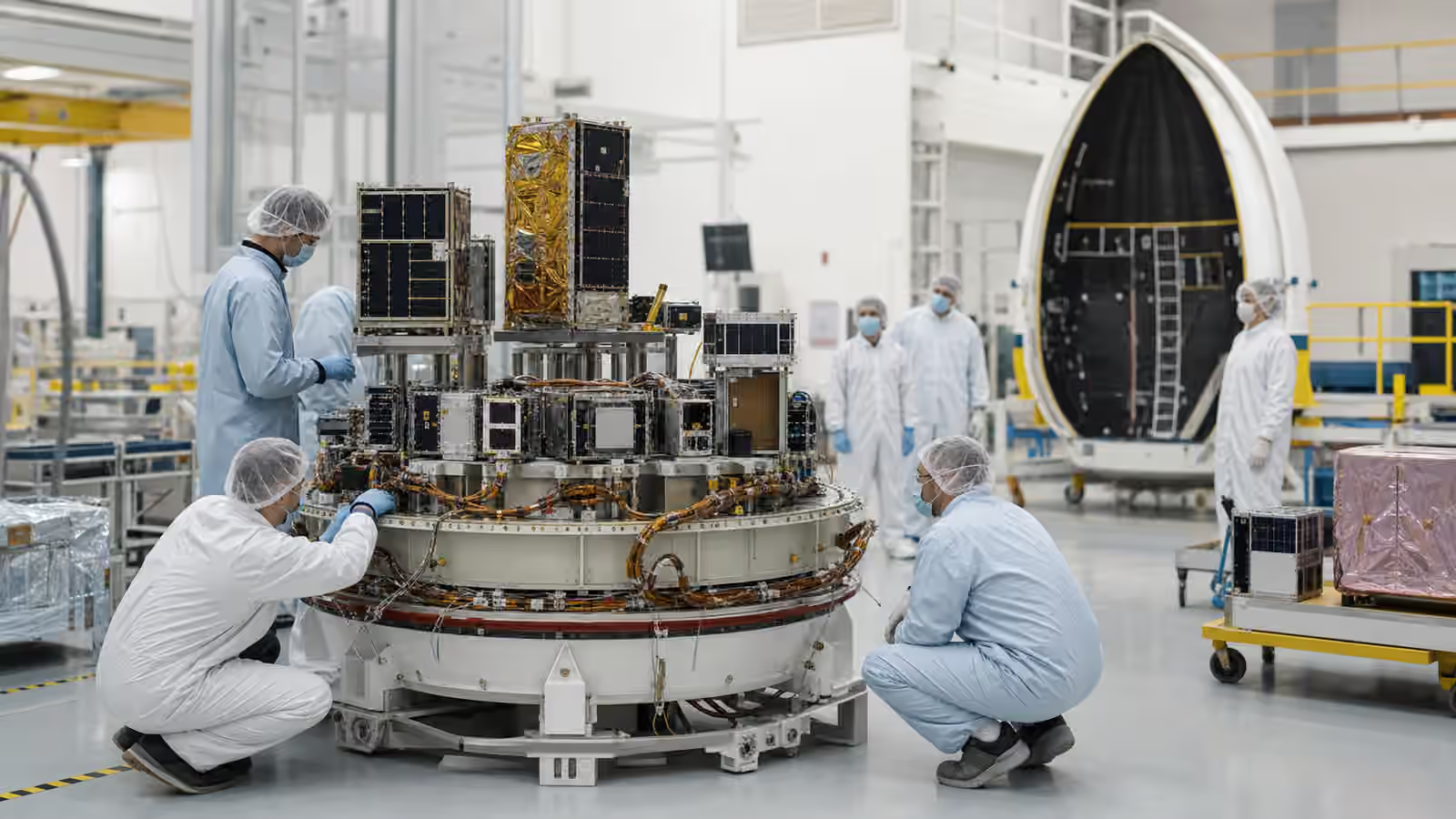
Deployment looks simple when a satellite drifts away from a dispenser. It is not simple for the people responsible for it. The upper stage must be in the right orbit, pointing the right way, spinning or not spinning as planned, and maintaining the correct separation conditions. The deployment device must release cleanly. Springs, clamps, rings, adapters, or separation systems must impart forces within expected limits. The satellite must avoid recontact and begin its own startup sequence.
For a single payload, this handoff can be tuned closely to the mission. For a rideshare, it becomes choreography. One upper stage may carry many satellites, each with its own desired orbit, separation timing, attitude constraints, and safety rules. The stage may deploy spacecraft in sequence, adjust attitude between releases, perform small maneuvers, or deliver groups into slightly different conditions.
Rideshare missions are powerful because they reduce barriers to orbit, but they also involve compromise. A secondary payload may not get the perfect orbit. It may need more onboard propulsion or accept a longer drift into position. It may have limited influence over launch timing. That does not make rideshare inferior. It means the spacecraft design and operations plan must be honest about the handoff.
Satellite Propulsion and Stationkeeping begins to matter as soon as the payload separates. The satellite’s own propulsion system may inherit whatever imperfections, compromises, or phasing tasks the launch left behind.
The Upper Stage Shapes the Early Operations Story
After separation, the spacecraft team waits for first contact. They want to know whether the satellite deployed, powered on, stabilized, and began transmitting. The upper stage has already influenced all of that. Deployment attitude affects initial tumbling. Injection accuracy affects ground station pass predictions. Separation timing affects lighting, thermal state, and communications opportunities. A clean handoff makes commissioning calmer. A messy handoff can make the first hours tense.
This is where launch and operations meet. Satellite Operations After Launch often begins with telemetry, but the conditions behind that telemetry were partly set by the upper stage. If the satellite is rotating faster than expected, if it appears in a slightly different orbit, if the first pass is shorter than planned, or if a deployment event created uncertainty, operators have to adapt quickly.
Mission teams therefore rehearse the upper-stage timeline in detail. They need deployment times, expected orbital elements, attitude assumptions, separation rates, communication windows, and contingency plans. A successful launch is not merely a rocket reaching space. It is the entire handoff happening in a way the spacecraft can survive and the operators can understand.
Passivation and Disposal Are Part of Responsible Launch
The upper stage’s work does not end when the payload leaves. A spent stage can become a debris risk if it retains energy. Residual propellant, pressurized tanks, charged batteries, and other stored energy can contribute to explosions or fragmentation later. Passivation reduces that risk by venting, safing, discharging, or otherwise leaving the stage in a less hazardous state.
Disposal also matters. Depending on orbit and mission, the upper stage may perform a deorbit burn, move to a disposal trajectory, or be left in an orbit where drag will eventually bring it down. The details vary, but the principle is stable: launch systems should not treat spent hardware as somebody else’s orbital clutter.
This connects upper stages to Space Debris and Orbital Traffic and Satellite End of Life . A mature space economy has to think about the end of each object, not only the beginning. Upper stages are large, numerous, and energetic enough that responsible handling is part of launch quality.
Some Missions Need More Than Earth Orbit
Upper stages also serve missions beyond low Earth orbit. They may send payloads toward geostationary transfer orbit, lunar trajectories, planetary transfer windows, or deep-space escape. These missions add timing constraints, navigation demands, and coast-phase complexity. A burn that is merely late or slightly off can change the required correction budget downstream.
Launch Windows and Mission Timing explains why rockets cannot leave whenever they want. Upper stages are where that timing becomes velocity. They turn a launch opportunity into a trajectory. For lunar or planetary missions, the upper stage may be the difference between a payload reaching the right corridor and spending precious fuel correcting an avoidable error.
The upper stage may be discarded after a short mission, but its influence can last for years. A communications satellite delivered efficiently may preserve propellant for stationkeeping. A science mission inserted accurately may protect margins for observations. A constellation deployed cleanly may reach service faster. A responsible disposal maneuver may reduce risk for other operators.
The Quiet Precision After the Fire
Launch coverage tends to make the rocket’s work feel front-loaded. The countdown reaches zero, engines ignite, the vehicle climbs, and the crowd exhales. Yet the mission is still being made during the quieter minutes or hours afterward. The upper stage coasts through darkness and sunlight, restarts, turns, measures, releases, and safes itself. It works without spectacle because precision is the point.
When you read that a payload reached orbit, ask what orbit, how accurately, after how many burns, with what deployment constraints, and with what disposal plan for the stage. Those details decide how much work the satellite must do next. They also reveal whether launch is being treated as a responsible infrastructure service or as a dramatic ride that ends too early in the story.
The upper stage is the last piece of the rocket the satellite trusts. After that, the spacecraft is alone with its power system, radios, software, thermal limits, and operators. A clean orbit insertion gives it a fair beginning.