Spacecraft software is easy to underestimate because it rarely appears in the mission poster. The satellite may be described by its payload, orbit, antenna, solar arrays, or launch vehicle. Yet the mission’s behavior passes through code. Commands are checked by software. Telemetry is organized by software. Payload activities are scheduled by software. Fault responses are triggered by software. Updates, timers, memory, logs, modes, and autonomy all depend on software that has to behave far from the people who wrote it.
Satellite Onboard Computers and Data Handling explains the computer and data system that turns hardware into behavior. Software verification asks how the mission earns trust in that behavior before launch and how it preserves that trust afterward. The question is not whether the code looks clever. The question is whether the spacecraft can be commanded, recovered, updated, and understood when the state is inconvenient.
Flight Software Is Part of the Spacecraft
It is tempting to treat software as more flexible than hardware, and in one sense it is. A table can be changed. A command sequence can be rewritten. A patch can sometimes be uploaded. A mode can be adjusted after experience in orbit. That flexibility is valuable, but it can also invite a dangerous habit: assuming software can fix late confusion without carrying its own risk.
Flight software is part of the spacecraft as surely as a battery or reaction wheel is. It has interfaces, failure modes, resource limits, timing assumptions, and dependencies on hardware that may not behave perfectly. A processor can reset. Memory can corrupt. A sensor can report nonsense. A bus message can arrive late. A file can fill storage. A command can be valid in one mode and hazardous in another. Software that was safe in a lab can become unsafe if the spacecraft’s state is not what the lab assumed.
Verification begins by respecting that reality. The code must be tested not only as a program, but as a layer of spacecraft behavior. It has to interact with power, thermal control, attitude control, communications, payload operations, fault protection, and ground procedures. The more connected the software is, the more careful the evidence must be.
Verification Is Evidence, Not Ceremony
A verification program is a way of collecting evidence that the spacecraft will do what the mission requires. Some of that evidence comes from reviews. Some comes from automated tests, simulations, hardware-in-the-loop benches, command rehearsals, environmental testing, and operations exercises. The important point is that each test should answer a real question about mission behavior.
A simple function test may confirm that a command parser accepts a valid command and rejects an invalid one. That is useful, but it is not enough. The mission also needs to know what happens when the command arrives during an eclipse, when a file is already open, when the spacecraft is in safe mode, when a previous command failed, or when the ground station pass ends before all telemetry returns. Spacecraft software lives inside sequences, not isolated buttons.
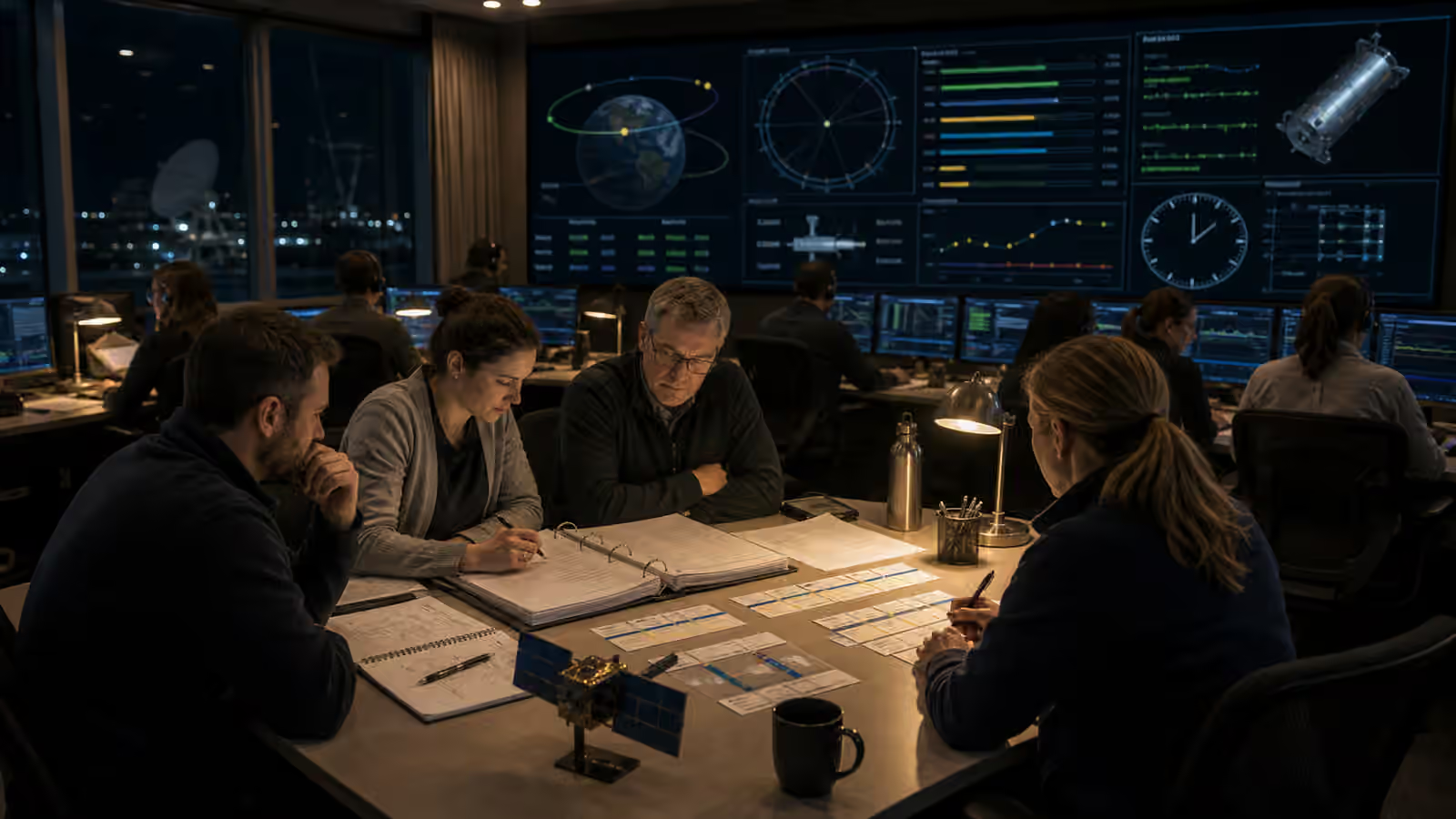
Mission Simulation and Digital Twins describes why rehearsing the mission before flight matters. Software verification is one of the main reasons. A simulation can expose a timing assumption. A hardware-in-the-loop bench can show how real avionics respond to a reset. An operations rehearsal can reveal that a procedure is technically correct but too confusing under pressure. Testing becomes stronger when it uses the same ground tools, command dictionaries, telemetry definitions, and procedures that the team expects to use in flight.
Configuration Control Keeps the Mission From Splitting
Software trust depends on knowing exactly what version of the mission exists. That sounds obvious until the system becomes large. The spacecraft may have flight software, bootloaders, parameter tables, command dictionaries, calibration files, test scripts, ground software, simulators, operations procedures, and documentation. If those pieces drift apart, the team can believe it is testing one spacecraft while preparing to fly another.
Configuration control is the discipline that keeps that split from happening. Which software build is loaded on the spacecraft? Which parameter set was used during thermal vacuum testing? Which command dictionary belongs to the current build? Which known issue was accepted before launch? Which procedure was updated after a test failure? Which simulator model matches the flight configuration well enough to support an operations decision?
These questions are not administrative trivia. They decide whether evidence is meaningful. If a payload test passed with one parameter table and flight uses another, the pass does not prove as much as people may want it to prove. If a ground tool expects an older telemetry field, an operator may misread a spacecraft state. If a software update changes fault behavior but the recovery procedure remains old, the mission has created a quiet trap for its future self.
Satellite Manufacturing and Testing treats documentation as part of the spacecraft. Software makes that point even sharper. The record of what was loaded, tested, changed, waived, and accepted becomes part of the mission’s memory.
The Unhappy Paths Deserve the Most Attention
Happy-path tests are necessary. A satellite should accept routine commands, collect routine data, downlink routine telemetry, and execute ordinary schedules. But the value of flight software verification often appears in the unhappy paths. What happens when the spacecraft loses contact halfway through an upload? What happens when a payload asks for more power than the current mode allows? What happens when a sensor disagrees with another sensor? What happens when a watchdog timer resets a processor while a file is being written?
These cases are uncomfortable because they multiply quickly. No team can test every possible combination of state, timing, and fault. The goal is not infinite proof. The goal is to test the cases that define the mission’s boundaries and to design software that fails in understandable ways when it reaches a boundary that was not perfectly rehearsed.
Satellite Fault Protection and Autonomy sits directly beside this work. Fault protection is software behavior under stress. It may switch modes, reset hardware, shed loads, reject commands, or wait for the ground. If those responses are not verified with realistic timing and telemetry, the spacecraft may protect itself in a way that operators did not expect.
Good verification also asks whether the software leaves enough evidence. If a safe mode triggers, operators need to know why. If an update fails, they need to know which step failed. If a command is rejected, the reason should be visible. A system that silently refuses, silently retries, or silently changes state may be harder to recover than one that fails loudly and preserves context.
Commands Are Software in Motion
Many mission problems do not come from a bug hidden deep in code. They come from the interaction between code and procedure. A command sequence is a small program written for a specific spacecraft state. It may turn on equipment, change modes, start a payload activity, load a table, prepare a burn, or collect diagnostic data. If the sequence assumes the wrong state, the software may execute exactly as designed and still produce trouble.
Command discipline is therefore part of software verification. Procedures should be reviewed against real constraints. State checks should be explicit. Timing should match communications windows. Recovery paths should be known before a risky command is sent. The ground team should understand which commands the spacecraft will accept, which it will reject, and which it will delay until conditions are right.
Satellite Operations After Launch shows how routine operations can become the mission’s real test. A software feature that is easy to operate during the day with the full team present may be fragile during an anomaly pass with limited data. A command interface that requires tribal knowledge is not mature enough for long-lived infrastructure. The best operational software makes wrong actions harder and leaves the right evidence when actions are refused.
Updating a Spacecraft Requires a Way Back
The ability to update flight software can save missions. It can fix bugs, improve performance, add resilience, adjust to aging hardware, or support new operations. It also creates risk because the spacecraft may be far away, contact may be intermittent, and the update path itself depends on software behaving correctly.
A responsible update plan thinks about failure before it celebrates flexibility. How is the new image transferred? How is it checked for integrity? Where is it stored before activation? What happens if the spacecraft resets during the upload? Can it boot from a known-good version? How does the team confirm that the new behavior is active? Which telemetry proves that the spacecraft is still recoverable?
Satellite Cybersecurity and Resilience belongs in the same conversation because update authority is sensitive. A mission needs to know that an update is legitimate, complete, and intended for the current configuration. Security and verification are not separate rituals. They both protect the mission from trusting the wrong behavior.
Some missions will update often. Others will avoid change unless the risk of staying unchanged is greater. Neither habit is automatically mature. The mature habit is to treat every update as an engineering event with evidence, rehearsal, rollback thinking, operational awareness, and clear configuration records.
Trusted Code Makes the Hardware Legible
The deepest reason to verify flight software is not only to prevent failure. It is to make the spacecraft legible. A well-tested system gives operators confidence that telemetry means what it appears to mean, that commands are interpreted consistently, that logs tell a usable story, and that mode transitions are not surprises. When something goes wrong, the team can reason from evidence instead of guessing through layers of undocumented behavior.
This legibility matters across the mission life. During commissioning, it helps the team separate a sensor issue from a software setting. During routine service, it supports efficient planning and data handling. During anomalies, it protects recovery. During end of life, it helps operators execute final commands with enough confidence that the spacecraft will retire responsibly.
Spacecraft software verification is sometimes described as a barrier to speed. It is better understood as a way to avoid false speed. Rushing code, tables, procedures, and ground tools into a mission without shared configuration may feel fast until the spacecraft reaches orbit and every ambiguity becomes expensive. A slower test campaign that produces clear evidence can save time later because operators are not debugging the mission from fragments.
Trusted flight software does not make a spacecraft free to improvise. It makes the spacecraft predictable enough to depend on, flexible enough to recover, and honest enough to explain itself. That is infrastructure work. The code is invisible from the ground, but the trust it earns is one of the things that lets a machine in orbit become a service rather than an experiment that people hope will keep working.