
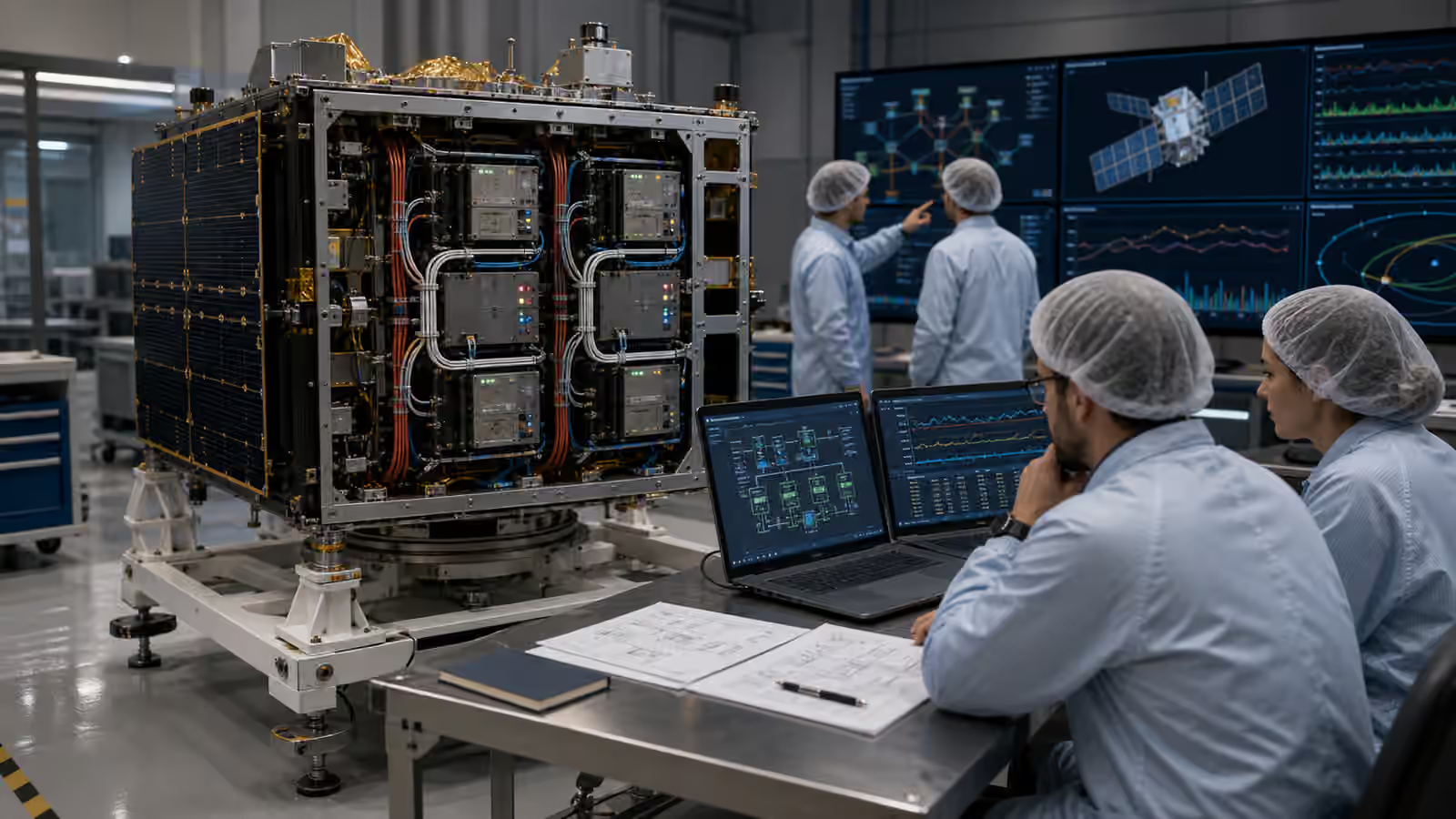
Reliability in space is not the hope that nothing will fail. It is the practice of deciding which failures are plausible, which ones are survivable, which ones are too expensive to cover, and how the mission should behave when hardware no longer matches the best day of the design. A spacecraft is a machine that has to keep making sense after launch, vibration, vacuum, thermal cycling, radiation, software updates, operations errors, and simple aging.
The word redundancy often gets used as if it means adding a second copy of everything. That is too simple. A second unit can help, but it can also add mass, cost, power draw, software complexity, test burden, failure modes, and confusion about which path is active. Good reliability design is more careful. It asks what service the mission must preserve, what evidence operators will have during trouble, and how the spacecraft can degrade without becoming mysterious.
Space Mission Architecture and Tradeoffs is the right upstream companion for this topic because reliability is never free. The mission has to spend mass, money, schedule, test time, and operational attention somewhere. The hard question is where those resources reduce meaningful risk instead of creating a more complicated way to fail.
Single-Point Failures Deserve Plain Language
A single-point failure is a component, connection, software path, or assumption whose failure can end a mission or prevent a critical function. The phrase sounds technical, but the idea is ordinary. If one power switch can disable the whole spacecraft, it is a single point. If one sensor is required to find the Sun after a fault, it is a single point. If one ground procedure is the only way to recover from a bad state, the mission may have an operational single point even if the hardware is duplicated.
The first step is naming these points honestly. Teams sometimes soften the language because a design has already committed to them. That does not help the spacecraft. A mission may accept a single point because the consequence is small, the probability is low, the payload is experimental, or the alternative is unaffordable. Acceptance is different from denial. A named risk can be watched, tested, documented, and handled with operating limits. An unnamed risk waits for flight to reveal itself.
Mission Assurance and Spaceflight Reviews exists partly to force this kind of honesty. Review boards, fault trees, hazard analyses, and test evidence can feel bureaucratic, but they are ways of asking whether the mission understands its own weak joints before the rocket makes them permanent.
Redundancy Has Architecture
Two boxes are not automatically redundant if they share the same fragile path. A backup transmitter may still depend on the same antenna switch. A backup computer may still depend on the same corrupted command table. Two batteries may still be exposed to the same thermal environment. Two sensors may fail together if they share a blind spot, a software assumption, or contamination on the same optical surface.
This is why redundancy has architecture. Engineers think about separation, cross-strapping, voting, isolation, power paths, command authority, and how a backup is tested without harming the primary system. Cross-strapping can let one computer use another radio or one power converter feed a different load, but it also increases the number of states the team must understand. A clean design balances flexibility with clarity.
There is also a difference between hot, warm, and cold redundancy. A hot backup may run continuously and take over quickly, but it consumes power and ages along with the primary. A cold backup may be safer from some faults but may not reveal its own problems until needed. A warm spare sits between those approaches. The right choice depends on how quickly the function must recover, how much power the spacecraft has, how often the backup can be tested, and what failures the design is trying to survive.
Satellite Onboard Computers and Data Handling shows how much of this becomes flight behavior. Redundancy is not only a wiring diagram. It is software deciding which unit is trusted, telemetry showing which path is active, and operators knowing how to command a transition.
Graceful Degradation Is Often Better Than Perfection
A reliable mission is not always one that preserves full performance. Sometimes the smarter goal is graceful degradation. A communications satellite may lose capacity but keep emergency service. An Earth observation satellite may lose one detector channel but continue lower-quality collections. A spacecraft may stop using a high-rate downlink and fall back to a slower mode. A rover may avoid a wheel behavior that risks damage and accept a slower traverse.
Graceful degradation begins with priorities. The mission has to know which functions are essential, which are valuable, and which can pause. Power-positive survival matters before payload collection. Thermal safety matters before convenience. Commandability matters before data volume. If those priorities are not built into procedures and onboard autonomy, the spacecraft may protect the wrong thing at the wrong time.
Satellite Fault Protection and Autonomy is the operational expression of graceful degradation. Safe mode is not a failure of ambition. It is a designed refuge where the spacecraft gives up performance to preserve recoverability. The refuge only works if it is tested, understandable, and reachable from the kinds of failures the mission actually expects.
Graceful degradation also protects people on the ground from bad incentives. If the only choices are full performance or total loss, teams may push a troubled spacecraft too hard. If reduced service is acceptable and planned, operators can make calmer decisions. Reliability is partly a technical property and partly a way to make responsible behavior easier.
Margins Are Not Decoration
Margins are the space between expected demand and allowable limit. Power margin, thermal margin, propellant margin, data storage margin, pointing margin, link margin, timing margin, and processing margin all matter because real missions are messier than clean calculations. Solar arrays age. Batteries lose capacity. Components run warmer than expected. Ground contacts are missed. Payload requests arrive in clusters. A small drag environment can accumulate into real stationkeeping work.
The danger is that margin can be spent quietly. A design review may show comfortable reserves, but later changes add heaters, software loads, cable mass, pointing demands, or operational constraints. Each change looks modest. Together they turn a sturdy mission into a narrow one. Configuration control is therefore part of reliability. A margin that no one tracks is not a margin; it is a memory of an earlier design.
Satellite Power Systems and Satellite Thermal Control are good examples. Power and heat are linked across the whole mission. A backup heater may protect hardware but drain batteries. A new operating mode may improve payload value but push a radiator. A high-rate transmitter may solve a data problem and create a thermal one. Reliability design follows these trades across subsystem boundaries.
Margins also have human value. Operators trust a spacecraft differently when they know there is room to pause, retry, collect more telemetry, or wait for a better pass. Narrow margins force hurried choices. Healthy margins buy time, and time is one of the most useful resources during an anomaly.
Testing Has to Include the Backup Story
Testing a primary path is not enough. The mission has to test how it detects a fault, how it switches to a backup, how it proves the switch worked, and how it avoids switching repeatedly between states. A redundant design that is never exercised may carry hidden assumptions. A backup radio may work electrically but use a command path no one rehearsed. A spare computer may boot but lack the latest configuration. A recovery procedure may be technically correct but too long for the available ground pass.
Satellite Manufacturing and Testing covers the environmental side of proving hardware. Reliability testing adds behavior: fault injection, safe-mode rehearsal, command validation, telemetry review, and end-to-end recovery practice. The point is to discover confusion while the spacecraft is still reachable.
No test program can prove that a mission will never fail. That is not the standard. The better standard is whether the mission understands the failures it claims to tolerate. If a team says it can survive a computer reset, it should know what happens to timing, command queues, payload state, telemetry storage, attitude control, and ground procedures. A reset is not a single event. It is a chain.
Dependability Is a System Habit
Reliability is sometimes treated as a property of parts. Better parts help, but dependable missions come from system habits. They come from clear requirements, honest risk acceptance, conservative interfaces, useful telemetry, tested safe modes, configuration control, skilled operators, and review cultures that let people say when a design is brittle.
This matters even for low-cost missions. A technology demonstration may accept more risk than a navigation satellite, but it still benefits from knowing what it is accepting. A small satellite can be simple and reliable if its mission is clear. A large spacecraft can be expensive and fragile if redundancy is added without discipline.
The most useful reliability question is not “How many backups are there?” It is “What happens next when something fails?” A spacecraft that can answer that question with evidence has a better chance of remaining useful after the first surprise. It may lose performance. It may pause service. It may retreat to safe mode. But it does not have to become unknowable.
Space infrastructure depends on that kind of reliability. The public experiences a service, not a block diagram. Behind the service is a mission that has to keep working when one path is gone, one sensor is suspect, one ground pass is missed, or one assumption has aged badly. Redundancy is valuable when it preserves understanding. Reliability is the broader discipline that makes the spacecraft worth trusting after the easy part of the mission is over.


