A spacecraft is not simply launched and left to perform. It has to be spoken to, listened to, located, checked, and understood across a link that may exist for only a few minutes at a time. The public service might be broadband, imagery, timing, science, or inspection, but underneath that service is a practical conversation: commands going up, telemetry coming down, and tracking data telling the mission where the vehicle really is.
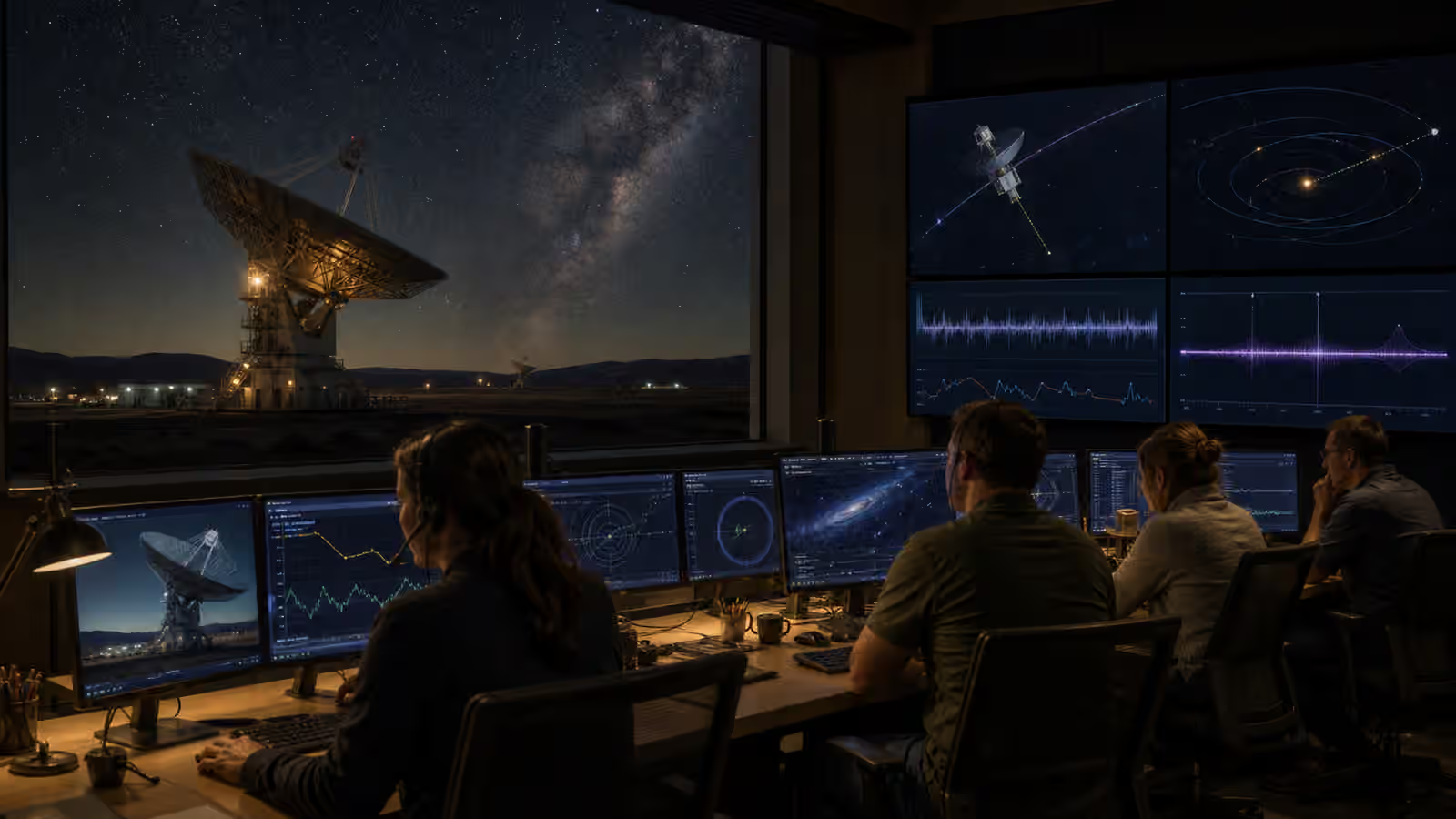
This discipline is often shortened to TT&C, for telemetry, tracking, and command. The abbreviation sounds administrative, but the work is intimate. It is how a mission keeps authority over a machine it cannot touch. Ground Stations explains the earthside infrastructure that carries the link, and Satellite Operations After Launch explains the long routine after deployment. TT&C sits between them. It is the language, timing, evidence, and restraint that make operations possible.
The Link Carries Authority
A command is not just a message. It is authority turned into radio energy, accepted by flight software, and translated into action on a real spacecraft. That action might change a mode, start a payload observation, open a valve, load a table, reset a computer, schedule a downlink, or prepare a maneuver. Even a simple-looking command can matter because it meets the spacecraft in a particular state.
This is why command systems are conservative. The mission needs a command dictionary that defines what each instruction means, what arguments it accepts, what mode restrictions apply, what telemetry should confirm success, and what recovery path exists if the result is not what operators expected. A command sequence is closer to a small operating procedure than a button press. It has assumptions about time, power, thermal state, attitude, contact duration, and the order in which previous commands succeeded.
The link also has to protect command authority. Mature missions use access control, authentication, encryption where appropriate, independent review of risky procedures, and careful logging. The important point is not that every mission uses the same security architecture. The important point is that commands deserve more respect than ordinary data traffic. A bad image file can be replaced. A bad command can change the spacecraft.
Spacecraft Software Verification and Configuration Control is directly connected to this work. Operators must know which command dictionary matches the flight software, which parameter tables are active, and which procedure was tested against which version of the vehicle. If those pieces drift apart, the ground team may believe it is commanding one spacecraft while the actual machine behaves like another.
Telemetry Makes the Machine Legible
Telemetry is the spacecraft’s account of itself. It includes health data, mode states, temperatures, voltages, currents, memory status, fault flags, attitude estimates, propulsion readings, payload status, event logs, software counters, time tags, and many other small signals. None of them is the whole story. Together they let operators build a usable picture of a distant machine.
Good telemetry is designed before the crisis. A mission cannot wait until an anomaly to discover that the key state was never reported, the event counter wraps too quickly, or the reason for a command rejection is hidden behind a generic error. Telemetry should help people distinguish between a sensor problem and a real system problem, between a one-time disturbance and a trend, between an expected mode transition and a surprise.
The same telemetry also supports routine service. A battery that charges a little differently over many orbits, a wheel that draws more current, a transmitter that warms faster, or a payload that produces more rejected frames than usual may all be early clues. Satellite Power Systems and Satellite Thermal Control show why those slow changes matter. TT&C is how the team sees them while there is still time to adjust operations.
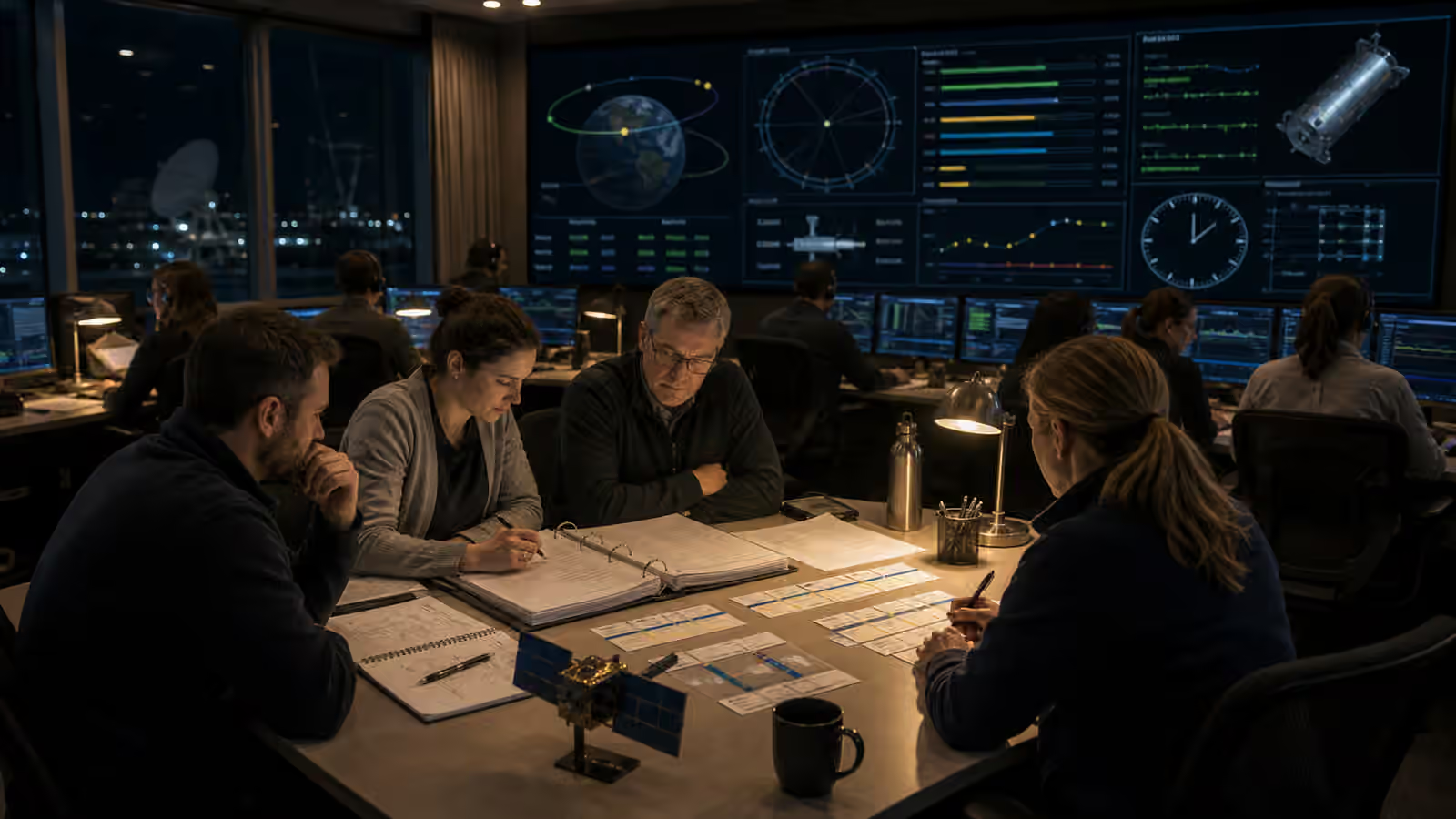
There is a human side to this as well. Telemetry must be displayed, filtered, archived, and explained in ways operators can use under pressure. A wall of numbers can hide a problem as effectively as too little data. Good mission control tooling turns raw spacecraft reports into context without pretending certainty is greater than it is.
Tracking Turns Contact Into Position
Tracking is the part of TT&C that answers where the spacecraft is and how fast it is moving. Some tracking comes from dedicated measurements such as range and Doppler. Some comes from normal communications links. Some may be supported by optical observations, onboard navigation, inter-satellite links, or external catalogs. The method depends on the mission, orbit, and available infrastructure.
Flight Dynamics and Orbit Determination explains how tracking observations become an orbit estimate. TT&C supplies part of the evidence. A ground station pass may not merely move data; it may refine the mission’s knowledge of where the vehicle will be during the next pass, the next imaging opportunity, the next maneuver, or the next possible conjunction.
Tracking quality is operational. A narrow uncertainty region can let the team point antennas accurately, plan a burn, schedule a close approach, or trust a payload geometry. A wide uncertainty region may require more observations, conservative pointing, or delayed action. This is especially important after deployment, after a maneuver, during low-thrust orbit raising, or when space weather changes drag in low Earth orbit.
The spacecraft is not alone in this measurement. The ground station has clocks, antennas, calibration, weather, software, and local procedures. A bad station configuration or missing time reference can pollute the tracking story. The link is a measuring instrument, and measuring instruments need discipline.
Passes Are Planned Before They Happen
For many low-Earth orbit missions, a ground contact is a narrow window. The satellite rises above the station’s horizon, the antenna tracks it, the link is acquired, data flows, commands may be uplinked, and then the spacecraft disappears again. The pass can feel brief compared with the amount of work it must carry.
That is why pass planning matters. The team decides what must happen before contact begins. Which telemetry is essential? Which stored data can wait? Which commands are safe to send if the link drops early? Which activities need confirmation before the next step? Which pass is the right one for a risky update because enough follow-up contacts are available? These are not glamorous questions, but they decide whether limited contact becomes useful contact.
Operations teams often rehearse important sequences before sending them. They run simulations, check command timing, confirm spacecraft state assumptions, and decide what evidence will prove each step. A maneuver plan, payload calibration, software patch, or recovery attempt should not depend on improvisation during a short radio window.
The pass also connects to Satellite Data Pipelines . Housekeeping telemetry, payload data, quality flags, logs, and timing information all need a path from spacecraft to ground systems. If the mission treats downlink as a generic pipe, it may discover too late that critical evidence was delayed behind less urgent data.
Security and Recovery Belong Together
Spacecraft command security is sometimes described as a wall that keeps attackers out. That is true, but incomplete. The system also has to preserve recovery when something goes wrong. Operators need ways to confirm identity, reject unsafe commands, restore known configurations, and regain contact after resets, missed passes, or confused spacecraft states.
A mission that is secure but impossible to recover is fragile. A mission that is easy to recover but careless with command authority is also fragile. The balance depends on threat, cost, mission consequences, and architecture, but the design question is always practical: who is allowed to tell the spacecraft what to do, how does the spacecraft know that, and what evidence remains afterward?
Satellite Cybersecurity and Resilience broadens this story to ground systems, supply chains, and data trust. TT&C is where the abstract word resilience becomes procedural. It appears in command review, link authentication, telemetry monitoring, protected update paths, off-nominal playbooks, and records that let teams reconstruct what happened.
Evidence Is Part of the Mission
TT&C leaves a trail: command histories, telemetry archives, pass records, tracking observations, anomaly notes, software versions, configuration changes, and operator decisions. That trail can look like overhead until the mission needs it. When a spacecraft enters safe mode, misses a contact, warms unexpectedly, rejects a command, or loses a payload mode, evidence is the difference between reasoning and guessing.
Insurance, regulation, customer trust, safety, and engineering learning all depend on this record. Space Insurance and Mission Risk treats loss investigation as a technical reconstruction, not just a financial exchange. TT&C is often where that reconstruction begins. What did the spacecraft report? Which command was accepted? What did tracking show? Which ground system handled the pass? Was the configuration known?
The most mature missions treat the conversation with the spacecraft as part of the spacecraft itself. Radios, antennas, command dictionaries, telemetry definitions, station schedules, clocks, keys, logs, operators, and procedures form a living interface across distance. Without that interface, a satellite is merely hardware overhead. With it, the mission can listen, decide, correct, learn, and keep a useful machine in service long after the launch webcast ends.