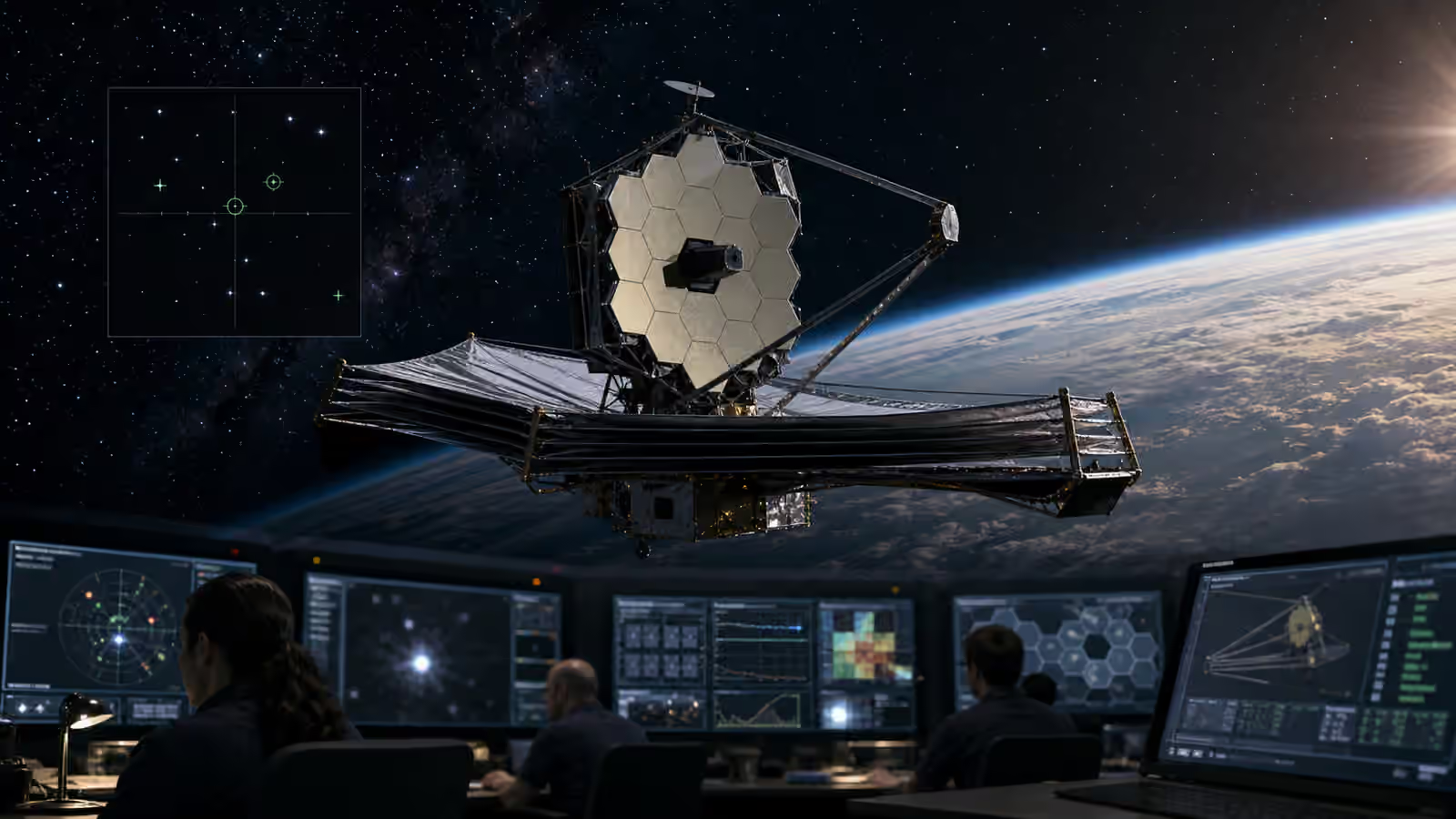
A space telescope is both a spacecraft and an instrument. The spacecraft keeps it powered, pointed, cooled, connected, protected, and alive. The instrument gathers faint evidence from distant targets, nearby planets, stars, galaxies, atmospheres, or transient events. Observatory operations are the bridge between those two identities. They turn a machine in space into a source of scientific measurements that other people can trust.
The public often sees the final image or discovery. Operators see the constraints that made the observation possible. A telescope may need a particular pointing angle, thermal state, guide target, exposure sequence, data volume, downlink plan, calibration reference, and avoidance rule before it can look. Satellite Bus and Payloads explains the relationship between the payload and the bus. A space telescope pushes that relationship hard because the payload often demands unusual stability and cleanliness.
Pointing Is Science Infrastructure
A telescope does not simply turn toward a target. It has to point with enough accuracy and stability for the measurement being attempted. Some observations tolerate modest drift. Others require very fine pointing over long exposures. A small jitter that would not matter for a communications satellite may blur an image or weaken a precise measurement. Pointing therefore becomes part of scientific validity.
Satellite Attitude Control covers the sensors and actuators that make this possible: star trackers, gyros, reaction wheels, thrusters, control algorithms, and safe modes. Observatory operations add a layer of scheduling and judgment. The team must know which attitudes are allowed, how long the telescope can dwell, whether guide stars are available, how momentum builds up, and when a maneuver or wheel desaturation might disturb observations.
Pointing also interacts with light avoidance. A telescope may need to keep the Sun, Earth, Moon, or bright objects outside certain angles to protect optics, preserve thermal stability, or avoid stray light. Those limits shape the observing calendar. A target that is scientifically urgent may still be unavailable because the spacecraft cannot safely or usefully point there at that time. Good observatory operations make those constraints visible to scientists before they become disappointment.
Thermal Stability Shapes What the Telescope Can See
Telescopes are sensitive to temperature. Mirrors, detectors, structures, electronics, and sunshields can expand, contract, emit heat, or change behavior as conditions shift. Infrared observations can be especially sensitive because warm hardware can glow in the same wavelengths the instrument wants to measure. Even when a telescope is not operating in the infrared, thermal changes can affect alignment and focus.
Satellite Thermal Control explains the spacecraft side of this problem. Observatory operations must translate it into observing practice. A maneuver may expose a surface to sunlight and create a settling period. A heater cycle may introduce a small disturbance. A detector may need a stable temperature before collecting useful data. A sequence may be arranged so that the telescope moves through attitudes gently rather than jumping between extremes.
Thermal discipline also affects safe modes. If an observatory enters a protective state, it may preserve power and commandability while losing a carefully maintained thermal condition. Recovering the telescope can then involve more than resuming the schedule. It may need cooldown, focus checks, calibration, and review before science operations restart.
Calibration Makes Beauty Trustworthy
Space telescope results are not trustworthy because they are visually impressive. They are trustworthy because the instrument is calibrated, the data are processed with known assumptions, and uncertainties are recorded. Calibration can include dark frames, flat fields, wavelength references, standard stars, detector behavior, pointing knowledge, background measurements, and comparison with previous observations.
Payload Calibration and Validation is essential background here. A telescope is not a perfect eye. It has detector quirks, optical distortions, sensitivity changes, cosmic-ray hits, thermal effects, scattered light, and aging. Calibration is the practice of characterizing those behaviors so that the final data product does not pretend the instrument disappeared.
Calibration also changes over time. Launch can shift alignment. Radiation can affect detectors. Contamination can alter optical surfaces. Mechanisms can age. A telescope may need periodic checks, special calibration campaigns, and updates to data processing. Observatory operations therefore includes maintaining the meaning of old data as well as collecting new data.
Scheduling Is a Scientific Negotiation
Observing schedules have to balance science priority with spacecraft reality. A target may be visible only during certain windows. Another may require a long uninterrupted exposure. A transient event may demand rapid response. A calibration observation may be less glamorous but necessary for everyone. Data storage and downlink capacity may limit how much can be collected before the next contact. Power and thermal constraints may rule out certain sequences.
This is why observatory scheduling is not just a calendar problem. It is a negotiation among science goals, spacecraft limits, fairness, urgency, and risk. Satellite Tasking and Payload Operations covers similar planning for Earth observation and other payloads. Space telescopes add the challenge that many observations are unique in time. A supernova, occultation, comet approach, or planetary weather event may not wait for the next convenient week.
Good scheduling systems make constraints explicit. They help scientists understand why an observation is possible, delayed, shortened, or rejected. They also protect the spacecraft from being treated as an infinitely flexible camera. The telescope can only create science if it remains healthy enough to observe tomorrow.
Data Pipelines Preserve the Observation’s Story
After photons become detector readings, the work moves through data systems. Raw observations need metadata: time, pointing, instrument mode, calibration state, exposure settings, quality flags, processing version, and sometimes environmental context. Without that story, data can be beautiful and difficult to use. With it, researchers can compare, reproduce, question, and improve the result.
Satellite Data Pipelines explains how raw space data becomes a trusted product. Observatory pipelines add scientific stewardship. Data may be reprocessed years later with better calibration. Archives may support researchers who were not part of the original observation. A telescope’s value often grows when its data remain understandable after the mission team has moved on.
This archival responsibility affects operations. If a command change, instrument anomaly, or calibration update occurs, the data record has to show it. If a detector region becomes less reliable, downstream users need quality information. If an observation was interrupted by a safe mode or pointing issue, the pipeline should not hide that history. Scientific trust depends on preserving caveats, not only polished outputs.
Contamination and Cleanliness Continue After Launch
Space telescopes can be sensitive to contamination. Outgassing, particles, thruster residue, ice, dust from mechanisms, or deposits on cold surfaces can change optical performance. Clean-room practice before launch matters, but the concern does not end when the fairing opens. Observatory operations may include attitude rules, heater strategies, deployment timing, venting awareness, and avoidance of activities that could expose optics to unwanted material.
Spacecraft Materials and Contamination Control explains why surfaces are functional hardware. For a telescope, a mirror coating, detector window, baffle, sunshade, or thermal surface may decide what the instrument can see. A tiny amount of contamination can matter if it scatters light or changes infrared behavior.
This is one reason payload activation is careful during Satellite Commissioning and Early Orbit Operations . A telescope may need to wait for outgassing, stabilize temperatures, deploy covers, verify focus, and test modes before beginning full science operations. The first image is not the same as a commissioned observatory.
Observatories Are Shared Infrastructure
A major space telescope often serves many scientific communities. It may observe exoplanets, galaxies, stars, solar system objects, transient events, and calibration targets for future missions. It may also inspire the public through images, but its deeper value is as shared measurement infrastructure. That shared role requires transparent scheduling, stable archives, clear documentation, and careful operation over years.
The spacecraft itself may be singular, but the observatory is a network. It depends on ground stations, operations centers, data archives, calibration teams, proposal review, software tools, and researchers who know how to ask good questions. Ground Stations and Mission Operations Centers and Flight Rules are therefore part of the telescope’s scientific output, even if they never appear in a press image.
The best way to understand a space telescope is not as a camera in the sky. It is a disciplined agreement between optical hardware, spacecraft systems, operators, scientists, and data stewards. When that agreement works, faint signals become evidence. The image may be memorable, but the infrastructure behind it is what lets the measurement endure.