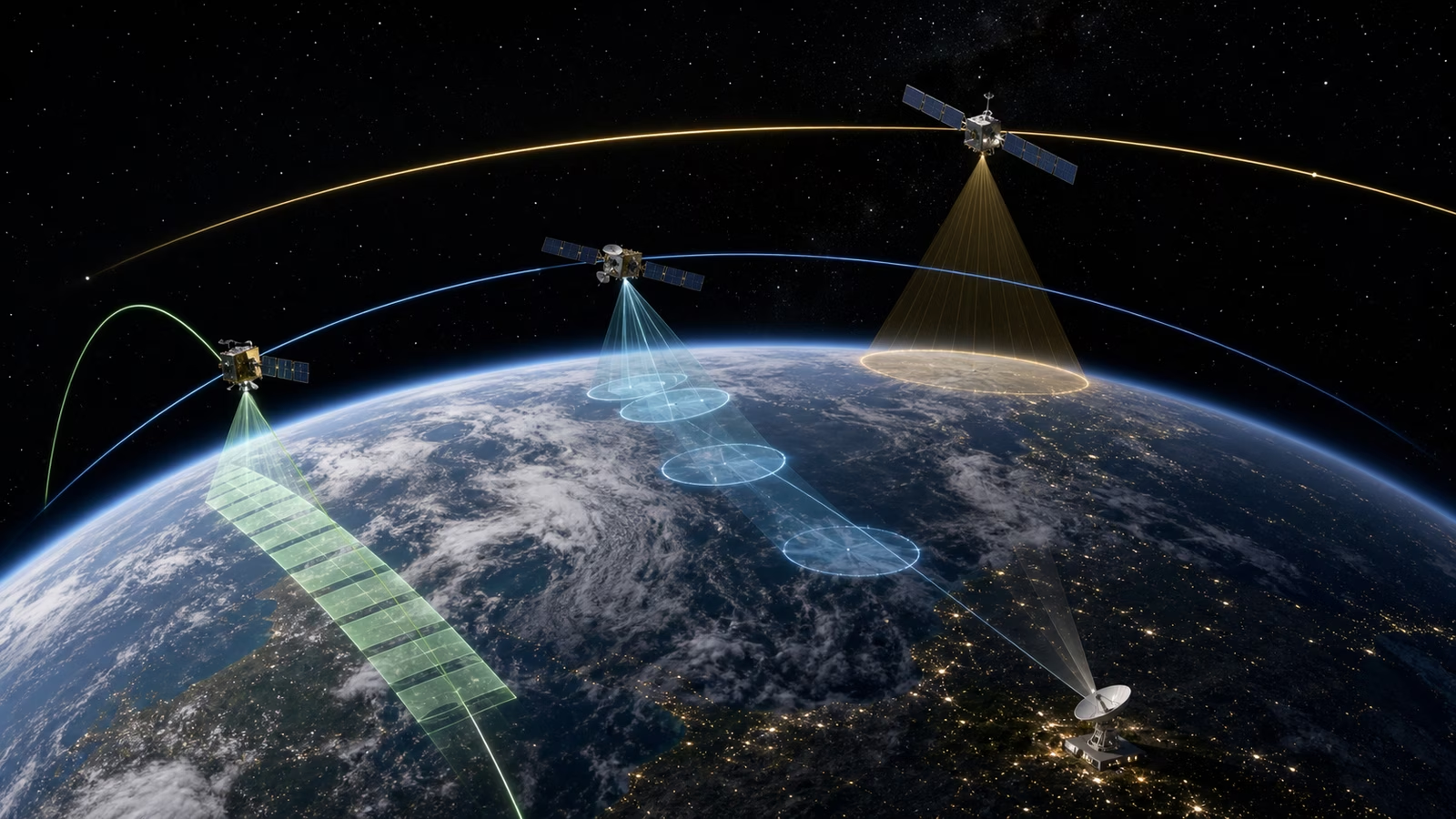
A space mission begins as a sentence that sounds cleaner than the machine it will require. Monitor fires faster. Connect remote communities. Measure ocean winds. Demonstrate a new propulsion system. Inspect a damaged satellite. Carry cargo toward the Moon. The sentence is the desire. Mission architecture is the work of turning that desire into a system that can survive physics, budgets, launch constraints, ground operations, and time.
The architecture is not only the satellite. It is the payload, bus, orbit, launch plan, ground segment, data path, operating concept, disposal plan, schedule, margins, interfaces, and assumptions that make the mission believable. Satellite Bus and Payloads explains the spacecraft split between service hardware and mission hardware. Architecture asks why that split should look the way it does at all.
The Mission Goal Has to Become a Measurement
The first hard step is making the goal precise. “Watch crops” is not yet a mission. Which crops, how often, at what resolution, in which weather, with what latency, and for whom? A farmer, insurer, water manager, and commodities analyst may all care about fields, but they may not need the same data. One user may need a broad regional signal every few days. Another may need small changes within a specific field. Another may care more about reliable delivery than maximum image sharpness.
This is where vague ambition becomes requirements. Requirements should describe what the mission must do, not merely what engineers might like to build. If wildfire monitoring is the goal, detection latency may matter more than beautiful imagery. If broadband service is the goal, capacity, handover behavior, and ground network reach may matter more than the elegance of a single satellite. If navigation timing is the goal, clock stability and signal trust become central.
Good architecture keeps asking what would make the mission fail from the user’s point of view. A sensor that collects excellent data but delivers it two days too late may fail an emergency-response mission. A satellite that reaches a perfect orbit but cannot downlink enough data may fail an Earth observation mission. A low-cost design that needs too many custom operating exceptions may fail as infrastructure.
Orbit Is a System Choice
Orbit selection is one of the most visible architectural choices, but it is not a decorative label. Orbital Regimes and Mission Design covers the differences among low, medium, geostationary, polar, sun-synchronous, and inclined orbits. The architecture question is how those differences serve the mission.
A low orbit can give stronger signals, lower latency, and sharper Earth observation for a given instrument size, but it also brings atmospheric drag, fast motion across the sky, frequent handovers, and a need for more satellites if coverage must be continuous. A geostationary orbit can stare at a region and simplify some ground antennas, but it is farther away, more expensive to reach, and less suitable for high-resolution imaging or low-latency service. A sun-synchronous orbit may give repeatable lighting for imagery, but the timing that helps one mission may constrain another.
Orbit also changes the rest of the design. It affects thermal cycles, radiation exposure, eclipse periods, ground station contact time, propulsion needs, debris risk, and end-of-life options. A mission architecture that chooses an orbit without tracing those consequences is not finished. It has only moved complexity into later meetings.
Payload and Bus Negotiate With Each Other
The payload is the reason the mission exists, but it does not get everything it wants. A radar instrument may need power, antenna area, onboard processing, thermal stability, and downlink capacity. A telescope may need pointing precision, cleanliness, and thermal calm. A communications payload may need spectrum coordination, antennas, beam steering, and enough power to serve users. Each demand flows into the bus.
The bus pushes back. Solar arrays have size and pointing needs. Batteries have mass and temperature limits. Reaction wheels saturate and wear. Thrusters need propellant, tanks, valves, and safety handling. Computers need radiation tolerance and recovery paths. Thermal control needs radiators, heaters, insulation, and operating rules. The spacecraft is a set of negotiated limits, not a blank platform under a useful instrument.
Architecture is the discipline of making those negotiations early enough to matter. If the payload data rate grows, the communications system may need a larger antenna or more ground contacts. If the orbit changes, the thermal and power budgets may change. If the launch opportunity changes, the mass and volume margins may become tighter. A neat block diagram can hide these dependencies. A good architecture review pulls them into the open.
Ground Systems Are Part of the Design
A satellite mission that ignores the ground segment is unfinished. Ground Stations describes the earthside half of space infrastructure: antennas, radios, schedules, mission control, networks, security, and data delivery. Architecture decides how much of that ground system the mission needs and how it will behave when conditions are imperfect.
An Earth observation satellite may collect more data than it can downlink on every pass, so the design must decide what to store, compress, prioritize, and transmit. A communications constellation may need gateways placed where weather, fiber networks, spectrum permissions, and user demand all make sense. A lunar mission may need relay assets because direct line of sight is not always available. A technology demonstration may accept sparse contacts because the main goal is flight learning rather than continuous service.
The operating concept belongs here. Who commands the spacecraft? How often are activities planned? What happens when a pass is missed? Which commands are safe to send automatically, and which require human review? How does the data move from raw telemetry to a product someone can use? Satellite Data Pipelines begins after measurement, but architecture determines whether the pipeline receives enough trustworthy input in the first place.
Margins Are Not Decoration
Space missions need margin because the environment is unforgiving and models are imperfect. Mass margin protects against design growth. Power margin protects against aging, eclipse, and unexpected loads. Thermal margin protects against seasons, attitudes, and instrument modes. Propellant margin protects stationkeeping, collision avoidance, orbit raising, and disposal. Schedule margin protects testing and launch integration from becoming a rush of compromises.
Margin is easy to treat as extra room that can be spent casually. That habit is dangerous. A kilogram added to structure can affect launch cost, adapter loads, and propulsion. A watt added to a payload mode can affect battery depth of discharge and heater availability. A late software feature can affect test time. Every mission spends margin, but mature architecture spends it consciously.
Risk is similar. A mission can accept risk, transfer it, reduce it, or design around it, but it should not pretend risk has disappeared. A small technology demonstrator may accept a single-string subsystem because the lesson is worth the chance of failure. A navigation or emergency communications mission may need redundancy, conservative operations, and stronger recovery paths. The right level of risk depends on purpose, users, cost, and consequences.
Launch Is an Interface, Not a Taxi
The architecture has to reach orbit through a real launch path. Payload Integration and Rideshare Launches shows how adapters, fairing volume, separation systems, schedules, and rideshare compromises shape the handoff. A mission that assumes a perfect launch opportunity may discover too late that the desired orbit, volume, access, or timeline is not available.
Launch choice can influence spacecraft design from the beginning. A rideshare-friendly spacecraft may use standard dispensers, flexible orbit-raising capability, robust battery behavior during delays, and a communications plan that tolerates uncertain first contact timing. A dedicated launch may allow a better target orbit, but it may cost more or wait longer. Upper Stages and Orbit Insertion then decides how accurately the mission begins its independent life.
The launch interface also includes what remains behind. Upper stages, dispensers, covers, and released objects can affect orbital traffic. Responsible architecture includes passivation, disposal, tracking, and identification planning. The mission is not separate from the neighborhood it enters.
Tradeoffs Are the Real Design
A mission architecture is not a search for the best answer in the abstract. It is a structured argument for one set of tradeoffs. More resolution may reduce swath width. More coverage may require more satellites. More autonomy may reduce ground workload but demand stronger testing and fault boundaries. More redundancy may improve reliability but increase mass, cost, and integration complexity. A lower orbit may improve the link budget but increase drag and replenishment pressure.
Good architecture makes those trades visible. It explains why a requirement matters, what alternatives were considered, what assumptions hold the design together, and what would force a redesign. It connects the user’s need to the orbit, payload, bus, launch, ground system, operations, and ending. It gives engineers a shared map when the project becomes difficult.
That map will change. Hardware tests will reveal surprises. Launch schedules will move. Suppliers will slip. Regulators may ask new questions. A sensor may need recalibration. A customer may care more about latency than anyone expected. Architecture is not a frozen poster. It is the logic the team uses to decide which changes matter and which changes would break the mission.
When a space mission succeeds, the spacecraft can look inevitable from the outside. It was not. It was a chain of choices made under constraint. Mission architecture is where those choices first become honest enough to build.