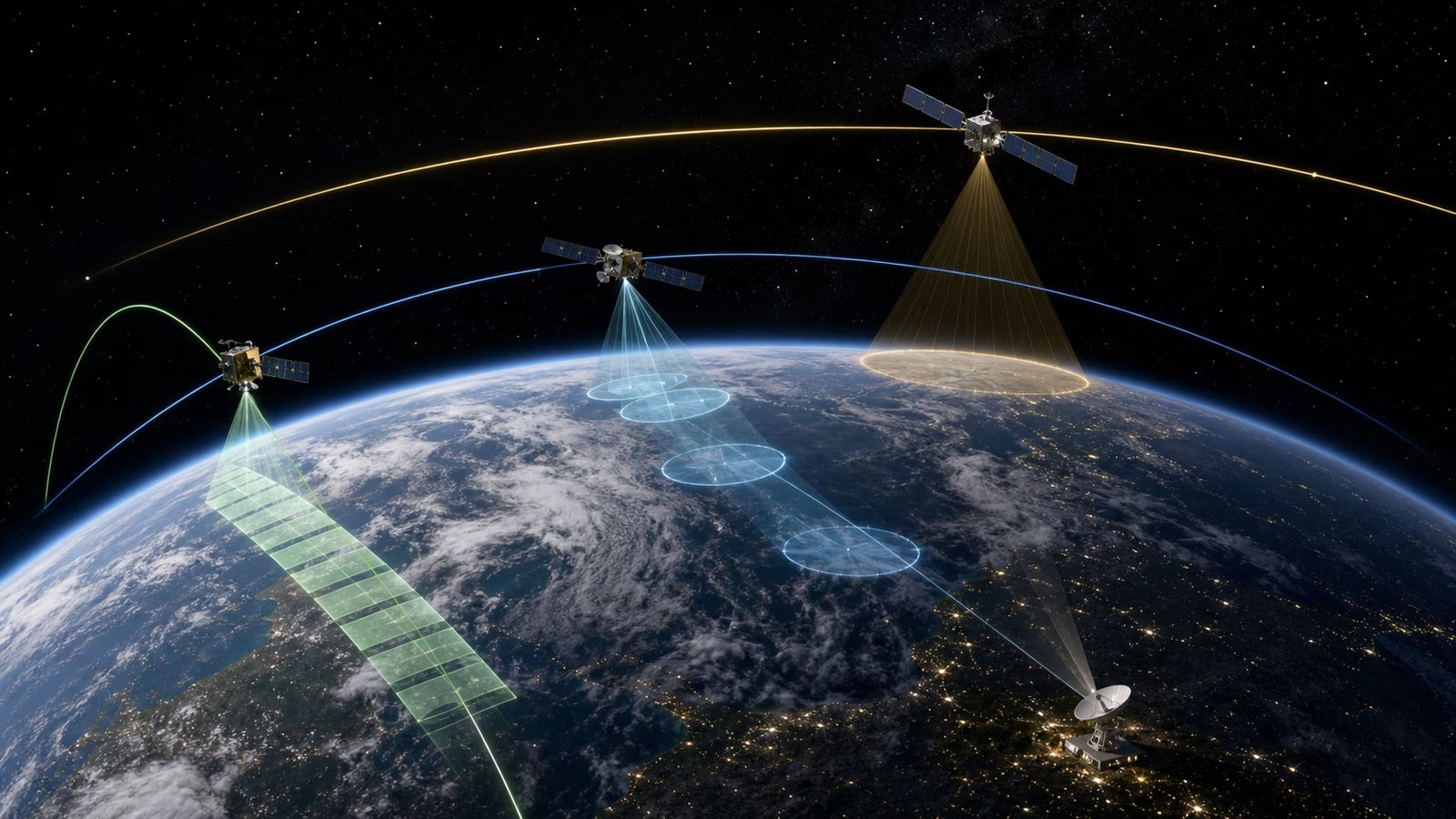
Small satellites changed the emotional texture of spaceflight. A mission no longer has to begin with a building-sized spacecraft, a dedicated rocket, and a decade of development. Universities, startups, agencies, and research teams can fly compact spacecraft, learn quickly, test instruments, build constellations, and accept risk in a different way. That shift is real, but it is often misunderstood. Small does not mean simple. It means the tradeoffs are closer together.
A CubeSat is a well-known kind of small satellite built around standardized units. Other small satellites use different sizes, buses, and mission architectures, but the common lesson is similar: shrinking the spacecraft changes launch access, payload ambition, power margin, thermal behavior, data handling, testing, and operations. Space Mission Architecture and Tradeoffs applies here with special force because a compact spacecraft leaves fewer places to hide a vague requirement.
Standard Form Factors Change the Starting Point
The CubeSat idea became influential because it gave missions a starting constraint. Standardized sizes, rails, deployment interfaces, and dispenser concepts made it easier to design payloads that could share launch opportunities. The standard did not remove engineering work, but it turned some launch and integration questions into known boundaries. A team could focus less on inventing a whole spacecraft interface and more on what useful mission could fit inside it.
That fit is not only physical. A CubeSat-scale mission has limited volume for payloads, radios, batteries, boards, harnesses, attitude-control hardware, propulsion if carried, thermal paths, mechanisms, and deployables. A clever layout can help, but geometry remains honest. If the payload needs a large aperture, a long focal length, a big antenna, strong transmitter, high pointing stability, or a large propellant tank, the small form factor will make the trade visible quickly.
Satellite Bus and Payloads explains the useful split between mission hardware and support hardware. In a small satellite, that split is crowded. The bus still has to keep the payload alive, powered, pointed, cooled, commanded, and connected. It simply has less mass, surface area, battery capacity, and internal volume with which to do it.
Small Budgets Force Honest Priorities
A small satellite mission often begins with a strong desire to do one important thing. That clarity is valuable. Trouble starts when the mission quietly grows into five important things without adding the resources needed to support them. A compact Earth observation payload may want better resolution, wider coverage, more spectral bands, lower latency, and longer life. Each desire touches power, pointing, storage, downlink, thermal control, orbit choice, and ground operations.
Power is one of the first constraints to become visible. Small satellites have limited area for solar cells and limited room for batteries. Deployable panels can help, but they bring mechanisms, hinges, release devices, wiring, stiffness concerns, and failure modes. A radio transmission, payload run, processor task, heater cycle, and attitude maneuver may compete for the same modest energy budget. Satellite Power Systems is therefore not background reading for small missions. It is one of the central design arguments.
Thermal design is just as direct. A small spacecraft has less thermal mass and tight internal packaging. Components can heat one another, radiators may have limited view to space, and a change in attitude can alter temperatures quickly. A payload that looks efficient on a bench can become difficult in orbit if the thermal path is weak. Satellite Thermal Control explains why heat management is never only about adding a blanket.
Rideshare Makes Flexibility Valuable
Small satellites gained much of their practical importance from rideshare launch. Sharing a launch can reduce access barriers, but it also changes the mission’s posture. The spacecraft may not get its ideal orbit. It may deploy after other payloads. It may have constraints on batteries, pressure vessels, propulsion, radio silence, deployment timing, access to the vehicle, and schedule changes. The launch is cheaper in some ways because the mission is accepting a shared choreography.
Payload Integration and Rideshare Launches is especially relevant here. A small satellite has to survive the same launch environment as its larger neighbors while meeting dispenser and range safety rules. It must be safe to carry, safe to deploy, and understandable to the people integrating many payloads into one campaign.
Rideshare also makes early operations more interesting. The first orbit may not be the final working orbit. The first contact time may depend on deployment sequence, ground station geometry, tumbling, antenna deployment, and radio constraints. A mission with propulsion may need days or weeks of orbit adjustment. A mission without propulsion may need to accept what the launch delivered. Upper Stages and Orbit Insertion describes the handoff before independent operations begin, and small satellites feel that handoff sharply.
Constellations Change the Value Proposition
One small satellite may be a demonstration, sensor, communications relay, student mission, or focused science platform. Many small satellites can become a constellation. That is where the economics and operations start to change. Instead of putting all value into one exquisite spacecraft, a mission can distribute value across a fleet, replace members over time, improve later versions, and design service around coverage, revisit, or capacity rather than a single vehicle.
Satellite Constellation Design explains the fleet-scale problems: orbital planes, phasing, coverage, handovers, ground networks, replenishment, end-of-life, and capacity. Small satellites make those problems more accessible but not easier. A fleet multiplies manufacturing, testing, licensing, tracking, software configuration, command authority, cybersecurity, collision avoidance, and disposal responsibilities.
The advantage is learning. A smallsat operator may improve the next batch based on flight data from the first. A payload can move from demonstration to service across iterations. A design can become more producible. But this only works if the organization treats each satellite as evidence rather than disposable clutter. A failed unit should teach the fleet. A successful unit should teach the fleet too.
Testing Cannot Disappear
The lower cost of a small satellite can tempt teams to treat testing as optional. That is a mistake. The test program can be scaled to the mission’s consequence and risk posture, but the space environment does not become gentle because the satellite is compact. Launch vibration, thermal vacuum, radiation, deployment uncertainty, workmanship errors, software states, and ground-command mistakes all remain available.
Satellite Manufacturing and Testing explains the broader clean-room and environmental-test culture. For small satellites, the hard question is not whether to test. It is which evidence is most valuable. A student technology demonstrator may accept more risk and fly sooner. A commercial data service may need stronger repeatability, calibration, and configuration control. A mission carrying propulsion or operating near other spacecraft may face stricter safety evidence.
Testing also protects the small team from its own familiarity. A compact mission may be built by people who know every wire and workaround. That closeness helps, but it can hide assumptions. A vibration test, deployment test, communications rehearsal, hardware-in-the-loop session, or operations simulation forces private knowledge into evidence that other people can inspect.
Operations Are Part of the Design
A small satellite still needs operations. It needs command procedures, telemetry definitions, ground contacts, software update plans, anomaly playbooks, orbit tracking, data storage, and an end-of-life path. The team may be smaller and the tools simpler, but the spacecraft does not know that. It only knows whether it has enough power, a usable attitude, a healthy computer, a link to the ground, and instructions it can safely execute.
Satellite Onboard Computers and Data Handling matters because small satellites may rely heavily on onboard prioritization. A limited downlink can make the spacecraft choose what to store, compress, summarize, or discard. Spacecraft Command, Telemetry, and Tracking matters because short passes and lean teams make clear evidence even more important.
Responsible disposal belongs in the same design conversation. A small satellite may deorbit naturally from a low orbit, use drag devices, carry propulsion, or plan another compliant end state depending on orbit and mission. Satellite End of Life is not only a large-satellite issue. Small objects can still become tracking burdens or collision risks if designers treat the ending as someone else’s problem.
Small satellites made space more experimental, more educational, and in many cases more useful. They lowered some barriers while exposing others. The best smallsat missions respect the constraint instead of pretending it is not there. They choose one promise carefully, fit the bus around it honestly, test enough to learn before launch, operate with discipline after deployment, and leave orbit responsibly. Shrinking the spacecraft can make a mission possible. It does not shrink the need to think clearly.